.jpg)

Restaurant Operations Management: What Separates Consistent Multi-Site Groups from Those Losing Ground
Restaurant Operations Management Starts with SOPs That Reach Every Location
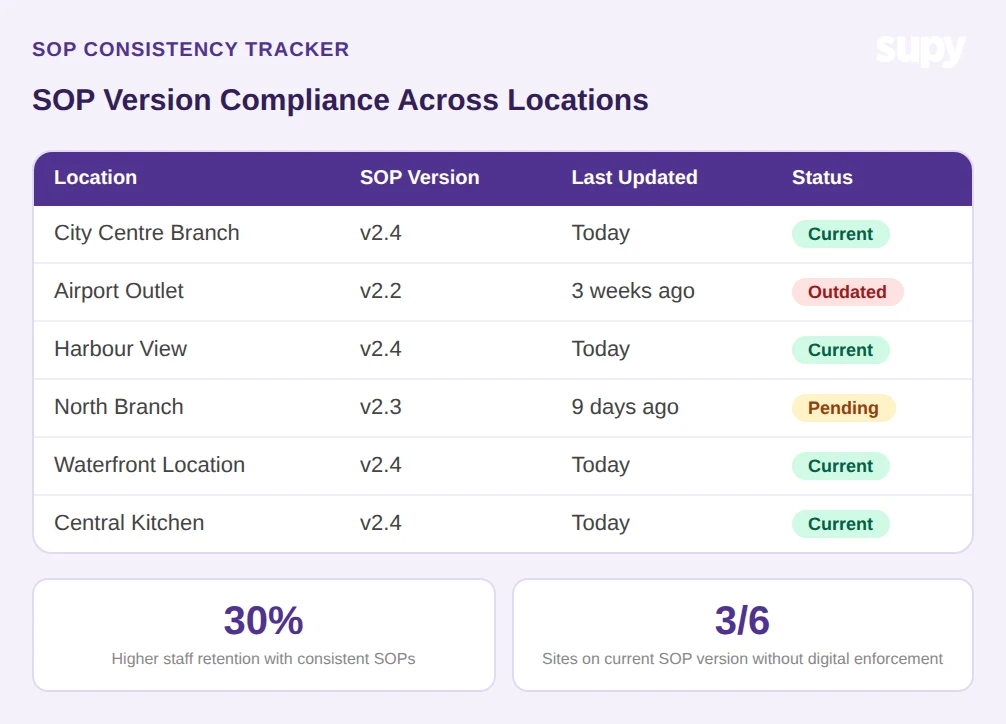
SOPs are the foundation of restaurant operations management. Every multi-site group has a set of standard operating procedures, but the problem is that paper-based or shared-document SOPs degrade the moment a manager at one site adapts a process for local convenience, a new hire is trained on an outdated version, or a corporate update fails to reach all locations simultaneously.
Research shows restaurants with well-defined SOPs experience up to 30% higher staff retention, because clear procedures reduce ambiguity that drives staff to leave. But that benefit only materializes when staff across all sites are operating from the same current version. A 10-location group where each site has drifted to its own interpretation of the SOP is, in practice, running 10 different operations.
The fix is not more thorough documentation. It is digital enforcement. Platforms that publish SOP updates to all locations simultaneously eliminate the lag between a policy change at head office and consistent execution at every branch. Role-based access controls determine which staff can view versus edit procedures, and audit logs confirm whether each location has acknowledged and applied an update.
Ask yourself: when your operations team changes a receiving procedure today, how long before every branch is following the new version?
Real-Time Inventory Visibility Across Every Site
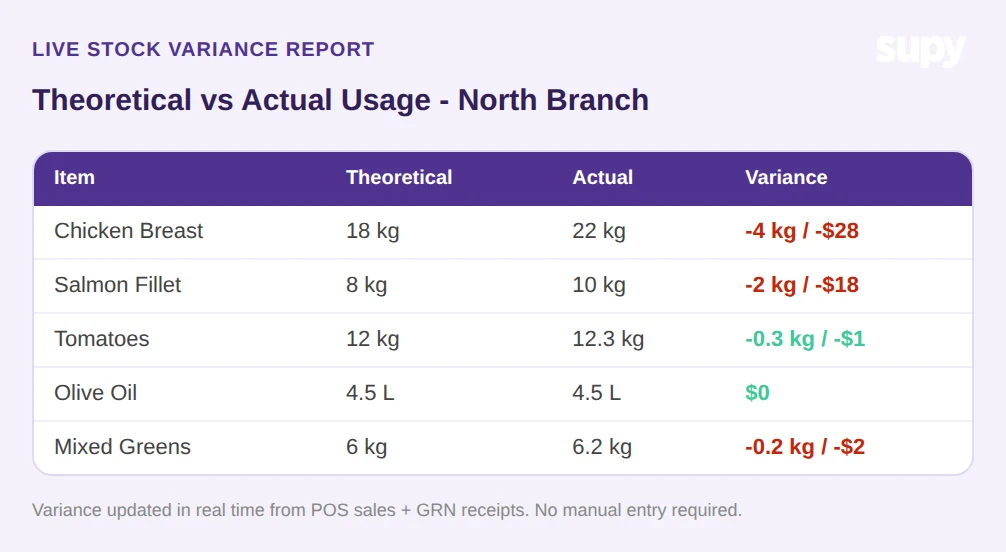
One of the most expensive patterns in restaurant operations management across multiple sites is the stock-take that happens once a week, followed by a reconciliation that shows variance from theoretical usage - but only after the margin has already been lost.
Top-performing multi-location groups run live stock visibility at every site, updated automatically as goods are received and as sales deplete ingredients through linked recipes. The theoretical-versus-actual comparison is visible daily, not weekly, and any site with unusual variance is flagged before it compounds.
The operational difference is material. A group running eight locations with an average $9,400 monthly food cost variance per site is carrying a combined exposure that manual weekly reconciliation cannot contain. Real-time stock movement data, tied to actual POS sales rather than estimated depletion, brings that exposure into view while there is still time to act on it.
For multi-site operators, the second critical requirement is inter-branch transfer visibility. When one location runs short and borrows stock from another, that movement needs to appear in both sites' inventory records with a confirmed acceptance before the receiving location's stock updates. Informal transfers that are not recorded are a hidden cost sitting between the sites.
Before selecting an inventory system as part of your restaurant operations management stack, verify: does the platform show live stock across all your branches on a single screen, with theoretical-vs-actual variance updated in real time?
AI Demand Forecasting: The Restaurant Operations Management Tool That Catches Drift Early
Manual reporting cycles create a structural blind spot. A branch can drift from target food costs for two or three weeks before the data surfaces in a monthly review. By then, the causes are harder to trace and the cost is already booked.
Multi-location groups achieving consistently low food cost variance - the defining metric in restaurant operations management - use per-site AI demand forecasting to detect drift within hours rather than weeks. The mechanism is direct: when daily forecast-versus-actual variance at a branch exceeds a threshold, the operations team can investigate that day rather than discovering it at the end of the month.
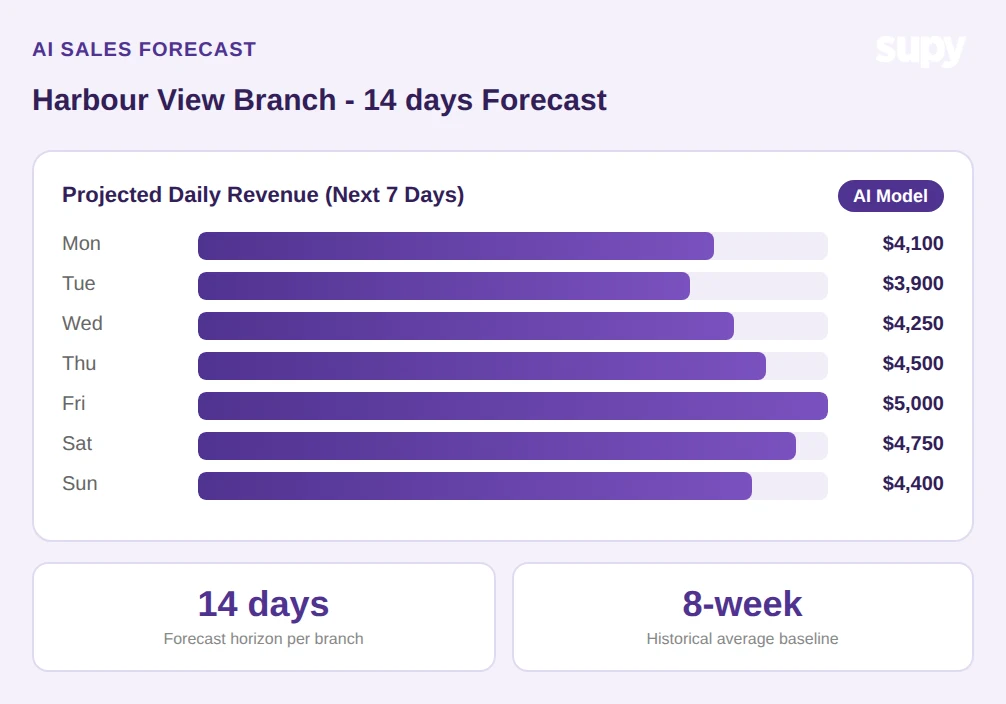
Supy's AI Sales Forecasting predicts daily sales by branch for 14 days ahead, down to menu item level, calibrated against an 8-week historical average per location. Operations teams can see forecast-versus-actual divergence as it develops, with manager-level overrides available without retraining the model. That per-branch model matters: a site in an office district has different demand patterns than a site in a leisure destination, and a single group-level forecast misses both.
AI predictive ordering builds directly on this. The system converts the sales forecast through the recipe database and compares the result against current stock, generating purchase orders that reflect actual projected demand rather than last week's habit. Managers review every line before submission - the system presents, not decides.
Ask your current platform: can it generate a per-site sales forecast for the next 14 days and feed that directly into a purchase order recommendation? If not, it is not built for restaurant operations management at the level multi-site groups require.
Traceability Requirements and Why Patchwork Systems Compound Compliance Risk
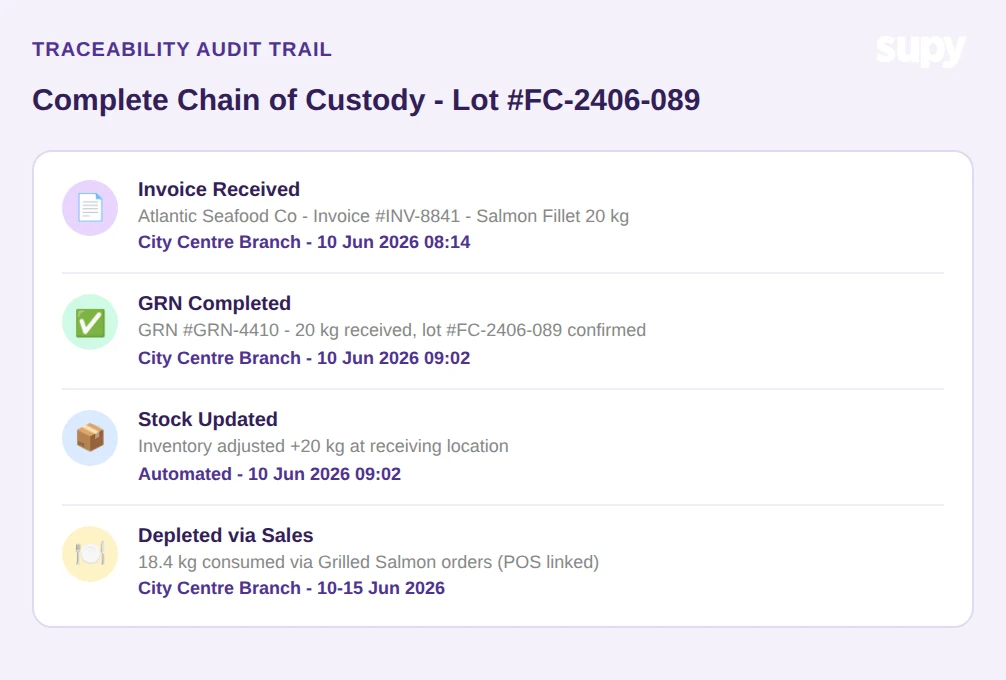
Effective restaurant operations management requires staying ahead of food safety traceability requirements, which have expanded materially for multi-site operators. FSMA 204 in the US imposes detailed tracking obligations on food products moving through the supply chain, requiring operators to document lot-level provenance from receipt through service. For a group operating multiple locations with separate procurement systems, disconnected supplier records, and paper-based goods receipt processes, compliance is an ongoing manual reconciliation exercise.
The risk is not just regulatory. A traceability failure during a food safety incident can mean recalling product across all locations, not just the site where the issue originated. Groups that cannot rapidly produce complete chain-of-custody records for a specific ingredient lot face both regulatory exposure and operational disruption that is orders of magnitude larger than the cost of getting traceability right.
Digital goods receipt with AI-assisted invoice matching creates an audit trail automatically. Each goods received note is timestamped, linked to the originating purchase order, and tied to the supplying invoice. When a trace is needed, the record is there without a manual search across filing systems at multiple branches.
This is a real restaurant operations management test. Multi-site operators should ask: if a food safety authority requested the complete trace for a specific lot received at any of your locations last month, how long would it take to produce that document?
Staff Retention and the Case for Low-Training-Overhead Systems
Restaurant operations management at scale is only as good as the people running it day to day. Hospitality's turnover rates mean that any system requiring substantial training investment becomes a recurring cost every time a trained employee leaves. A platform that a new hire can navigate with minimal instruction is not a convenience feature - it is a cost control mechanism.
This is particularly acute in restaurant operations management at scale. When a new branch manager joins and needs to get up to speed quickly, a platform with an intuitive mobile interface and minimal manual entry reduces the time between onboarding and productive operation. Conversely, a system that requires a week of training to use competently is a week during which the site runs without adequate management data.
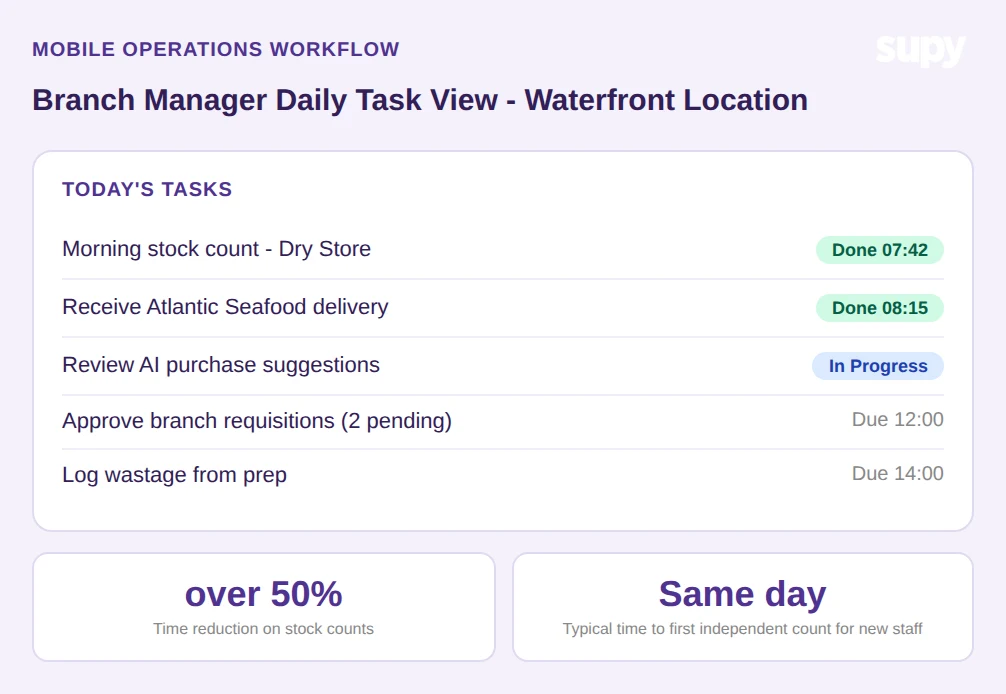
The practical requirement is mobile-first design with exception-based workflows. Staff should not need to enter data that the system can derive - purchase quantities from par levels and current stock, variance flags from actual versus theoretical, anomalies surfaced by the platform rather than discovered manually. Reducing the manual entry burden reduces both training time and the error rate introduced by staff who have not yet mastered the system.
This also shapes how groups evaluate software vendors. The question to ask is not "can your system do X?" but "how long does it take a new branch manager to run their first full stock count independently?" A platform where the answer is "same day" is fundamentally different from one where the answer is "after a week of training."
Ask any vendor you evaluate: what is the typical time from account setup to a new site manager running their first full stock count independently?
Centralized Procurement Controls and Spending Guardrails Across Locations
Uncontrolled procurement is one of the fastest ways a multi-site group loses margin visibility. In restaurant operations management, procurement is where the largest single cost category - food and beverage - is determined before a single dish is served. Without spending policies enforced at the system level, individual branch managers make purchasing decisions that are individually justifiable but collectively inconsistent with group cost targets.
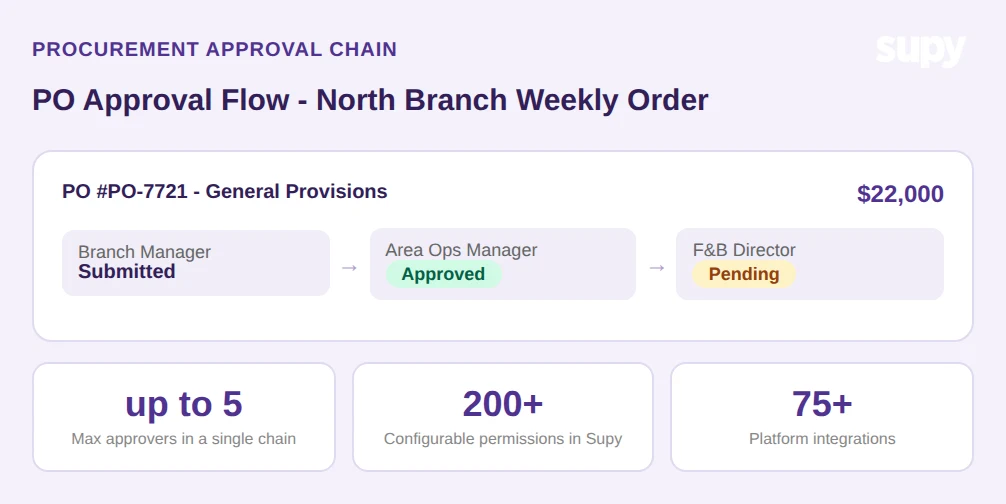
Effective restaurant operations management for multi-site groups requires spending guardrails that operate automatically. Order value limits by location, supplier, and category prevent a single branch from placing a week's worth of orders in one day. Sequential approval chains that trigger based on order value and branch mean that a $22,000 weekly procurement budget is spent through a controlled process, not a series of ad hoc decisions.
Supy's permissions module supports approval chains with up to 5 approvers, triggered by branch and order value thresholds, with 200+ configurable permissions covering procurement, inventory, and receiving. Spending policies can be set by location, supplier, category, user, or time period, and the system enforces them without requiring manual oversight of every order. Operators connect Supy to their existing accounting, POS, and HR platforms through 75+ integrations, so procurement data flows into financial reporting without a separate reconciliation step.
Before scaling to additional sites, verify that your procurement controls are enforced by the platform, not by individual manager discretion.
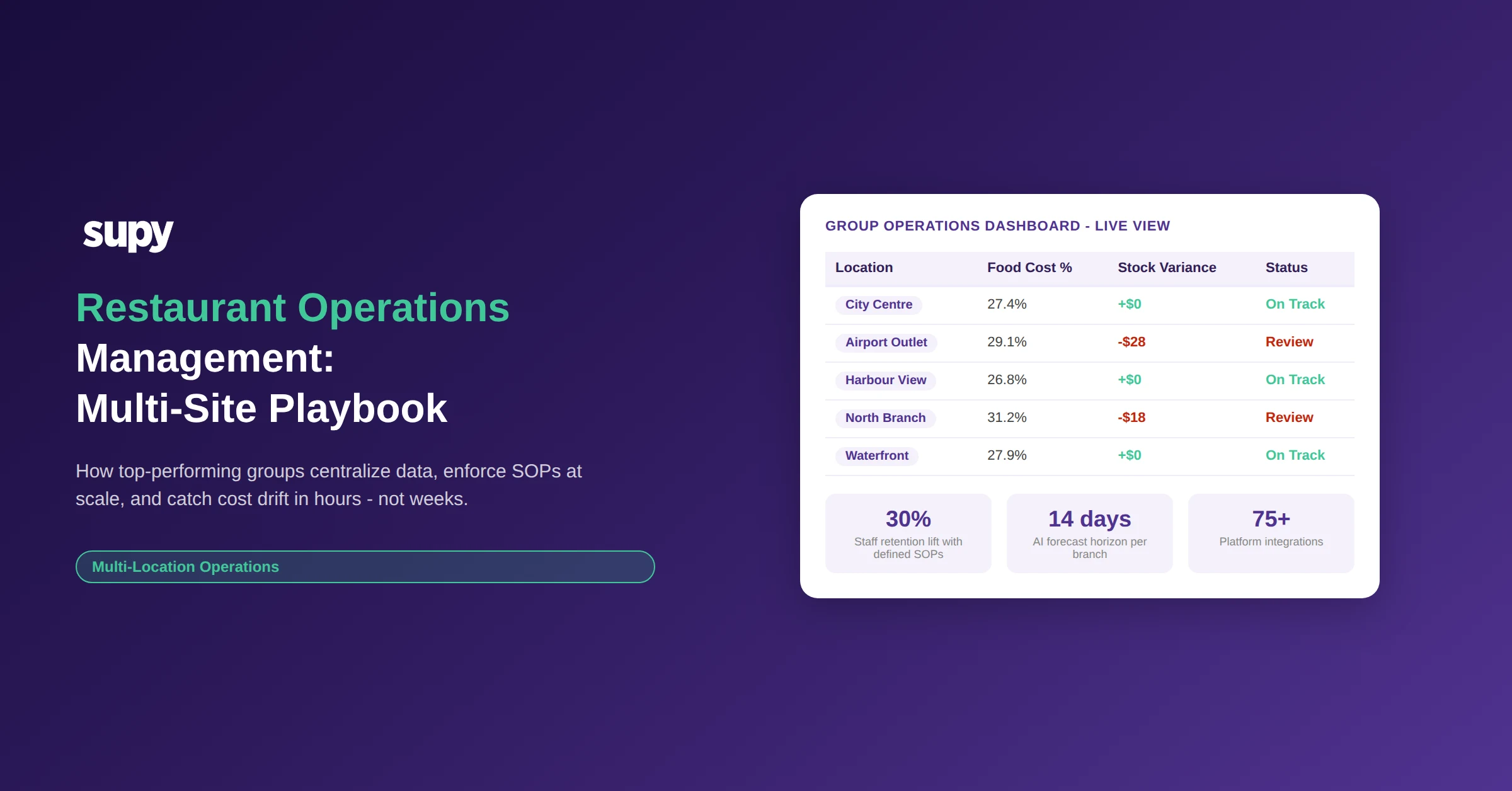
Restaurant operations management at multiple locations is a data coordination problem as much as it is a people management problem. The operators who have figured out restaurant operations management at scale share one common characteristic: they use a single platform that connects inventory, procurement, and financial reporting rather than managing those disciplines in separate systems. The groups that scale without accumulating hidden costs are those that have replaced periodic manual reconciliation with real-time visibility, enforced SOPs digitally rather than relying on consistent voluntary compliance, and used per-site forecasting to catch drift before it appears in the monthly P&L.
The platforms that support this operate across procurement, inventory, and financial reporting in a single data environment, connected to the POS systems, accounting tools, and HR platforms already in use. For operators evaluating their current setup, the practical test is direct: can your operations team identify a stock variance at a specific branch today, trace it to its source, and act on it before the end of that shift? If not, the gap is worth closing. Learn more about how Supy supports multi-site operators at supy.io.