.jpg)

Restaurant ERP: What It Is and Whether Your Operation Actually Needs One
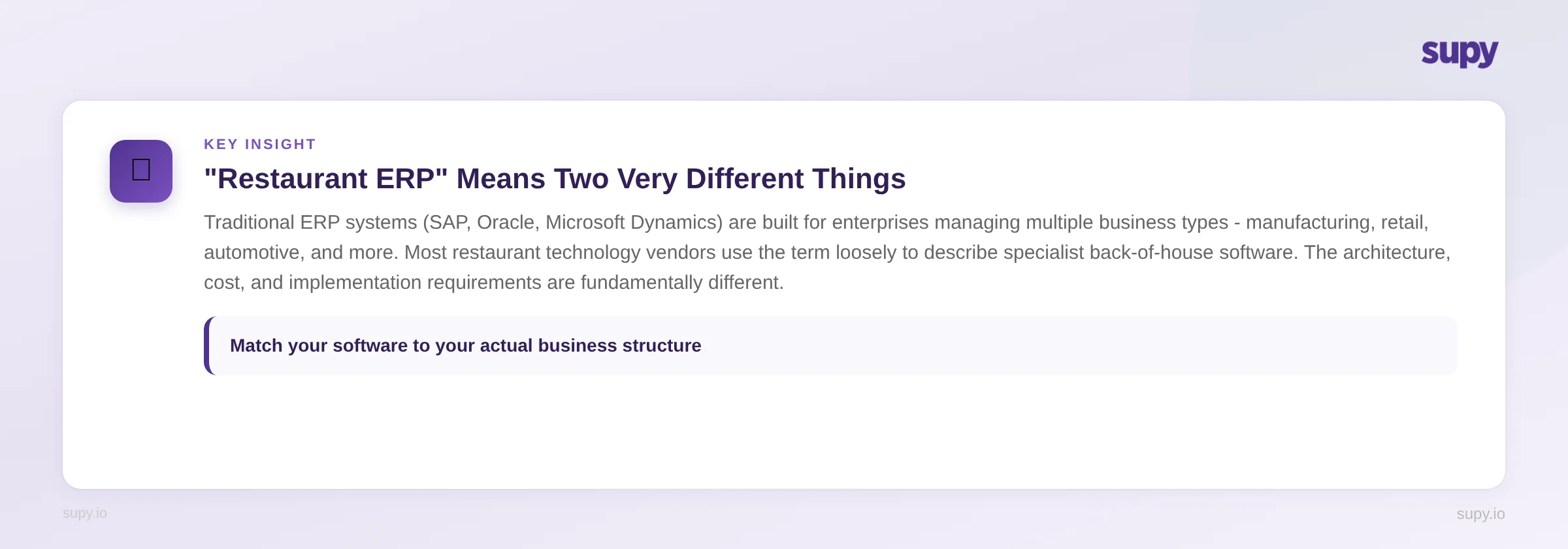
If you operate a restaurant group and you're researching ERP software, there's a reasonable chance you're asking the wrong question. That's not a criticism - it's a reflection of how loosely the term "ERP" gets used in the hospitality technology market. A restaurant ERP can mean two very different things: a traditional enterprise resource planning system (SAP, Oracle, Microsoft Dynamics) built to manage entire diversified business empires, or a specialist back-of-house platform that vendors market using "ERP" as shorthand for "comprehensive."
Understanding the difference determines whether you're about to invest in the right solution or a very expensive mismatch. This guide explains what ERP actually is, who genuinely needs one, and what most multi-location restaurant groups are better served by.
What an ERP Actually Is
Enterprise Resource Planning systems were developed to solve a specific problem: how do large enterprises managing multiple, fundamentally different business types coordinate their data in one place?
The original ERP platforms - SAP, Oracle, and Microsoft Dynamics - were designed for conglomerates running operations across manufacturing, finance, HR, logistics, retail, and other industries simultaneously. The defining characteristic of an ERP is not that it manages operations well. It connects operations across diverse business types into a single data model, giving group leadership a consolidated view of a business that spans entirely different industries.
An ERP answers group-level questions: what is our total inventory position across the restaurant division, the food manufacturing arm, and the retail stores? What are our consolidated liabilities across five legal entities in three markets? For enterprises where these questions need a single system to answer them, an ERP is the right tool.
For the restaurant operations layer specifically - procurement, stock management, recipe costing, supplier relationships - traditional ERPs are not built natively. They can be extended to handle food service, but doing so requires significant customisation by specialist implementation consultants. That customisation is expensive to build, takes months to complete, and requires ongoing IT maintenance every time something needs to change.
Why Traditional ERP Is Often the Wrong Choice for Restaurant-Only Groups
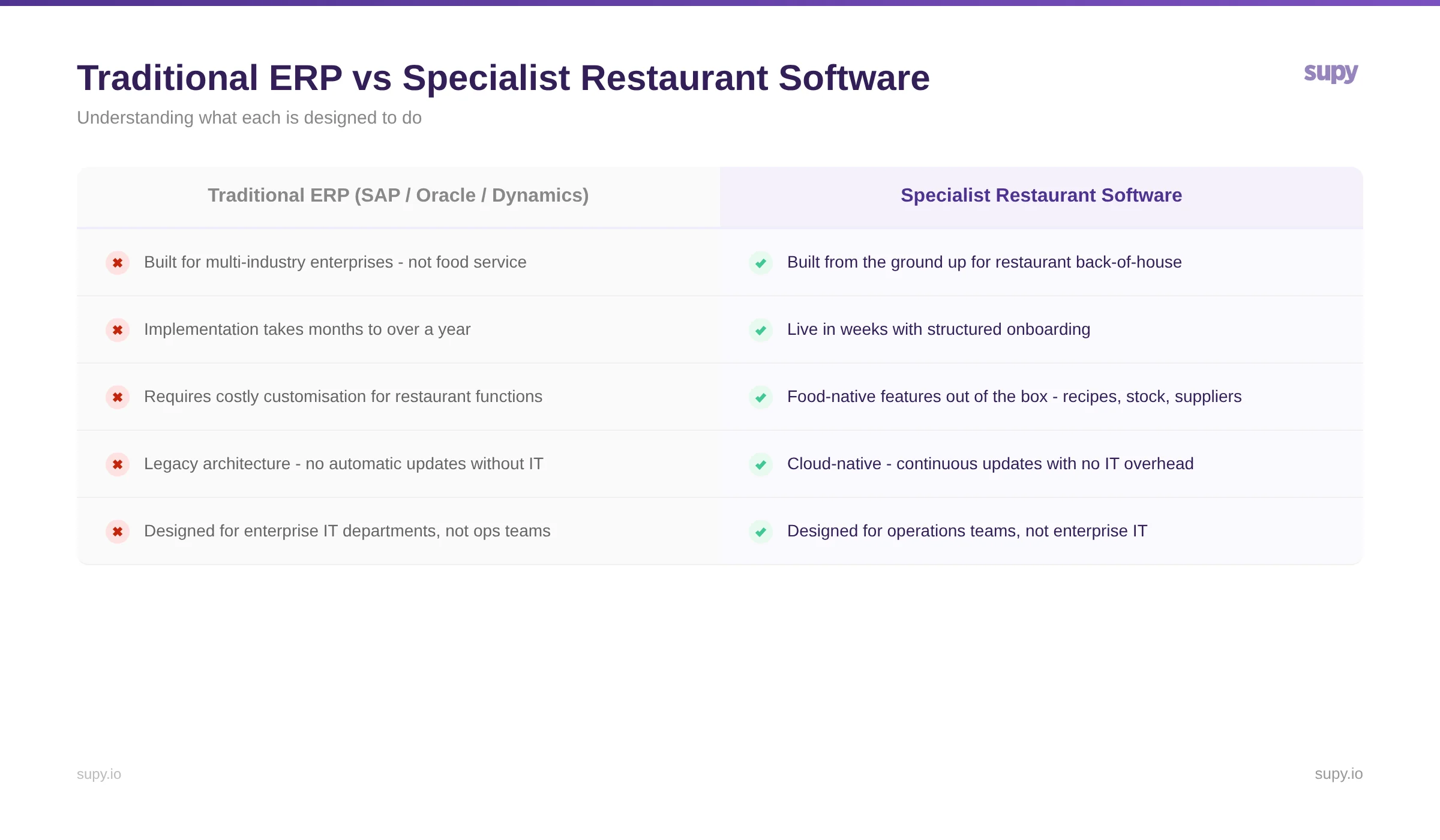
If your business is restaurants and nothing else, the architecture of a traditional ERP is likely to work against you.
Implementation costs are significant. Restaurant-specific functionality does not come standard in enterprise ERP platforms. Building out recipe costing, supplier catalogues, multi-location stock tracking, and invoice reconciliation requires custom development work. That customisation can run into hundreds of thousands of dollars before you have taken a single stock count. Industry research suggests that nearly half of all ERP implementations run over budget, and a similar proportion face significant delays.
Legacy architecture creates friction. Traditional ERP systems are monolithic platforms. They do not update like modern cloud software - new features require IT intervention to deploy, configuration changes require developer time, and the interface typically reflects enterprise origins rather than the daily reality of an operations manager running stock counts at six in the morning. Operations teams find these systems difficult to use and frequently work around them rather than within them.
Maintenance overhead is substantial. ERP platforms require dedicated IT resource to manage - security patching, module configuration, integration maintenance, user management. For restaurant groups without a large internal technology function, this represents a meaningful ongoing cost and an operational distraction that specialist software does not create.
The data model is not food-native. ERPs are not designed around how restaurant operations actually work. Recipe yields, par level management, waste logging, POS reconciliation, and supplier price variance tracking all require customisation in a traditional ERP. In specialist restaurant software, these are core functions that come out of the box.
When a Traditional ERP Does Make Sense
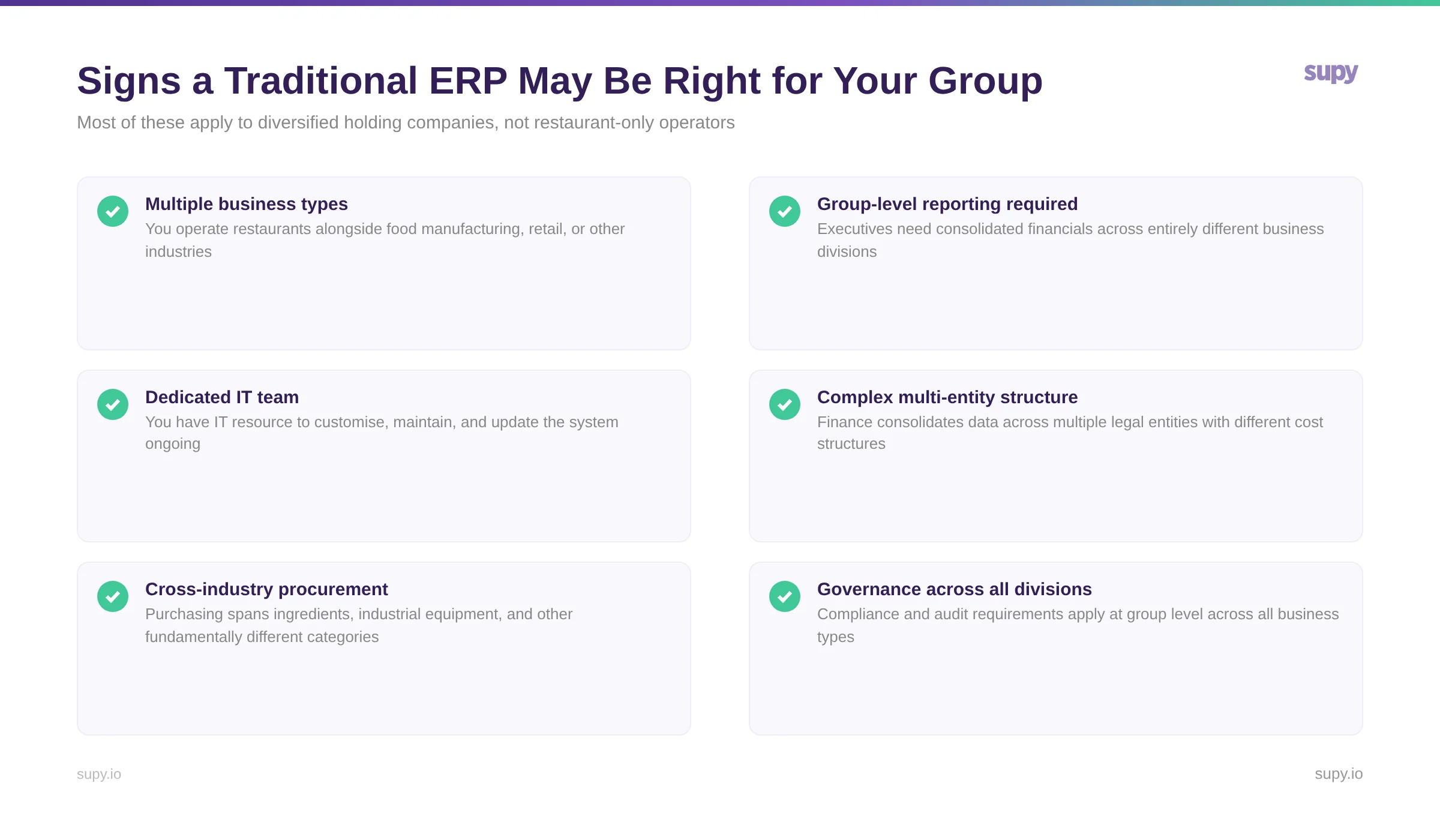
There is a specific scenario where a traditional ERP is genuinely the right choice for a restaurant business: when the business is part of a holding company operating genuinely diverse business lines.
If you run restaurants alongside food manufacturing, retail, automotive dealerships, construction, or any other industry, a group-level ERP provides something no specialist restaurant software can - consolidated financial and operational data across completely different business types. This is the model used by large diversified conglomerates in the GCC and elsewhere: the restaurants are one node within a larger enterprise system that also handles the factory, the property portfolio, and the retail chain.
In this model, the ERP does not manage restaurant operations directly. It receives consolidated data from each business unit and provides group-level visibility for finance, compliance, and executive reporting. The restaurant division typically still runs specialist back-of-house software for the operational detail, which then pushes summarised data up to the ERP level.
This pattern is particularly common in GCC markets, where large diversified family groups operate across multiple industries and have long used enterprise ERP platforms (SAP, Oracle) as the group data backbone - while their F&B divisions need tools that the ERP alone cannot provide.
If your operation is restaurants and nothing else - even a large group with 50 or more locations - a traditional ERP is very likely overkill for what you actually need to do.
What Most Multi-Location Restaurant Groups Actually Need
The operators who benefit most from the category of software often labelled "restaurant ERP" are looking for specialist back-of-house software. These are fundamentally different products.
Specialist restaurant back-of-house platforms are built around a food-native data model: ingredients link to recipes, recipes link to menu items, menu items connect to POS sales data, and all of it ties to procurement and stock. This is not a general-purpose ERP adapted to handle food - it is a system designed from the ground up to answer the questions restaurant operators actually ask: what is my food cost this week, why is my actual stock lower than my theoretical position, and which supplier invoices do not match their purchase orders?
For multi-location restaurant groups, the core operational requirements are:
- Consolidated procurement across all sites, with approval workflows that enforce spending controls without slowing operations
- Real-time inventory visibility at each location, with automated stock alerts and variance analysis against theoretical usage
- Recipe and menu costing that updates when ingredient prices change, so operators always know their current gross margin on every dish
- Invoice processing that flags discrepancies between purchase orders and what was actually charged - without requiring finance to manually check every line
- Business intelligence that surfaces cost trends, supplier performance, and location-level anomalies without a data analyst building custom reports
This is the operational layer that directly drives food cost performance. For operators working to reduce COGS from 40% towards the 30% benchmark of a well-run multi-location group, this is where the margin improvement happens - not in group-level ERP reporting, but in the daily data that specialist software makes visible and actionable.
For a deeper look at what good inventory management looks like operationally, see our complete guide to restaurant inventory management.
How Specialist Software Integrates with ERPs
For operators within a holding company that does use a traditional ERP at group level, specialist restaurant software does not replace it. It works alongside it.
The integration model works like this: the specialist software handles the operational detail within the restaurant division - purchase orders, stock counts, recipe costs, invoice reconciliation, and daily reporting. Aggregated financial data then flows from the specialist platform into the ERP, where it sits alongside data from other business units for group-level reporting, compliance, and consolidated accounts.
This is increasingly standard in GCC markets, where diversified conglomerates use enterprise ERP systems for group oversight whilst their F&B divisions run specialist back-of-house software for day-to-day management. The ERP receives clean, consolidated data; operations teams get a system built for how they actually work.
How Supy Fits Into This
Supy is a specialist back-of-house operations platform built specifically for multi-location restaurant operators. It is not a traditional ERP - and that is a deliberate design choice.
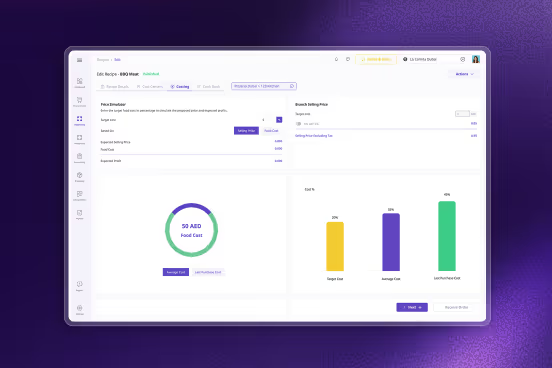
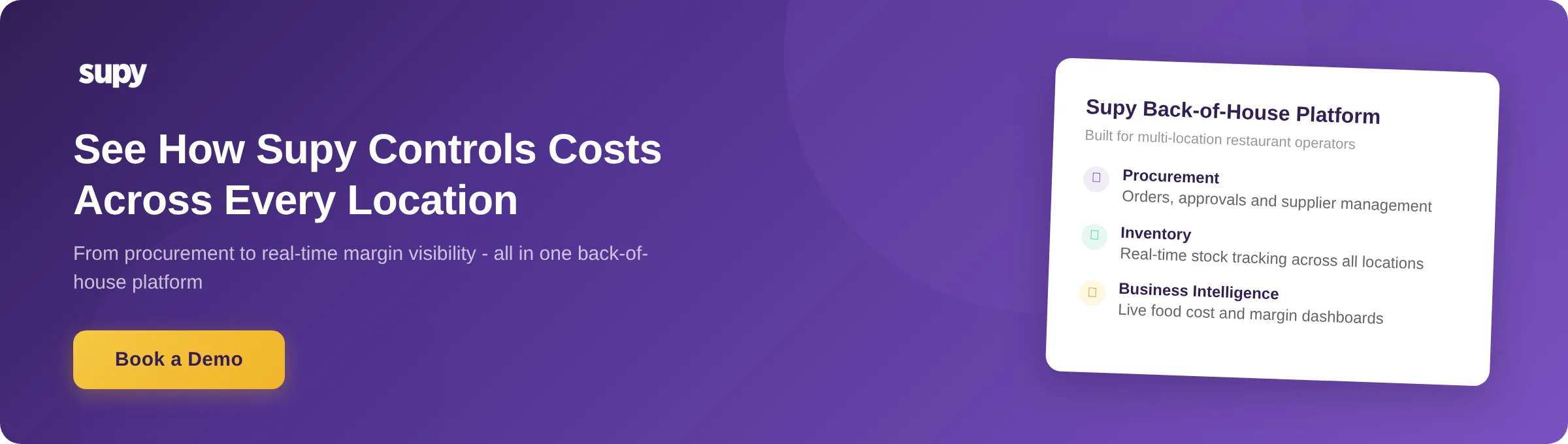
The platform covers procurement (purchase orders, multi-supplier management, multi-level approval workflows, RFQ processes), inventory (stock counts, par level monitoring, location transfers, waste tracking), recipe and menu costing (real-time cost per dish, yield management, variance analysis against theoretical), and business intelligence (consolidated dashboards, food cost performance by location, supplier analysis, live COGS tracking).
For operators who work within a group that uses a traditional ERP, Supy integrates with it via API rather than replacing it. Operational data flows from Supy into SAP, Oracle, Microsoft Dynamics, or similar platforms - keeping the ERP financial reporting accurate without requiring restaurant operations to be run through a system that was never designed for them.
Supy is particularly well established in GCC markets, where the combination of specialist back-of-house software and enterprise ERP infrastructure is a well-understood model across the region's diversified hospitality groups.
For the analytical framework underpinning cost control, see our guide to how to calculate food cost percentage. For the broader discipline of multi-location operations management, see our guide to restaurant operations management.
About Supy
Supy is a back-of-house operations platform for multi-location restaurant operators. The platform centralises procurement, inventory management, recipe costing, and business intelligence, enabling operators to control food costs, standardise processes, and make data-driven operational decisions across every location. Supy integrates with leading POS, accounting, and ERP systems and is used by hospitality groups, franchise networks, hotel F&B operations, and central kitchen operators across the Middle East, UK, and APAC.