.jpg)

Restaurant Digital Transformation: A Practical Guide for Multi-Unit Operators
Most restaurant groups plan their digital transformation and then stall on it. The stall is not a technology problem - it is a sequencing problem. Operators who try to implement procurement, inventory, recipe costing, and reporting all at once end up with inconsistent adoption and no clear ROI to show the finance committee. The groups that close a 10-point COGS gap do it in phases, not in one sprint.
In short: Restaurant digital transformation is the process of replacing manual, disconnected back-of-house operations with integrated software that connects procurement, inventory management, recipe costing, and business intelligence into a single live operational view. For multi-unit operators, this typically means a phased 12-18 month journey beginning with procurement, followed by inventory and costing, and culminating in a live COGS dashboard that gives you daily food cost visibility across all locations.
What Digital Transformation Actually Means for Restaurants
The term gets used loosely. In the restaurant industry, it means one specific thing: replacing the disconnected, manual processes that characterise most back-of-house operations with an integrated restaurant ERP or back-of-house platform that gives you a live operational picture across every location.
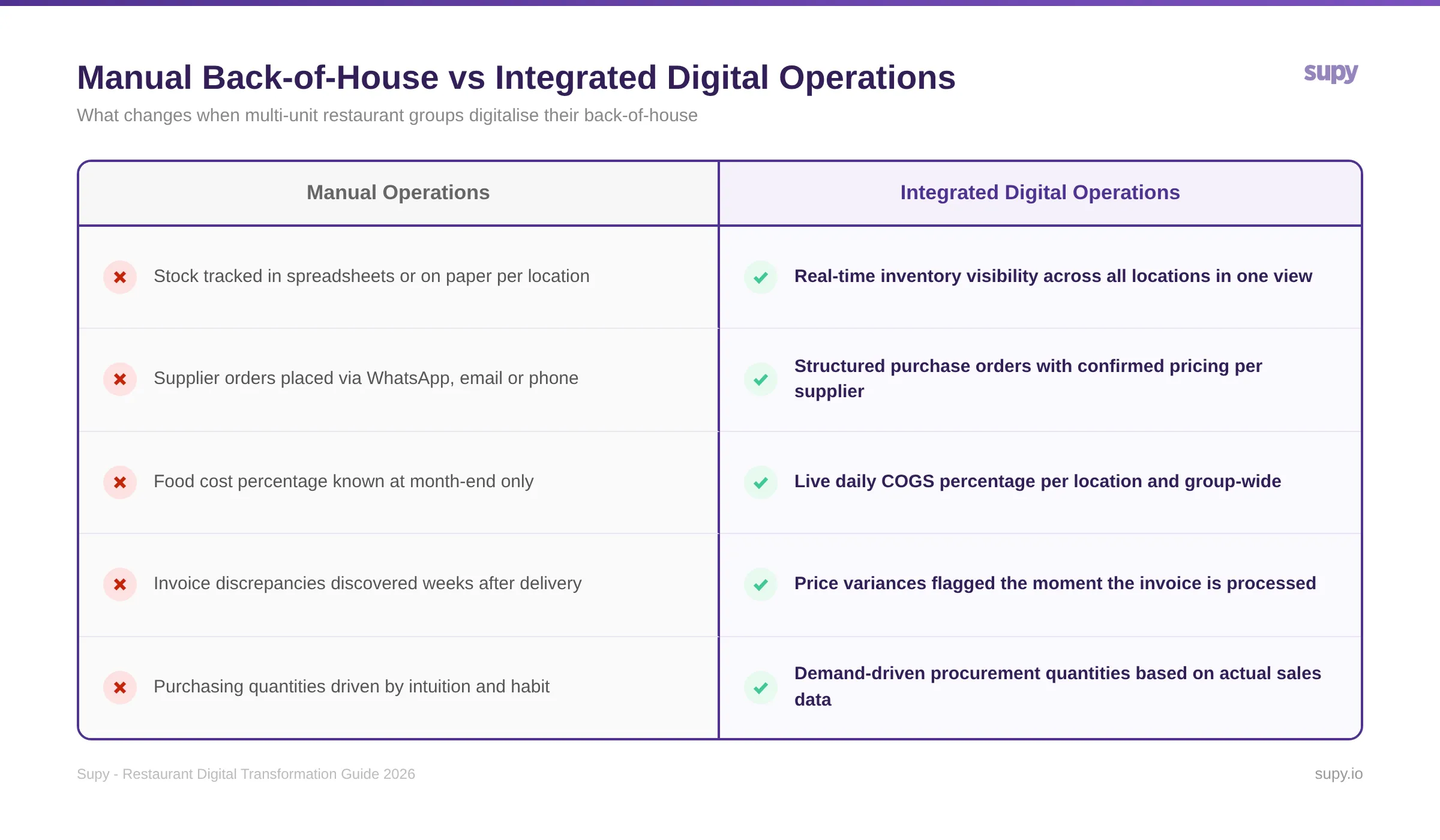
For most multi-unit operators, the starting position is somewhere between fully manual and partially connected. Stock sheets in spreadsheets. Ordering by WhatsApp to suppliers. Purchase orders raised from memory or historical habit. A P&L that tells you what your food cost was last month, not what it is today.
The operational cost of that starting position is not abstract. Operators running multi-site groups describe their reality plainly - one put it simply: "We have many documents, and each one is manually entered into Excel." Another, on how stock transfers are tracked: "Just writing it down in the log - more manual." The error surface of that approach compounds at scale. Three locations with manual processes are three times the exposure. Ten locations are ten times.
Digital transformation means closing that gap systematically - not all at once, but layer by layer, with each new system building on the one before it.
The Restaurant Tech Stack: POS and Back-of-House Are Two Different Things
Before beginning a transformation, operators need to understand the architecture. There are two distinct software layers in a restaurant operation, and confusing them is the most common source of failed transformation projects.
Front-of-house (POS system): Records transactions, takes orders, tracks covers and revenue. Every location already has one.
Back-of-house (BOH software): Manages what happens before and after the POS transaction - procurement, inventory movement, recipe costing, and business intelligence. This is where cost data lives.
These two layers are designed to integrate, not to replace each other. The POS and the BOH platform connect so that sales data flows into your inventory and costing system automatically - which is how you get a live food cost percentage rather than an end-of-month surprise. For multi-unit operators beginning a transformation journey, the BOH layer is typically where transformation delivers the fastest, most measurable ROI.
Understanding this distinction also clarifies budget and project scope: a POS replacement and a BOH implementation are two separate projects with different teams, timelines, and business cases. Starting with the back-of-house layer does not require touching the POS at all.
The Five Pillars of Restaurant Back-of-House Transformation
A complete back-of-house transformation covers five interconnected pillars. The sequencing matters because each layer supports the one that follows.
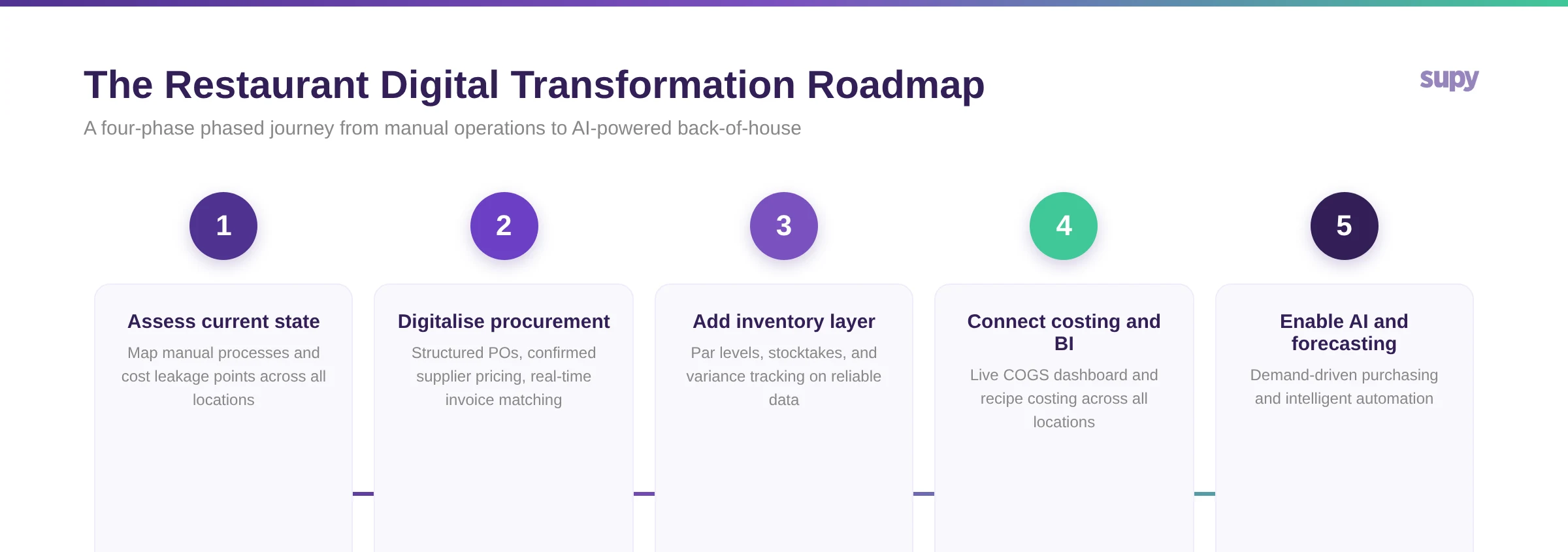
1. Procurement and Purchasing
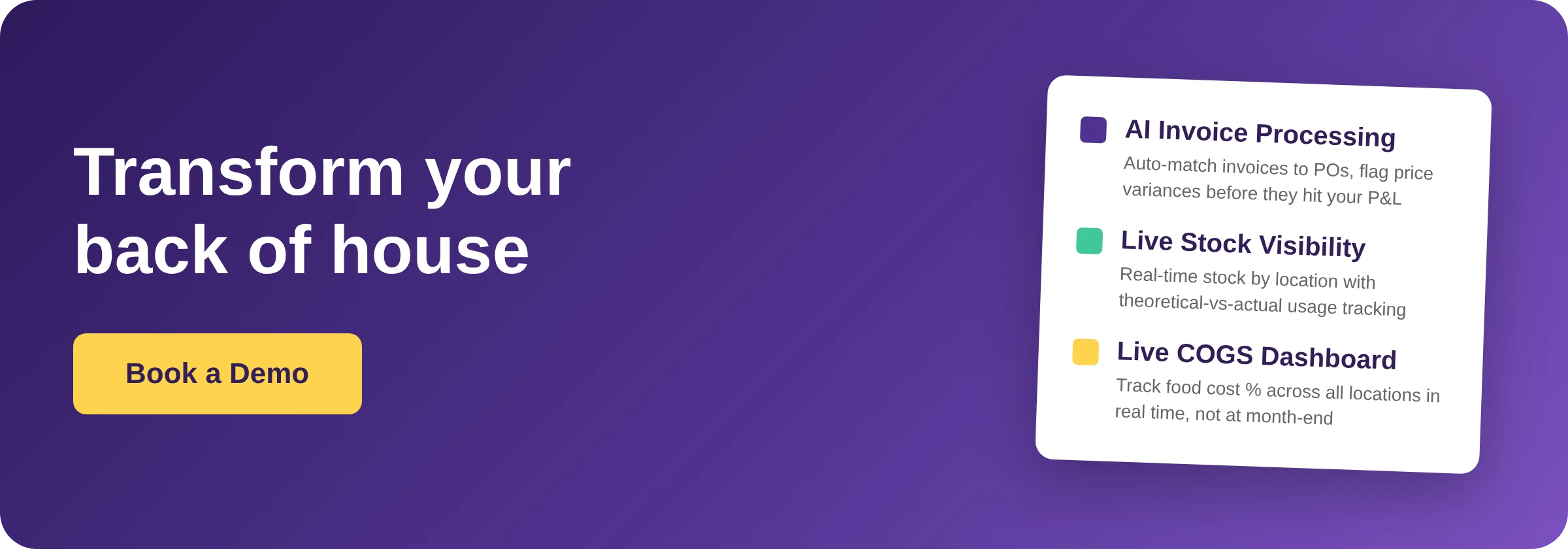
The highest-ROI starting point for most operators. Replacing unstructured ordering - WhatsApp messages to suppliers, emailed spreadsheets, phone-call POs - with a structured procurement system gives you a supplier database, purchase order workflow, and invoice matching in one place. In Supy, purchase orders are raised directly against confirmed supplier pricing, which means price variances surface the moment an invoice is processed rather than at month-end when nothing can be done about them.
2. Inventory Management
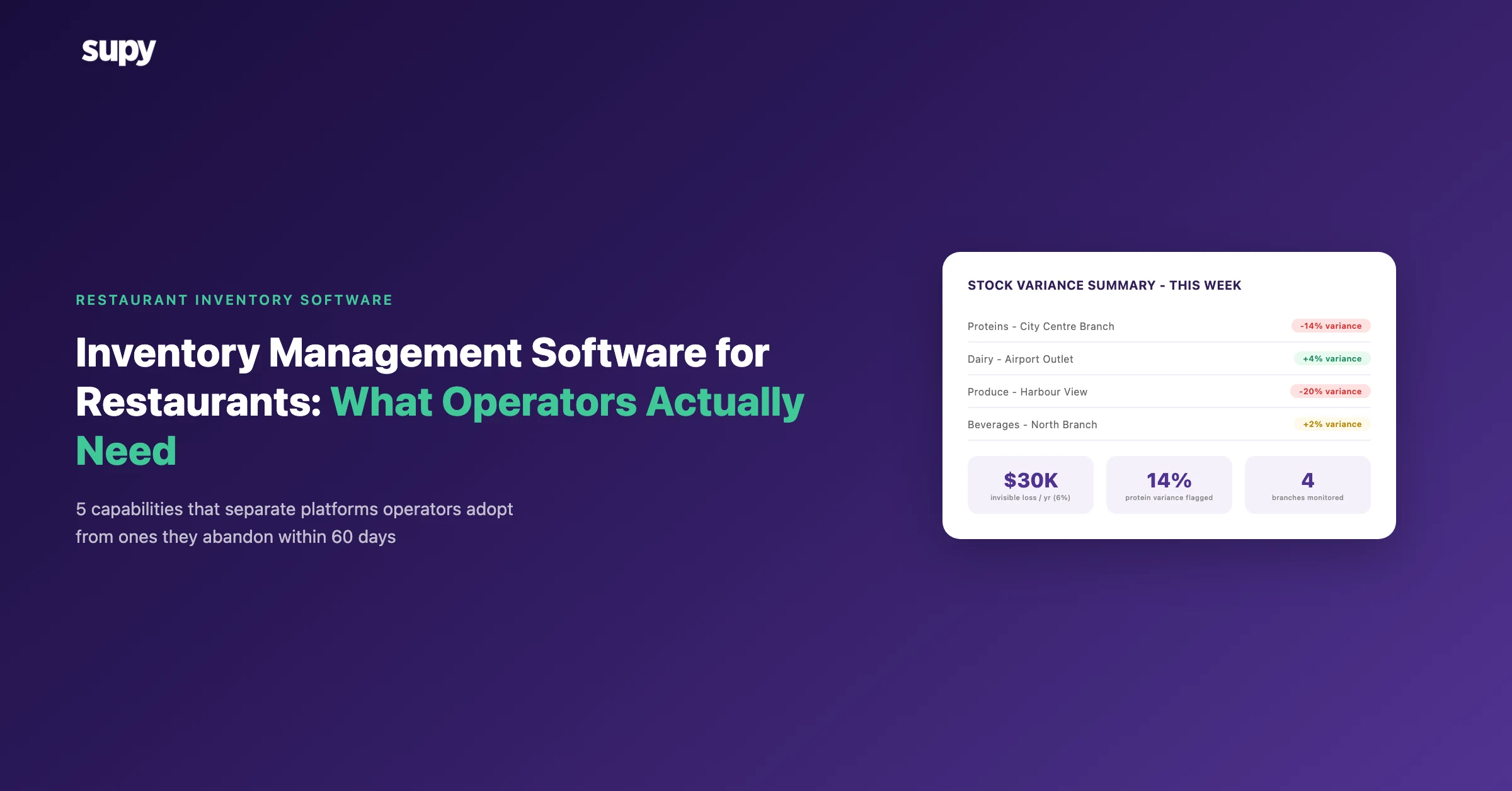
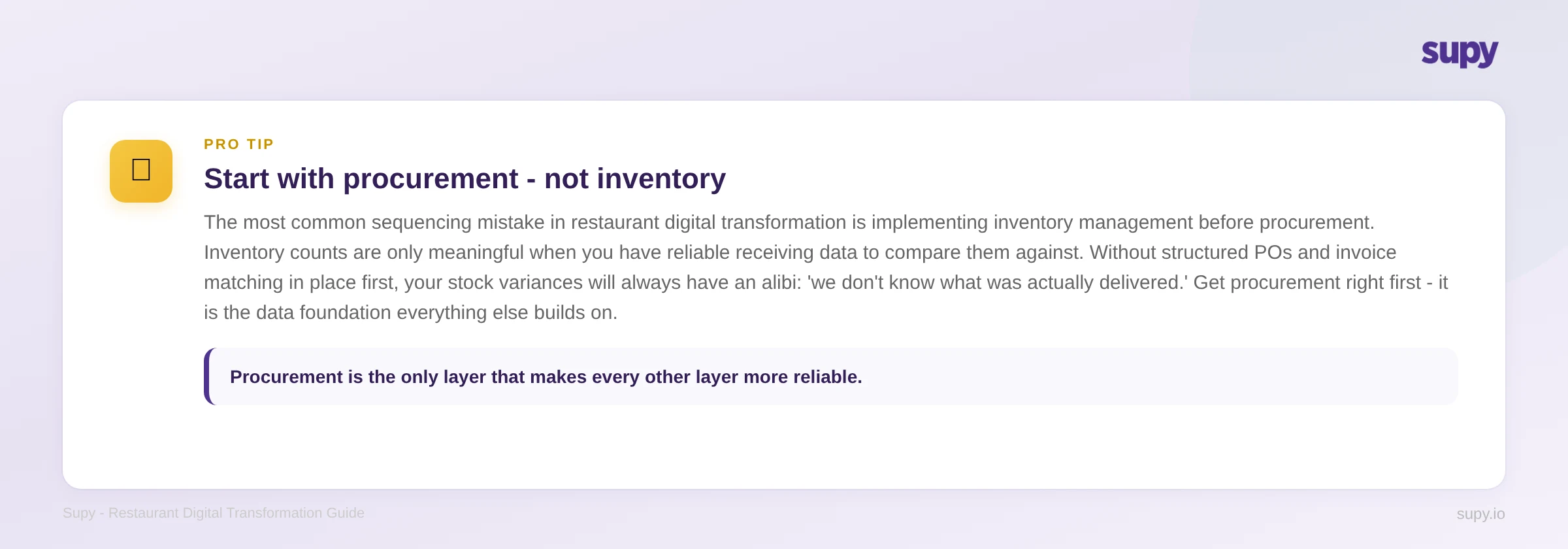
Once procurement is structured, inventory becomes measurable. Par levels, stocktake scheduling, and variance tracking all depend on reliable receiving data as a foundation. Operators who implement inventory management before procurement often find their counts are accurate but their deliveries are not - the ordering layer needs to be in place first.
3. Recipe and Menu Costing
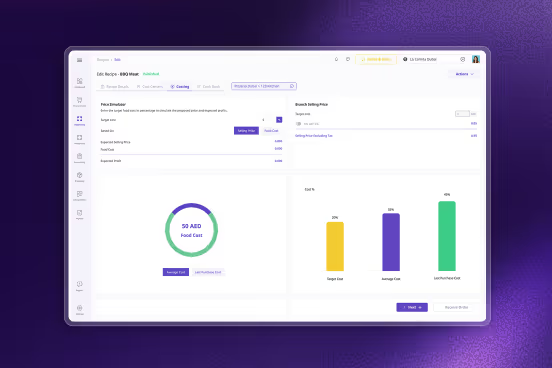
With accurate inventory data, recipe costing becomes reliable. Every menu item carries a theoretical cost based on ingredients and portions. That theoretical figure, compared against actual ingredient usage, produces your variance - the number that tells you whether kitchen execution is matching the recipe card or not.
4. Business Intelligence and Reporting
Connecting procurement, inventory, and recipe data into a unified reporting layer gives operators the live COGS view that most restaurant groups currently lack. One operator described the ambition directly: "I'm really excited to be able to have a better live view of everything." Another was explicit about the target: "My goal is to get cost of goods down to about 30%, and we're still skating at around 40%." That 10-point COGS gap on a million operation is 00,000 per year. Restaurant business intelligence at this stage moves from retrospective reporting to live operational control.
5. AI and Intelligent Automation
The most forward-looking pillar - and increasingly accessible. AI invoice processing (extracting and matching line items from supplier invoices automatically), demand forecasting (using sales history to generate purchase recommendations), and waste prediction are all live capabilities in modern BOH platforms. Enterprise operators entering transformation conversations today frequently arrive with high AI expectations - realistic framing on what is available now versus what is still emerging keeps implementation grounded and builds trust with operations teams.
The Transformation Roadmap: Sequencing the Journey
Most failed digital transformation projects in restaurants share the same root cause: attempting to implement everything simultaneously. The hesitation operators express when they encounter a full transformation scope is consistent - one multi-unit group put it directly: "Transitioning is the biggest issue - it's like moving all of this." Another common concern is not wanting to "take on more than they know they can execute well, and not wanting to be in a position where they're not utilising stuff that they're paying for."
The answer is a phased roadmap, not a big-bang cutover.
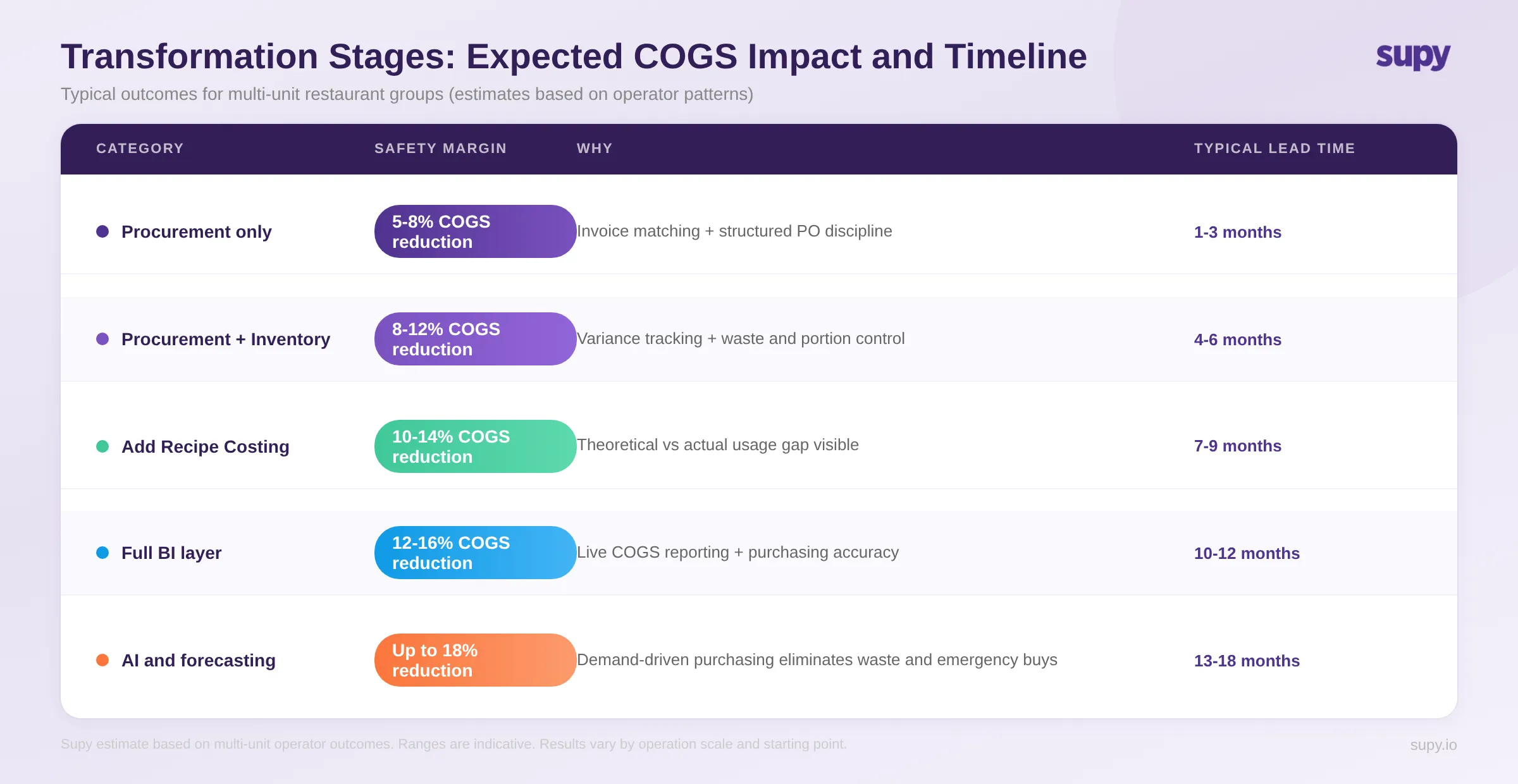
Phase 1 (months 1-3) - Foundation: Implement procurement and receiving. The lowest-disruption, highest-ROI entry point. Teams adapt quickly because it replaces a process they already run - the mechanics change, the familiar workflow does not disappear overnight.
Phase 2 (months 4-6) - Inventory layer: Add stocktaking, par level management, and variance tracking. At this stage, the procurement data provides a reliable baseline so inventory counts are compared against trustworthy demand figures rather than estimates.
Phase 3 (months 7-12) - Costing and BI: Connect recipe costs to actual usage. Begin using the unified reporting layer for real COGS visibility. This is where the financial case becomes undeniable - the operation moves from estimated food cost to a live daily figure.
Phase 4 (months 13-18) - AI and optimisation: Layer on forecasting and intelligent automation once the data foundation is solid. AI forecasting is only as good as the historical data it operates on - 12 months of clean procurement and inventory records is what makes demand-driven purchasing meaningful rather than speculative.
Building the CFO Business Case
Digital transformation conversations in multi-unit restaurant groups eventually reach the finance committee. The investment needs to be justified not as a technology expense but as a margin improvement programme.
The framing is straightforward: the cost of manual systems is not the licence fee for the software replacing them - it is the margin leakage that integrated data prevents.
A 10-location restaurant group operating at 40% COGS across $8 million combined revenue has a $3.2 million cost-of-goods line. Closing the gap to 32% - a realistic target for operators with structured procurement and inventory controls - recovers $640,000 per year. The investment in back-of-house software is typically a fraction of that figure, with most operators reaching payback within 12 months.
The business case builds around four levers:
In Supy, the CFO business case often crystallises through the live COGS dashboard - a single view connecting every purchase, inventory movement, and recipe cost into a real-time food cost percentage across all locations.
Where to Start
The most common barrier to digital transformation is not budget or technology - it is knowing where to begin. The transformation planning phase often produces a list of everything an operator wants to change simultaneously. That list, presented to the operations team, generates precisely the "we can't take this all on" response that delays projects by months.
The practical first step is simpler: identify the single highest-cost manual process currently running across your locations. For most multi-unit operators, this is purchasing - whether through unstructured supplier ordering, lack of PO matching, or invoice processing that happens in arrears.
Start there. Build one layer of digital control, demonstrate the ROI to the finance committee, and use that proof to fund the next phase. Operators who complete a full digital transformation are not those who planned most comprehensively at the outset - they are those who started with the smallest defensible scope and expanded systematically from a position of proven results.
About Supy
Supy is a back-of-house operations platform built for multi-unit restaurant groups. It connects procurement, inventory management, recipe costing, and business intelligence into a single operational layer - giving operators a live view of food cost and COGS across every location. Supy integrates with existing POS systems and is designed for operators at any stage of their digital transformation journey, from first-time procurement digitalisation through to AI-powered demand forecasting. See how Supy fits your digital transformation roadmap.