.jpg)


Inventory Control Software for Restaurants: Why Generic Tools Miss the Variance Your Recipes Create
What Generic Inventory Control Software Actually Tracks (And What It Misses)
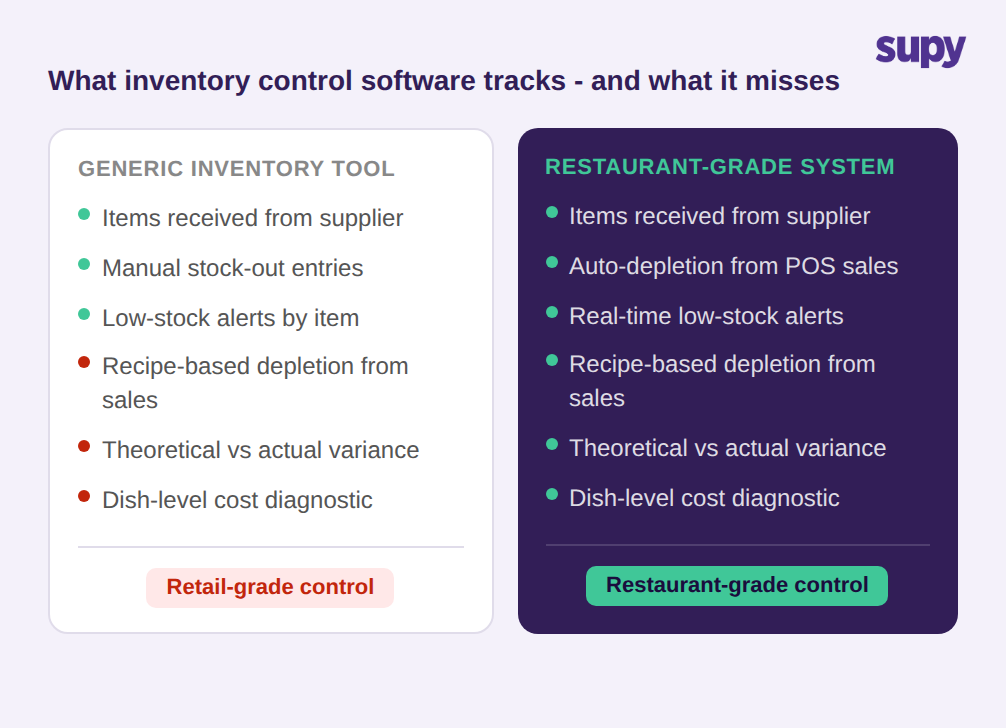
Generic inventory control software - tools built primarily for retail, manufacturing, or wholesale - manages stock through simple inbound and outbound transactions. A product arrives: inventory increases. A product is sold or used: inventory decreases. The core mechanism is sound and works correctly for the category it was designed for.
Restaurants break this model at the first step. A restaurant does not sell products directly from stock. It sells dishes. And dishes are not individual items - they are assemblies of weighted, portioned ingredients. When a kitchen fires 30 covers of the pan-seared salmon, it depletes a precise quantity of salmon fillets, lemon butter, fresh herbs, and capers - each at a specific yield-adjusted weight. The inventory software does not know this unless it has a recipe engine built into its core depletion logic.
Without recipe-based depletion, operators face a structural gap: the only way to record outflows is to manually count what left the shelves. That count happens once a week at best. It cannot tell you which dishes consumed which ingredients or whether a specific dish is running above its theoretical cost. The variance - what should have been used versus what was actually used - is invisible until month-end, and even then it shows up as a bulk figure across all items, not as a dish-level diagnostic.
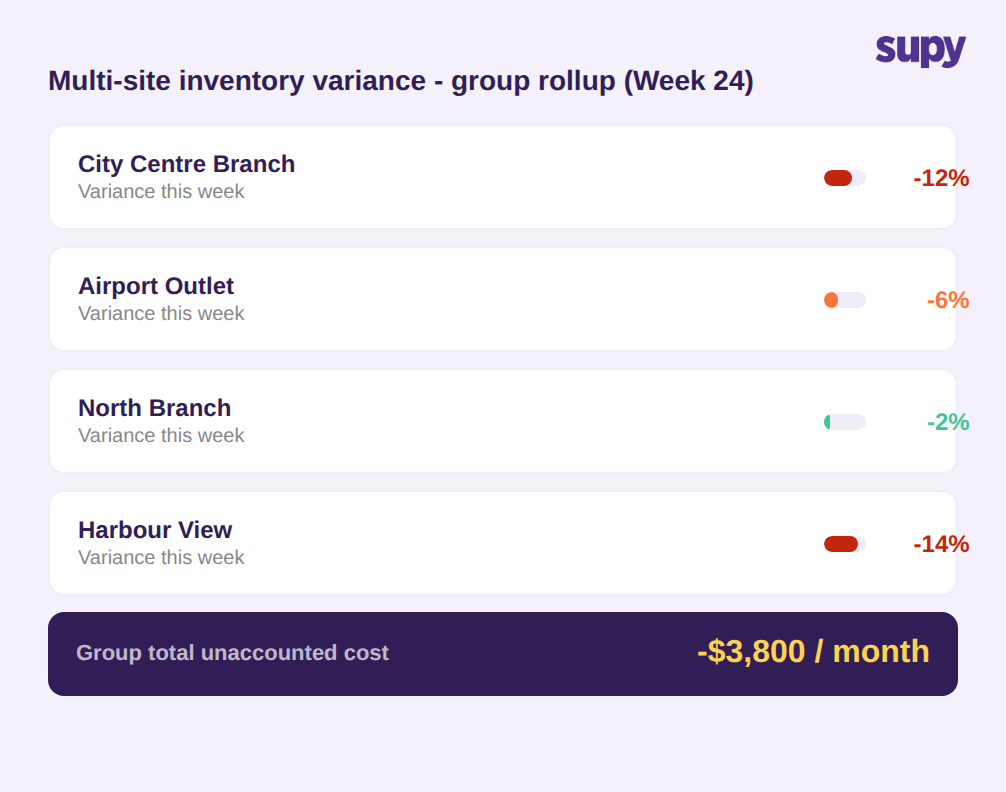
A 4-location casual dining group's operations manager described operating without recipe integration for 18 months: stock counts at each location took their team 6 hours per week across all sites, and the reconciliation at month-end still left a 12% unaccounted variance. The variance had a cost: roughly $3,800 per month the group could not explain or act on. When they moved to a restaurant-grade system with recipe depletion, the same variance shrank to under 3% within 60 days - because the software finally knew what each dish should consume.
Before evaluating any inventory control software for a restaurant, ask: does the system deplete ingredients from stock automatically when a sale is recorded? If the answer requires a manual count to trigger outflows, the tool is a retail inventory tracker, not restaurant inventory control.
Recipe-Based Depletion: The Control Layer Restaurants Can't Skip
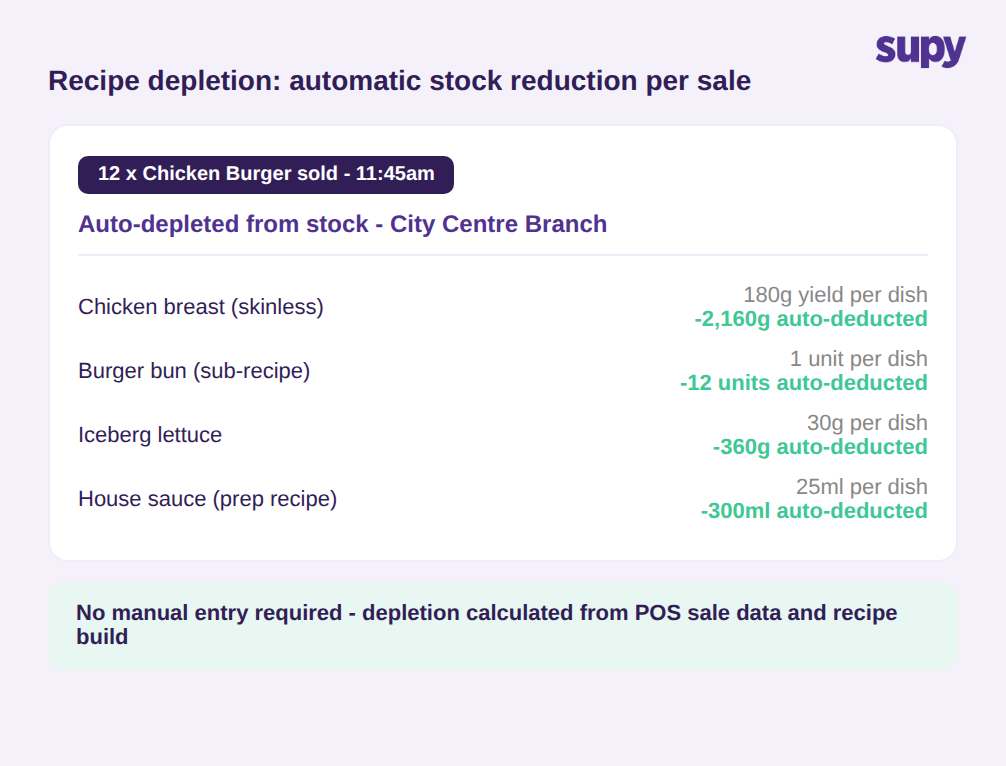
Recipe-based depletion means the inventory system knows the exact bill of materials for every dish on your menu - including yield percentages, prep wastage, and modifier-level variations. When a POS records a sale, the inventory module calculates the theoretical ingredient consumption for that dish and deducts the weighted quantities from the appropriate stock locations in real time.
This is not a reporting feature. It is the foundation of control. Without it, the gap between theoretical and actual stock consumption is invisible during service. With it, the gap is visible at any point in the shift - and it is dish-specific.
The bill of materials must handle two levels of complexity common in multi-site restaurants. The first is sub-recipes: a burger bun is not a single ingredient purchase; it is a combination of flour, yeast, sesame seeds, and labour that gets assembled in a central kitchen and then transferred to branches. The inventory system must track the sub-recipe as a production unit and deplete its components at the recipe level, not just record a "burger bun" inflow at branches. The second is modifiers: a build-your-own rice bowl with 12 protein options and 8 sauce variations has a different theoretical cost depending on what the customer chose. The depletion must reflect the actual modifier selection, not an average.
A multi-location hospitality group's procurement manager noted that their previous generic inventory tool had no sub-recipe support. Their central kitchen prepared 280 ingredients into 65 assembled components, none of which appeared correctly in the stock depletion model. Every theoretical-vs-actual variance was contaminated by untracked production consumption, making dish-level analysis impossible even with a full month of data.
When evaluating inventory control software, check specifically: can the recipe engine handle sub-recipes and prep recipes with yields? Can it accept POS modifier data and adjust depletion accordingly? If the demo shows only simple single-ingredient dishes, ask to see a dish with a nested prep recipe. The answer reveals whether the tool was designed for restaurant environments.
Theoretical vs Actual Variance at the Dish Level
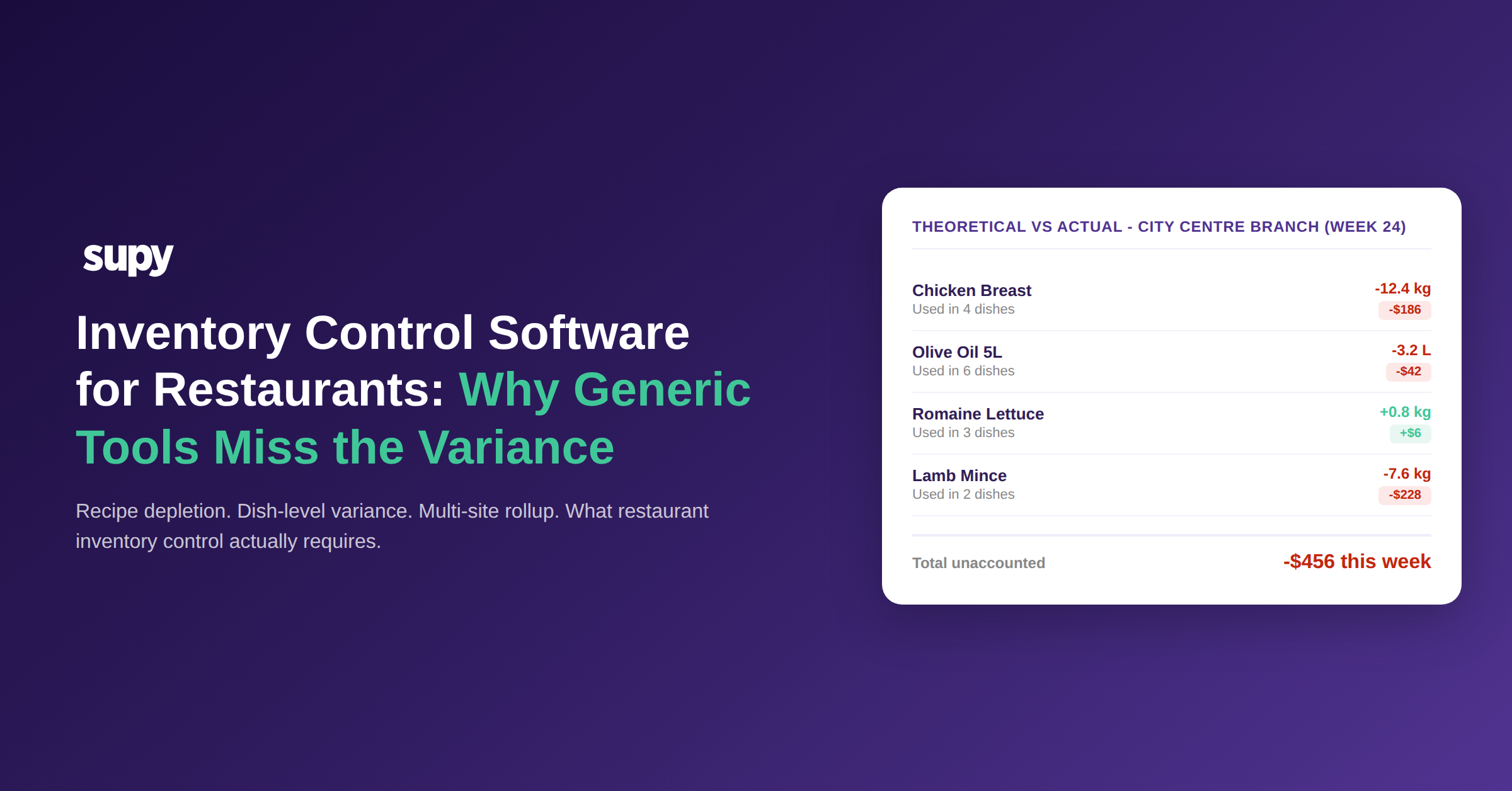
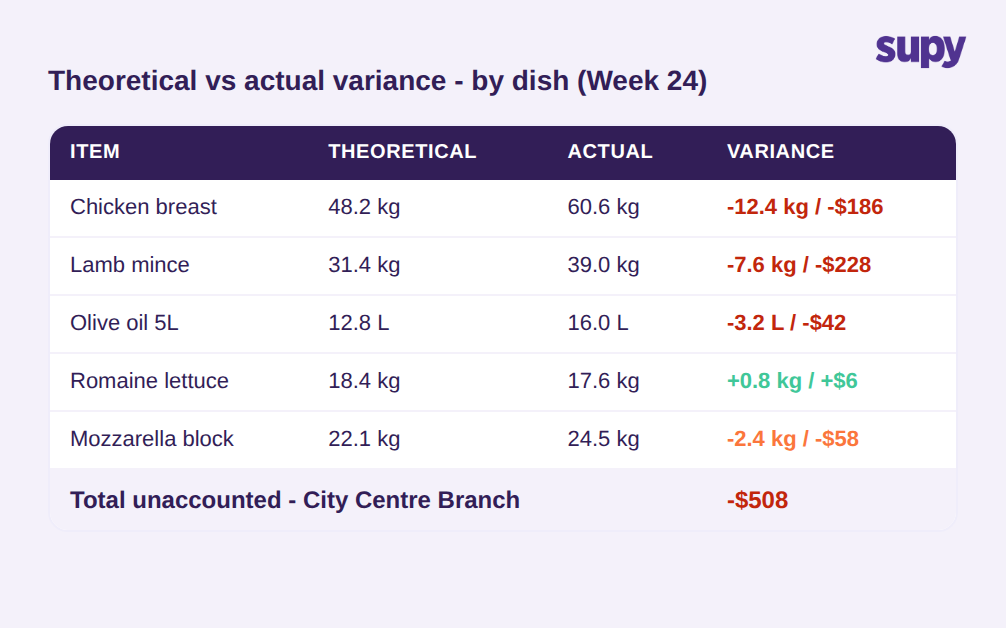
The theoretical vs actual variance report is the central diagnostic in restaurant inventory control. Theoretical usage is what the recipes say each ingredient should have consumed, given the recorded sales volume. Actual usage is what the stock count shows was consumed. The gap between them is where margin problems live.
Generic inventory tools cannot generate this report because they have no theoretical baseline. They can show you what was purchased and what the count says remains. They cannot tell you what should have remained if every dish was cooked to spec.
Dish-level variance is a more granular version of the same diagnostic. Instead of showing a variance for "chicken breast" across all menu items that use chicken, it shows the variance contribution from each specific dish that includes chicken - the grilled chicken wrap vs the chicken burger vs the chicken caesar. This granularity changes the operational response. A high chicken variance spread evenly across dishes suggests a portioning or yield issue. The same variance concentrated in one dish suggests a recipe misconfiguration, a substitution, or systematic over-portioning on a specific station.
A 7-location restaurant group's head of operations noted that without dish-level variance data, their management response was always reactive and imprecise: they knew food costs were running high on chicken but could not pinpoint whether it was the prep kitchen, a specific branch, or a specific dish. After moving to a system with dish-level variance reporting, they identified within two weeks that one prep recipe had an incorrect yield setting for a popular dish - a setting that had been incorrect since the item was first added to the menu.
The dish-level variance report also surfaces inconsistency across sites. If the chicken burger theoretical vs actual variance is within 1% at six branches but sits at 9% at a seventh, the seventh branch has a different problem - and it is identifiable without a physical visit.
Before signing a contract with an inventory control software provider, ask: can you show me theoretical vs actual variance at the dish level, not just the ingredient level? Can I filter that report by branch, time period, and menu category? A system that cannot answer yes to both questions is not providing restaurant-grade inventory control, regardless of what the marketing materials say.
Multi-Site Inventory Control: Why Group-Level Visibility Matters
A single-location restaurant operator can compensate for limited software with physical presence. When the owner is in the kitchen, variance problems are visible in real time. At 8 or more locations, this compensation is impossible - and the requirement for group-level inventory visibility becomes structural, not optional.
Group-level inventory control means the software can aggregate theoretical vs actual variance across all sites while still allowing drill-down to branch and dish level. It means stock counts at one branch do not require a manager from another branch to reconcile. It means a transfer of inventory from a central kitchen to branches is tracked as a stock movement, not recorded as a separate purchase at the receiving end. And it means the PAR levels and minimum thresholds can be set group-wide or individually by branch, with the system maintaining both views simultaneously.
The practical failure mode for generic tools at multi-site scale is data fragmentation. Each location runs its own instance of the software, with its own item master, its own stock records, and its own count history. Cross-location comparison requires manual exports and spreadsheet consolidation. The consolidated view always lags by at least a week, usually more.
This fragmentation has a cost that compounds over time. An 8-location group performing manual weekly stock counts at 6 hours per location spends 48 management hours per week on counting alone. A group with a centralised inventory control system - shared item master, shared recipe library, automated theoretical depletion from POS sales - can cut that count time by over 50% and run the theoretical-vs-actual variance report daily rather than weekly.
Group-level visibility also changes how purchasing decisions are made. When the software can show that two branches are consistently running above theoretical usage on the same three ingredients, procurement can flag a potential quality or portioning issue before it accumulates into a significant loss. Before committing to any multi-site inventory system, ask: can I see group-level theoretical vs actual variance without manual data exports, and can I drill down to a single branch without leaving that view?
How to Choose Inventory Control Software for a Multi-Site Restaurant Group
The right inventory control software for a restaurant group is the one that closes the variance gap at the dish and branch level - not the one with the most feature flags or the lowest per-seat price.
Choose restaurant-grade inventory control software when:
You operate more than one location and need consolidated theoretical vs actual variance across all sites. Your menu has more than 20 dishes or relies on prep recipes assembled before service. You have a central kitchen supplying branches and need inter-branch transfer tracking. You want to run variance analysis at the dish level, not just the ingredient category level.
A simpler generic tool may be adequate when:
You operate a single location with a short menu and no central kitchen. Your primary need is purchase order management and supplier tracking, not recipe depletion. You have fewer than 50 active menu items and no sub-recipes.
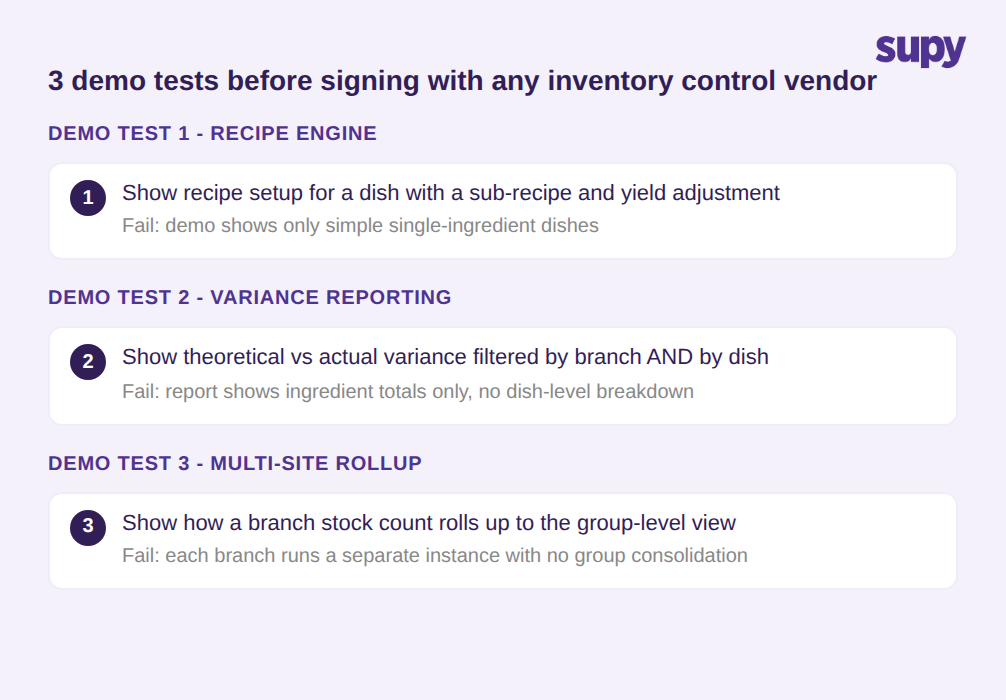
For groups that have outgrown the second category, the evaluation process should be structured around three demos before any commercial conversation: first, show recipe setup for a dish with a sub-recipe; second, show the theoretical vs actual variance report filtered by branch and dish; third, show how stock count discrepancies are recorded at the branch level and how they roll up to the group view. Any vendor that cannot run all three demos on their live system is not in the right product category for a multi-site restaurant operation.
Supy is built specifically for multi-site restaurant and hospitality groups. The inventory module uses POS-integrated recipe depletion to calculate theoretical consumption in real time, with dish-level and branch-level variance reports available at any point during service. Stock counting uses reusable templates in shelf order, cutting count time by more than 50%, and all count data rolls up to a group-wide view without any manual consolidation. Supy connects with 75+ POS, accounting, and ERP systems, so the inventory data layer sits alongside the tools your group already uses. Groups that have moved from generic tools to Supy typically see their unaccounted variance drop from double digits to under 3% within the first two count cycles.