.jpg)


How to Open a Franchise Restaurant: The Operational Systems Setup Most Operators Miss
Why Franchise Operators Carry Inventory Risk the Franchisor Doesn't
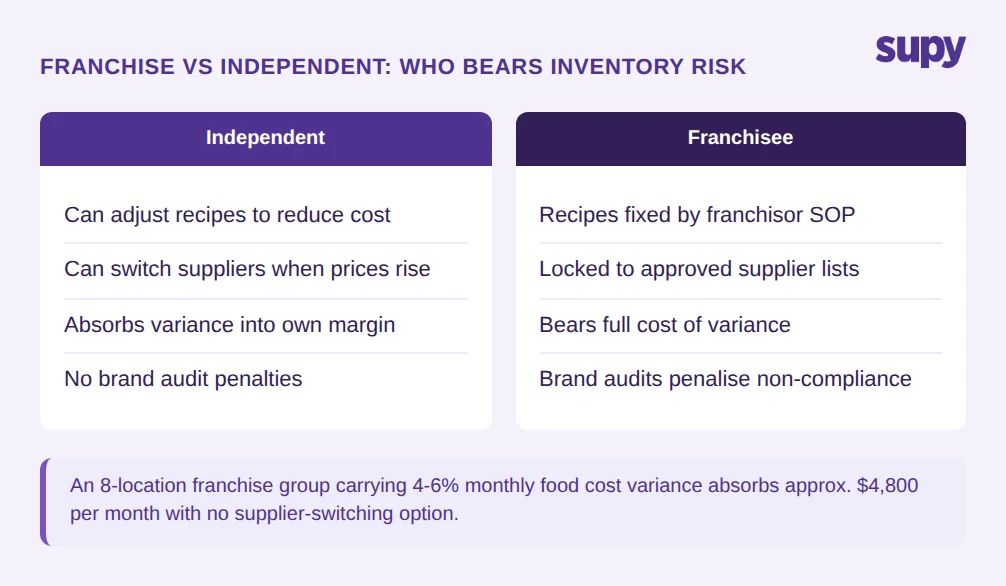
When you join a franchise, you inherit the brand's operational standards - but you bear the cost of failing to meet them. The franchisor sets recipe specifications, approved supplier lists, portion standards, and receiving protocols. You pay for every variance.
This creates a risk structure that is fundamentally different from an independent restaurant. An independent operator can adjust recipes, switch suppliers, or absorb variance into their margin with flexibility. A franchisee cannot. Approved supplier lists are non-negotiable. Recipe portion sizes are audited. Stock rotation protocols are enforced.
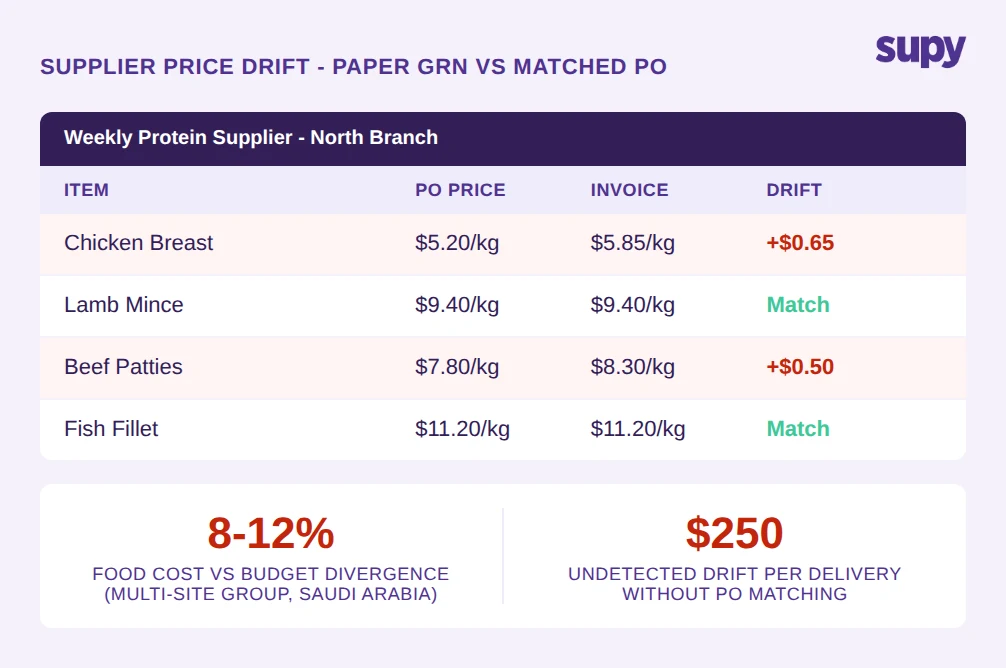
One multi-site F&B group that Supy was speaking to discovered this cost the hard way. Supplier price increases had been slipping through a paper-based GRN process for weeks. By the time finance flagged the discrepancy at month-end, actual food cost versus budget had diverged by 8-12%. The group was locked to approved suppliers with no ability to switch - which made the gap between the PO and the invoice the only lever available. Without automated PO-to-invoice matching, that lever was invisible.
Before you open, ask: which of your inventory costs are controlled by the franchisor's systems, and which are controlled by yours?
The Tech Stack Franchise Agreements Assume You Have
Franchise operations manuals specify procedures that require a technology layer to execute consistently: approved supplier lists with ordering procedures, goods receiving protocols, inventory labelling and rotation standards, spoilage recording, and recipe adherence tracking. What they do not typically specify is which software to use.
This creates a gap. The manual assumes the operator has tools to enforce these standards across shifts and locations. Some new franchise operators underestimate how much of this falls on them from day one.
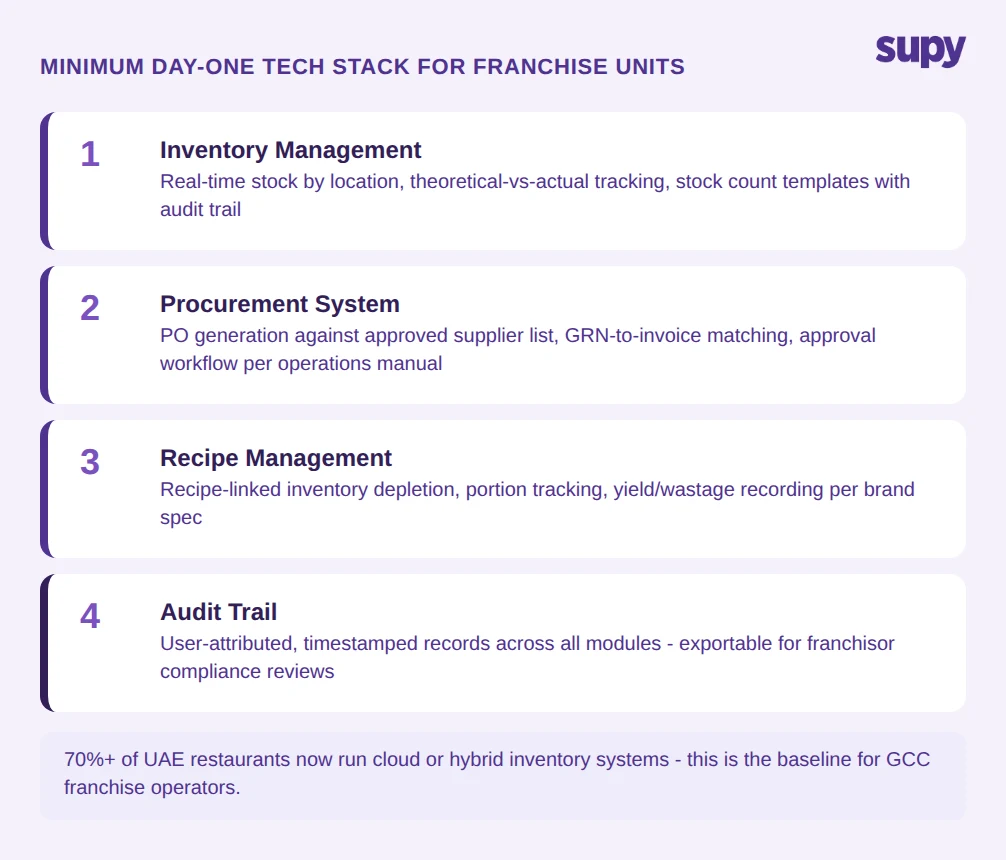
The minimum viable technology stack for a franchise unit at opening includes: an inventory management system with real-time stock visibility and theoretical-versus-actual usage tracking; a procurement system with PO generation against approved supplier lists, GRN processing with invoice matching, and an approval workflow aligned to the franchisor's ordering procedures; recipe management software with recipe-linked inventory depletion, portion tracking, and yield and wastage recording; and a full audit trail across every module - every receiving, transfer, count, and wastage action must be attributable to a named user with a timestamp.
Over 70% of restaurants now operate cloud or hybrid inventory systems. For franchisees, this is the baseline expectation - not an upgrade. Ask your technology provider: does the system produce the audit-trail exports your franchisor will request at a brand inspection?
Supplier Price Drift: The Silent Margin Killer for Franchisees
Franchise operators face a procurement challenge that independent restaurants do not: you cannot switch suppliers when costs rise. Approved supplier lists are a brand-compliance requirement. When a supplier increases prices on a line item, your options are limited to catching it early and raising it with the supplier, or absorbing the cost.
Paper-based and spreadsheet GRN processes make catching it early effectively impossible. When a supplier invoice comes in at $3,450 against a PO raised at $3,200, that $250 discrepancy per delivery may not surface until month-end if there is no automated reconciliation step. Across multiple locations and multiple suppliers over a month, these gaps compound.
The solution is a closed procurement loop: PO raised against the approved supplier, GRN processed against the PO with line-item variance flagging, and invoice matched to the GRN before stock and accounts are updated. Any price discrepancy - above a configurable acceptable threshold - should pause the receiving process and require an authorised exception before proceeding.
For multi-location franchise groups, this loop also needs to work on mobile. Branch-level receiving staff should be able to process a delivery on a tablet against the pending PO, with variance flags surfacing immediately to a procurement manager - not five weeks later in a finance reconciliation.
Ask before opening: can your procurement system flag a price discrepancy at the point of goods receipt, and route it for approval before updating your accounts?
Recipe Standardisation as a Compliance Requirement, Not a Choice
For a franchise operator, recipe adherence is not primarily a food cost decision - it is a brand compliance requirement. When an auditor arrives, or when a mystery shopper orders the signature dish, the question is not whether your food cost is within target. The question is whether the dish matches the franchisor's specification.
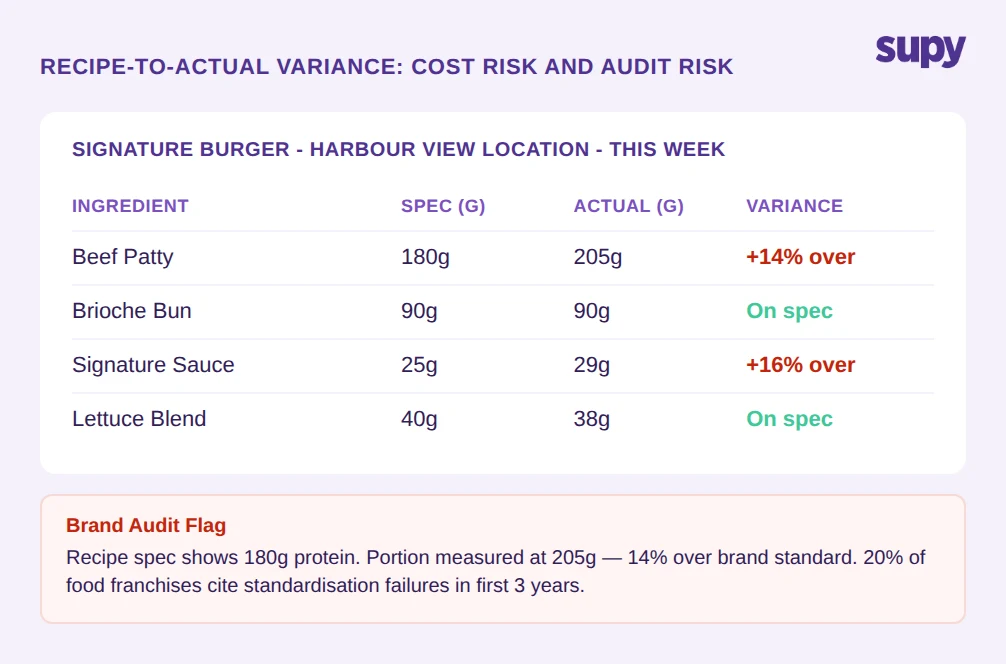
This creates a dual pressure that competitor content rarely addresses. Recipe-to-actual variance is simultaneously a cost problem and a brand risk. If a branch is consistently using 205g of protein per dish against a recipe spec of 180g, that is a 14% over-portioning error - both a margin problem and an audit flag.
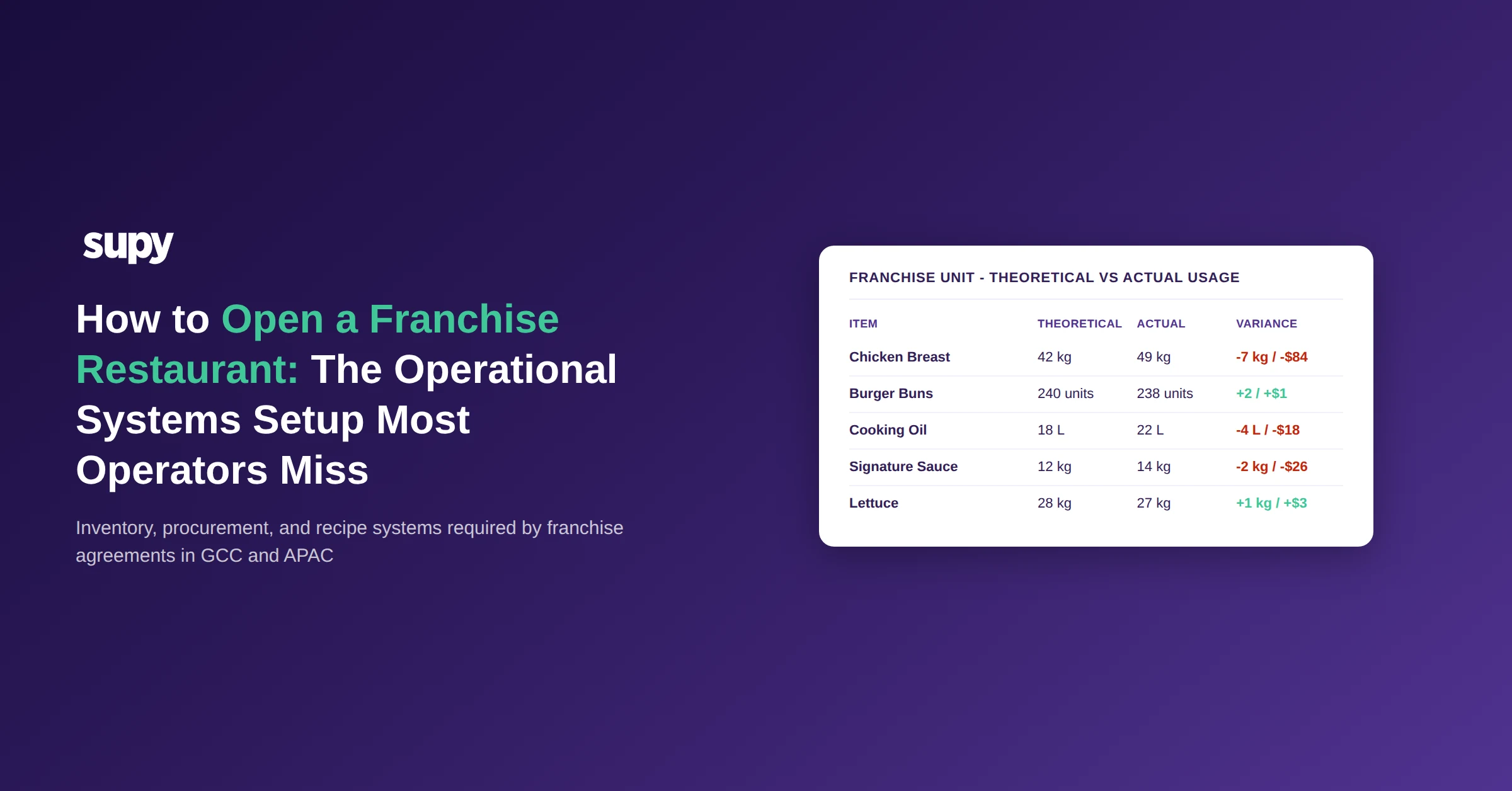
The tool that resolves this dual pressure is recipe-linked inventory tracking: a system where every sale depletes the theoretical ingredient quantities from your stock in real time. The gap between theoretical consumption (what the recipe says you should have used) and actual consumption (what is recorded in your stock count) tells you whether your portioning, wastage, and receiving are aligned with the franchisor's standards.
Industry research indicates that 20% of food franchises struggle with standardisation and quality control in their first three years. Many of those failures begin not with bad product but with the absence of the measurement layer that would have caught drift early.
Ask before you open: can your system produce a theoretical-versus-actual usage report by recipe and by location, so that you can demonstrate recipe compliance before a brand audit rather than discovering variance during one?
Stock Counting Across Franchise Locations: Building the Audit Trail
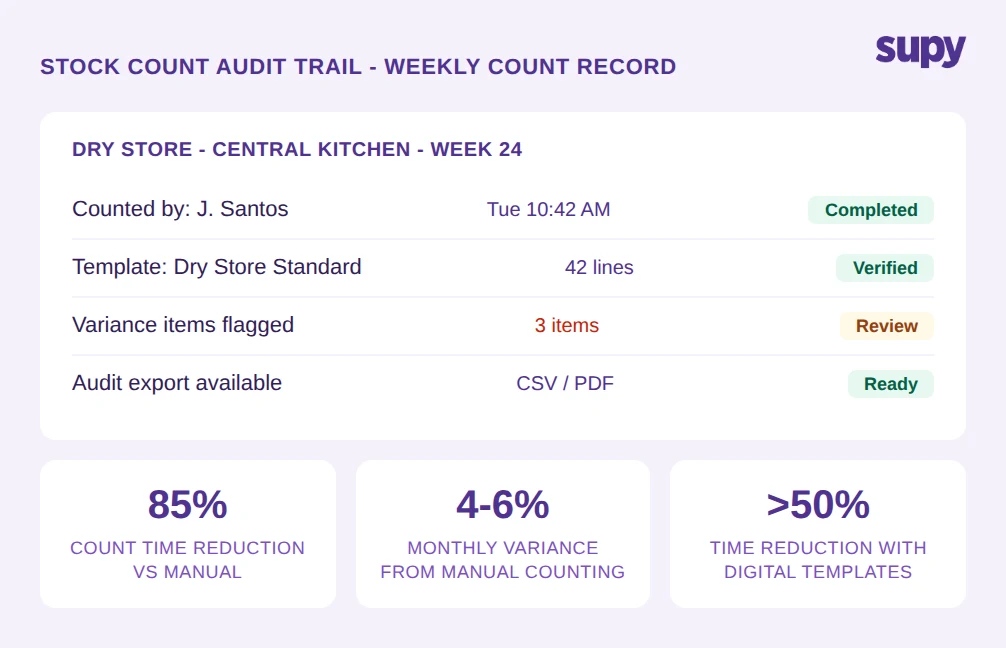
Manual stock counting is the single most common root cause of food cost variance for new franchise operators. A multi-location QSR group found that spreadsheet-based counts caused 4-6% monthly food cost variance across branches. Managers spent hours reconciling numbers. There was no audit trail to distinguish genuine usage from loss during that period - and no defence to present during a franchisor compliance review.
The practical problem is not just accuracy. It is time. Operators who have moved to cloud-based inventory systems with mobile counting report reducing stock count time by up to 85%. For a franchise group with multiple locations counting weekly, that time saving has a direct labour cost implication.
The audit trail requirement is equally important. A stock count in a compliant system records: who counted, which template was used, what the system-expected quantity was, and what the counter recorded. Variance is surfaced immediately, not reconciled manually. This record is what a franchisor audit requests - and what a manual process cannot reliably produce.
For multi-location franchise groups, a parallel counting capability - where multiple staff count simultaneously with automatic merge and attribution - is operationally important during the first weeks of opening when processes are still being embedded.
Ask before opening: does your stock counting system produce a timestamped, user-attributed count record that can be exported for a franchisor compliance review?
Setting Up Approval Workflows That Match the Franchise Operations Manual
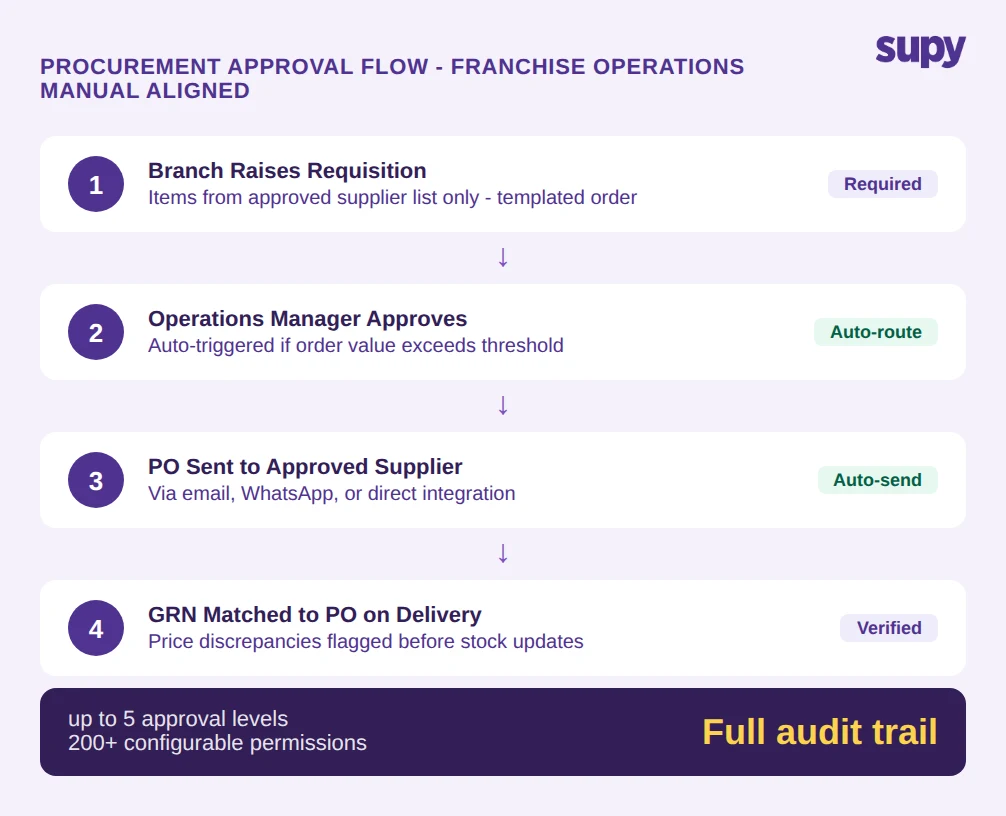
Every franchise operations manual describes an ordering procedure. Who can raise a requisition. Who can approve a PO. What order value triggers additional approval. Which suppliers are authorised for which categories. These rules exist in the manual - but they only function if they are enforced by your procurement system, not by informal team practices.
The risk is specific to franchise operators: your internal approval workflow must align with the franchisor's required procedures. A branch manager who has learned the threshold below which orders do not require approval is not just a procurement governance issue - it is a brand-compliance failure that can appear in an audit.
A digital approval workflow enforces the rules the manual describes: sequential approvals up to five levels, triggered by branch, order value, or supplier category; separate flows for requisitions and purchase orders; spending limits by location, supplier, or user. When combined with order-to-par logic and approved supplier lists loaded directly into the system, the daily ordering process becomes a guided procedure rather than a judgment call.
This level of control also produces the reporting that matters during a franchise review period. Spend by supplier, by branch, and by category - with timestamps and approval attribution - is the evidence that demonstrates operational compliance to a franchisor.
Ask before you open: can your procurement workflow be configured to mirror the approval rules in your franchise operations manual, including value thresholds and supplier restrictions?
Getting Operational Before Day One: Supy for Franchise Operators
Supy is a restaurant operations platform built for multi-location operators globally. For franchise groups, it covers the full stack the franchise operations manual assumes: inventory tracking with theoretical-versus-actual variance, a closed procurement loop from PO through AI-assisted invoice scanning, recipe management with recipe-linked stock depletion, and a tamper-proof audit log across every module.
The platform supports multi-level approval workflows (up to 5 approvers) with 200+ configurable permission settings, approved supplier lists with per-branch contacts and delivery schedules, and real-time stock visibility with below-par alerts. Stock counting uses reusable templates with parallel counting and immediate variance reporting - delivering greater than 50% time reduction versus manual processes. AI Sales Forecasting predicts daily sales 14 days ahead to support procurement planning. Supy integrates with 75+ POS, accounting, and ERP systems.
For franchise operators opening their first units or scaling an existing group, Supy's setup covers the technology layer your franchise agreement expects you to have in place from day one. Learn more about Supy's inventory and procurement platform.