.jpg)


Restaurant Franchise Stock Counts: Why They Drift Across an Estate
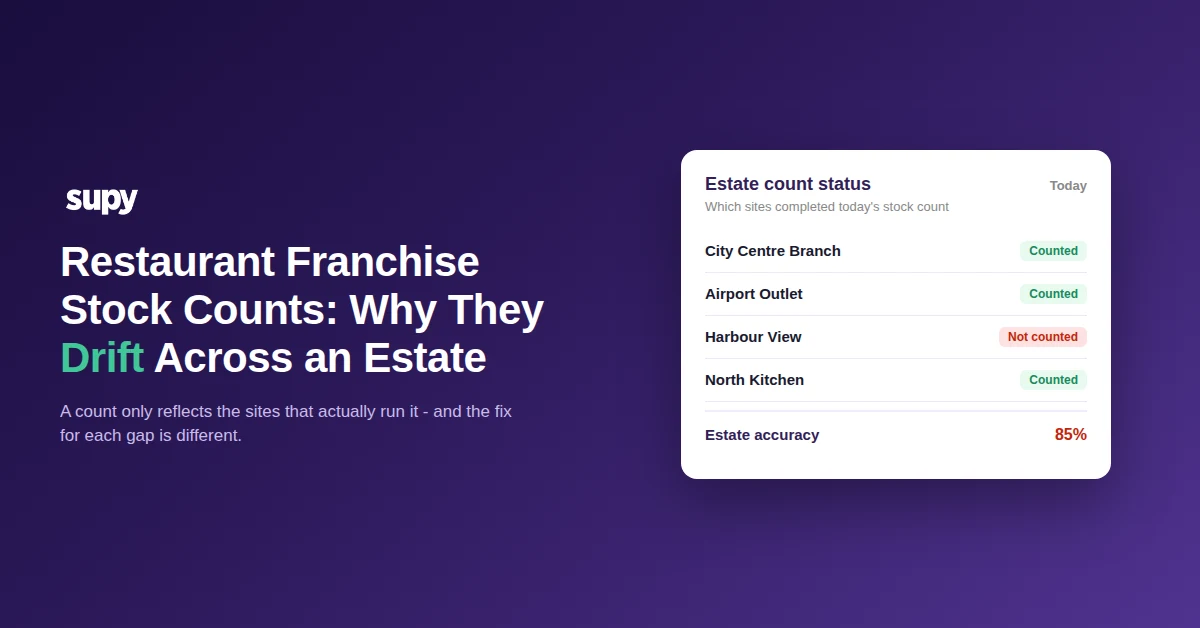
A restaurant franchise group running dozens of sites had its franchise development lead go looking for why estate stock-count accuracy sat at 85%, not the near-100% head office assumed. The answer was not one broken setting. It was several separate gaps stacked on top of each other, and the biggest was that around 60% of franchisees were not using the stock system at all.
That is the trap with franchise stock count accuracy: the causes look like one problem but each needs a different fix, and some are governance rather than configuration. Here is where estate counts actually drift, and the concrete fix for each.
Where franchise stock counts drift that single-site counts don't
Franchise stock count accuracy drifts because an estate count is only ever the sum of the sites that actually ran it, counted the same way, on the same structure. A single site controls all of that itself. Across a franchise network, adoption, count discipline, and invoice capture vary site by site, so the group number hides which locations are wrong and by how much.
The single biggest cause is adoption. When franchisees can opt out of the stock system under their agreement, the estate figure reflects the disciplined sites and quietly ignores the rest. No configuration change fixes a count that was never run, which is why the first move is always to see who is counting before you touch how they count. The question to ask first is simple: how many of your sites actually appear in this week's completion view?
Six franchise stock count accuracy gaps, and the fix for each
Work through these in order. The first two decide whether a count happens and whether it is honest; the rest decide whether the number you get can be trusted. Most estates have more than one running at once.
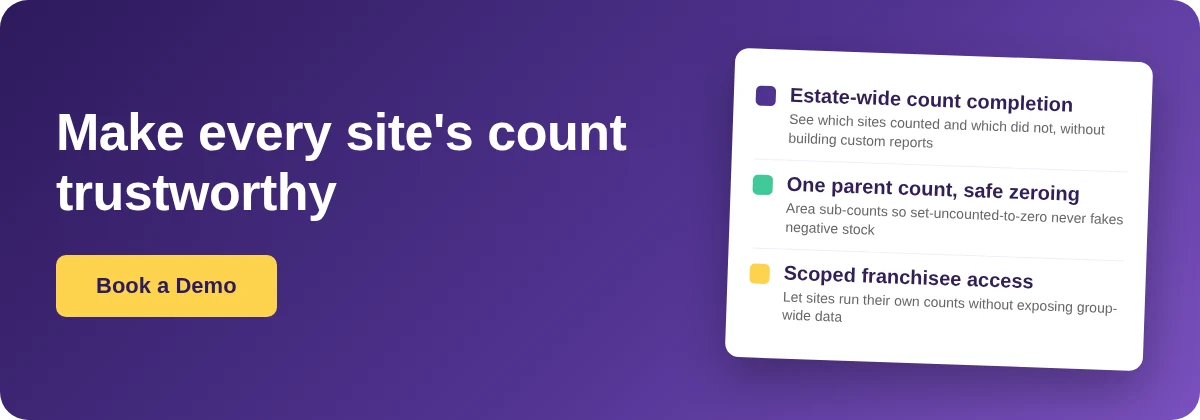
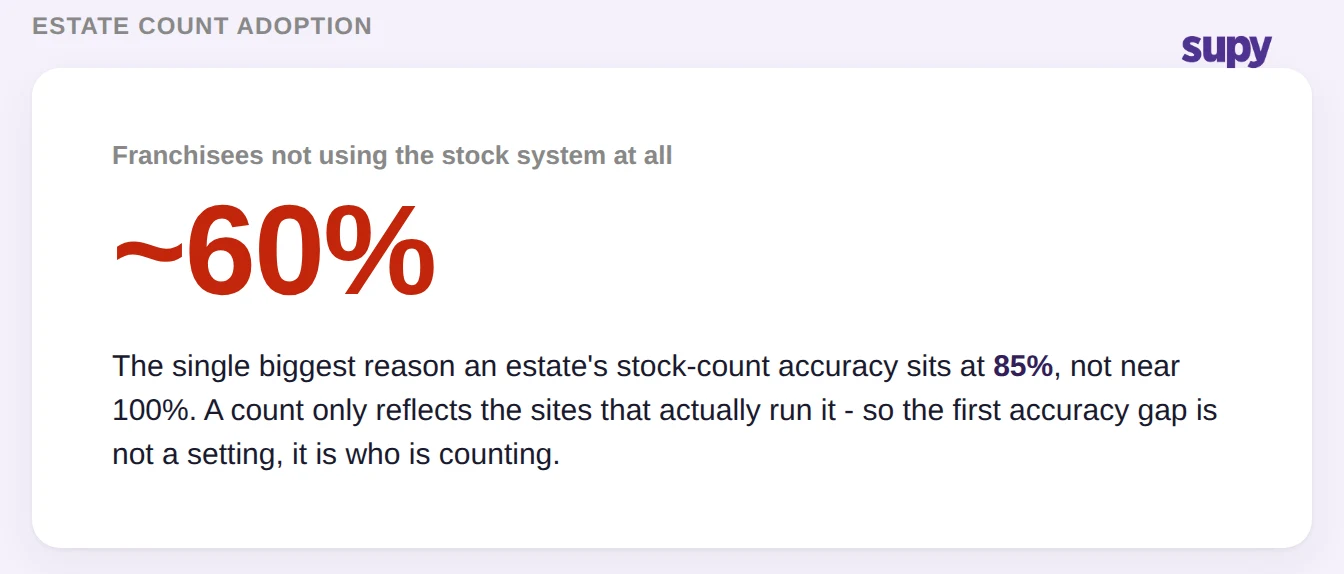
- Franchisees opt out of the stock system entirely. This is a governance gap, not a product one. If the franchise agreement only mandates sales reporting, no setting can force a site to count. The fix is to write system adoption into the agreement at renewal or at a set estate size, and meanwhile use an estate completion view that shows the dates when every location counted versus when only some did, so non-participation is visible at head office without building a custom report.
- Waste and staff meals never get logged. Product given away, sampled, or binned that never hits the system shows up later as unexplained shrinkage and drags accuracy down. The fix is process, not tooling: make waste and staff-meal logging part of the daily close at every site, so consumption that is not a sale is still recorded before the count runs.
- Separate counts per category break the set-uncounted-to-zero step. Sites that run several standalone counts a day, one for disposables, one for cleaning, and so on, cannot safely use the step that sets uncounted items to zero, and sales that deplete stock before the first count produce impossible negative figures, a single line showing minus $1,700 that then has to be wiped and re-baselined. The fix is structural: run one parent count per day with named area sub-counts. Each sub-count can be locked individually so several people count different sections at once and the results auto-merge, and only that structure lets zeroing work safely across the whole inventory.
- Every site counts to its own list. When merged or newly onboarded brands each name and order items differently, the same product is counted inconsistently across the estate and reconciliation becomes rework. The fix is to push one per-outlet stock count template in shelf order, so every location counts the same items in the same sequence and the numbers are comparable across sites.
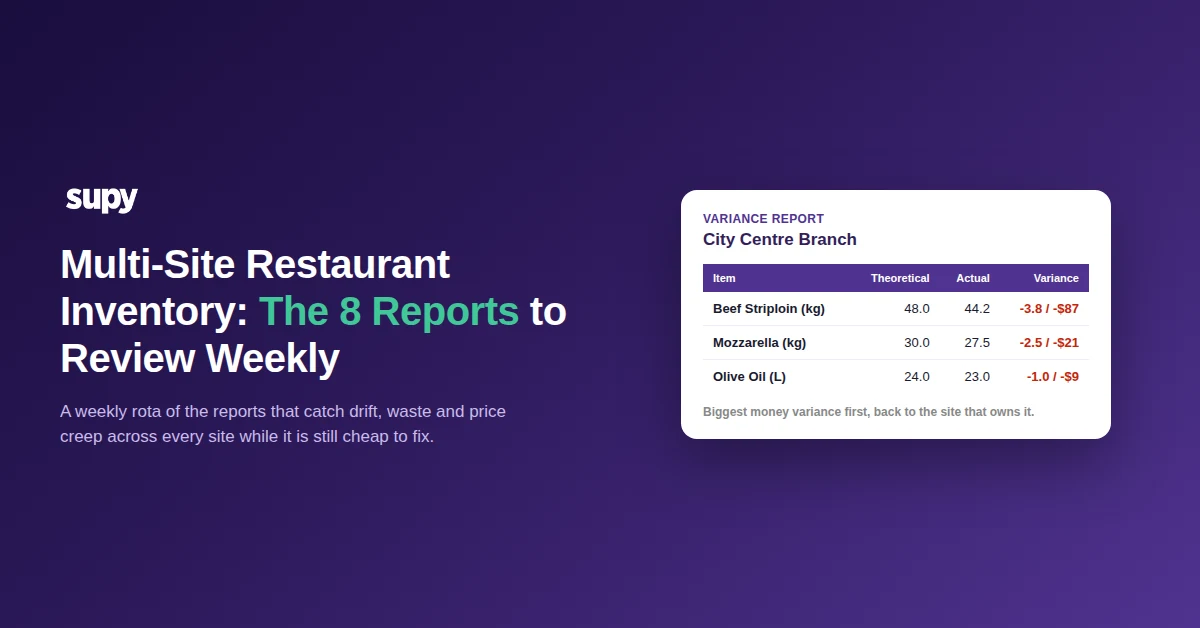
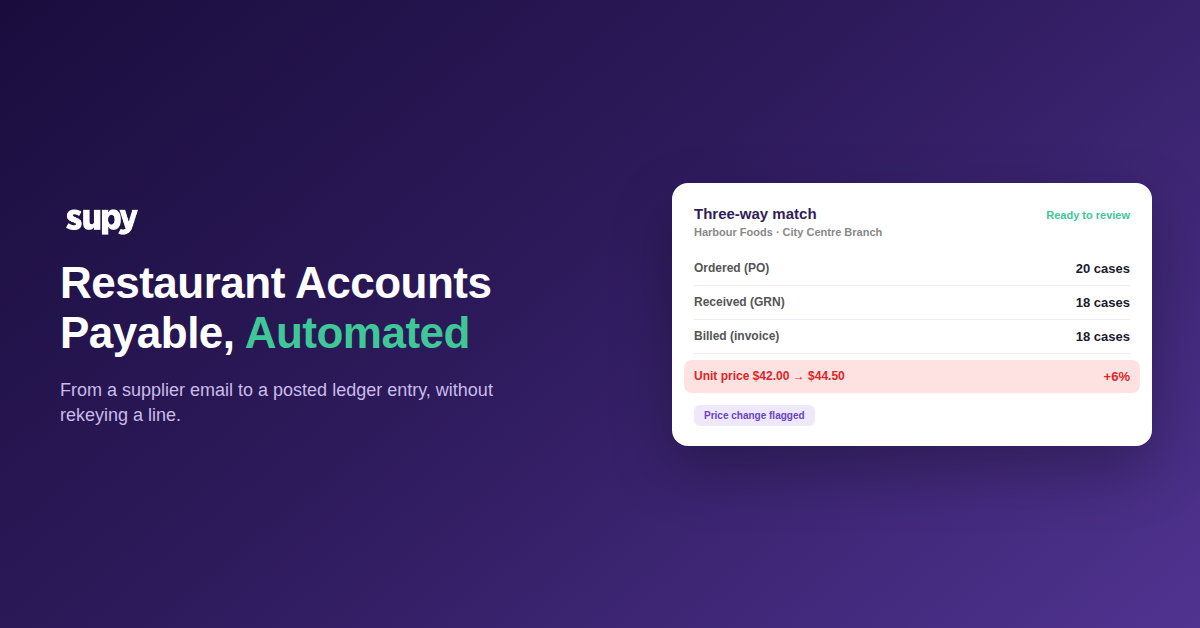
- Missing invoices fake a healthy variance. A single franchise site can show a theoretical cost around 30% against an actual around 24%, a flattering six-point positive variance, purely because invoices were never entered and certain items show no purchases at all. A good-looking number is not always good news. The fix is to treat invoice capture as the prerequisite for trusting any variance: put ordering and invoices through the platform so purchases are recorded, and read a large positive swing as a sign to check invoice completeness per item first. With purchases captured, the variance report can attach the food-cost impact to each site so you see where the real money is, not just a quantity gap.
- Franchisee permissions are too locked to take part. If a franchisee cannot authorise its own invoices, approve its stock-take, or manage its own suppliers without routing everything through head office, participation stalls and the group number suffers. The fix is scoped, role-based access: give each franchisee control over its own counts and site data without exposing group-wide figures. One honest limit to plan around, common across systems today, is that franchisees still usually cannot add their own ad-hoc supermarket top-ups as items, so those off-book buys need a manual catch-up process rather than a self-serve one.
The decision this list forces is which of the six you can honestly rule out today. Most estates cannot rule out more than three, so treat any you cannot dismiss as an open accuracy gap.
Which franchise stock count accuracy gap to close first
The order matters because a configuration fix cannot rescue a count that never ran. Use the quick self-audit below: find the row that matches what you are seeing, and start with the highest one on the list that applies to your estate.
| Accuracy gap | How to tell it is happening | First move |
|---|---|---|
| Sites not counting | Estate accuracy looks fine on paper but only a fraction of sites appear in the completion view | Get adoption into the agreement; watch the completion view weekly |
| Broken count structure | Negative stock values appear, or the set-uncounted-to-zero step is unusable | Switch to one parent count per day with area sub-counts |
| Untrustworthy variance | A site shows a suspiciously large positive variance | Check invoice entry completeness per item before believing the number |
| Inconsistent counting | The same item is named or ordered differently across sites | Push one per-outlet template in shelf order |
Start with who is counting. Estate stock count accuracy is a participation problem before it is a configuration one, so fix adoption and get every site into a single completion view first, then fix the count structure so zeroing is safe, then make variance trustworthy by capturing invoices. If you want to see the estate-level completion view and per-site variance in one place, Supy's restaurant inventory management software is built for exactly this multi-site picture. For the wider set of count failures beyond franchising, see our guide to why multi-site stocktakes go wrong, and to sanity-check what a variance is really costing you, our food cost calculator turns the gap into a number.