.jpg)

Food Inventory Software: Track, Control and Reduce Food Costs
An 8-location UAE restaurant group now knows its live food cost at every branch, updated in real time, without a single spreadsheet. Their finance director can pull a group-level COGS report in seconds. Within 90 days of adopting food inventory software, they had cut waste by 28% and reclaimed up to 10 hours per week previously lost to manual stock counting. That shift - from reactive guesswork to real-time control - is what modern food inventory software makes possible for multi-site operators across the GCC.
This guide covers exactly how food inventory software delivers that: from live stock visibility and faster counting to supplier invoice accuracy, waste tracking and inter-branch transfers.
Why Real-Time Stock Visibility Changes How Multi-Site Groups Operate
For multi-site restaurant groups, the gap between what stock records say and what is actually on the shelf is where margin disappears. Branch managers ordering from memory, over-purchasing perishables because there is no shared visibility, and inter-branch discrepancies that go unnoticed for weeks - these are not edge cases. They are the default operating state for groups relying on spreadsheets or disconnected systems. Food inventory software replaces that fragmented picture with a single, real-time ledger.
An 8-location UAE restaurant group's operations manager described discovering that the business had been running a 38% food cost for six weeks before their spreadsheet process surfaced the variance. By then, the damage was done. Six weeks of purchasing and portioning decisions made without any accurate baseline. The business had no mechanism to flag the drift in real time.
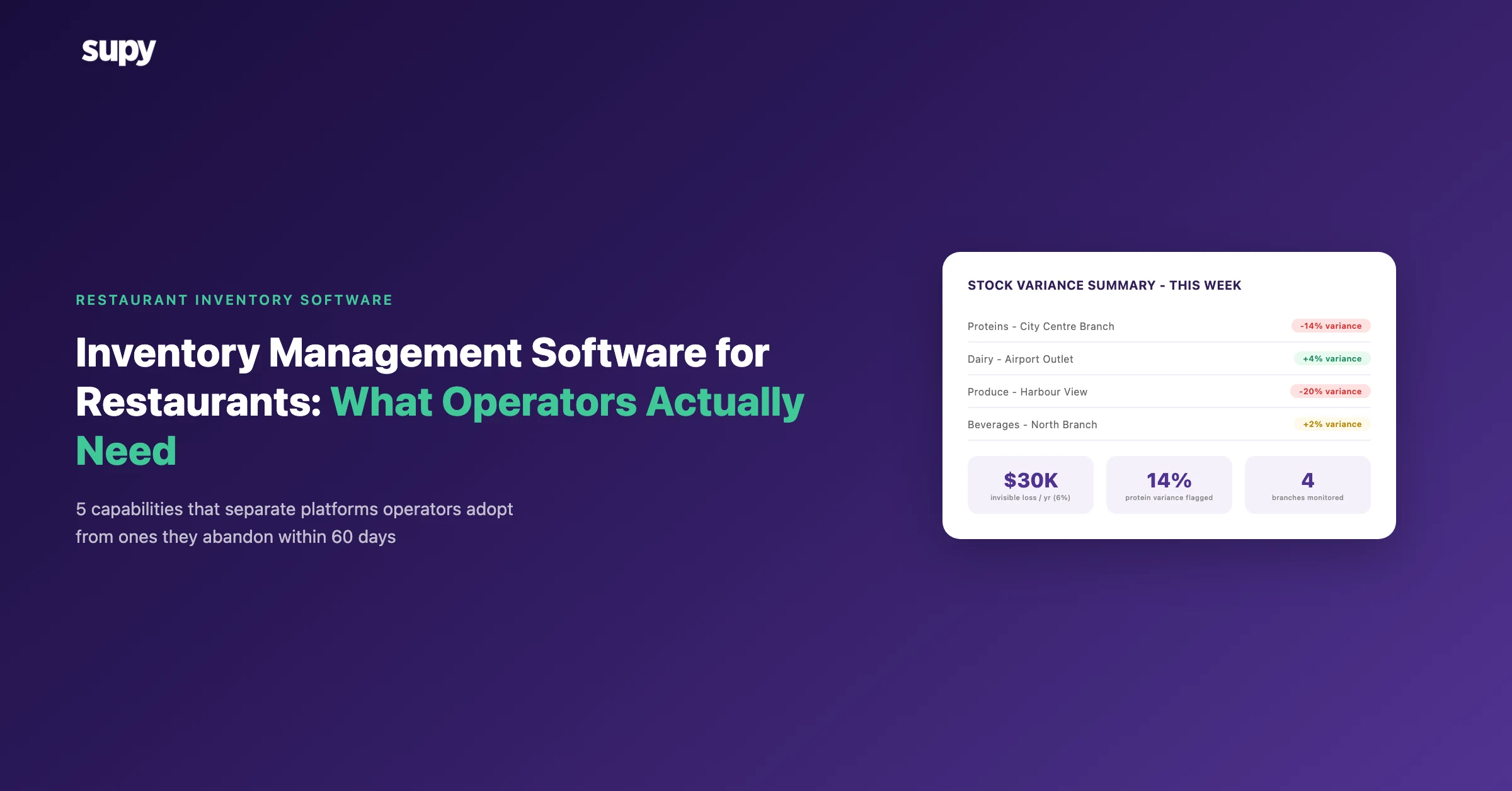
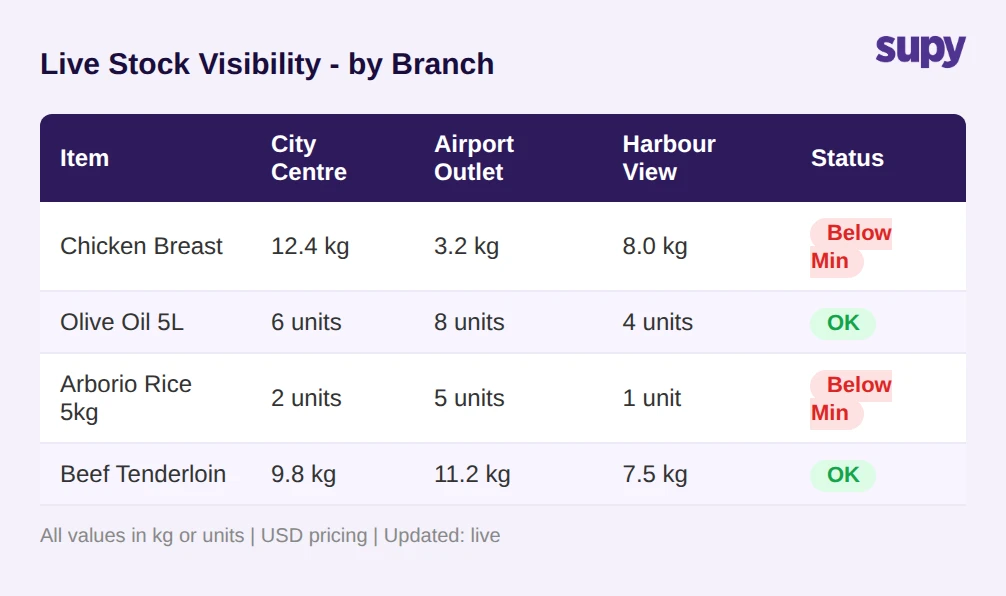
Food inventory software fixes this by giving every branch a live stock position and giving management a consolidated view across all locations. When a branch receives a delivery, stock levels update. When a recipe is sold via the POS, theoretical stock depletes accordingly. The result is a running variance between theoretical and actual usage - visible every day, not just at month-end.
For groups operating across multiple cities or formats, the ability to see which branch is running low, which has surplus, and where inter-branch transfers can prevent waste is operationally significant. It replaces a chain of WhatsApp messages and manual counts with a single source of truth.
What to ask: Can your current system tell you your actual food cost - by branch - right now, without waiting for month-end?
How Food Inventory Software Eliminates Counting Time - and Errors
Stock counting is one of the most time-consuming and error-prone tasks in any restaurant operation. Managers and kitchen staff typically spend 5-10 hours per week on physical counts - time that pulls senior people away from service, training and cost management. Food inventory software removes most of that burden by moving the entire process to mobile devices with automatic variance calculation.
A multi-location QSR group's F&B director flagged that manual counting was producing a 4-6% food cost variance monthly - equating to tens of thousands of USD per month in unrecovered margin. Not because the team was careless - but because manual counts, transcription into spreadsheets, and formula-based reconciliation introduced compounding errors at each stage. By the time variances were reconciled, the data was too stale to act on.
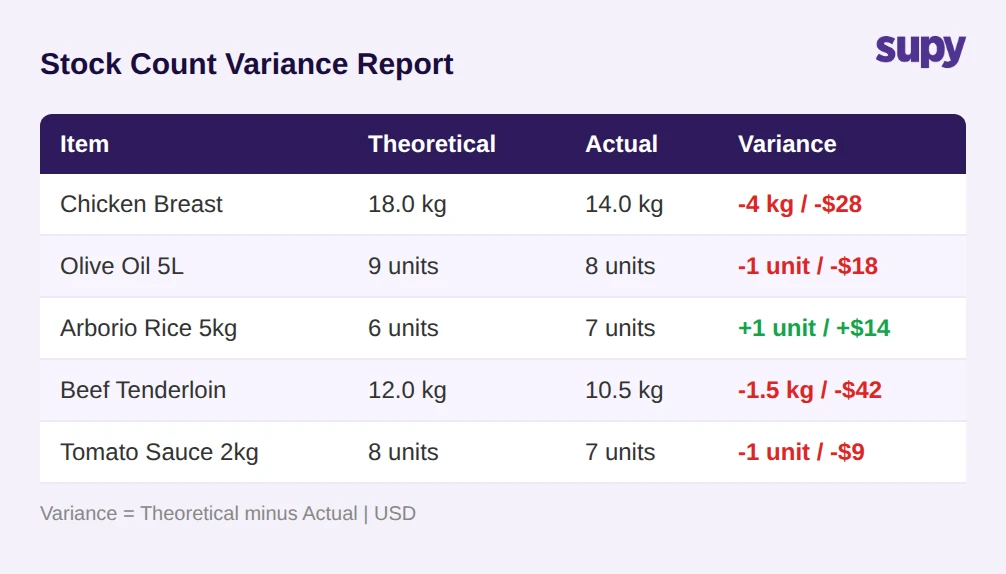
Modern food inventory software reduces count time by up to 85% by moving the entire counting process to mobile devices. The same food inventory software that records the count also compares it to theoretical usage. Critically, multiple counters can work simultaneously across different sections or locations, which means a full count can be completed in a fraction of the previous time.
The system then automatically calculates the variance against theoretical usage based on sales data pulled from the POS. Instead of a manager spending hours in a spreadsheet working out what should have been used versus what remains, that comparison is generated instantly. The output is a ranked variance report - showing where the biggest gaps are, by item, by branch.
This shift from lagging indicator to immediate feedback changes how operators respond to inventory problems. A variance identified the same day can be investigated and resolved. A variance identified three weeks later becomes a write-off.
What to ask: Does your counting process create an automatic variance report against theoretical usage, and can multiple counters work simultaneously?
Tracking Waste at Branch Level to Protect Margin
The GCC hospitality benchmark for acceptable waste variance sits at 6-7%. Operators without dedicated food inventory software routinely exceed this - not because waste is unavoidable, but because it is invisible. Without a formal waste recording process, there is no way to distinguish between portioning inconsistency, operational waste, spoilage and theft. All of it surfaces as an unexplained gap in the stock count.
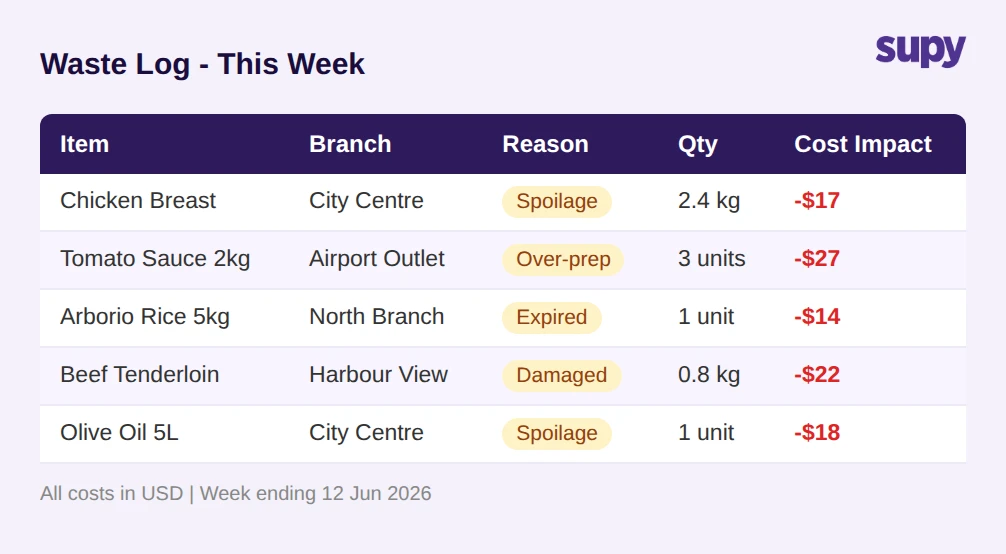
An 8-location GCC casual dining group's F&B director overseeing the rollout of waste tracking via food inventory software reported a 28% reduction in recorded waste within 90 days. The mechanism was not a new kitchen procedure - it was visibility. When kitchen teams log waste in real time through a mobile interface, tagging each item with a reason (spoilage, over-prep, damaged, expired), the data becomes actionable. Chefs can see which items are being wasted most frequently, at which branches, and on which shifts.
The scale of the problem across the region underscores why this matters. UAE food waste sits at approximately 40% of total food purchased. Saudi Arabia loses an estimated SAR 40 billion annually to food waste. These numbers include household waste, but the commercial food sector is a significant contributor - and it is the portion of the problem that operators can directly influence.
Recipe-linked waste tracking is what distinguishes effective food inventory software from a basic stock sheet. When waste is logged against a specific recipe or ingredient, the platform can separate the waste from the portioning calculation and show whether the gap in the stock count is driven by theft, over-portioning, or genuine spoilage. That distinction determines whether the response is a kitchen process change, a staffing investigation, or a supplier quality conversation.
What to ask: Can you currently separate waste from theft from portioning errors - by branch, by ingredient, by shift?
Supplier Invoice Accuracy: Why Price Drift Goes Undetected for Weeks
In manual procurement workflows - before food inventory software with AI scanning - supplier invoice processing typically involves a staff member entering line-item prices into a spreadsheet or system by hand. Price changes go undetected because there is no automated comparison against the agreed purchase order price. By the time a discrepancy surfaces - usually at month-end reconciliation - the business has already absorbed the overcharge across multiple deliveries.
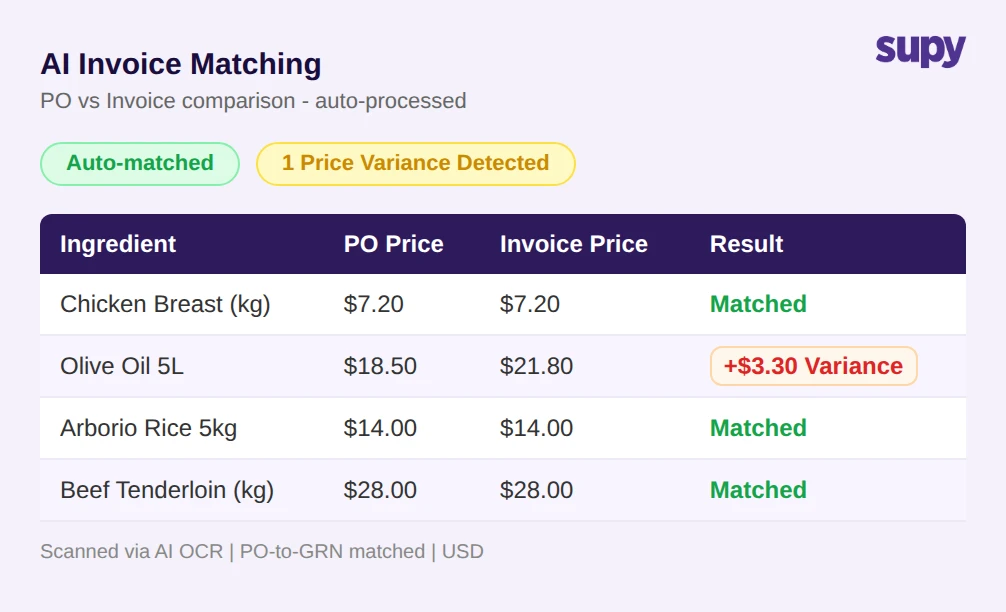
A Saudi Arabia multi-site F&B group's procurement manager described a situation where supplier price increases went unnoticed across several categories. Budget versus actual diverged by 8-12% before month-end reporting revealed the gap. The increases had not been negotiated or approved - they had simply appeared on invoices and been processed without comparison.
AI-powered invoice scanning changes this by reading supplier invoices automatically using OCR and matching each line item against the corresponding purchase order. Where the invoiced price exceeds the PO price, a variance is flagged before the invoice is approved. The buyer can then query the supplier or update the agreed price - either way, the overcharge does not enter the cost base undetected.
PO-to-GRN matching adds a second layer of control: the quantities received at the goods receipt note stage are compared against what was ordered and what was invoiced. Short deliveries and substitutions are caught at the point of receipt, not weeks later.
For multi-site operators managing dozens of suppliers and hundreds of SKUs across several locations, the time saving from removing manual invoice entry is substantial. More important is the cost saving from catching price drift when it happens rather than after the fact. This is a core financial control that food inventory software makes possible at scale.
What to ask: Does your current process automatically flag when a supplier invoices above the agreed PO price?
Inter-Branch Stock Transfers and the Phantom Variance Problem
Multi-site operators with five or more locations routinely move stock between branches - a branch running low on a key ingredient borrows from a nearby location that holds surplus. In manual systems, these transfers are often unrecorded, or recorded informally in a message thread. The result is a phantom variance: the sending branch shows a stock deficit, the receiving branch shows a surplus, and neither figure reflects reality. Food inventory software with a formal transfer module eliminates this problem entirely.
Multi-site operators with 5+ locations consistently report that inter-branch transfers are one of the leading causes of unexplained variances in their stock counts. When transfers are not formally recorded - with the sending branch deducting stock and the receiving branch adding it - the variance appears to indicate waste or loss when it is simply movement. This is one of the core problems food inventory software is designed to close.
Food inventory software addresses this through a formal transfer workflow: the sending branch raises a transfer request, the receiving branch accepts the delivery and confirms quantities, and both sides' inventory updates automatically. The process creates a named approval trail for every transfer - who requested, who approved, what was sent, what was received.
For groups running high-volume kitchens, the audit trail has value beyond accounting accuracy. It enables management to see which branches are consistently running short, which are overstocking, and where purchasing behaviour needs to be adjusted. Transfers stop being an uncontrolled workaround and become a managed part of the supply chain. Food inventory software makes that governance possible without adding administrative overhead.
What to ask: When stock moves between your branches, does both sides' inventory update automatically - with a named approval trail?
How Supy Connects Inventory, Procurement and Sales in One Platform
Supy is an inventory management platform built specifically for multi-site restaurant and hospitality groups in the GCC and beyond. It connects purchasing, receiving, stock counting, waste recording and sales data in a single system - with 75+ POS and ERP integrations ensuring that sales data flows directly into inventory calculations without manual entry.
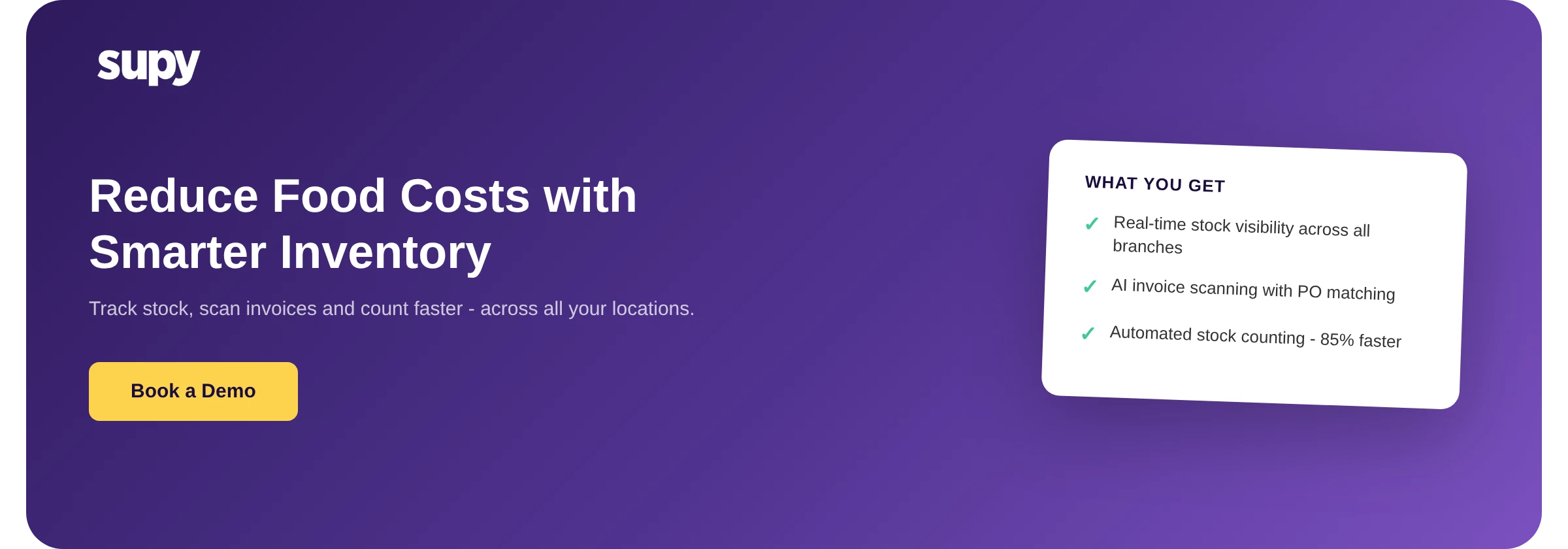
The platform's core capabilities cover the full inventory cycle. Live Stock Visibility gives operations teams a real-time view of stock levels across all branches, with automated depletion based on POS sales and instant alerts when items fall below minimum par levels. Stock Counting runs on mobile devices and supports parallel counting across sections and locations, with variance reports generated automatically on submission - cutting count time by up to 85% compared with manual processes.
Wastage Recording enables kitchen teams to log waste in real time against specific recipes and reasons, giving management branch-level waste data rather than an aggregate figure. AI Invoice Scanning reads supplier invoices automatically, matches each line to the corresponding PO, and flags price variances before approval - removing manual entry and catching overcharges at the point of processing. Inventory Transfers use a receiver-accept workflow so that inter-branch movements update both sides' stock automatically, with a full audit trail.
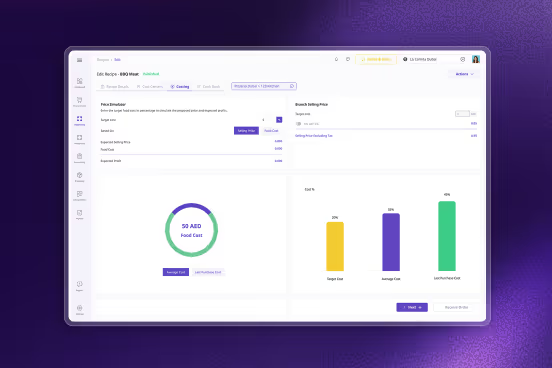
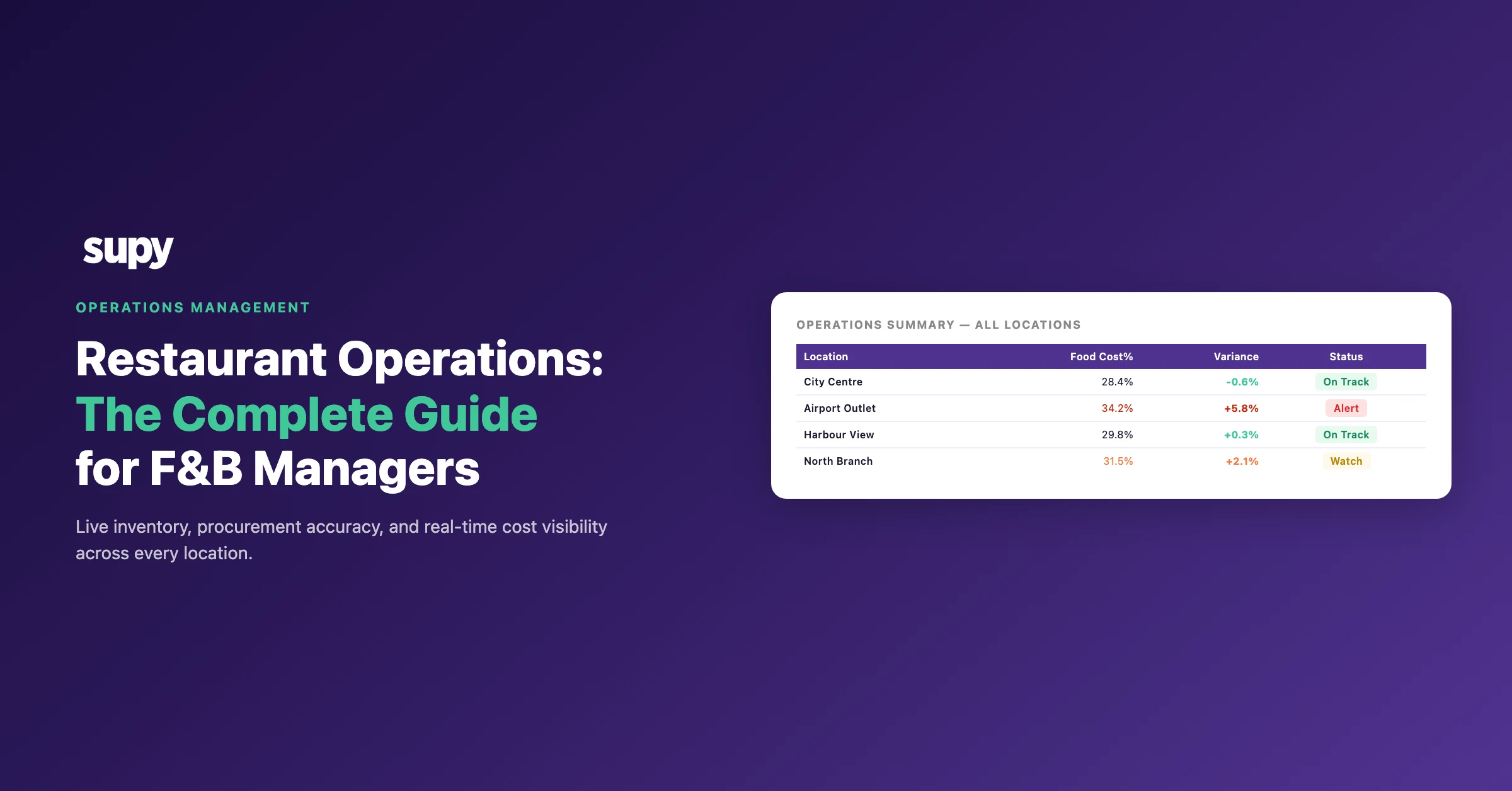
Additional capabilities include AI Predictive Ordering, which generates purchase recommendations based on historical usage and upcoming demand; Fill to PAR ordering that calculates the exact quantity needed to reach target stock levels; and Interactive Dashboards that give finance and operations teams a consolidated view of food cost, variance, and waste across the group.
Groups using Supy have reported up to 80% reduction in food cost variance, up to 55% reduction in overall food cost, and up to 10 hours per week reclaimed from manual counting and administrative tasks.
Ready to see what that looks like for your operation? Book a demo at supy.io/book-a-demo and see how Supy's food inventory software performs across your specific locations and formats.
What to ask: Does this food inventory software connect to your existing POS, handle multi-site counting, and give you a live food cost view - without a six-month implementation?