.jpg)

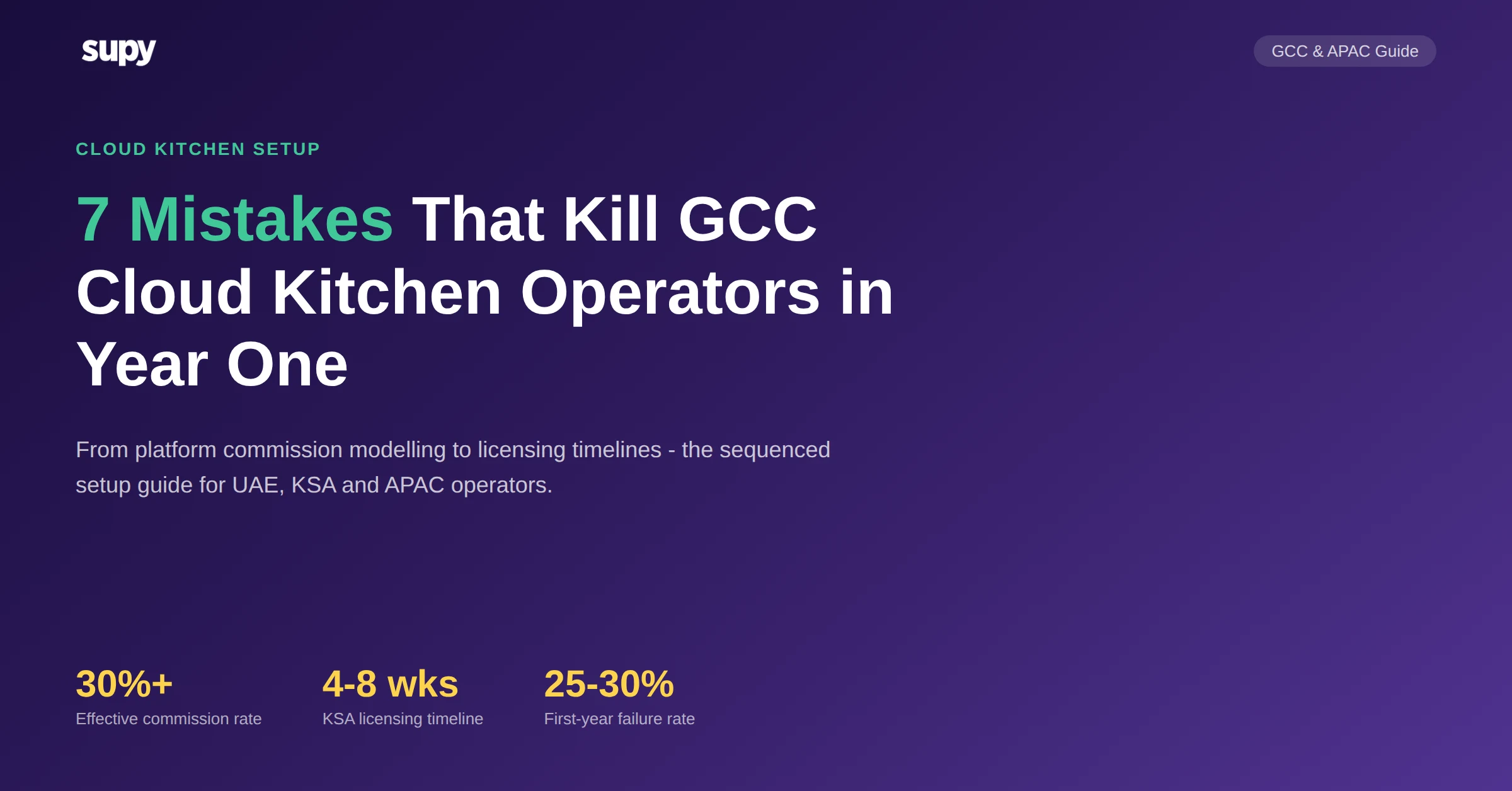
Cloud Kitchen Setup: The 7 Mistakes That Kill GCC Operators in the First Year
Mistake 1: Modelling Headline Commission Rates Instead of Effective Rates
Aggregator commission structures in the GCC and APAC have become significantly more complex than a single percentage. Talabat, HungerStation, Deliveroo, and their regional peers charge a base commission - typically 15-20% - but then layer on additional fees: online payment processing charges, mandatory participation in promotional periods, co-funded discounts to the end customer, and required packaging upgrades.
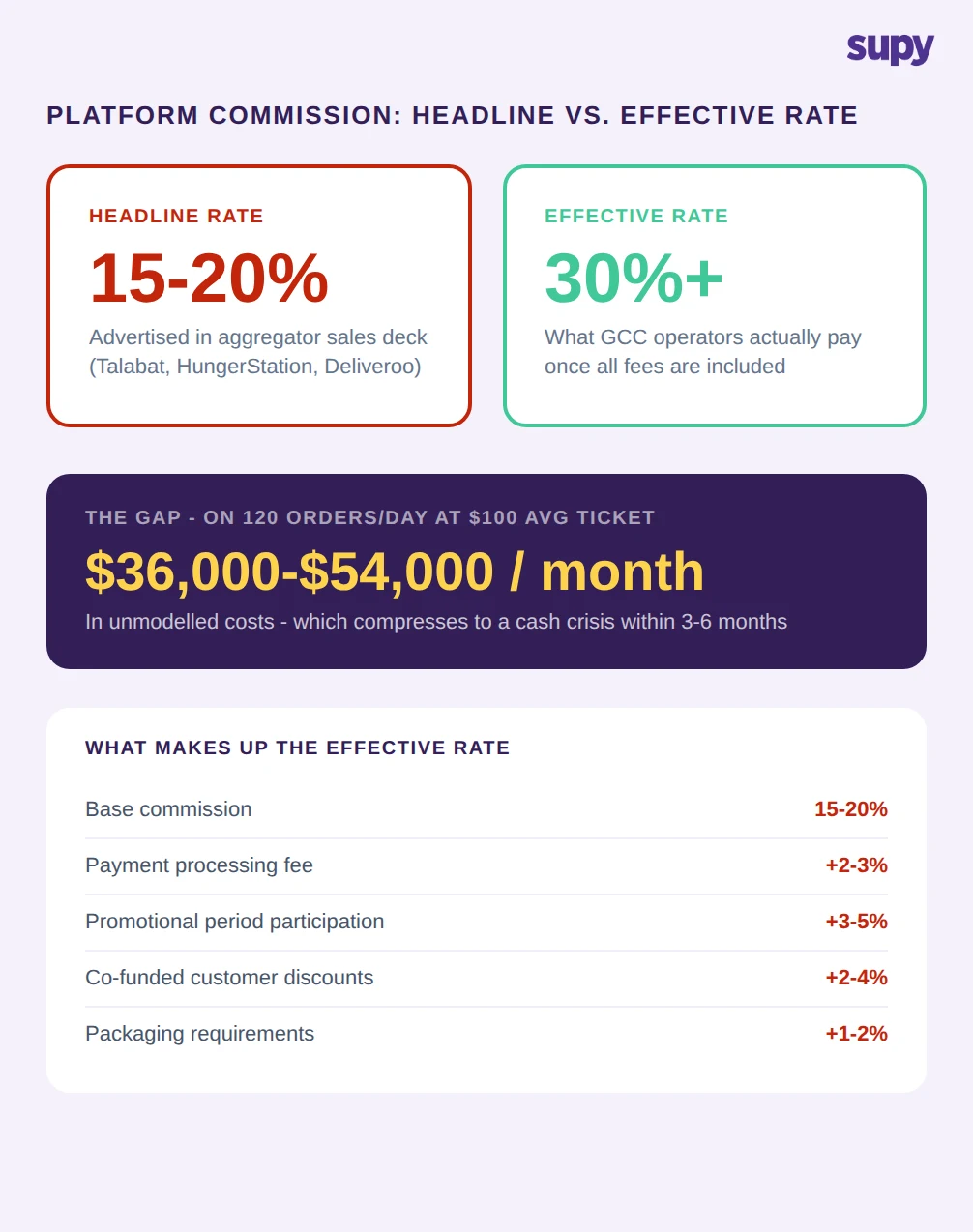
Before signing with any aggregator, get a unit economics breakdown from an existing operator on that platform in your market. Request a detailed invoice history, not a rate card. Model conservatively using a 30%+ effective rate and test whether your menu pricing still generates target margins at that cost. If it does not, adjust pricing before launch - aggregators will resist pricing changes after you have customer reviews and rating history, because price increases visibly appear to customers who have ordered from you before.
For multi-brand operators running four or more virtual brands from a single kitchen, this commission exposure is multiplied. Each brand on each aggregator carries its own fee structure. A consolidated view of commission cost by brand - not just total revenue - is essential from day one.
Ask: what is the effective rate this platform charges operators in my cuisine category, at my expected order volume, including all fees and mandatory promotions - not just the headline rate in the sales deck?
Mistake 2: Buying Equipment Before Engineering the Menu
The $40,000-$200,000 equipment procurement decision is made correctly only after menu engineering is complete, not before. The sequence most operators get wrong: they lease the kitchen space, inventory the equipment included, then build the menu around what they have. Or they build the menu first but procure equipment before finalising recipes, then discover the final recipe set requires a different configuration.
Menu engineering for a cloud kitchen is a distinct exercise from a dine-in restaurant. Delivery packaging, transit time, and reheating behaviour all affect which dishes work on an aggregator platform. Items that photograph well but arrive cold are not viable. Items with short preparation windows and reliable hold times are. Your equipment list should be derived from the finalised recipe set - not the other way around.
For GCC operators specifically: factor in the climate impact on cold chain delivery. Packaging standards required to maintain food quality across typical delivery distances in Dubai, Riyadh, or Singapore are more demanding than in temperate markets. The cost of packaging that meets these standards is a recurring cost that belongs in the menu engineering model, not discovered as an afterthought.
Ask: is the recipe set finalised, including portion yields, packaging requirements, and cold chain hold times - or am I about to spend $40,000-$200,000 on equipment for a menu that will change after I have opened?
Mistake 3: Ignoring GCC Licensing Timelines
Cloud kitchen licensing in Saudi Arabia involves at minimum three separate regulatory bodies: MISA (Ministry of Investment) for commercial registration, the municipality for the food establishment permit, and SFDA (Saudi Food and Drug Authority) for the food safety certification. The combined timeline for a new entity with no prior Saudi registration runs 4-8 weeks under normal circumstances - and SFDA inspections are unannounced and can trigger a re-inspection cycle if standards are not met on the first visit.
Operators who plan a launch date without accounting for this sequence regularly find themselves with a fitted kitchen, hired staff, and aggregator accounts approved - but no license to operate. Every week of delay at that point costs the full fixed overhead of the operation: rent, labour, loan repayments.
In the UAE, the licensing pathway is faster but still requires coordination between the DED (Department of Economic Development), the relevant emirate municipality for food handling, and the aggregator's own merchant onboarding process. Allow a minimum of three weeks in Dubai; licensing in other emirates can be longer.
Singapore's NEA (National Environment Agency) food establishment license typically takes two to four weeks, but the kitchen premises must pass a hygiene inspection before the license is issued - which means the fit-out must be complete before the application can be approved. Build licensing timelines into your launch schedule as a dependency, not as a parallel track.
Ask: does my launch date account for 4-8 weeks of licensing in Saudi Arabia, or am I planning to run those applications concurrently with the fit-out on the assumption they will clear in time?
Mistake 4: Choosing the Wrong Location Based on Rent Alone
Cloud kitchen site selection in GCC and APAC markets involves a trade-off that does not exist in dine-in: you need proximity to high-density delivery demand zones, but the spaces closest to those zones carry the highest rents - which eliminates the cost advantage that makes a cloud kitchen viable in the first place.
The resolution is aggregator heatmap data. Talabat, Deliveroo, and HungerStation all have merchant onboarding teams who can share demand density data for specific postcodes. Request this data before signing a lease. What you are looking for is not just high demand volume but demand that is not already saturated by competing kitchens in your cuisine categories - because aggregator algorithms give priority placement to kitchens with strong ratings and high acceptance rates, and entering a saturated zone means fighting for visibility from a weaker starting position.
Peripheral sites with lower rent but poor delivery density generate low order volumes and low ratings - because customers who do order face longer delivery times, which drives lower satisfaction scores regardless of food quality. Once your rating falls below the 4.5+ threshold required for prominent algorithmic placement, recovery is slow and expensive. The rent saving is not worth the rating damage.
Ask: have I requested aggregator demand heatmap data for my specific postcode - and does that data show unsaturated demand in my cuisine category, or am I entering a zone where established kitchens already hold the rating advantage?
Mistake 5: Launching with a Disconnected Technology Stack
The technology errors that cost cloud kitchens the most are not complex. They are the basic integrations that should be connected at launch and are not: the POS is not linked to the KDS, so orders arrive at the kitchen without the modifiers attached. The inventory system is not receiving sales depletion from the aggregator platforms, so stock levels are updated manually at the end of each shift - which means mid-service stockouts are not caught in real time. Supplier orders are placed by phone and tracked in a spreadsheet.
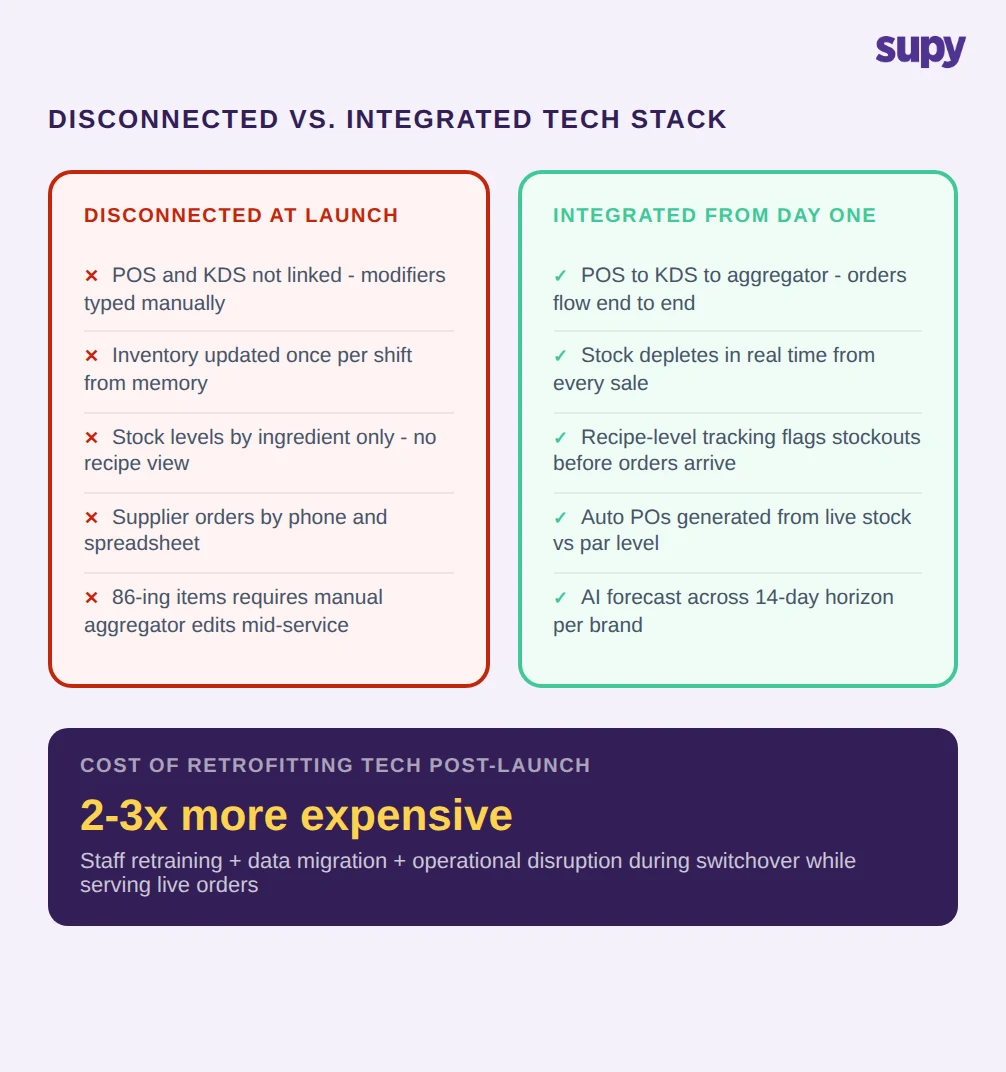
Fixing this post-launch costs 2-3x what it costs at setup. You are not just configuring software - you are retraining staff, migrating historical data, and managing operational disruption during the switchover while continuing to serve live orders. Getting integration right at setup requires defining the technology requirements before procuring equipment or hiring kitchen staff, because system configuration determines workflows, and workflows determine staffing.
The minimum viable integrated stack for a cloud kitchen: a POS system connected to your aggregator management platform so orders flow in without manual re-entry; inventory software that receives real-time stock depletion from sales, records wastage at the item level, and alerts when stock drops below par level; and a procurement module that generates purchase orders from stock levels rather than from memory. Restaurant inventory management connects all three inputs - POS depletion, goods received, and wastage - into a single real-time stock position.
Ask: can I demonstrate that orders placed on each aggregator platform will deplete the correct ingredients in real time on launch day - or will my team be updating stock counts manually between service periods?
Mistake 6: Running Multiple Brands Without Recipe-Level Inventory Tracking
Multi-brand cloud kitchen operations have a specific inventory failure mode that single-brand operators do not face: shared ingredients are consumed across multiple active menus simultaneously, and without recipe-level tracking, the stock model breaks down under peak load.
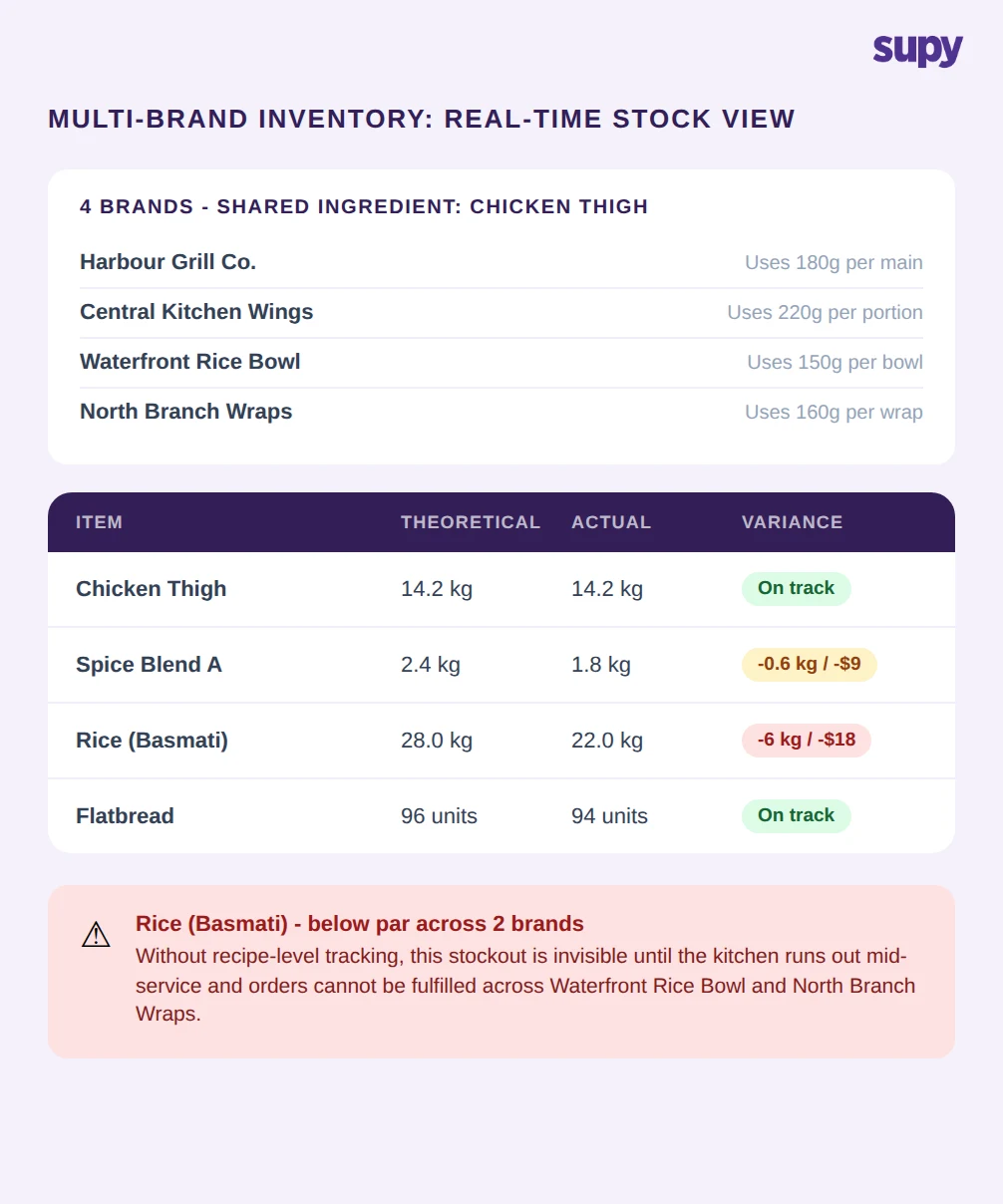
The scenario: it is a Friday evening and three of your four virtual brands are running simultaneously on Talabat. Brand A and Brand C both use the same chicken thigh cut. Brand B uses the same spice blend as Brand D. The kitchen runs out of chicken thighs mid-service. The inventory system shows stock remaining because it is tracking total chicken intake, not recipe-level depletion per menu item per brand. The kitchen team cannot 86 the affected items in real time on the aggregator platforms without manual intervention - and during peak service, that intervention is delayed. Orders continue to arrive for items the kitchen cannot fulfil. Cancellations drive down acceptance rates and rating scores.
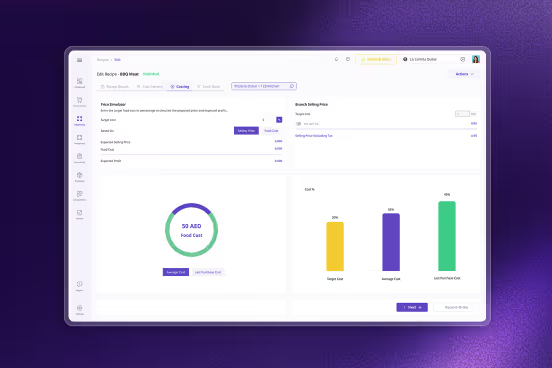
Recipe-level inventory tracking - where each sale automatically depletes the exact ingredients at the exact quantities specified in the recipe - is not optional for multi-brand operations. This also applies to prep recipes. If your brands share semi-finished components - a sauce, a marinated protein, a pre-portioned base - those prep recipes need to be in the system with their own ingredient depletion chains, or the tracking breaks at the prep stage.
Ask: if three brands run concurrently during peak, does my inventory system know which shared ingredients have been consumed per brand - or does it only know total usage at the end of the shift?
Mistake 7: Scaling Without Standard Operating Procedures
Cloud kitchens lack the natural quality feedback loop of a dine-in restaurant. There is no table service team observing plate condition. No manager walking the floor. No customer complaint delivered in person within minutes of it occurring. Quality degradation accumulates in silence - visible only in the rating score that trends downward over weeks, by which time the cause is difficult to isolate.
The mechanism is usually the same: the founding chef or kitchen manager is present during the first months and maintains quality through direct supervision. As order volume increases, more staff are added. Without documented SOPs covering portion weights, plating standards, packaging procedures, and quality checks before dispatch, each new hire recreates the method from observation rather than from specification. Variation compounds. Ratings fall.
SOPs for a cloud kitchen are not a bureaucratic exercise - they are the only mechanism for quality consistency at scale in an environment without customer-facing staff. They should be written before the first hire, not after the first rating complaint. The cloud kitchen technology stack guide covers the systems that make SOPs enforceable across multi-brand operations, including how recipe standardisation in your inventory system enforces portion consistency at the item level.
Ask: if I doubled my kitchen staff tomorrow, would the second cohort produce identical output to the first - or does consistency depend on who is working?
The Setup Sequence That Avoids All Seven
The correct sequence is not complicated, but it requires committing to it before the more exciting decisions - branding, interior, aggregator negotiations - pull attention away from the foundations.
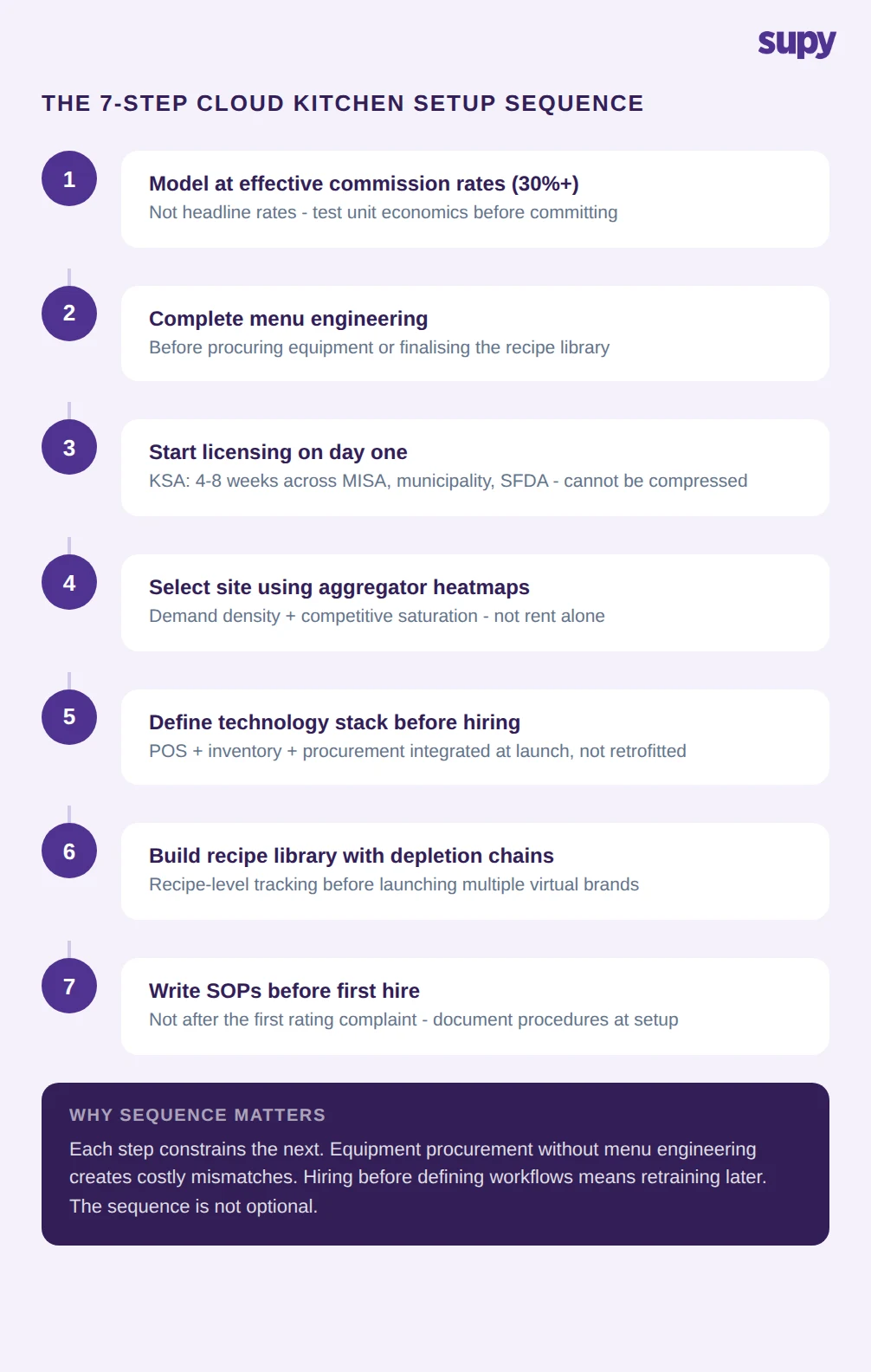
Cloud kitchen operators who follow this sequence avoid the cash flow crises, the mid-service stockouts, and the rating degradation that drive the 25-30% first-year failure rate in GCC and APAC markets.
Supy supports cloud kitchen operators from launch through scale - real-time inventory across all brands and locations, AI-powered demand forecasting across a 14-day horizon, recipe-level depletion tracking, and 75+ integrations with the POS and aggregator systems already in your stack. For operators evaluating platforms built for multi-brand cloud kitchen operations, see Supy's cloud kitchen inventory management.