.jpg)
The Pizza Express Finance Playbook: Scaling to 500 Restaurants Without Chaos
Watch extracts
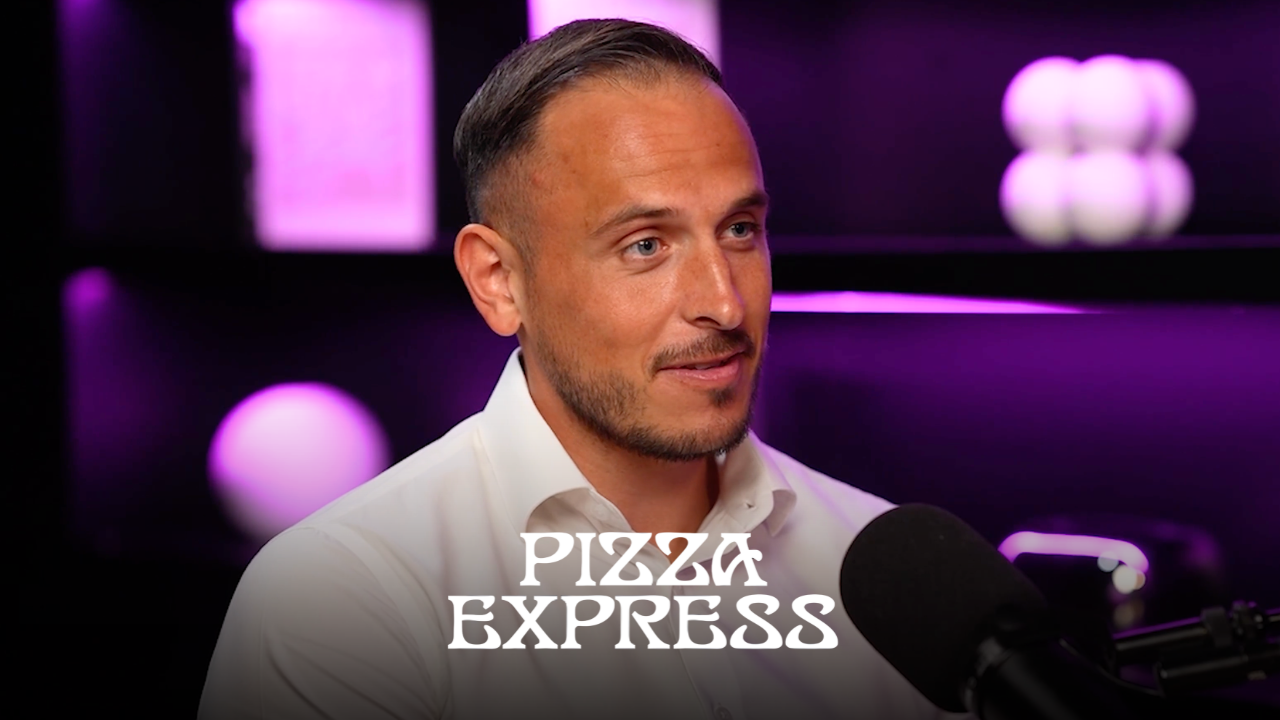
Guest & host

Episode Summary
Most restaurant brands that look effortless from the outside are held together by financial discipline, strategic trade-offs, and decisions that guests never see. Pizza Express - with 500 restaurants across the globe and a target of 1,000 - is no different.
In this episode, Dan Jarvis, Head of Finance at Pizza Express UAE, sits down with Karin to pull back the curtain on what running the finances of one of the world's most recognisable restaurant brands actually looks like. Dan joined the company six years ago after a career that started as a school leaver in a small local firm, moved through one of the big London firms, and eventually brought him to Dubai in 2018.
The conversation covers the cash flow system Pizza Express runs every single week without fail, the menu engineering matrix they use to decide what stays and what goes, why they deliberately turn off delivery on their busiest days, and the one tomato supplier in Naples who has been supplying every Pizza Express in the world since the very first restaurant opened in Soho in 1965.
From fixed labor costs in the UAE to the beach club salary war, from the four-scenario model used before every new restaurant opening to the Q4 test that tells you whether a location will ever work - this is one of the most practical and entertaining conversations about restaurant finance you will hear.
Learnings From The Episode
Dan Jarvis has spent six years keeping one of the world's most iconic restaurant brands financially healthy across multiple markets and hundreds of locations. Every lesson here was earned on the floor - or in the weekly cash flow forecast.
You can be the most profitable restaurant in the world and still go broke
Profit and cash are not the same thing. This is the lesson that sits at the heart of everything Dan does at Pizza Express - and it's the one he believes most operators underestimate until it's too late.
Pizza Express runs a detailed cash flow forecast every single week. Every expense is accounted for: payroll dates, supplier payment terms, quarterly and annual rental checks, gratuity costs, capital expenditure for new openings. Not because the business is in trouble, but because a single month where a million-dirham rent payment lands on the same day as payroll can create a crisis even in a healthy, profitable business.
The lesson: revenue tells you how you're doing. Cash flow tells you whether you can keep going.
Saying no to revenue is sometimes the most profitable decision you can make
During Friday brunch at Pizza Express, when the restaurant is serving 300 to 400 guests simultaneously, they turn off delivery. Completely. On purpose.
In theory, delivery should be incremental revenue - the restaurant is already open, the staff are already there. But when the kitchen cannot physically cope with both, forcing it through means longer wait times, worse food, and online complaints. The short-term revenue gain creates long-term retention damage.
The same logic applies to expansion. Dan's view is simple: if you say yes to every opportunity without the cash reserves to support it, the golden pot runs dry very quickly. The ability to say no - to a revenue stream, to a new site, to a market - is a financial discipline as important as any spreadsheet.
Menu engineering is not a once-a-year exercise - it's an ongoing conversation between data and instinct
Pizza Express runs menu engineering two to three times a year. Every single item on the menu is placed into a matrix: how popular is it, and what margin does it generate? The results drive decisions on pricing, promotion, and removal.
But Dan is clear that the process is not purely financial. A dish might be underperforming because guests genuinely don't want it - or because nobody on the floor is talking about it. A price increase on a popular item might be absorbed without any drop in demand - or it might be the thing that tips a regular into trying somewhere else.
The qualitative feedback from restaurant managers is what gives the numbers context. The data points in the direction. The people on the floor tell you whether to follow.
Before every new restaurant opening, build four scenarios - and make the worst case feel like Armageddon
When Pizza Express evaluates a new restaurant opening, Dan builds four financial scenarios: expected, best case, break-even, and worst case. The worst case is not a conservative estimate. It is, in his words, Armageddon - the scenario where everything that can go wrong does go wrong.
The point is not pessimism. It is preparation. If the business can survive the Armageddon scenario - if there is enough cash to pay staff, pay suppliers, and keep the lights on even in the worst possible outcome - then the decision to open is financially defensible.
This model forces honest conversations before a single dirham is committed, rather than after the lease is signed and the fit-out is underway.
If it's not working in Q4 in Dubai, it's not going to work
Dubai has a natural rhythm. Q4 - October through December - is when the city is at its busiest. Tourists arrive, residents return, events fill the calendar, and restaurant footfall peaks. If a restaurant cannot perform during this window, when every possible condition is in its favour, the case for keeping it open becomes very hard to make.
Dan's approach: if a location is underperforming heading into Q4, run a focused marketing campaign during the busiest period of the year. If that doesn't move the needle, cut your losses. Waiting for a quieter month to turn things around is not a strategy.
The same logic applies to seasonality planning more broadly. Ramadan, summer, January - these are predictable dips that should be in the forecast from day one, not surprises that catch the cash flow off guard.
Ready to optimize your restaurant operations?
More stories from F&B leaders
.png)


.png)
.png)
.png)
.png)
準備好轉變您的營運了嗎?
加入3500多家餐廳營運商的行列,透過Supy削減成本、簡化營運並做出更明智的決策。
