.jpg)


從達美樂送貨司機到首席營運官
.png)
Watch extracts
Guest & host

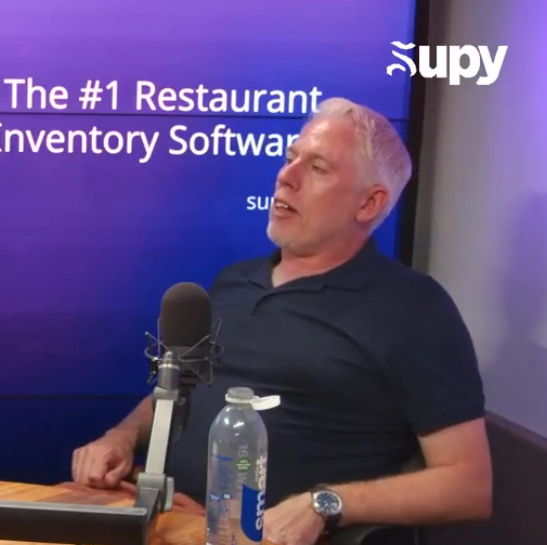
Episode Summary
Chris Daniels has spent over 30 years in QSR, starting as a teenage delivery driver at Domino’s and working his way up to COO of a 43-store franchise group. In between, he’s led iconic brands like Freedom Pizza in Dubai, built virtual kitchen operations for Delivery Hero in Europe, and helped launch a new delivery platform at The Entertainer.
In this episode, Chris shares the systems, metrics, and leadership philosophies behind fast, profitable QSR operations. From the “Valentine’s Day Massacre” (when Two-for-Tuesday collided with Valentine’s Day and crashed the system), to a $40k chicken shipment that got rejected at port, he’s brutally honest about what it really takes to scale from a single shop to 40+ locations without losing speed, quality, or your team.
Learnings From The Episode
Chris’s story is all about combining tight operational discipline with real-world empathy for the people doing the work. Here’s what he’s learned on the way from driver to COO.
From delivery driver to Europe’s fastest pizza maker
Chris didn’t plan a career in pizza – he was a machinist engineer who picked up delivery shifts at Domino’s to earn extra cash. Once he saw a clear path to progress, he leaned into every opportunity:
- Put his hand up for tough roles (like running a notoriously difficult store in a rough part of Nottingham at 18).
- Entered – and eventually won – Domino’s “fastest pizza maker” competition, producing 14 pizzas in 3 minutes and later becoming Europe’s fastest pizza maker.
- Used that visibility and performance to move into area and regional roles by his early 20s.
The through-line: say “yes” to scary opportunities and prove yourself where others don’t want to go.
The Valentine’s Day Massacre: when demand breaks your systems
One of the most chaotic nights of his career came when Two-for-Tuesday and Valentine’s Day landed on the same day. Domino’s ran buy-one-get-one-free on pizzas and desserts. By early evening:
- Sales were already double a normal Tuesday.
- Stores were hundreds of pizzas behind.
- The POS systems literally crashed under the order volume.
IT had to wipe unknown batches of orders, and teams spent the evening firefighting and fielding “Where’s my pizza?” calls. The lesson:
- Promo mechanics + peak days + system limits must be modelled together.
- Just because the marketing idea sounds great doesn’t mean your operation or tech can handle it.
The $40k chicken disaster: managing supplier and regulatory risk
At Freedom Pizza in Dubai, Chris took on procurement and commissary responsibility for the first time. One painful episode stands out:
- A refrigerated container (“reefer”) arrived with 15 tonnes of chicken tenders (~$40k in stock).
- A change in halal preparation rules meant the shipment no longer met requirements.
- Despite weeks of lobbying and meetings “up the chain”, the container was ultimately sent back and destroyed.
Takeaways:
- Regulatory changes can invalidate a whole category overnight – someone in your team must track this proactively.
- For critical SKUs, you need risk mitigation: alternative suppliers, diversified sourcing, and clearer documentation.
- In supply chain, “we’ve always done it this way” is not a defense – law trumps precedent.
Designing QSR kitchens for speed, not theatre
Chris is ruthless about kitchen layout and flow:
- Today, ~90% of Domino’s orders are digital, so giant phone banks and walk-in order stations are dead space.
- New stores shrink the front-of-house order area and invest that space in a tight, efficient production line.
For Domino’s, the kitchen is built around a circular flow into and out of the conveyor oven. Principles he uses:
- Minimal steps: team members should be able to reach everything they need with tiny movements, not laps around the kitchen.
- Specialised stations: when it’s busy, people should mostly stand still and let the work flow through them.
- Layout follows data: watch busy services and move equipment or ingredients to remove friction, not to look pretty on a drawing.
Why menu simplification beats “paradox of choice”
One of Chris’s most powerful levers has been simplifying the menu:
- Items like Double Decadence bases sold only a handful per day but blocked the make-line and disrupted rhythm.
- Half-and-half pizzas on small and medium sizes caused quality issues and lower satisfaction scores, so they’re now limited to large.
The impact:
- Faster make times and fewer bottlenecks on a busy Friday night.
- Less mental load for teams and better product consistency.
- Higher guest satisfaction because the menu is easier to navigate and the product quality is more reliable.
The metric he uses to keep labour efficient
Labour is the biggest controllable cost line in his P&L, so he anchors it to a simple, operational metric:
Orders per man-hour (OPMH).
He tracks:
- Total orders vs total hours worked (in-store + delivery).
- A target of >2 orders per man-hour, with a recent improvement of ~12%.
Despite rising minimum wage, improving OPMH has:
- Reduced labour cost as a % of sales.
- Improved delivery times (average ~23.5 minutes from order to door across 43 stores).
- Given teams a clear, intuitive efficiency metric they can understand and influence.
Working with aggregators: if you can’t beat them, partner properly
After building an aggregator at The Entertainer and later joining Delivery Hero (owners of Talabat), Chris is realistic about delivery apps:
- Aggregators have the eyeballs, especially with younger guests who don’t want 10 different brand apps on their phone.
- They’re not going away – they’re moving into profitability and have deep marketing pockets.
His advice for operators:
- Treat aggregators as a channel partner, not the enemy.
- Obsess over ratings, reliability, and uptime – if you’re often offline or delivering lukewarm food, your ranking will tank and recovery is hard.
- Build an aggregator strategy that complements your own channels, not one that cannibalises your on-premise experience.
Scaling from 5 to 50 sites: focus on your #2s and #3s
What gets you from one to five sites won’t get you to 50. Chris sees a common pattern:
- Founders and GMs focus all attention on today’s best people in the top job.
- But the real constraint is the next layer: supervisors, assistant managers, future area managers.
If they’re not being trained, stretched, and developed deliberately, each new site is weaker than the last. His playbook:
- Invest heavily in the “bench” – your number twos and threes.
- Make sure they can replicate what made the first sites successful, not just “get by”.
- Accept that scaling without that layer just spreads mediocrity faster.
Culture and leadership: you’re in the people business, not the pizza business
One quote that shaped Chris’s leadership comes from Domino’s founder Tom Monaghan:
“I’m not in the pizza business, I’m in the people business.”
Chris applies that by:
- Spending Friday and Saturday nights in stores, apron on, making pizzas shoulder-to-shoulder with the team.
- Expecting area managers and support staff to do the same – if you’re above store level, you’re there to support stores, not sit in the back office.
- Building a professional team, not a “family”: high standards, clear roles, but genuine camaraderie and mutual support.
The result: significantly better staff retention, less churn, and a stronger culture in an industry notorious for high turnover.
His hardest-earned leadership lesson: own your mistakes
If he had to pick one lesson he’ll never forget, it’s this:
Own your mistakes quickly and openly.
- Don’t waste days or weekends worrying about how bad it will look – that’s lost time you could spend fixing the problem.
- Put your hand up, explain what happened, and shift the conversation to solutions.
- Create a culture where your team knows they won’t be screamed at for honest errors – they’ll be expected to learn from them.
In fast-moving operations and tech-heavy environments, there’s no end state where everything is “finished”. Things will break. What matters is how fast you surface the issue, what you learn, and how you improve the system next time.

Ready to optimize your restaurant operations?
More stories from F&B leaders
.png)
.png)
.png)
.png)
.png)
.png)
.png)
.png)
.png)
.png)
.png)
.png)
.png)
.png)
.png)
.png)
.png)
.png)
.png)
準備好轉變您的營運了嗎?
加入3500多家餐廳營運商的行列,透過Supy削減成本、簡化營運並做出更明智的決策。
