Food Safety Fridge Storage: Where Everything Goes in a Kitchen Fridge

Where each food goes in a kitchen fridge, shelf by shelf
Food safety in a kitchen fridge comes down to two habits: store everything in cooked-down order, and check the temperature every night. Ready-to-eat food goes on top, raw meat and poultry at the bottom, so nothing raw drips onto food you serve as it is. Keep the fridge at 8°C or below. This article shows the storage order, the temperatures the rules set, the fix for a warm reading, and how to keep records across sites.
The lower a food sits, the higher the temperature it needs to reach to be safe. So store raw poultry at the bottom and keep ready-to-eat food on top, clear of any raw juices. Use the same order in every fridge, so the team stocks each one the same way.
| Shelf | What goes there | Why it sits here |
|---|---|---|
| Top shelf | Ready-to-eat food: cooked dishes, desserts, washed salad, garnishes | Nothing above it can drip onto it |
| Middle shelves | Dairy, eggs, cooked and cured meats | Cold and clear of raw drips |
| Lower shelf | Raw fish and shellfish | Below ready-to-eat food, above raw meat |
| Bottom shelf | Raw meat and poultry | You cook off anything that drips from it |
| Fridge door | Condiments and drinks | The warmest spot, so nothing high-risk goes here |
The fridge and freezer temperatures the rules set
A business fridge holding chilled food must stay at 8°C or below, the legal maximum in England, Wales and Northern Ireland and the recommended limit in Scotland. The Food Standards Agency recommends going lower, to 5°C or below, for headroom. A freezer should run at -18°C or below.
Between 8°C and 63°C sits the danger zone, where most bacteria grow. Chilled food belongs below it, hot-held food above it. These limits are the UK figures at the time of writing, taken from the Food Standards Agency; confirm them with the Food Standards Agency before you rely on them.
| Equipment | Temperature | The rule |
|---|---|---|
| Fridge, chilled food | 8°C or below | Legal maximum in England, Wales and Northern Ireland; the FSA recommends 5°C or below |
| Freezer | -18°C or below | FSA guidance for frozen storage |
| Danger zone | 8°C to 63°C | Where most bacteria grow, so chilled food stays below it |
What to do when a fridge reads too warm
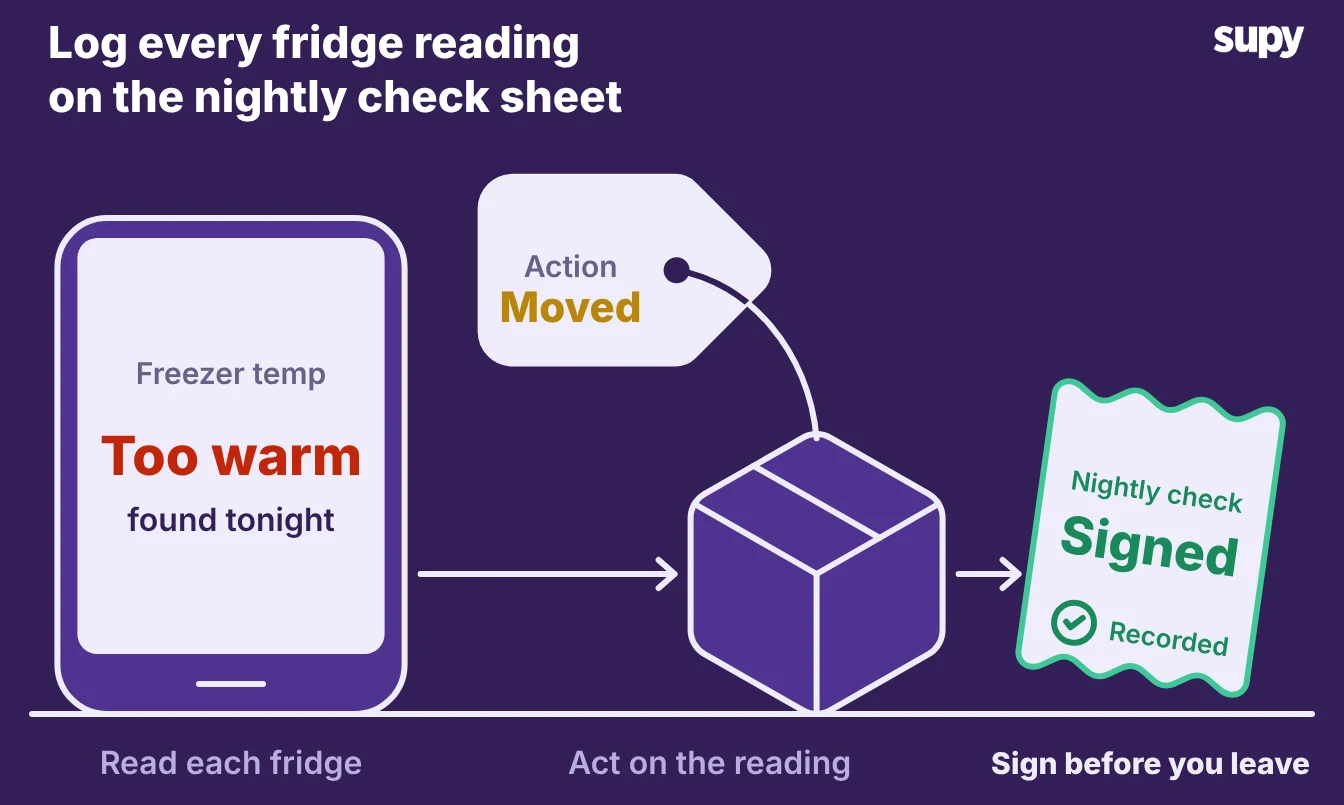
A warm reading is only a problem if nobody acts on it. When a fridge reads above the limit, check the temperature of the food inside before you decide anything, because the air warms faster than a full shelf of stock.
Work it in order:
- Read the core temperature of the food, not just the air, with a clean probe.
- If the food is still at or below the limit, move it to a fridge that works and get the unit repaired.
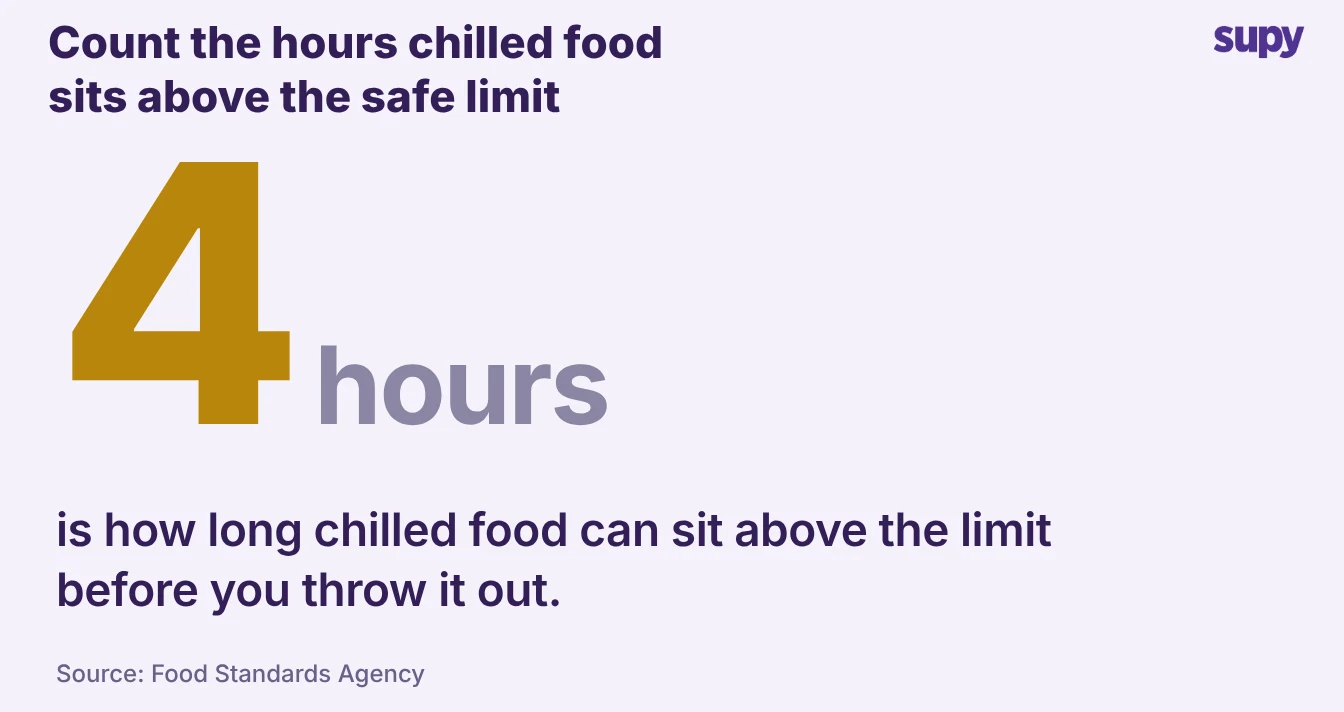
- If it has been warmer, follow the power-cut rule. Throw away chilled food that reaches 8°C or above after 4 hours, unless power returns first.
- Record the reading, what you did and the time, so the next shift and any inspector can see the decision.
You run the check to catch a real problem before it reaches a plate. A fridge that is down, a reading too high, or food near its use-by date all show on the nightly walk. A reading nobody follows up is the same as no reading at all.
The nightly fridge check, step by step
Turn the nightly walk into a fixed check, so it takes minutes and never gets skipped. In many kitchens a staff member already walks every fridge and storage area each night to count stock. Adding a short temperature and storage check to that same walk costs little, and it catches a failing unit before the morning.
Run the same steps at every fridge:
- Read and record each fridge and freezer temperature.
- Check the shelf order, so raw meat and poultry sit below ready-to-eat food.
- Check covers, labels and use-by dates, and clear anything past its date.
- Note anything out of range and the action you took, following the too-warm sequence above.
- Sign and time the record before you leave.
Supy is building a daily operations checklist that will carry this nightly routine, with the temperature and storage checks built in, and it is coming soon. Until it is live, a printed sheet the closing manager signs does the job, so long as every reading gets an action and a signature.
Keeping fridge records across several kitchens
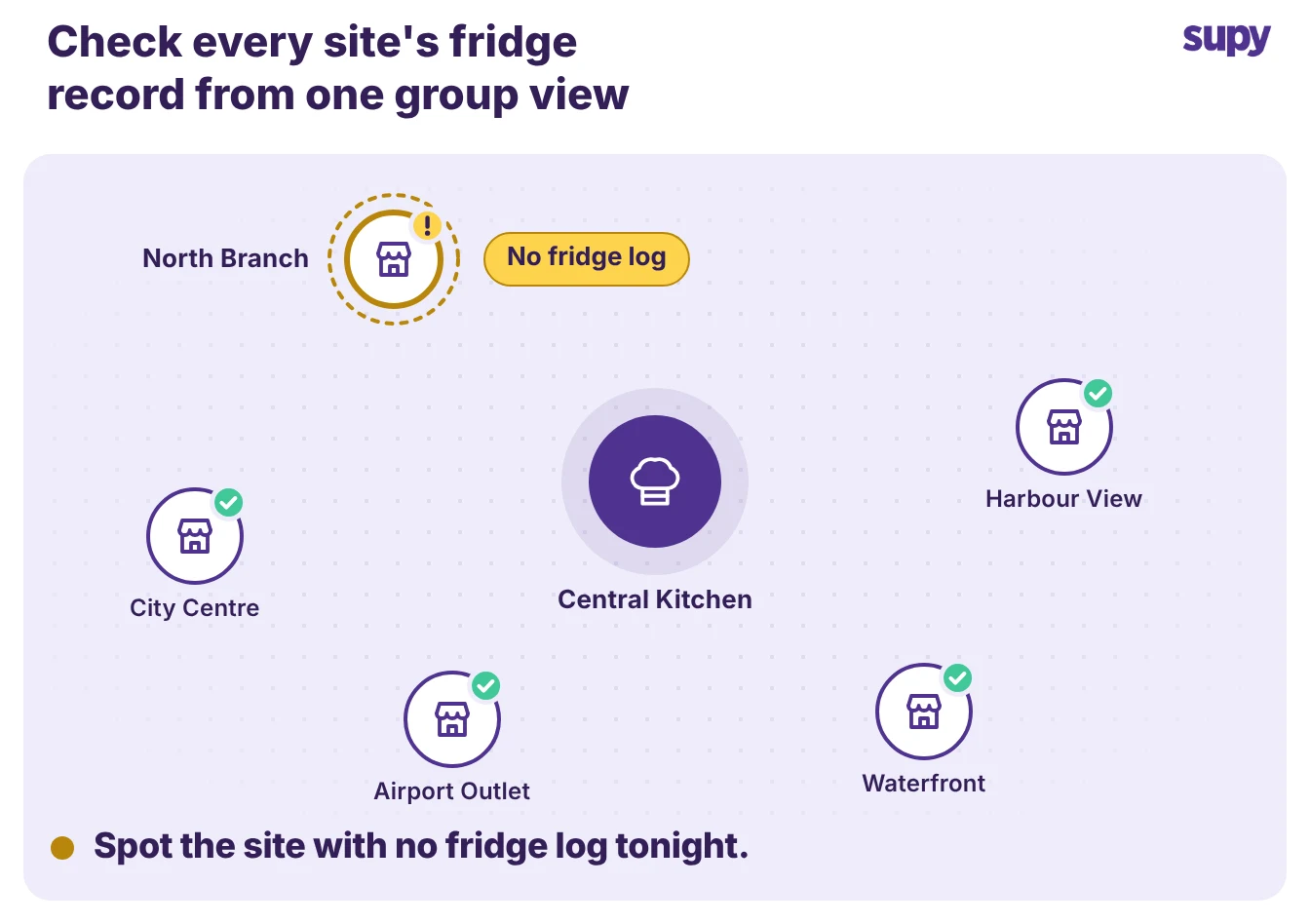
Across several sites the hard part is not the check itself. It is proving every kitchen ran it the same way. One 15-site group still keeps its checks, temperature readings and compliance logs on paper, and expects digital records to free up a staff member at every venue.
Paper logs are slow to fill, easy to skip and hard to review across a group until something has gone wrong. Restaurant inventory management software keeps the inventory side of those records consistent across every site today:
- Live stock on hand. See stock by location and storage unit, updated from each delivery and recipe.
- Inter-branch transfers. Both sites confirm a transfer, so the record matches what moved.
- A tamper-proof audit log. Filter every action by branch, user and date, and export it for an inspector.
The digital fridge-temperature checklist that would carry the nightly check itself is coming soon. For now, pair the paper check with the live records you already have.
Set the fridge to 5°C for headroom under the limit, store raw below ready-to-eat on every shelf, and run the nightly check at each unit. When a reading hits the limit or above, work the too-warm sequence. After a power cut, throw out chilled food that has sat at 8°C or above for 4 hours, per FSA guidance.
Start tonight: print one check sheet per fridge and name who signs it. See how a kitchen runs a full day of service for where this check fits into the shift.