.jpg)

Restaurant ERP Software: When a Multi-Site Group Actually Needs One
What Restaurant ERP Software Actually Covers
Restaurant ERP software is a single system that runs a hospitality group's core business functions - finance and the general ledger, procurement, inventory, and often HR and payroll - from one shared database. A true ERP replaces several back-office tools at once. For most multi-site restaurant groups, the real question is not which ERP to buy, but whether they need a dedicated one at all.
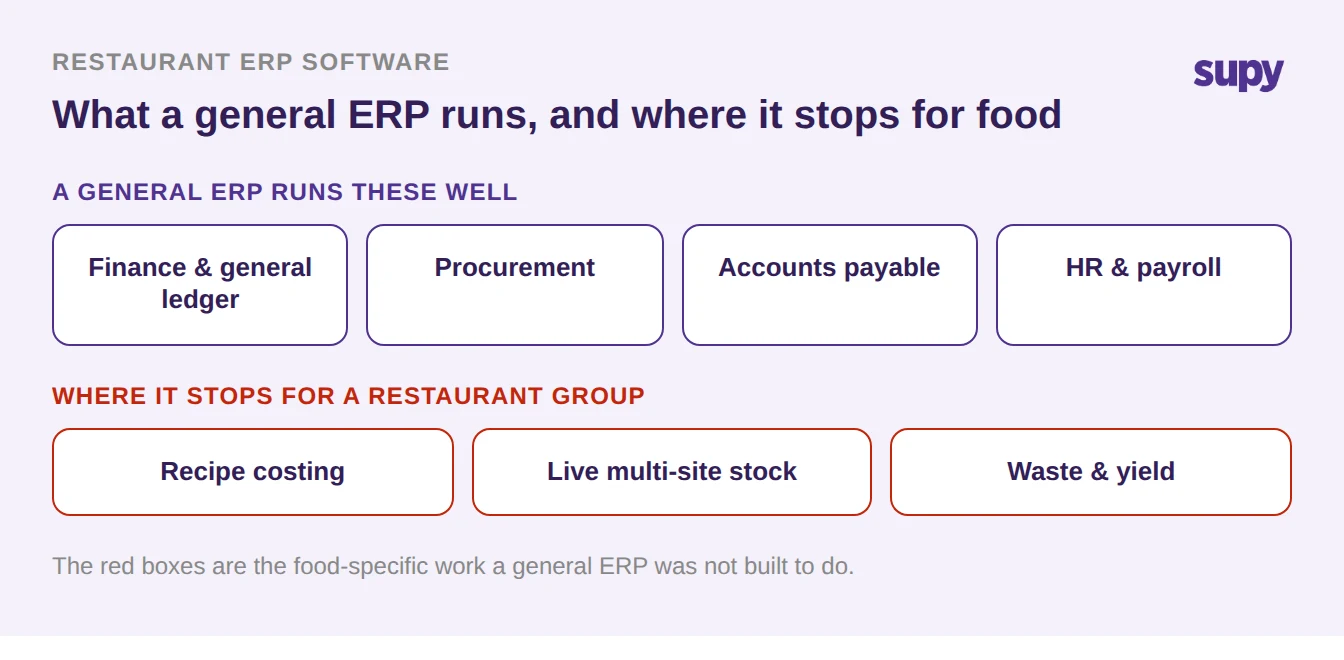
General-purpose ERPs such as NetSuite, SAP, Odoo and Microsoft Dynamics do the finance job well. They consolidate accounts across legal entities, hold the general ledger, and manage accounts payable at a scale a spreadsheet cannot. That is genuinely what a growing group needs from its financial backbone.
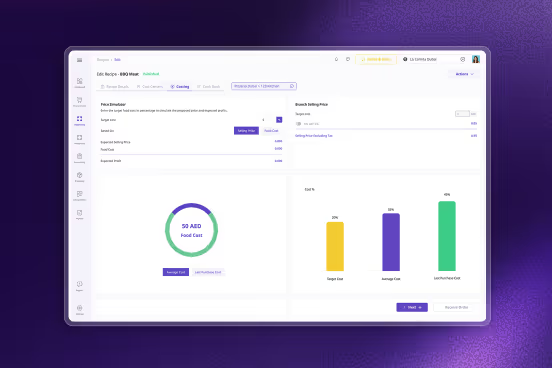
Where a general ERP tends to stop is the food-specific detail: costing a recipe as ingredients and their prices move, and tracking stock as it flows between a central kitchen and its outlets. Those gaps are a topic in their own right - our look at where ERP inventory modules break for a central kitchen covers one of them. The point for a buyer is simpler: an ERP is built to run your books, not to cost your menu.
The Signs You Have Outgrown Your Current Setup
You have outgrown your current setup when the systems you already run can no longer answer basic questions without manual work. The signs are consistent across multi-site groups, and they are about effort and accuracy, not feature envy.
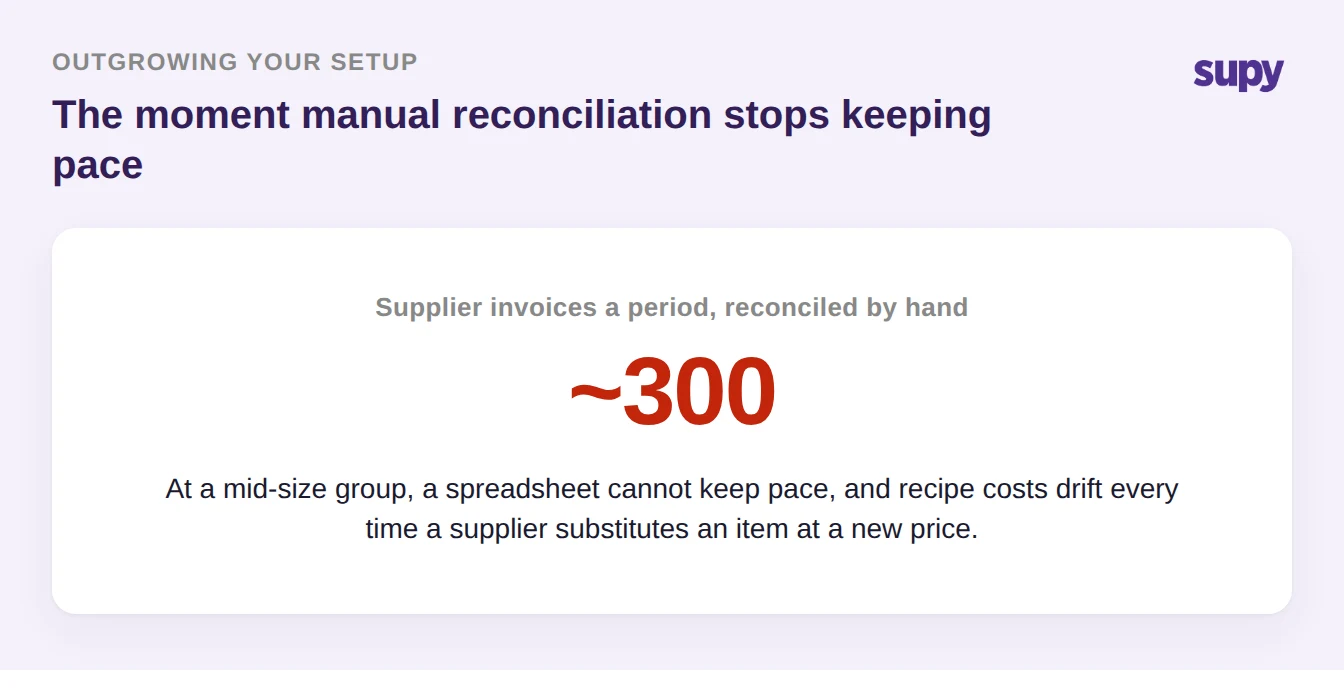
Costing teams export purchasing and goods-received data into a spreadsheet by hand to keep recipe costs current, then re-key it every time a supplier substitutes an item at a different price. A group processing around 300 supplier invoices a period cannot reconcile them to the books manually without falling behind. Floor and branch staff find the back-office system too heavy to use, so counts and receipts go in late or wrong, and the data everyone reports on is already stale.
Two more signs are structural rather than daily. An ERP is arriving in a few months and nobody has decided whether the ERP or the operations platform owns supplier and item master data. Or a connectivity or usability failure has pushed someone to ask for a single all-in-one system to make the problem go away. Both are real decision points, and neither on its own means you need a dedicated ERP.
Dedicated ERP vs a Specialist Layer That Feeds It
There are two honest paths out of that friction, and they are not the same purchase. One is to buy a dedicated restaurant ERP and run finance, procurement and operations inside it. The other is to keep your accounting or ERP for the books and add a specialist food and beverage layer on top for the parts a general ERP handles poorly. The table below compares them on the criteria that actually decide the call.
| Criterion | Dedicated restaurant ERP | Specialist layer plus your accounting |
|---|---|---|
| Recipe and menu costing | Rarely built for food | Core function |
| Live multi-site stock | Limited | Core function |
| Financial consolidation | Core strength | Left to your accounting system |
| Invoices and credit notes to the books | Native | Pushed via integration |
| Ground-staff usability | Often heavy | Built for daily floor use |
| Time and cost to implement | Months, higher | Weeks, lower |
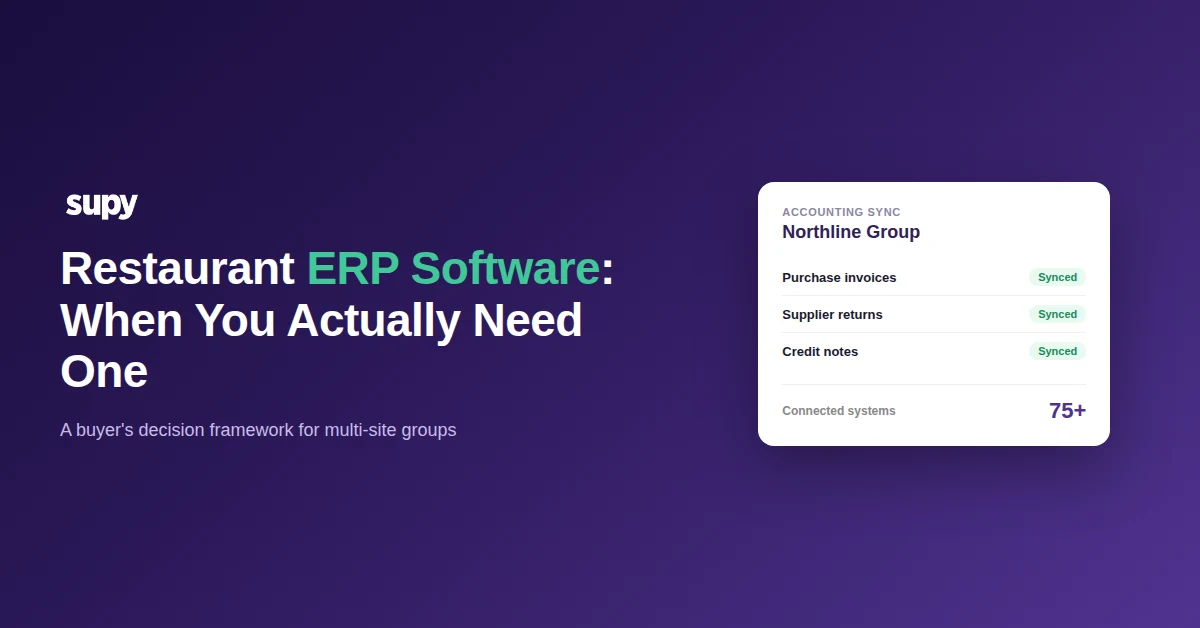
Supy is the second path, not the first. It is not an ERP; it is the specialist layer that sits on top of the finance system you already run. It connects to 75+ platforms - including Oracle NetSuite, SAP, Odoo, Microsoft Dynamics, QuickBooks, Xero, Zoho Books, MYOB and Wafeq - and pushes purchase invoices, supplier returns and credit notes into your accounting or ERP, with live sync status shown on each record and configurable mapping to the right general-ledger account, tax code and cost centre. It costs recipes and tracks multi-site stock in the detail an ERP does not, and it hands the finished financial transactions to the system of record rather than trying to replace it. If your procurement data also needs to reach a wider ERP and reporting stack, connecting it through an API is a related piece worth reading.
Four Questions That Decide Whether You Need an ERP
Four questions settle the decision for almost every group. Answer them honestly about your own operation rather than about where you hope to be in three years.
First, how complex is your legal and financial structure? Multiple legal entities, several currencies and statutory consolidation point toward a dedicated ERP. A single entity or a handful of them rarely justifies one. Second, what is your system of record today? If an ERP already owns finance and master data, you need a layer that feeds it cleanly, not a second system competing to be the source of truth. Third, where do your gaps actually sit? If the pain is recipe costing, stock accuracy and procurement, that is a specialist layer's job and not a reason to replace your finance system. Fourth, how well will any new system integrate with what you already run? Data fidelity across your point-of-sale, accounting and ERP is the criterion that separates a working stack from a set of disconnected tools, so weigh it heavily in any demo.
If you want to see how the operational side maps to your sites before you weigh any of this, our restaurant inventory management platform is the part that would sit on top of your books.
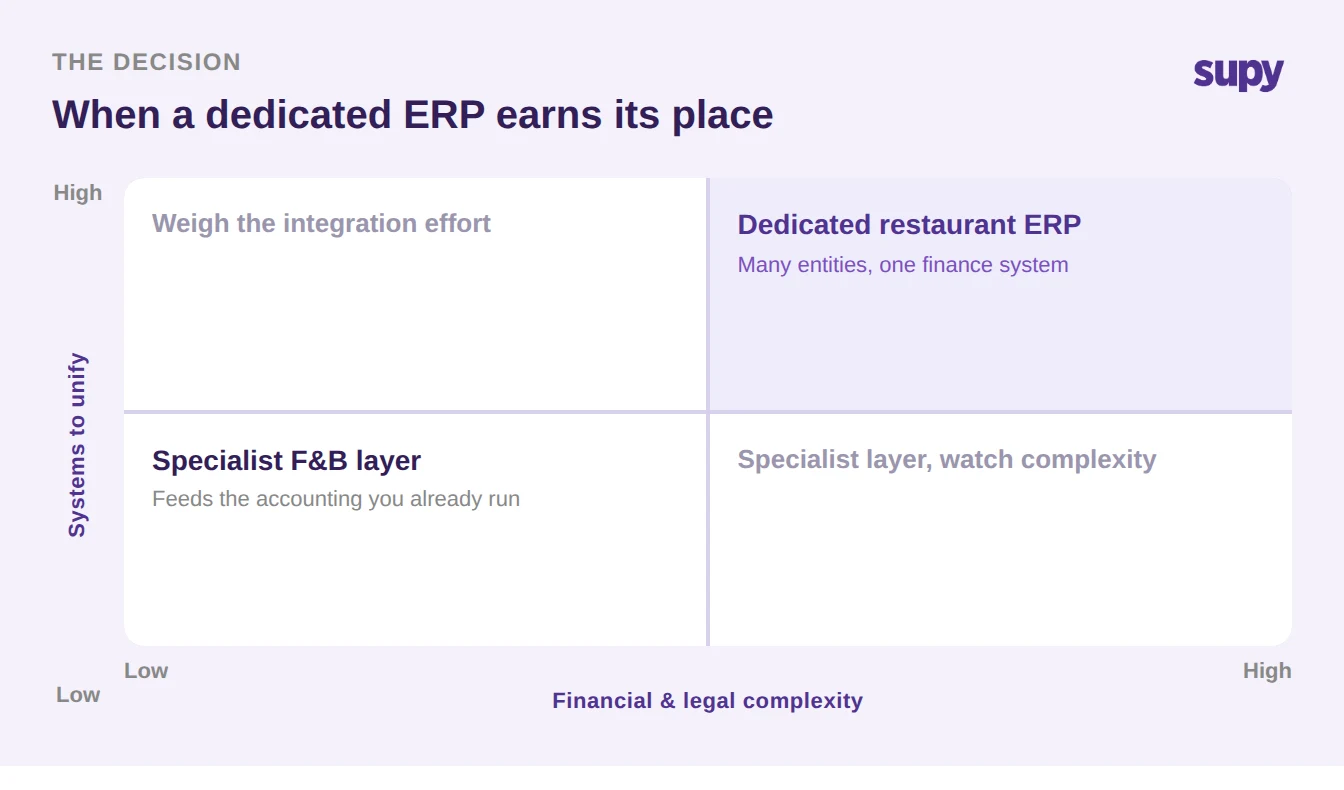
Choose a dedicated restaurant ERP when your group runs multiple legal entities, needs statutory consolidation, and wants finance, procurement and HR in one system, and you can absorb the months of implementation that choice carries. Choose a specialist food and beverage layer feeding your existing accounting or ERP when your gaps are recipe costing, stock accuracy and procurement, and you want floor teams using the system every day without a heavy rollout. Most multi-site groups sit in the second case: they do not need another finance system, they need the food-specific layer their finance system was never built to provide. Decide which case is yours before you sit through a single vendor demo, and you will spend that demo checking the right things.