.jpg)


Restaurant Kitchen Cleaning Checklist: Daily, Weekly and Monthly Jobs
Daily kitchen cleaning tasks, station by station
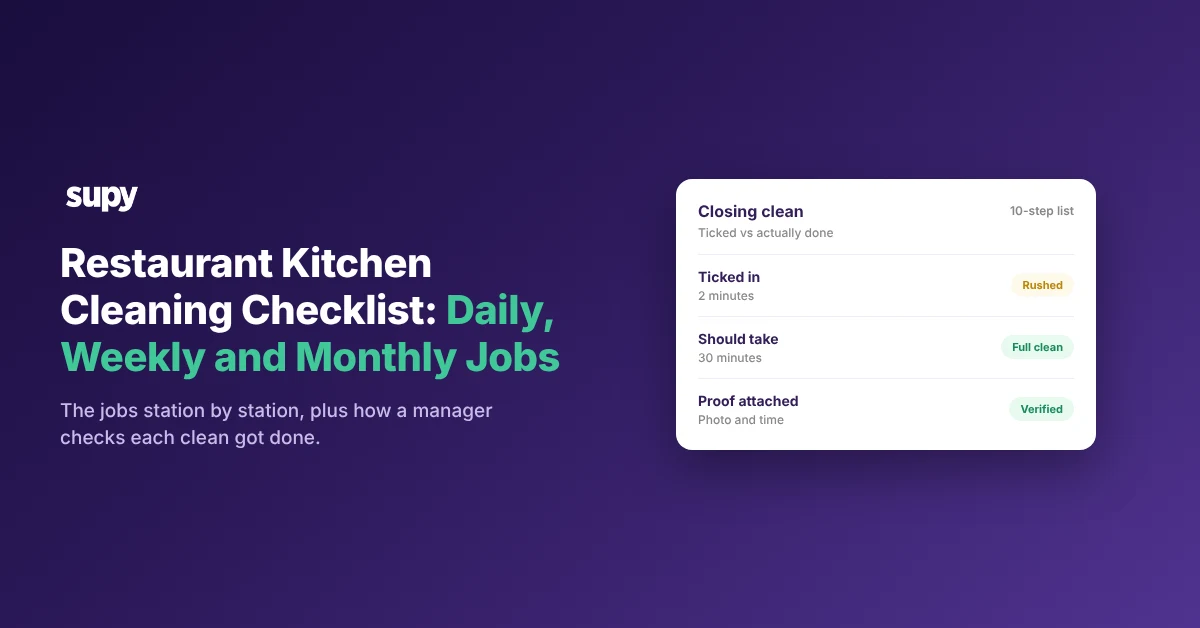
A kitchen cleaning checklist works only when the clean behind each tick actually happened. Most lists get the tasks right and the proof wrong: a 10-step clean that should take 30 minutes gets ticked in two, sometimes from home after the shift. This article gives you the daily, weekly and monthly jobs station by station, and how a manager confirms each one was done across every site.
Run this list at open and close, station by station. Clean first to lift grease and food, then sanitise to kill what is left.
| Station | Daily cleaning task |
|---|---|
| Prep benches and boards | Wash, rinse and sanitise after each task and at close; keep raw and ready-to-eat boards apart |
| Cooking line and grill | Degrease the range, salamander and grill; empty and wipe the grease tray |
| Fridges and freezers | Wipe handles, seals and shelves; check and log temperatures; clear out-of-date stock |
| Sinks and handwash basins | Clean and sanitise; restock soap and paper towel |
| Floors and drains | Sweep, mop and clear drain covers at close |
| Bins | Empty, wash and reline; sanitise lids and touch points |
| Food contact surfaces | Clean, then sanitise; never sanitise over grease |
Your local food safety code sets the cleaning frequencies and methods, so confirm the detail with your authority before you rely on this list. The rules sit with the FDA Food Code in the US, the Food Standards Agency in the UK, and FSANZ in Australia.
Keeping fridges clean sits next to keeping their stock in date, so a view of live stock and expiry shows which items have expired, not just which shelves look clean.
Weekly and monthly deep-clean tasks
Daily cleaning keeps surfaces safe between shifts. The weekly and monthly deep clean reaches what daily wiping misses, which is where grease, scale and pests actually build up. These are also the jobs an inspector asks you to prove.
| Deep-clean task | How often |
|---|---|
| Extraction filters, soak and degrease | Weekly |
| Extraction canopy, full strip and degrease | Monthly |
| Behind and under line equipment | Weekly |
| Walk-in shelving, strip down and sanitise | Weekly |
| Descale sinks, taps and the dishwasher | Monthly |
| Dry store, empty shelves and wipe | Monthly |
| Ice machine, empty and sanitise | Monthly |
| Drains, deep flush | Monthly |
Date and keep the deep-clean records. A weekly filter clean nobody can show is, to an inspector, a filter clean that did not happen.
Why cleaning checklists get ticked but not done
A ticked box is not a clean station. The most common failure is a checklist filled in fast, or filled in later, rather than at the station while the work happens.
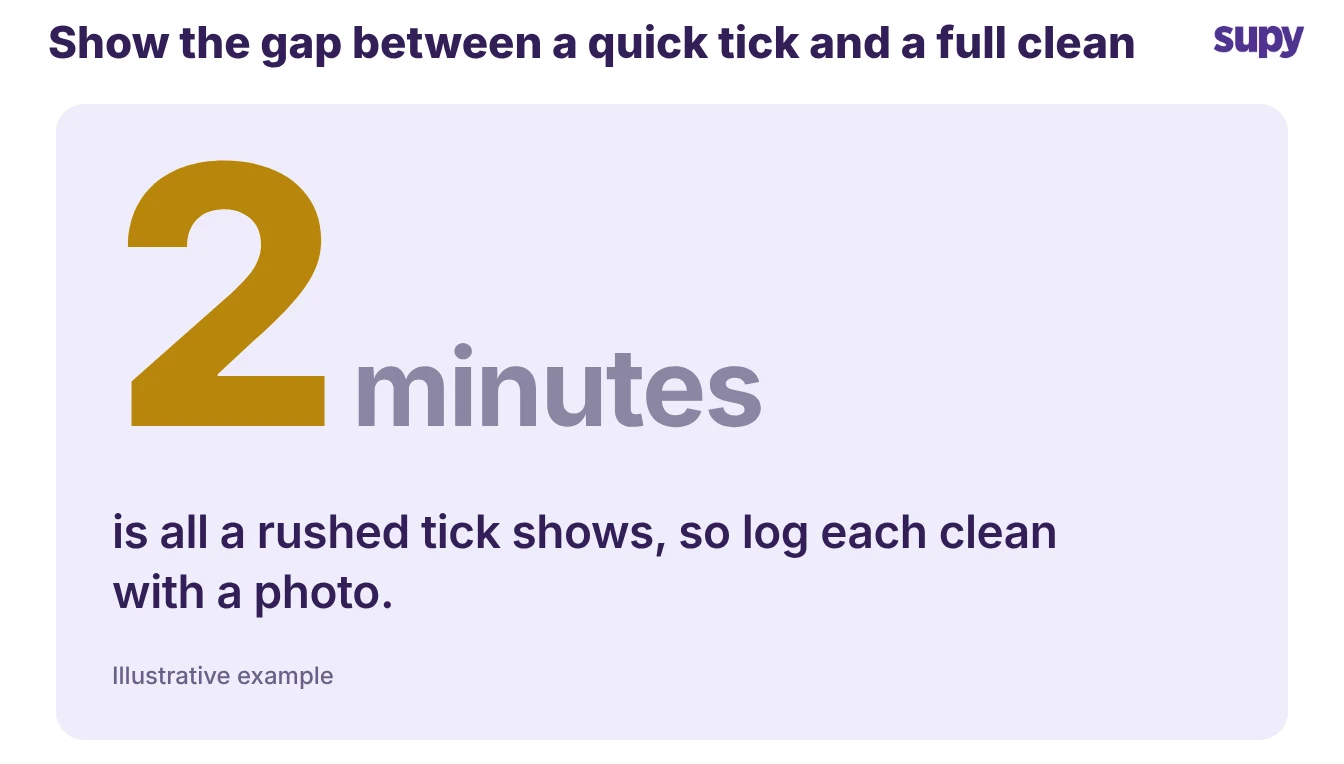
- Ticked in two minutes. A 10-step clean that should take 30 minutes gets signed off in two, so steps get skipped and nobody sees which ones.
- Done from home. Staff complete the list after the shift, away from the station, so the tick records intent, not work.
- No phone on the floor. Many kitchens ban phones on shift, so a checklist with no shared device moves off the floor or waits until later.
- No proof. A tick carries no evidence, so a manager cannot tell a wiped shelf from a signed-off one without walking the floor.
How a manager can tell a clean was done properly
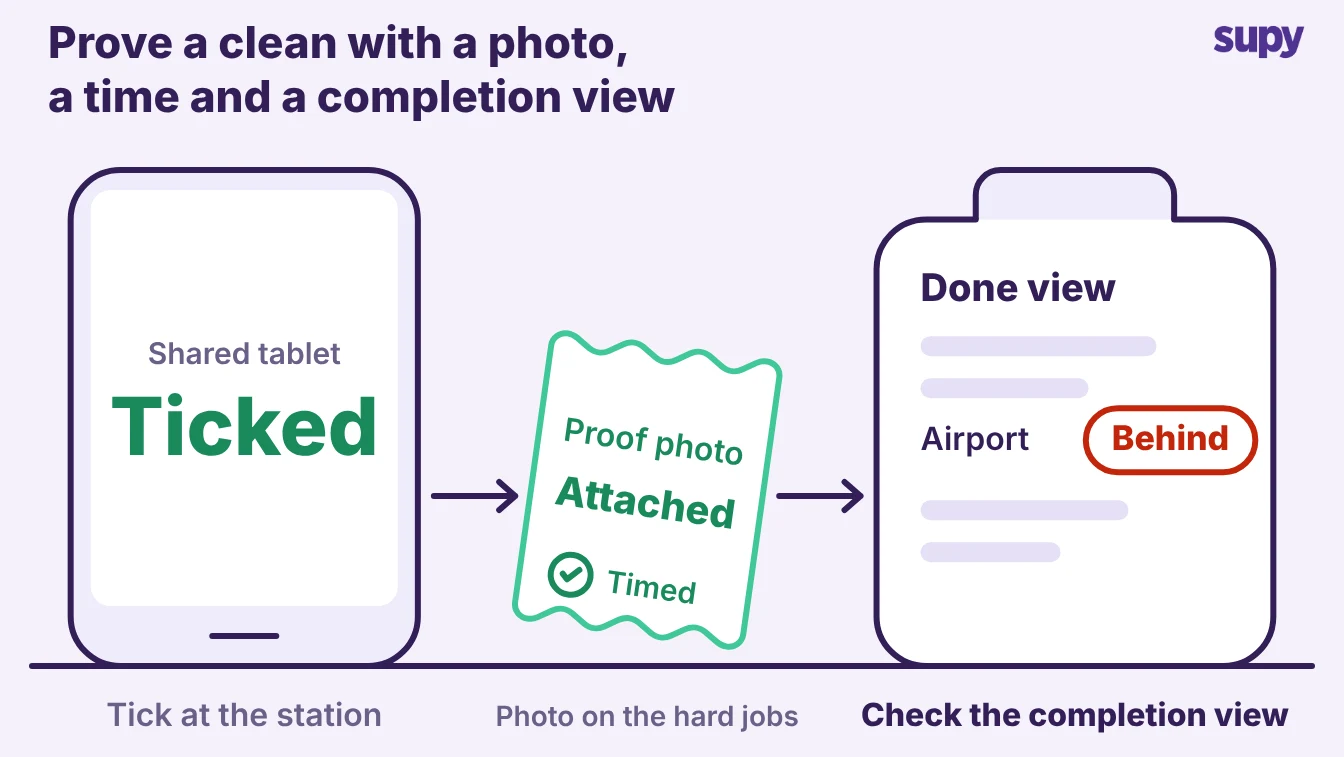
You confirm a clean by asking for evidence, not a signature. The checks that hold up are the ones tied to a time, a place and a photo.
- Photo evidence on the hard jobs. Ask for a picture of the cleaned canopy, the empty fridge or the stripped shelf, taken at the station.
- A shared device at the station. A tablet or kiosk by the line lets staff tick as they clean, on the floor, without a personal phone.
- Spot checks against the list. Walk two or three stations a shift against the same list the team uses, so the standard is the same for everyone.
- A completion view, not a pile of paper. One screen that shows which stations are done, late or missed tells a manager where to look first.
Supy's checklists feature, coming soon, turns a failed check into a tracked job with a note and a proof photo, and shows managers completion across sites. Until it launches, the practices above do the same work with a tablet and a camera.
One cleaning standard across every site
One kitchen cleaning well can be luck. Getting every kitchen to clean the same way takes a system.
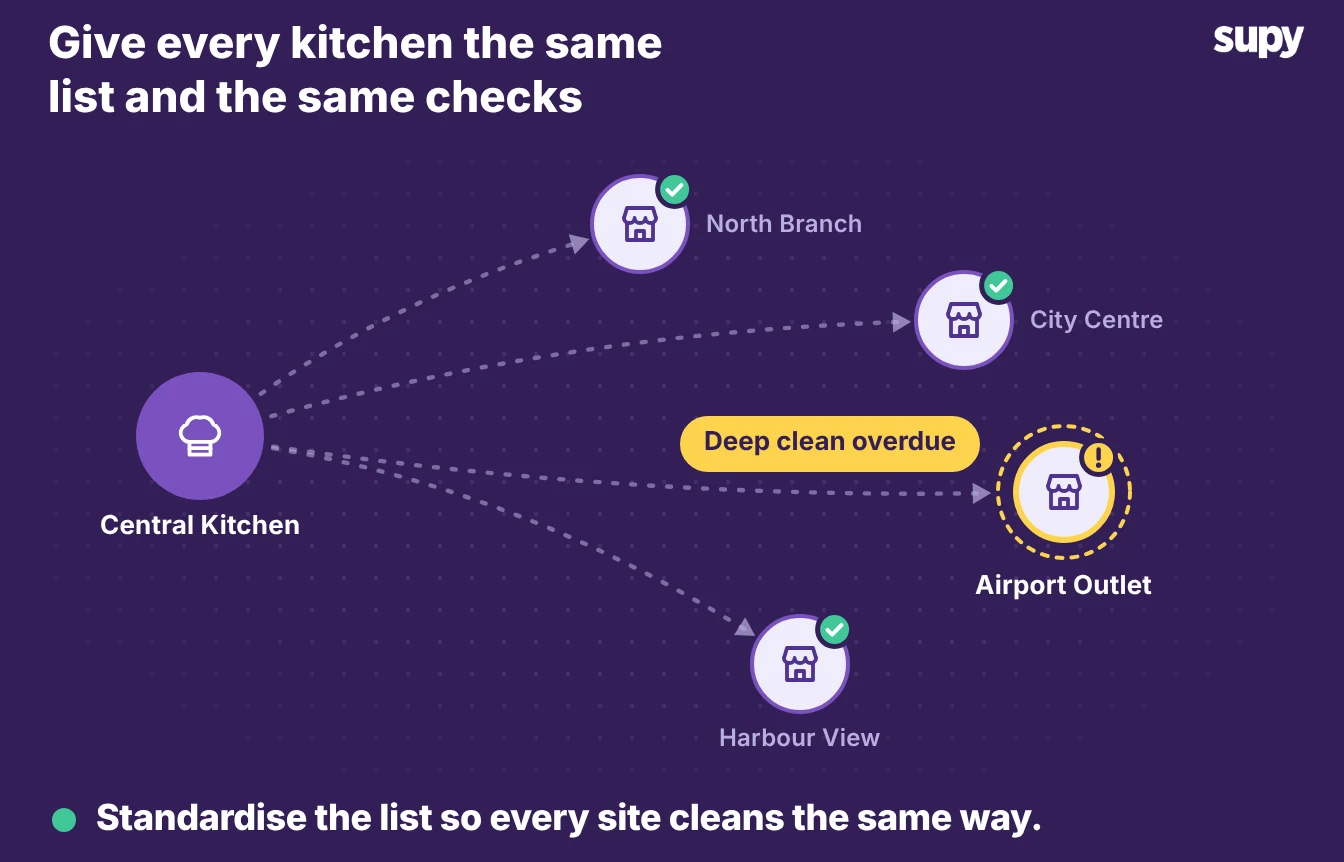
A group holds the standard with one list, one method and one place to see completion, not a different binder in each kitchen. The broader opening and closing routine sits in the kitchen operations checklist, and cleaning is the part of it that fails quietly.
- One list, every kitchen. The same daily, weekly and monthly checklist at each site, so a clean means the same thing in every location.
- One method for clean-then-sanitise. Written steps for each task, so a new starter in any kitchen cleans the way the group expects.
- One completion view across sites. A single screen of which sites are done or behind lets an area manager compare like with like.
- Deep-clean records per site. Dated records of the weekly and monthly jobs, ready for an inspection at any location.
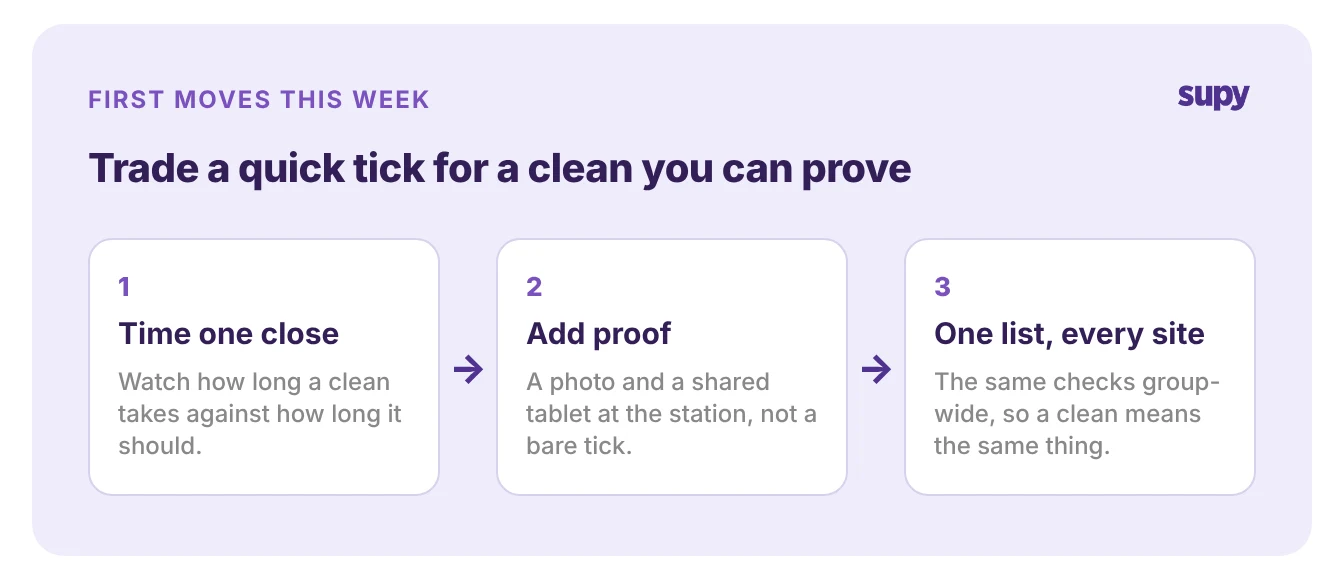
Where to start this week
Pick the smallest version that changes something this week.
- Time one close. Watch how long a clean actually takes against how long it should; a 30-minute close ticked in 2 minutes is a proof problem, not a list problem.
- Add proof before anything else. Put a photo and a shared device at the station, so the tick happens where the work does.
- Put every site on one list. Roll the same daily, weekly and monthly checklist out group-wide, so a clean means the same thing and an inspector gets the same answer at any door.
When you can prove a clean happened, you can repeat it, in one kitchen or fifty.