.jpg)


Kitchen Closing Checklist: What to Check Before the Last Chef Leaves
What a Kitchen Closing Checklist Should Cover, Station by Station
A kitchen closing checklist should do more than clean-down and lockup. It walks each station in a set order, confirms the fridges and prep are safe overnight, and catches stock that will not last to the morning shift. This article gives you the checklist, the storage and labelling checks, and the two things most closes miss: expired stock and a real sign-off.
Work the checklist in station order so nothing gets skipped on the way out, and assign each station to a person before service rather than after. This is the closing half of a wider kitchen operations checklist, narrowed down to the end of the night.
| Station | Check before you leave | Why it matters |
|---|---|---|
| Walk-in and fridges | Shut the doors, log the temperatures, cover everything left inside | A warm fridge overnight can spoil a whole shelf of stock |
| Prep and line | Label and date the prep, move the oldest to the front, strip the line | Unlabelled prep gets binned in the morning or served past its date |
| Dry store | Seal the opened packs, clear the spills, move the oldest to the front | Damp and pests ruin stock you have already paid for |
| Dishwash and waste | Drain the machine, put the bins out, log the waste | Logged waste is the only waste you can put a cost against |
| Counter and pass | Clear the surfaces, empty the displays, reconcile the cash | Leftover display stock becomes tomorrow's giveaway or bin |
| Close-out | Submit the stock count, sign the checklist, set the alarm | A signed close is the only proof the close actually happened |
Food Storage and Labelling Checks That Stop Morning Waste
The checks that save the most money at close are about labels and storage, because that is where the team either labels tonight's prep or bins it in the morning. Run these before anyone leaves:
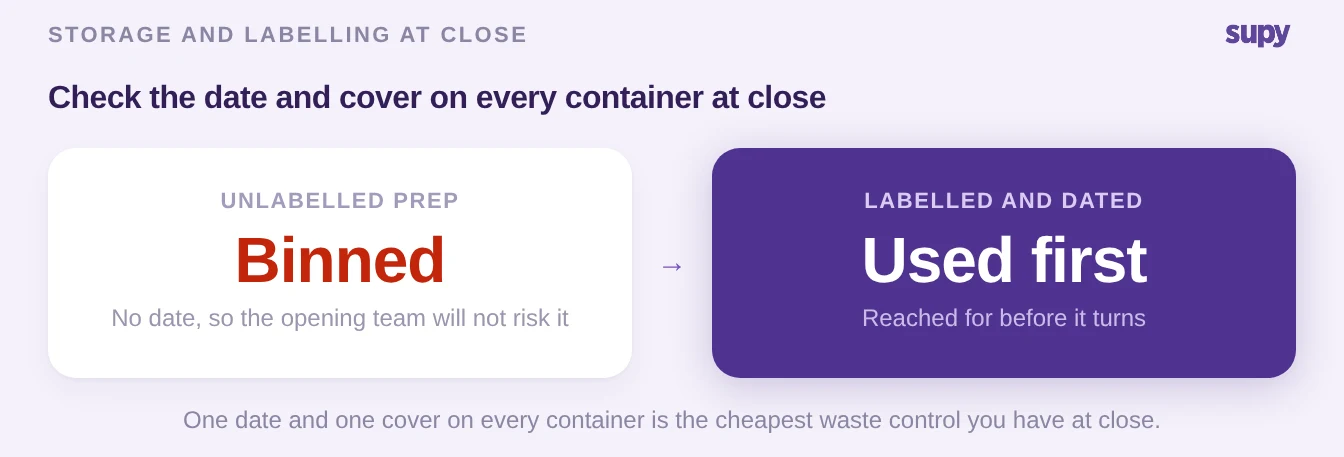
- Date and use-by on every container. A prep item with no date gets thrown out in the morning, because nobody will risk serving it.
- Oldest stock to the front. Put the earliest use-by dates where the opening team reaches first, so good stock gets used before it turns.
- Allergen prep covered and apart. Keep allergen items sealed and separated overnight, so a mix-up cannot happen on the next service.
- Everything covered and sealed. An open container dries out, picks up smells, or spoils before morning.
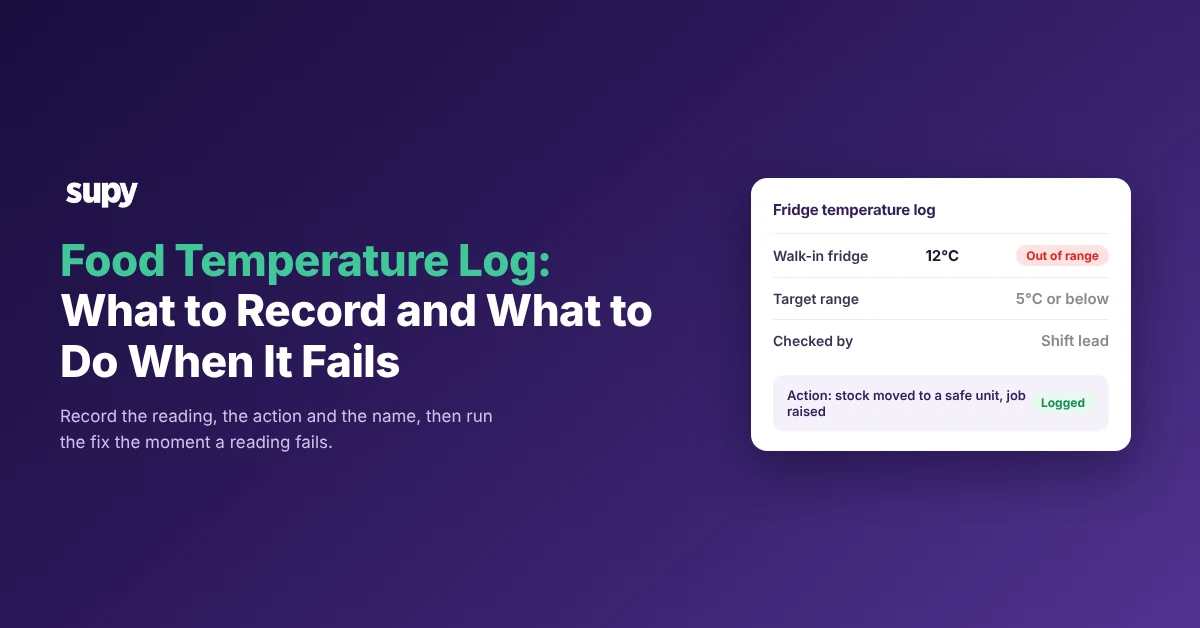
- Right storage, right temperature. Chilled stays chilled and frozen stays frozen; a reading outside the safe range is a job for tonight, not for the opening team.
Labelling also decides how clean your next count is. When every ingredient has one record and its allergen tags carry through to the recipes that use it, the opening team knows what each container holds without guessing. Supy keeps ingredients and allergens at that single-record level, so what the closing team labels is what the system already expects.
Why Closing Checks Get Rushed, and How to Make Them Stick
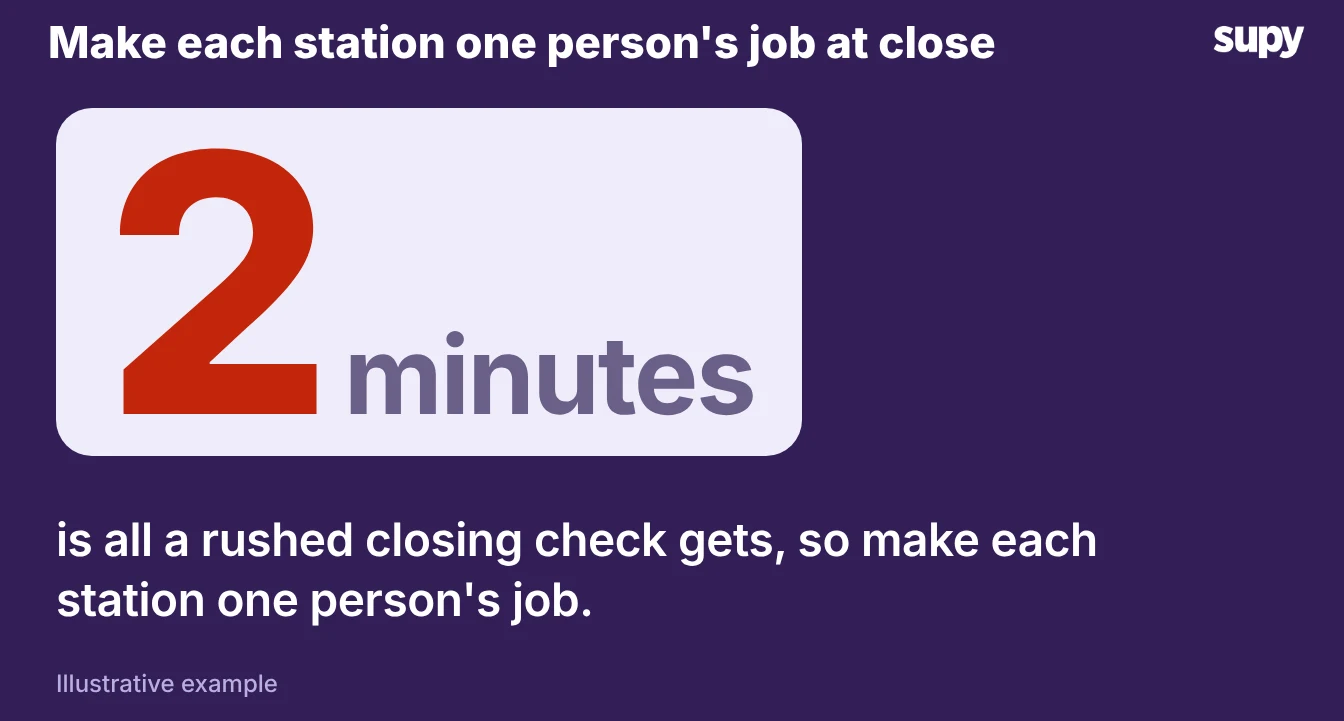
A closing checklist only works if the team runs it for real. At the end of a long shift, a check that should take 30 minutes gets done in 2, and some get finished from home after everyone has left.
The fix is not a longer list. It is three changes that make the close hard to fake:
- Give each station a name. One person owns the walk-in and another owns the line, so no check falls into the gap between two people.
- Keep the list short and specific. Ten real checks beat forty vague ones that nobody reads past the first few.
- Make the close visible to a manager. When the submitted close shows up where a manager can see it, finishing the checklist from home stops being an option.
A short checklist that someone signs beats a long one that gets ticked blind. Cut any line that has not caught a real problem in months, and keep the ones that have.
Catch Expired Stock at Close, Not at the Morning Delivery
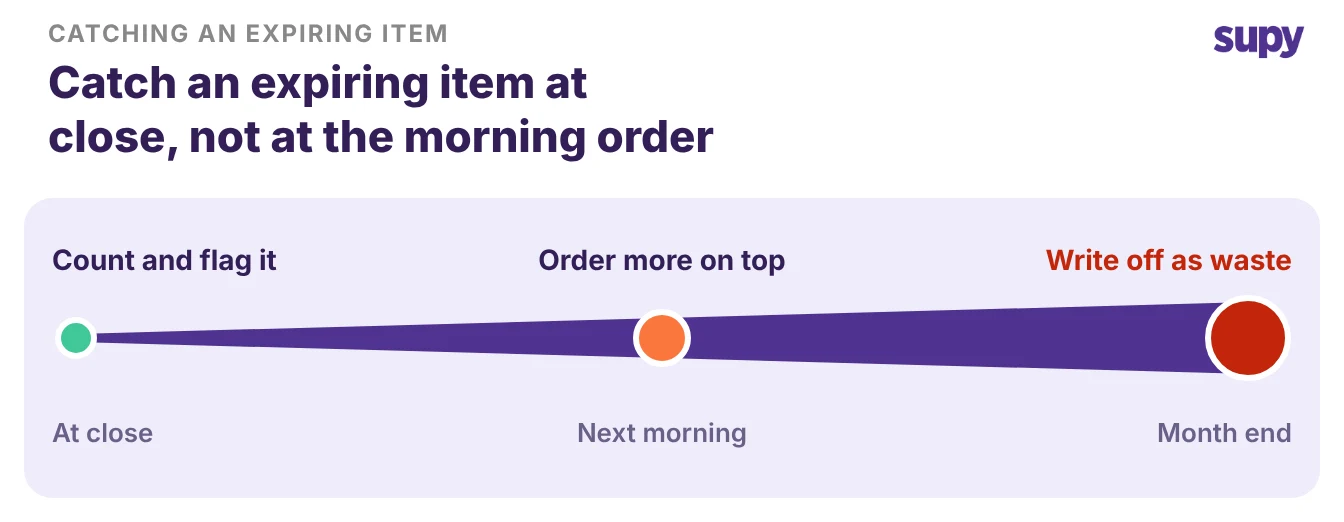
The close is your last chance to catch stock that will not survive the night. An end-of-day stock count, taken against what the system already expects, flags the items that are short, slow-moving, or past their date. It does this before the morning team orders more on top of them.
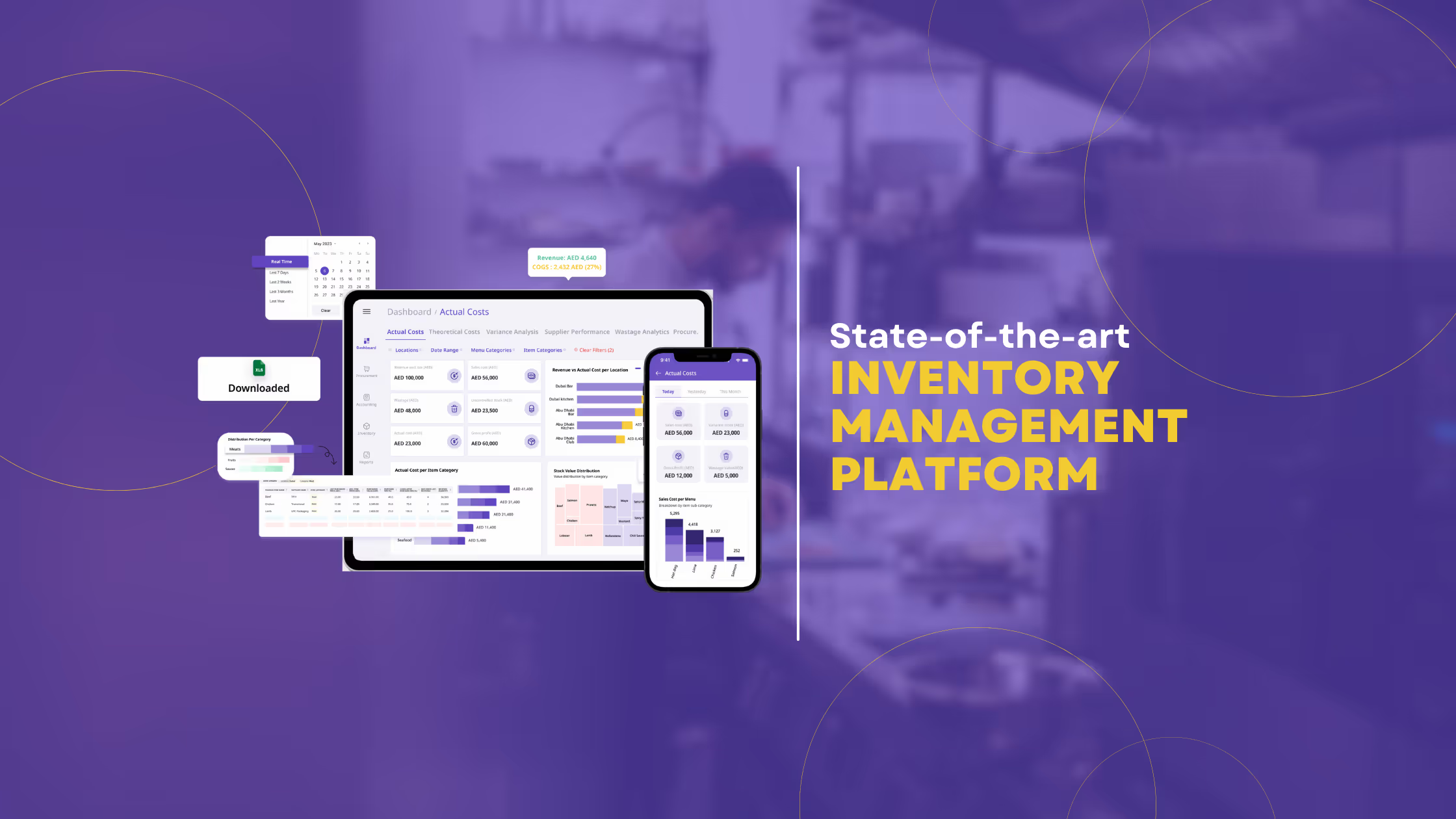
In Supy, a closing count does three things a paper sheet cannot:
- Counts the same way every night. It runs from a reusable template in shelf order, so the count takes less than half the time.
- Shows the variance on the spot. A missing case shows up at close, not at month end, and a tighter stock count at close is what makes the rest of this work.
- Flags items below minimum or above par. Live stock visibility catches slow-moving stock that is about to expire before anyone reorders it.
If you set par and minimum levels per item, the close becomes the moment you act on them.
If you'd rather not work par out by hand, the free par level calculator does it for every item on your sheet. It works from your usage, delivery days and supplier lead times.
Sign Off the Close the Same Way at Every Site
At a single site, the close is only what the manager remembers. Across 8 sites it has to be written down the same way, or you cannot tell which branch actually did it. A signed, timestamped close gives you that proof.
Supy's audit log records who submitted the count and when, tied to a named user, and nobody can edit or delete it after the fact. Group-level par visibility lets an area manager see where every site sits against its par from one view. A branch that never submitted its close shows up as the one gap in the row.
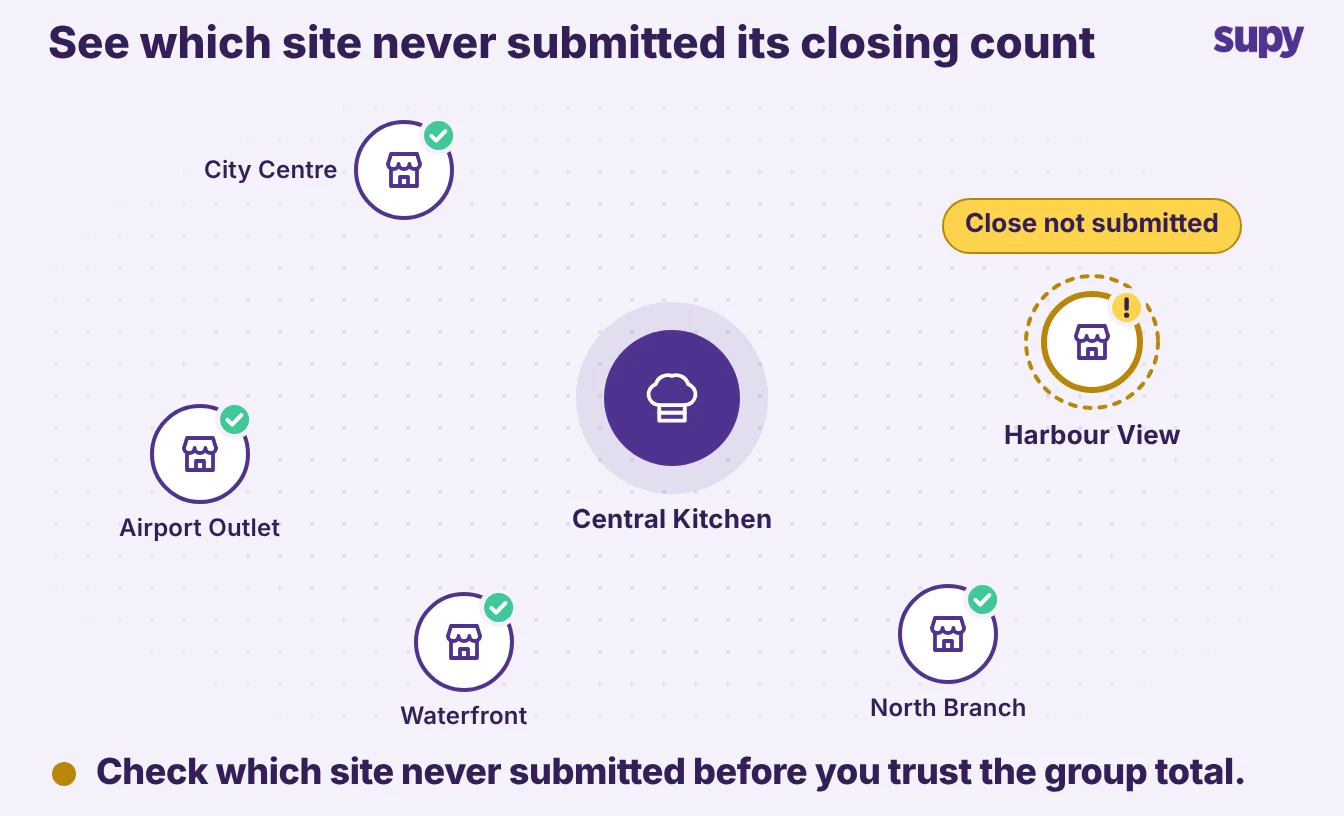
The point is not to watch people. It is to run the same close at every site and know it happened. So run one test tonight: time your current close and check whether every station got signed off by a named person.
If the check that should take 30 minutes took 2, start with one change. Assign each station to a name and move the stock count to the end of the close. That single move catches the expired stock and gives you the proof the close happened, whether you run one site or 8.