

Inventory

What to Put on a Food Safety Audit Checklist for Every Site

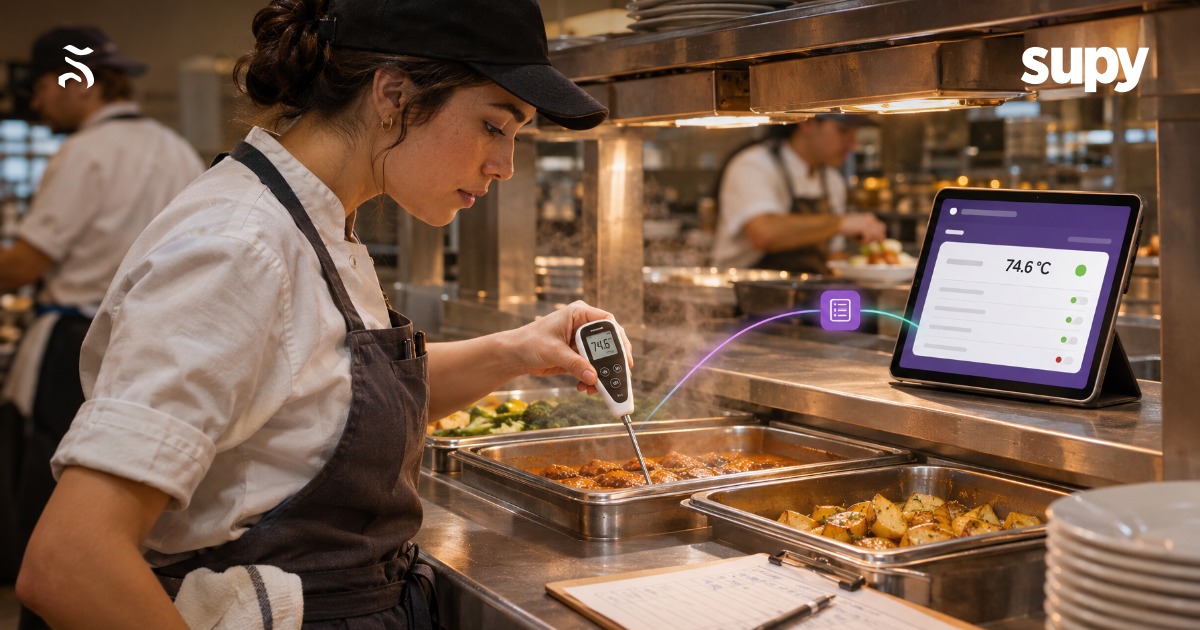
An operations manager and head chef run a food safety audit by the walk-in fridge, checking it off on a tablet showing the Supy checklist

What Belongs on a Food Safety Audit Checklist

A food safety audit checklist proves every site meets the law and the brand standard, from fridge temperatures to allergen labels. It works only when someone owns each failed line and fixes it, not when a red mark sits on a sheet until the next audit. This article gives the eight areas to cover, and how to run the audit so a failed check becomes a tracked job you can show an inspector.

  • Cold and hot. Two numbers matter most on the whole list. Cold food must stay cold and hot food hot.
  • Danger zone. In England, Wales and Northern Ireland the Food Standards Agency sets cold holding at 8C or below and hot holding at 63C or above. The US FDA Food Code uses 41F and 135F, and 41F to 135F is the danger zone.

Check the exact figures with your local authority before you rely on this list. Record the real reading on every unit, not a tick, so a drifting fridge shows up before it spoils stock.

Group the checklist by the area an inspector checks, so nothing gets missed and each failed line names who fixes it. Cover these eight areas, and for each one write down what good looks like.

Audit areaWhat to checkWhy it matters
Temperature controlCold and hot holding readings on every fridge, freezer and hot-hold unitA drifting unit spoils stock and fails inspection
Delivery and storageChilled and frozen temperatures at the door, and fast put-awayA warm delivery is a supplier conversation only if you caught it on arrival
Cleaning and sanitationThe schedule names each surface, who cleans it and how often, and was signed offAn unfollowed schedule is the most common audit failure
Hygiene and trainingHandwashing, clean uniforms, illness reporting and current training recordsAn auditor will ask to see training records
Allergens and labellingAccurate allergen information, and legible, in-date prep and date labelsA labelling gap is both a legal and a safety risk
Traceability and recordsBatch numbers and best-before dates that trace back to the supplierA recall starts here
Pest control and premisesSigns of pests, intact proofing, and the last visit on fileStructural gaps let problems in
Corrective actionsEvery failed line from the last audit closed, by whom and whenAn audit with open actions is a list of problems, not a control

On allergens, a UK operator making prepacked-for-direct-sale food must label it with a full ingredients list and the 14 allergens emphasised, as Natasha's Law has required since October 2021. Pull the daily-risk lines (holding temperatures, cleaning and labels) into the opening and closing checks staff run every shift. Keep the full list as a monthly or quarterly audit.

When a Check Fails, Raise a Fix, Not Just a Flag

The point of the checklist is what happens after a line fails. On a paper sheet, a failed fridge check is a note nobody reads, and the walk-in is still warm at the next audit. A digital checklist turns that failed step into a job someone owns.

  • Assigned work order. In Supy Ops, a failed check becomes a work order you assign to a person or a team. It moves from open to resolved on a board the manager can see.
  • Closing needs proof. Closing it needs a written note and a proof photo. So the audit stops being a record of problems and starts clearing them.
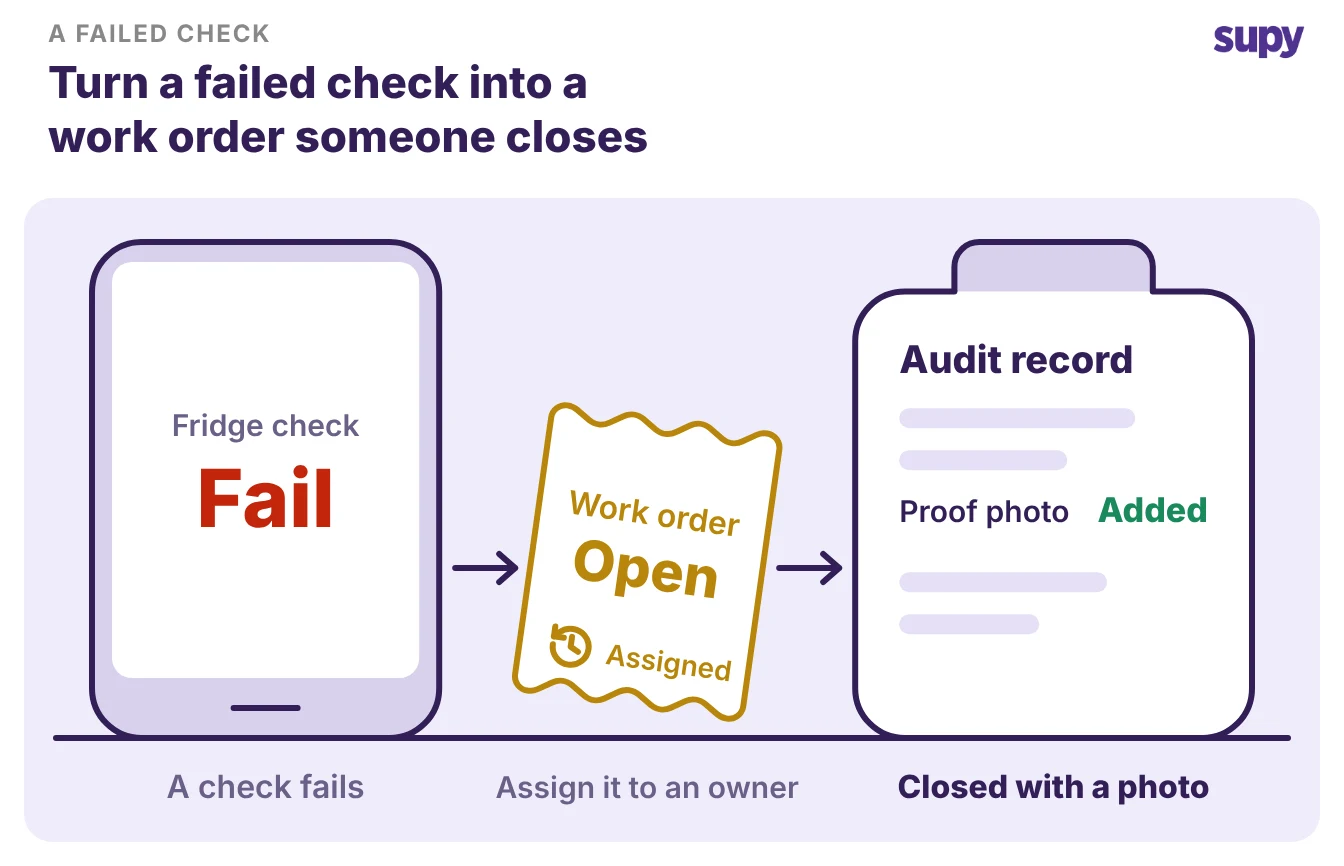
A failed fridge check becomes a work order, assigned to an owner and closed with a proof photo

Check out Supy Ops, Supy's checklist software, to build an audit checklist once and run it at every branch. A failed step raises a fix and tells staff what to do next. For how these records fit into one system, see our guide to a food safety management system.

Prove the Audit Was Actually Done

An audit only counts if you can show it happened. On sales calls, the real reason managers want checks done is to avoid blame: to show an inspector what was done and the compliance score for it.

A ten-step check marked complete in two minutes tells you a corner was cut. Timestamped, watermarked photos make it hard to sign off a check that never happened. The proof is in the record, not in a promise.
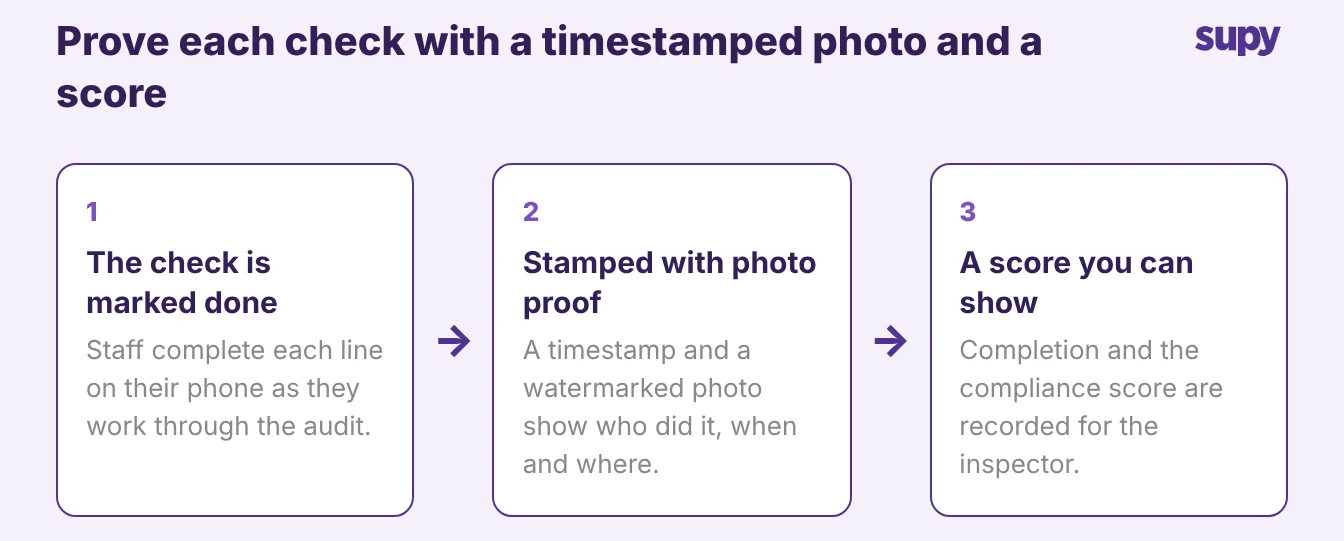
Three steps: a check marked done, stamped with a timestamped photo, then a compliance score

An inspector checks some lines more closely than others:

  • Holding temperatures. Logged through the day, not once at open.
  • The cleaning schedule. Signed off, not just pinned to the wall.
  • Allergen labels. In date and legible on open stock.
  • Training records. Current for every member of staff.

Keep the completed audits dated and filed, so you can show a history, not a snapshot, the moment someone asks.

Run the Same Checklist at Every Site

A single-site checklist is a sheet in a binder. A group needs the same audit at every branch, and one view of who has done it and who has not.

  • Build and push. Build the checklist once and push it to every site. A new venue then opens to the same standard as the flagship, and the central team is not rewriting a sheet per location.
  • Sites kept apart. One operator ran an 18-venue group on a standalone checklist app, at around 40 pounds per site a month, and it did none of this. They paid that every month for a setup that kept their sites apart, not for compliance.
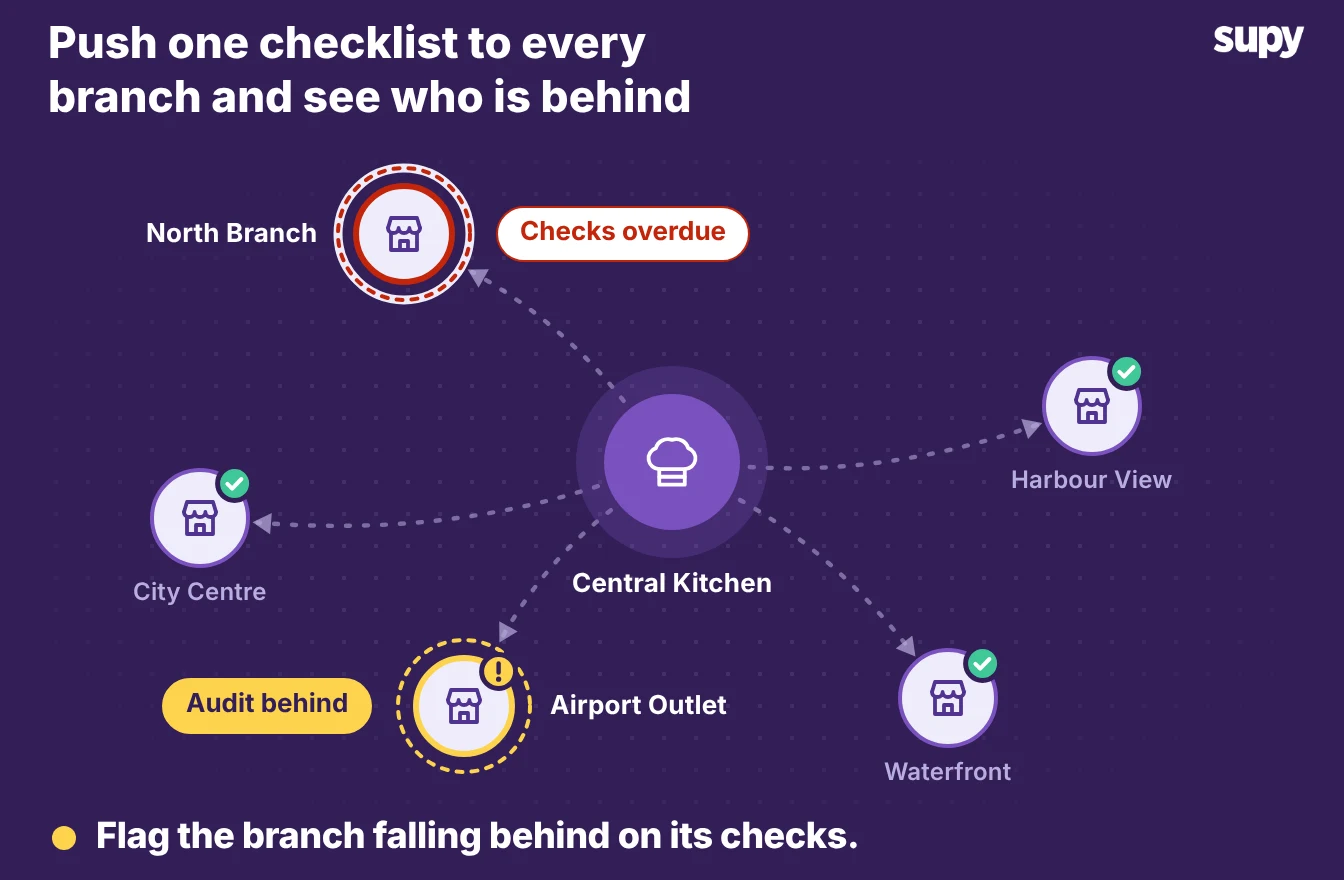
Central Kitchen pushing one checklist to five branches, with one flagged overdue and one behind

To act on it, run your current audit against the eight areas above and mark the lines that fail. Fix the one with the biggest safety risk first, usually a holding temperature or an allergen gap, and give it an owner and a date rather than a tick.

Then pull completion and compliance scores into one report, so you can see the branch falling behind before an inspector does. Track the daily opening and closing checks alongside stock on Supy's platform, and let the monthly audit confirm what the team already does.
Book a Demo with Supy - food safety audit checklist

Ready to optimize your restaurant operations?

Blog

Our operational insights

A kitchen manager checks the printed use-by date on a labeled container in the walk-in chiller, with a Supy food-safety screen on the wall
Inventory

How to Get Food Safety Labeling and Dating Right Across Every Site

A kitchen team member wiping down a stainless prep counter at close while a phone shows the cleaning checklist signed off
Inventory

How to Build a Food Safety Cleaning Schedule Template for Every Site

A stockroom worker counting dry-goods shelves on a tablet showing the Supy stock count screen
Inventory

How to Lay Out a Restaurant Inventory Form in Shelf Order

A line cook checks the temperature of hot-held food with a probe thermometer while a Supy food-safety log screen records the reading
Inventory

How to Build a Temperature Log Sheet for Your Restaurant

F&B
Menu engineering

How Barcode Scanning Speeds Up Restaurant Stock Counts

Your questions 
answered

Everything you need to know about Supy — from setup to integrations, pricing, and daily use. If it’s not covered here, just ask.

What is a food safety audit checklist?
+
A food safety audit checklist is the structured list a manager works through to confirm a site meets food safety law and the brand's own standard. It covers temperature control, cleaning, hygiene, allergens, traceability, pest control and corrective actions, and it records the real reading or result for each line, not just a tick. Run it as a scheduled internal audit, usually monthly or quarterly, and pull the daily-risk lines into the opening and closing checks. A good checklist does more than list problems, because each failed line names what to fix and who owns it.
What should be on a food safety audit checklist?
+
Cover eight areas: temperature control on every unit, chilled and frozen deliveries at the door, cleaning and sanitation, personal hygiene and training, allergens and labelling, traceability and records, pest control and premises, and corrective actions from the last audit. For each line, write what good looks like rather than a yes or no box, so the result is specific. Anchor the temperatures to your own food authority, such as the FSA's 8C cold and 63C hot holding limits in the UK, and keep training and cleaning records where you can show them quickly.
How often should you run a food safety audit?
+
Run a full food safety audit monthly or quarterly, and run the high-risk lines every day. Holding temperatures, cleaning and allergen labels change shift to shift, so they belong in the opening and closing checks staff complete daily, while the full list of eight areas suits a monthly or quarterly internal audit. Date every completed audit so you can show a history rather than a single snapshot. The right frequency also depends on your risk level and what your local food authority requires, so confirm their expectations before you settle on a schedule.
Who is responsible for completing a food safety audit?
+
The site manager or a nominated food safety lead owns the audit, but the whole team feeds it. Staff record daily checks such as temperatures and cleaning, the manager runs the full periodic audit, assigns each failed line to a named person with a date, and signs it off. In a group, a central operations or compliance lead sets the standard and reviews completion across sites. The key is a named owner for every failed line, because an audit with open actions nobody holds is a list of problems, not a control.
What is the difference between a food safety audit and a daily checklist?
+
A daily checklist covers the high-risk tasks a site must do every shift, while a food safety audit is a wider, periodic review that confirms the whole system works. The daily checks catch today's risks, such as fridge temperatures and handwashing, and the audit steps back to test cleaning schedules, training records, traceability and whether past failures were fixed. They work together, because the daily checks feed evidence into the audit, and the audit confirms the daily checks are actually happening. Run both, and keep them in one place so each supports the other.
How do you prove a food safety audit was done?
+
Prove it with dated records that show what was checked, the result, who did it and what was fixed. An inspector wants to see holding temperatures recorded through the day, a cleaning schedule signed off, allergen labels in date and training current, not a promise that it happened. A ten-step check marked complete in two minutes tells an inspector a corner was cut, so timestamped and photo-backed records carry more weight than a tick. Keep completed audits filed and dated so you can show a history the moment someone asks for it.
Can you run the same food safety audit across multiple sites?
+
Yes, and a group should. Build the audit checklist once and push it to every branch so each site works to the same standard and a new venue opens like the flagship. Running separate sheets per site means no central view and a standard that drifts between branches. Pull completion and compliance scores into one report so the central team can see which branch is falling behind before an inspector does. Tools such as Supy Ops let you build a checklist once, run it everywhere, and track completion across every site from one board.

Ready to transform your operations?

Join 5,000+ restaurant operators cutting costs, streamlining operations and making smarter decisions with Supy.