
Wareneinsatz

Recipe Setup: The Onboarding Blocker That Stalls Restaurant Software Before Go-Live
Recipe setup is the onboarding blocker that stalls restaurant software before go-live

Why Go-Live Means Nothing Until Recipes Are Built

Recipe setup is the point at which your ingredients, your menu and your POS finally connect. In Supy, a recipe links a plated dish to the ingredients it consumes and to the POS menu item that sells it, so that selling one dish depletes the correct stock automatically. Until that link exists, a sale is just a number in the till: nothing is deducted, nothing is costed, and every downstream report reads from data that was never generated.

That is why a restaurant software rollout can hit its go-live date and still deliver zero value, and why recipe setup is the onboarding blocker that decides whether that value ever arrives. The install is done, but POS-driven stock depletion and food-cost reporting stay completely dark until recipes are built and linked. One multi-site casual-dining group reached go-live on several sites with recipe setup unfinished, and the platform reported nothing useful until the recipes were in. Go-live is not the day the software is switched on. It is the day the recipes behind it are complete.
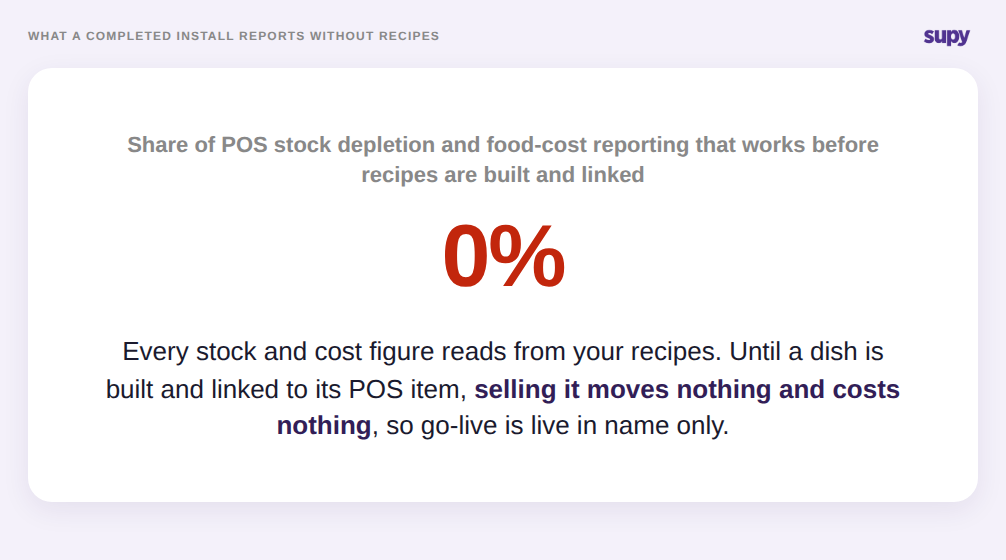
Share of stock depletion and food cost reporting that works before recipes are built is zero


The Data Prerequisites Teams Discover Too Late

Recipe setup does not start with recipes. It starts with clean inputs, and those inputs are usually where the onboarding timeline slips. Before a recipe can be costed, every ingredient has to exist as a single Base Item with its supplier packaging and prices attached. Before those costs are trustworthy, the system needs real purchase history, several months of invoices, so an ingredient price reflects what you actually pay rather than a one-off number typed at setup.

Teams consistently scope these as quick exports and discover they take weeks. A single-site operator described submitting full item lists and months of invoice history as hard prerequisite gates, creating a multi-week implementation window during which new invoices risked being missed entirely. The lesson is to treat data readiness as the first phase of recipe setup, not a formality that happens before it. If the item list is partial or the invoice history is thin, recipe setup cannot produce correct numbers no matter how carefully the recipes themselves are built.
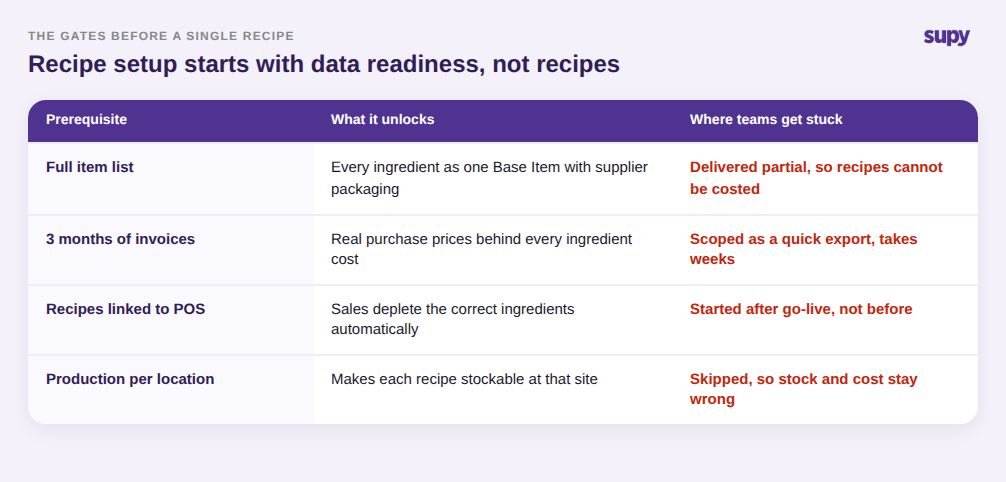
Recipe setup prerequisites: full item list, invoice history, recipes linked to POS, production per location


Where Half-Finished Setup Silently Breaks Your Numbers

The most damaging failure mode is not skipped recipe setup. It is recipe setup that looks done but is missing a setting, because the platform will happily report wrong numbers rather than warn you. The key mechanism to understand: a recipe only becomes stockable when at least one location has production enabled for it. A recipe without that setting stays non-stockable and is costed differently, so a half-configured recipe produces stock and cost figures that quietly disagree with reality.

The damage cascades. When batch and production recipes are not set up, production events cannot convert raw ingredients into prepped stock, so an entire layer of inventory tracking silently switches off. A head chef at a multi-site group flagged exactly this: prep that is made every day never appears in stock because the recipe behind it was never configured for production. The costing side is more forgiving once setup is right, because Supy uses a 365-day rolling weighted average for ingredient cost, so a single high-price delivery does not spike a recipe, and recipes can carry a target food-cost percentage that alerts when a dish drifts over it. But none of that self-correction happens for a recipe that was never finished. The number is not missing, which is the trap. It is present, confident and wrong.
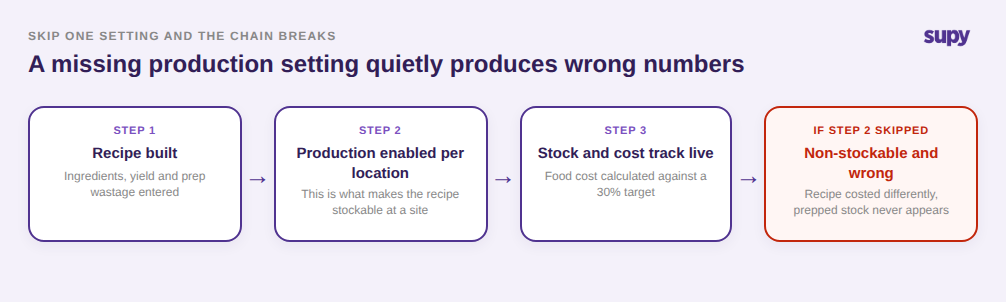
If the per-location production setting is skipped, a recipe stays non-stockable and reports wrong numbers


How to Sequence Recipe Setup So Go-Live Is Real

Recipe setup is finite, but only if you sequence it by what actually blocks value rather than by menu order. The work splits cleanly on two questions: how much does this recipe drive value, and how much effort is it to set up correctly. Start with the small share of the menu that generates most sales, get those plated recipes linked to their POS items, and turn on production per location so they are stockable from day one. That is the set that makes go-live real.

Confirm the quick, high-impact prerequisites next: the item list is complete, Base Items carry supplier prices, and prep recipes for anything you make in-house exist and are production-enabled. Defer the genuinely low-stakes work, such as full printable cookbooks with per-step photos and rarely-sold seasonal specials, until after the numbers are flowing. Sequenced this way, the capabilities that justify the whole rollout, live stock depletion, food-cost reporting, production tracking and forecast-driven ordering, come online at go-live instead of weeks after it.
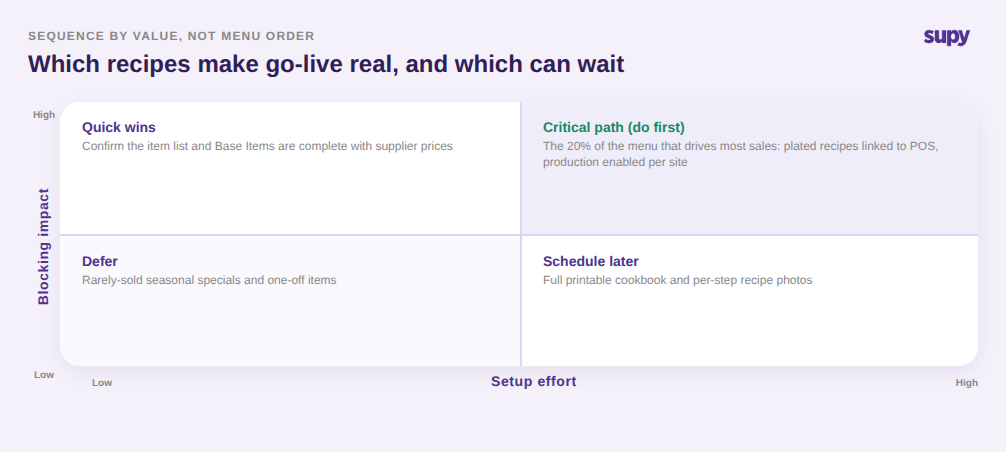
Sequencing recipe setup by blocking impact and effort: do core POS-linked recipes first, defer cookbooks


The self-diagnostic is quick. Pull up your live stock report and pick three dishes you sold yesterday: if selling them did not move the ingredients, those recipes are not linked. Check whether your daily prep shows as stock: if it does not, those production recipes are not set up. And look for any recipe reporting a food cost with no target set against it. Each gap is a recipe that was counted as done but is not, and each one is a number you cannot yet trust.

Fixing them is what turns a technical go-live into a real one. If you want to see what a complete recipe setup looks like before your own rollout, and how Supy sequences it so stock and cost track from the first day, a short walkthrough is the fastest way to scope it accurately.
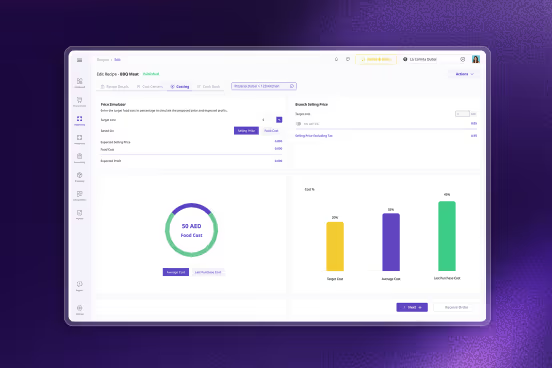
Book a Demo with Supy to see restaurant recipe setup done right

Ready to optimize your restaurant operations?

Blog

Our operational insights

No items found.

Your questions 
answered

Everything you need to know about Supy — from setup to integrations, pricing, and daily use. If it’s not covered here, just ask.

Was ist die Rezepteinrichtung in Restaurantsoftware?
+

Die Rezepteinrichtung umfasst die Arbeit, jedes Gericht und jeden Vorbereitungsartikel in der Plattform aufzubauen: Zutaten, Mengen, Ausbeute und Schwund zu erfassen und das Rezept mit dem entsprechenden POS-Menüartikel zu verknüpfen, der es verkauft. Diese Verknüpfung ermöglicht es, dass ein Verkauf automatisch den korrekten Bestand reduziert und den Wareneinsatz berechnet. Es ist kein kosmetischer Schritt und keine Trainingsübung. Es ist die Verbindung zwischen Ihrem Menü, Ihrem Lagerbestand und Ihrer Kasse – solange sie nicht vorhanden ist, hat die Plattform keine Möglichkeit, einen Verkauf in eine Bestandsbewegung oder eine Kostenzahl umzuwandeln.

Warum stocken Einführungen von Restaurantsoftware vor dem Go-live?
+

Der Grund für den Stillstand liegt meist darin, dass das Projekt auf die Installation ausgerichtet war – nicht auf die Daten dahinter. POS anbinden, Lieferanten einlesen und Personal schulen kann alles termingerecht abgeschlossen werden, und dennoch meldet die Plattform nichts, weil die Rezepte nie fertiggestellt wurden. Bestandsabgang und Wareneinsatz-Berichterstattung bleiben dunkel, bis jedes Gericht aufgebaut und mit dem entsprechenden POS-Artikel verknüpft ist. Teams behandeln die Rezepteinrichtung als eine Aufgabe, die nach dem Go-live erfolgt – dabei ist sie die Voraussetzung dafür, dass der Go-live überhaupt etwas bedeutet. Die Fertigstellung der Installation ist nicht dasselbe wie eine funktionsfähige Plattform.

Welche Daten werden benötigt, bevor die Rezepteinrichtung beginnen kann?
+

Zunächst müssen zwei Voraussetzungen erfüllt sein: eine vollständige Artikelliste und eine reale Einkaufshistorie. Jede Zutat muss als einzelner Basisartikel mit den zugehörigen Lieferantenverpackungen und -preisen vorhanden sein, damit ein Rezept eine Grundlage für die Kalkulation hat. Die Plattform benötigt außerdem Rechnungen aus mehreren Monaten, damit die Kosten einer Zutat das tatsächlich bezahlte Preisniveau widerspiegeln – und nicht eine einmalig eingetragene Zahl bei der Einrichtung. Teams schätzen diese Vorbereitungen häufig als schnelle Exporte ein und stellen fest, dass sie Wochen in Anspruch nehmen. Die Datenbereitschaft als erste Phase der Rezepteinrichtung zu behandeln – und nicht als Formalität davor – ist das, was den Zeitplan realistisch hält.

Was passiert, wenn die Rezepteinrichtung nur halb abgeschlossen ist?
+

Was eine unvollständige Einrichtung so gefährlich macht, ist, dass die Plattform falsche Zahlen ausgibt, anstatt Sie zu warnen. Ein Rezept wird erst dann bestandsfähig, wenn für mindestens einen Standort die Produktion aktiviert wurde; ohne diese Einstellung bleibt es nicht bestandsfähig und wird unterschiedlich kalkuliert – die Werte weichen daher still von der Realität ab. Fehlende Batch- und Produktionsrezepte bedeuten, dass Produktionsereignisse keine Zutaten in vorbereiteten Bestand umwandeln können, sodass eine gesamte Nachverfolgungsebene kommentarlos deaktiviert wird. Die Zahl ist nicht leer – das ist die Falle: Sie ist vorhanden, wirkt schlüssig und ist dennoch falsch. Niemand bemerkt es, bis eine Abweichung oder eine Marge auffällig wird.

Wie lange dauert die Rezepteinrichtung in der Regel?
+

Wie lange dies dauert, hängt fast ausschließlich von der Datenbereitschaft und der Menügröße ab – nicht von der Software. Die eigentliche Rezepterstellung ist schnell erledigt, sobald die Eingaben vollständig sind. Das Zusammenstellen einer vollständigen Artikelliste, das Erfassen von Lieferantenpreisen und das Aufbereiten mehrerer Monate Rechnungshistorie verlängert Projekte häufig um Wochen, die im ursprünglichen Plan nicht vorgesehen waren. Der praktische Weg, diesen Zeitaufwand zu reduzieren, ist eine wertebasierte Reihenfolge: Beginnen Sie mit dem kleinen Teil des Menüs, der den größten Umsatz generiert, und stellen Sie sicher, dass diese Rezepte bestandsfähig sind – anstatt alphabetisch alle Artikel abzuarbeiten. So liefert die Plattform bereits ab dem Go-live Mehrwert, während der Rest nachgezogen wird.

Wie wirkt sich die Rezepteinrichtung auf die Wareneinsatz-Berichterstattung aus?
+

Die Berechnung des Wareneinsatzes hängt vollständig von dem Rezept ab, das hinter jedem Gericht steht. Sobald ein Rezept erstellt und verknüpft ist, ergibt sich seine Kalkulation aus einem rollenden gewichteten 365-Tage-Durchschnitt der Zutatenpreise – so verfälscht eine einzelne teure Lieferung den Wert nicht, und Sie können einen Ziel-Wareneinsatz in Prozent festlegen, der Sie benachrichtigt, wenn ein Gericht diesen überschreitet. Diese Selbstkorrektur findet nicht statt, wenn ein Rezept nie fertiggestellt wurde. Eine vollständige Rezepteinrichtung ist der Unterschied zwischen einem Wareneinsatz-Bericht, auf dessen Grundlage Sie handeln können, und einem, der präzise wirkt, aber auf Lücken aufgebaut ist.

Wie sollte eine Gruppe mit mehreren Standorten die Einrichtung von Rezepten sequenzieren?
+

Die Reihenfolge der Einrichtung sollte sich am Mehrwert und an der Blockadewirkung orientieren, nicht an der Speisekarte. Beginnen Sie mit dem kleinen Teil des Menüs, der den größten Umsatz generiert, verknüpfen Sie diese plattierten Rezepte mit den entsprechenden POS-Artikeln, und aktivieren Sie die Produktion je Standort, sodass sie ab Tag eins eingelagert werden können. Stellen Sie anschließend sicher, dass die grundlegenden Voraussetzungen erfüllt sind: eine vollständige Artikelliste, Basisartikel mit Lieferantenpreisen und Vorbereitungsrezepte für alles, was intern hergestellt wird. Verschieben Sie weniger kritische Aufgaben wie vollständige druckbare Kochbücher und saisonale Specials auf einen späteren Zeitpunkt, wenn die Zahlen bereits fließen. Auf diese Weise gehen Live-Bestand, Wareneinsatz und Produktionsverfolgung bereits zum Go-live-Zeitpunkt in Betrieb – und nicht erst Wochen später.

Bereit, Ihre Abläufe zu transformieren?

Schließen Sie sich mehr als 3.500 Restaurantbetreibern an, die mit Supy Kosten senken, Abläufe optimieren und klügere Entscheidungen treffen.