Beschaffung

Credit Note, Zero-Quantity GRN, or Standalone Adjustment: Which Document Fixes Which Supplier Discrepancy
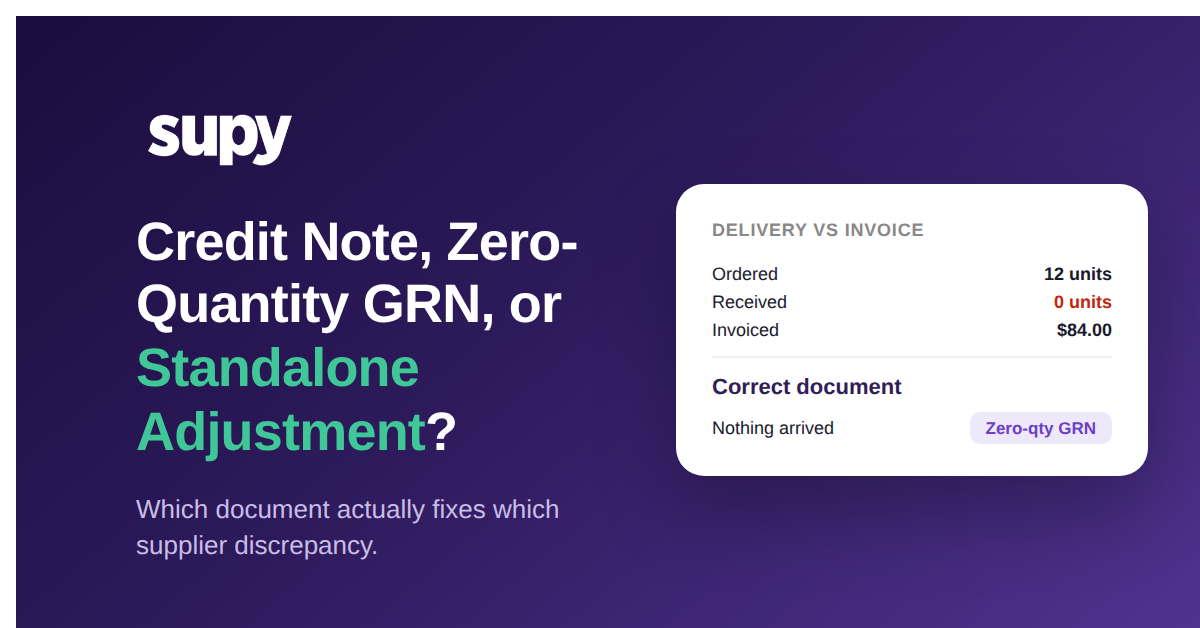
Three Documents, One Question: Which One Actually Fixes Your Discrepancy

Three documents can correct a supplier discrepancy, and each has a distinct job. A zero-quantity or edited goods received note (GRN) fixes what you catch at delivery. A credit note handles an overcharge or a return once the invoice is confirmed. A standalone credit note records a financial-only credit with no delivery attached. You pick by what went wrong, and when.

Teams get this wrong because all three end in the same place, a smaller amount owed to the supplier, so any of them looks like it worked. The difference surfaces later, in whether your stock on hand is right and whether the credit ever reaches your accounting system. Choose the wrong document and you either fix the invoice while quietly breaking the count, or settle the books on paper while your accounts never see the credit.

This guide walks the scenarios operators hit most and names the correct document for each. For the companion view on why these credits slip through the cracks operationally, see our breakdown of where supplier credit notes go missing in multi-site groups.
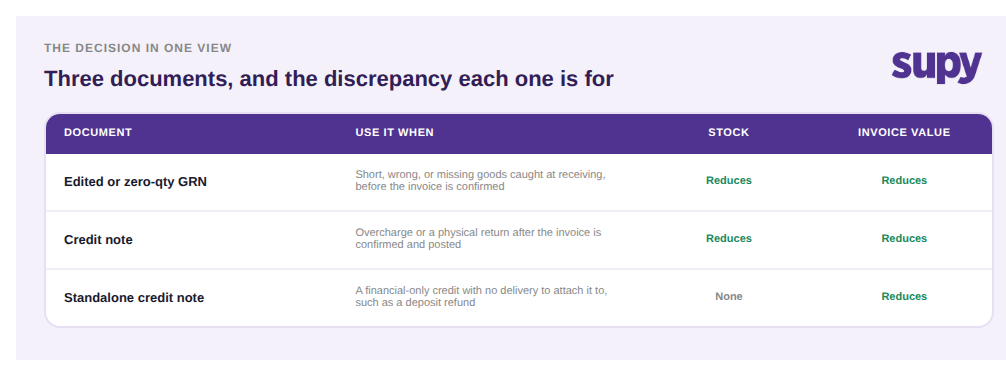
Decision table matching a zero-quantity GRN, a credit note, and a standalone credit note to the supplier discrepancy each one is for


When the Goods Never Arrived: Zero the Quantity, Do Not Raise a Credit Note

The most common misfire is raising a credit note for goods that never showed up. A supplier bills a case of 12 units at $7.00, the case never arrives, and the back of house raises a credit note to claw back the $84.00. It feels right, and it is the wrong document.

A no-show is a receiving problem, not a credit. The fix is to set the received quantity to zero on the GRN for that line, which drops both the received and the invoiced quantity for the item. The purchase order's fulfilment then recalculates from the GRN automatically, so the $84.00 is never recorded as owed and the 12 units never enter stock. Raise a credit note instead and you get the opposite result: the phantom 12 units sit in inventory inflating your count, and you have credited a charge that was never valid in the first place.
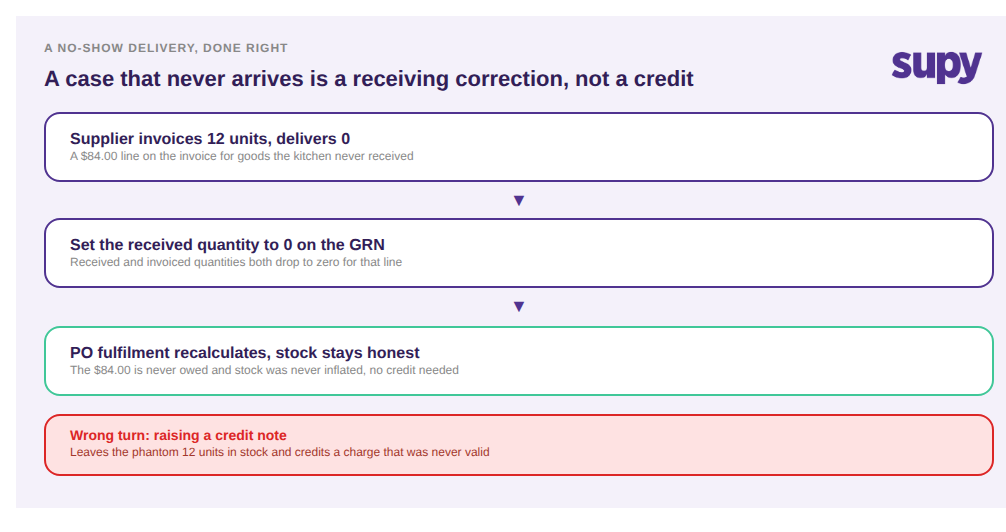
Process flow showing a no-show delivery corrected by setting the received quantity to zero on the GRN instead of raising a credit note


When You Were Overcharged or Sent Goods Back: Raise a Credit Note, Not a Negative GRN

Once an invoice is confirmed, the picture changes. If a supplier overcharged you by $45.00 on goods you did receive, or you are returning stock that was genuinely delivered, the correct document is a credit note. This is where a popular workaround does real damage: entering the credit as a negative GRN.

A negative GRN adjusts your stock and invoice value inside the procurement system, but it is not a credit note, and your accounting system treats it as nothing. It never posts as a vendor credit, never syncs to your connected accounting, and leaves no clean audit trail, so the numbers stop reconciling at month-end. A proper credit note does all of that. In Supy, recording a supplier return automatically generates a credit note and pushes it to your connected accounting as a vendor credit, so you are not rekeying the same adjustment into your ledger by hand. Credit notes for over or incorrect charges run through the same AI invoices and credit notes flow.
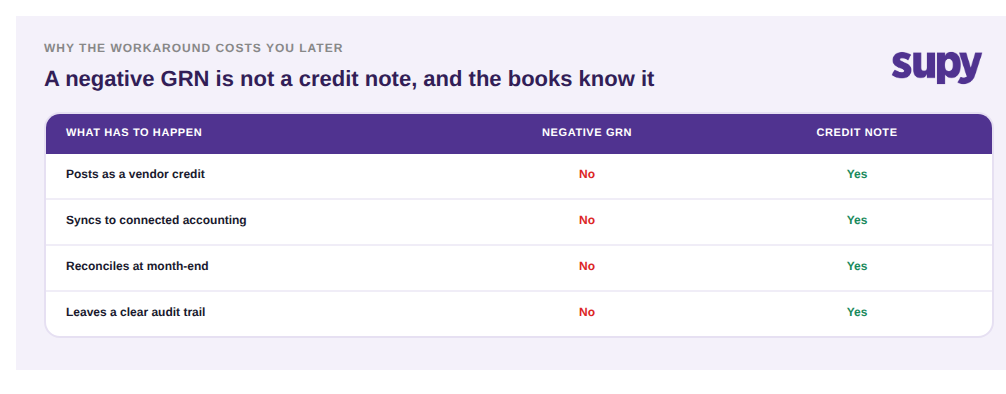
Comparison table showing a negative GRN fails to post as a vendor credit, sync to accounting, reconcile, or leave an audit trail, while a credit note does all four


When the Credit Is Financial Only: Use a Standalone Credit Note, Not a Return

Some credits have nothing to do with stock. A refund on a returnable-crate deposit of $120.00, a billing correction, a negotiated rebate: the money moves but no goods do. Treating these as a return is the mistake here, because a return reduces inventory you never actually sent back, throwing your count out by exactly the value of the item you supposedly returned.

This is what a standalone credit note is for. It records a supplier credit with no delivery to attach it to, posting against your account and flowing through to accounting without touching a single stock figure. The test is simple: ask whether physical goods moved. If nothing left your shelves, it is a standalone credit note, not a return.
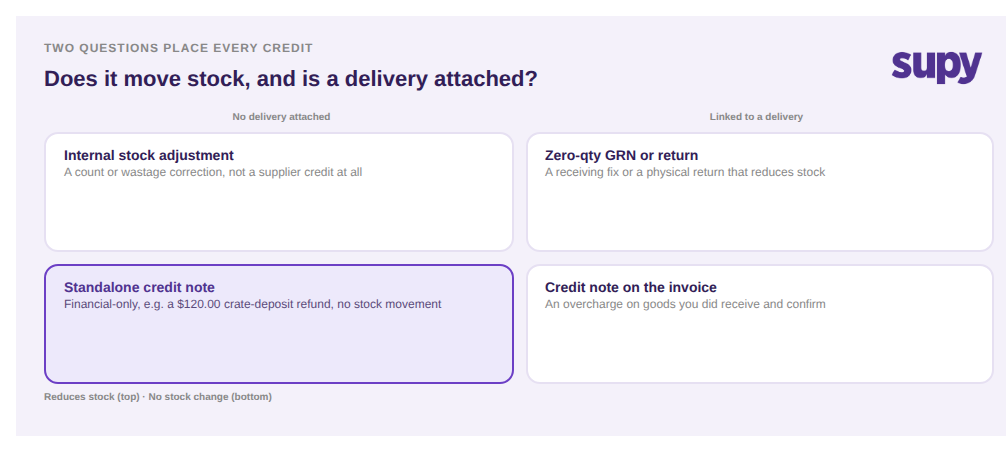
Two-axis matrix placing a standalone credit note in the no-stock, no-delivery quadrant, separate from GRN corrections, returns, and invoice credit notes


Catch It at the Right Moment: Why Timing Decides the Document

Which document is even available to you often comes down to when you notice the problem. The same $45.00 price error has three different fixes depending on the stage it is caught at.

Caught at receiving, before the delivery note is confirmed to an invoice, you edit the price or quantity directly on the GRN and move on. Once the invoice is confirmed, those edits are closed, so the correction has to come back as a credit note against the invoice. And once a GRN is posted to the ledger it is locked permanently, by design, to protect the integrity of your stock and cost records, which leaves a credit note as the only route. The earlier you catch a discrepancy, the cheaper and simpler the document you need to resolve it.
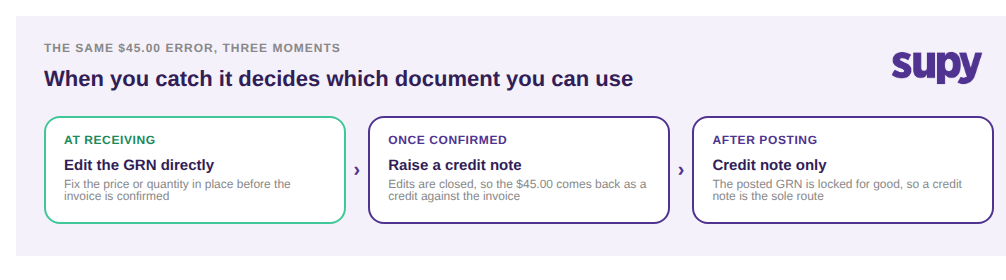
Timeline showing the same price error fixed by editing the GRN at receiving, a credit note once confirmed, and a credit note only after the GRN is posted


The rule in one line: match the document to what actually went wrong, not to the amount you want back. Ask two questions in order. First, did the goods physically move or fail to arrive? If a delivery was short or never came and you catch it at receiving, correct the GRN; if goods came back or you were overcharged after the invoice was confirmed, raise a credit note. Second, is there any delivery attached at all? If not, and the credit is purely financial, use a standalone credit note.

Run a quick check on your own operation: pull last month's supplier credits and count how many were entered as negative GRNs or chased over email instead of the system. Each one is a credit your accounts likely never reconciled, and if it was really a no-show, a phantom unit still sitting in your stock. Correcting the document is the fastest way to make your count and your ledger agree again.

This is the logic Supy is built around: credit notes and returns handled inside the system rather than over email, returns that post their own vendor credits to your accounting, and no-show deliveries corrected at the GRN so your stock never carries goods you did not receive.

Book a Demo with Supy to record every supplier discrepancy once, correctly

Ready to optimize your restaurant operations?

Blog

Our operational insights

No items found.

Your questions 
answered

Everything you need to know about Supy — from setup to integrations, pricing, and daily use. If it’s not covered here, just ask.

Was ist der Unterschied zwischen einer Gutschrift und einer GRN mit Nullmenge?
+

Eine GRN mit Nullmenge und eine Gutschrift lösen unterschiedliche Probleme. Eine GRN mit Nullmenge korrigiert eine Lieferung zum Zeitpunkt des Empfangs: Sie setzen die empfangene Menge auf null für Waren, die zu kurz geliefert wurden oder nie ankamen, und das System reduziert sowohl die empfangenen als auch die in Rechnung gestellten Beträge, bevor die Rechnung bestätigt wird. Eine Gutschrift bearbeitet eine Transaktion nach der Bestätigung der Rechnung, z. B. bei einer Überberechnung oder einer Retoure, und wird in Ihrer Buchhaltung als Lieferantengutschrift gebucht. Verwenden Sie die GRN für Empfangsfehler und die Gutschrift für Korrekturen nach der Rechnungsbestätigung.

Wann sollte ich eine eigenständige Gutschrift anstelle einer Lieferantenretoure verwenden?
+

Verwenden Sie eine eigenständige Gutschrift, wenn es sich um eine rein finanzielle Gutschrift handelt und keine Waren physisch bewegt wurden, z. B. bei der Rückerstattung einer Pfandkaution für Behälter, einer Rechnungskorrektur oder einem ausgehandelten Rabatt. Eine Lieferantenretoure ist für Waren vorgesehen, die Ihre Regale tatsächlich verlassen haben, und sollte sowohl den Bestand als auch den Rechnungswert mindern. Wenn Sie eine rein finanzielle Gutschrift als Retoure erfassen, reduziert das System den Bestand, den Sie nie zurückgesendet haben, was Ihre Inventur um den Wert der Phantomretoure verfälscht. Der Test ist einfach: Wenn nichts Ihren Standort physisch verlassen hat, wählen Sie die eigenständige Gutschrift.

Warum sollte ich ein Lieferantenguthaben nicht als negativen GRN erfassen?
+

Weil ein negativer GRN keine Gutschrift ist und Ihr Buchhaltungssystem ihn auch nicht als solche erkennt. Er passt Bestand und Rechnungswert innerhalb der Beschaffung an, wird jedoch nie als Lieferantenguthaben gebucht, nie mit Ihrer verbundenen Buchhaltung synchronisiert und hinterlässt keine saubere Prüfspur. Das Ergebnis sind Zahlen, die sich zum Monatsende nicht mehr abstimmen lassen, und ein Guthaben, das Ihr Finanzteam nicht nachvollziehen kann. Eine ordnungsgemäße Gutschrift erfasst das Guthaben, überträgt es automatisch in die Buchhaltung und hält die Belegkette lückenlos, was ein negativer GRN stillschweigend ausspart.

Wie korrigiere ich eine Rechnung für Waren, die ein Lieferant nie geliefert hat?
+

Setzen Sie die erhaltene Menge für die fehlende Position im Wareneingangsbeleg auf null, anstatt eine Gutschrift zu erstellen. Durch das Nullsetzen der Menge werden sowohl der empfangene als auch der berechnete Betrag für diesen Artikel gestrichen – die Belastung wird nie als geschuldet erfasst und die Waren gelangen nie in Ihren Bestand. Die Erfüllung der Bestellung wird automatisch anhand des Wareneingangsbelegs neu berechnet. Würden Sie stattdessen eine Gutschrift erstellen, würden die nicht gelieferten Einheiten im Lagerbestand verbleiben und eine Belastung gutgeschrieben, die nie gültig war. Die Korrektur am Wareneingang ist daher sowohl einfacher als auch präziser.

Kann ich eine Lieferantenabweichung noch korrigieren, nachdem die Rechnung gebucht wurde?
+

Ja, aber die Optionen werden enger, je weiter das Dokument seinen Lebenszyklus durchläuft. Wird die Abweichung beim Wareneingang festgestellt – bevor der Lieferschein zur Rechnung wird –, können Sie Menge oder Preis direkt im Wareneingangsbeleg bearbeiten. Sobald die Rechnung bestätigt ist, werden diese Bearbeitungsmöglichkeiten gesperrt und die Korrektur muss als Gutschrift erfolgen. Nachdem ein Wareneingangsbeleg ins Hauptbuch gebucht wurde, wird er dauerhaft gesperrt, um die Integrität Ihrer Bestands- und Kostendatensätze zu schützen – eine Gutschrift ist dann der einzige Weg. Je früher Sie die Abweichung erkennen, desto einfacher ist die Korrektur.

Erstellt das Erfassen einer Lieferantenretoure automatisch eine Gutschrift?
+

Ja. Wenn Sie in Supy eine Lieferantenretoure erfassen, wird automatisch eine Gutschrift erstellt und als Lieferantenguthaben an Ihr verbundenes Buchhaltungssystem übermittelt. Das bedeutet, dass Sie dieselbe Anpassung nicht manuell in Ihr Buchhaltungssystem eintragen müssen – Retoure, Gutschrift und Buchungseintrag bleiben miteinander verknüpft. Dies ist bei physischen Rücksendungen relevant, bei denen Bestand und Rechnungswert gleichzeitig sinken müssen. Für eine rein finanzielle Gutschrift ohne Warenbewegung würden Sie stattdessen eine eigenständige Gutschrift anstelle einer Retoure verwenden.

Welches Dokument sollte ich für eine rein finanzielle Rückerstattung wie eine Kaution verwenden?
+

Verwenden Sie eine eigenständige Gutschrift. Eine Kautionsrückerstattung, z. B. Geld zurück für Pfandbehälter, bewegt Wert, aber keine Waren, und sollte daher nie Ihren Warenbestand berühren. Eine eigenständige Gutschrift erfasst das Lieferantenguthaben auf Ihrem Konto und fließt in die Buchhaltung ein, ohne eine einzige Bestandszahl zu verändern. Wenn Sie es als Retoure erfassen, wird der Bestand reduziert, obwohl Sie nichts zurückgesendet haben; wenn Sie es als GRN-Bearbeitung erfassen, wird eine korrekte Lieferung falsch ausgewiesen. Wenn Geld fließt, aber nichts Ihre Regale verlässt, ist die eigenständige Gutschrift der richtige Weg.

Bereit, Ihre Abläufe zu transformieren?

Schließen Sie sich mehr als 3.500 Restaurantbetreibern an, die mit Supy Kosten senken, Abläufe optimieren und klügere Entscheidungen treffen.