.jpeg)


Credit Note, Zero-Quantity GRN, or Standalone Adjustment: Which Document Fixes Which Supplier Discrepancy
Three Documents, One Question: Which One Actually Fixes Your Discrepancy
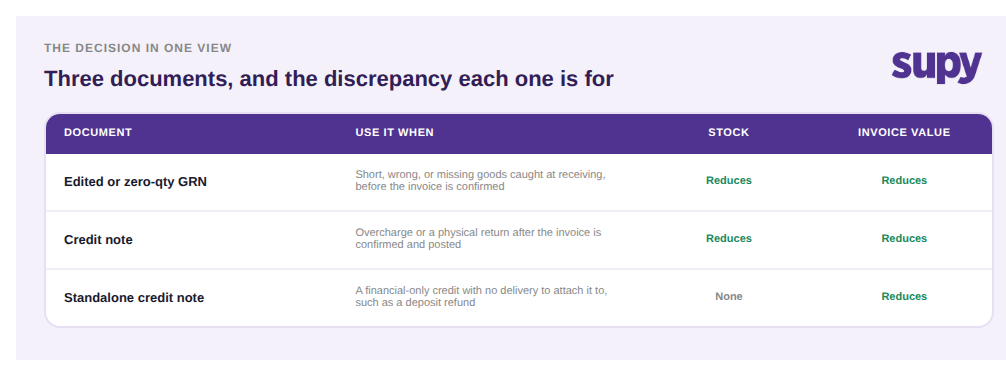
Three documents can correct a supplier discrepancy, and each has a distinct job. A zero-quantity or edited goods received note (GRN) fixes what you catch at delivery. A credit note handles an overcharge or a return once the invoice is confirmed. A standalone credit note records a financial-only credit with no delivery attached. You pick by what went wrong, and when.
Teams get this wrong because all three end in the same place, a smaller amount owed to the supplier, so any of them looks like it worked. The difference surfaces later, in whether your stock on hand is right and whether the credit ever reaches your accounting system. Choose the wrong document and you either fix the invoice while quietly breaking the count, or settle the books on paper while your accounts never see the credit.
This guide walks the scenarios operators hit most and names the correct document for each. For the companion view on why these credits slip through the cracks operationally, see our breakdown of where supplier credit notes go missing in multi-site groups.
When the Goods Never Arrived: Zero the Quantity, Do Not Raise a Credit Note
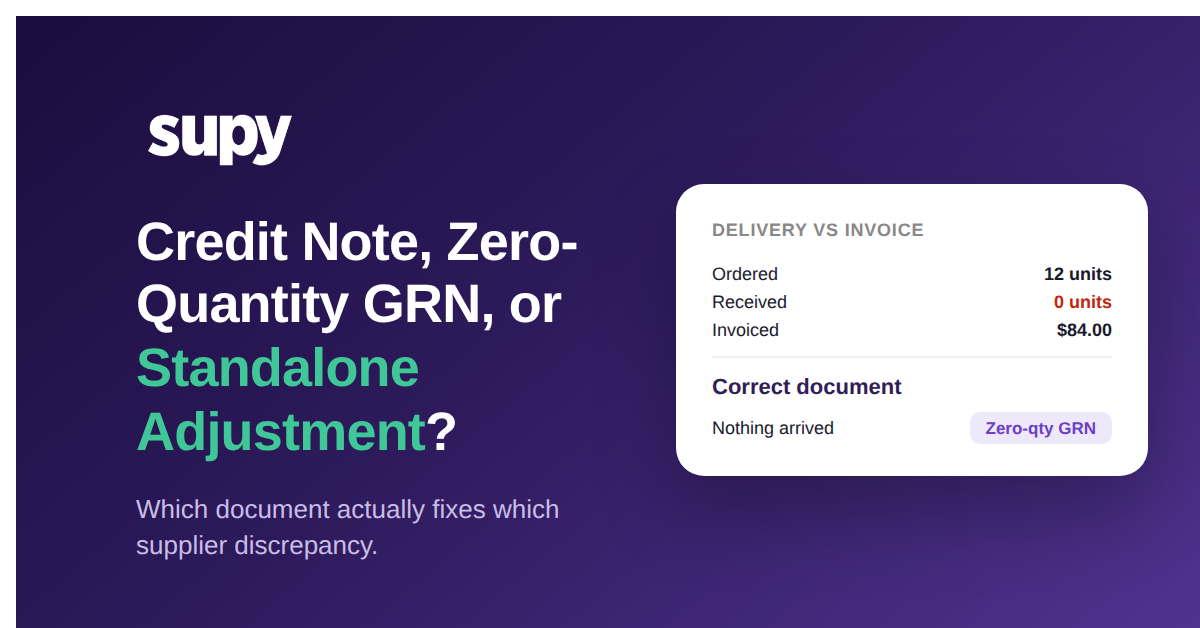
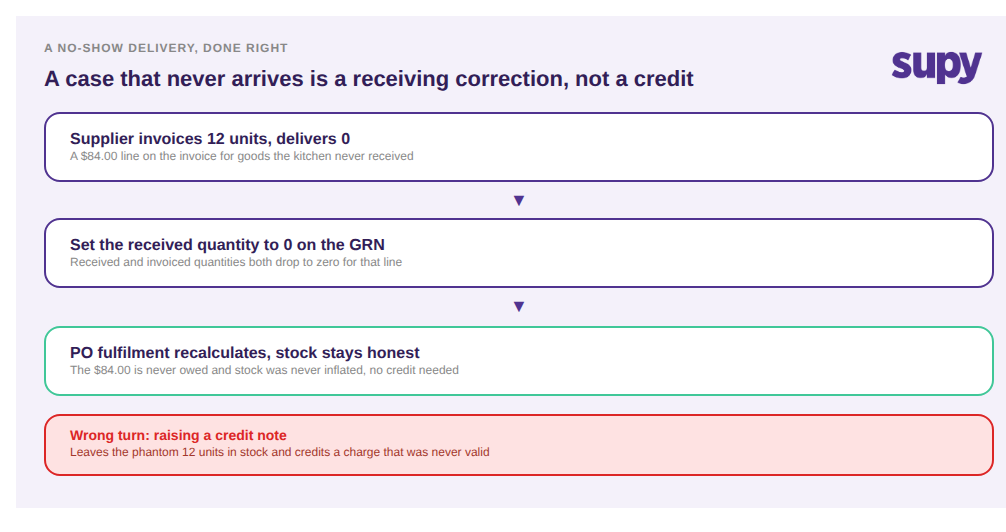
The most common misfire is raising a credit note for goods that never showed up. A supplier bills a case of 12 units at $7.00, the case never arrives, and the back of house raises a credit note to claw back the $84.00. It feels right, and it is the wrong document.
A no-show is a receiving problem, not a credit. The fix is to set the received quantity to zero on the GRN for that line, which drops both the received and the invoiced quantity for the item. The purchase order's fulfilment then recalculates from the GRN automatically, so the $84.00 is never recorded as owed and the 12 units never enter stock. Raise a credit note instead and you get the opposite result: the phantom 12 units sit in inventory inflating your count, and you have credited a charge that was never valid in the first place.
When You Were Overcharged or Sent Goods Back: Raise a Credit Note, Not a Negative GRN
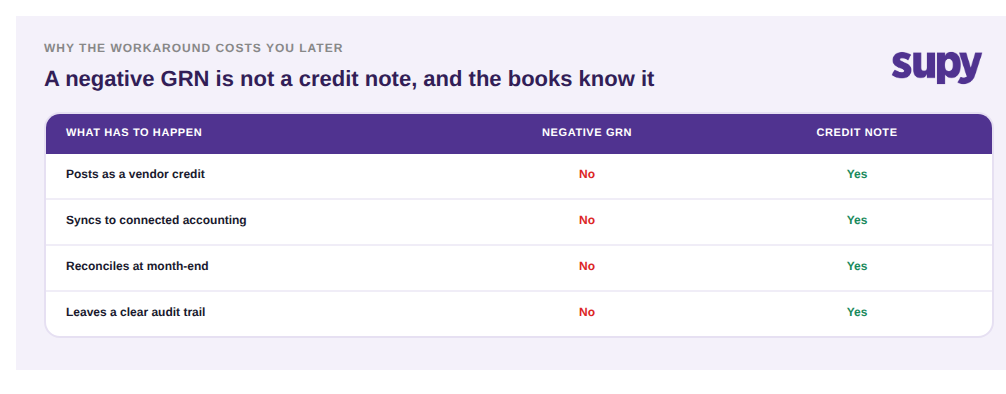
Once an invoice is confirmed, the picture changes. If a supplier overcharged you by $45.00 on goods you did receive, or you are returning stock that was genuinely delivered, the correct document is a credit note. This is where a popular workaround does real damage: entering the credit as a negative GRN.
A negative GRN adjusts your stock and invoice value inside the procurement system, but it is not a credit note, and your accounting system treats it as nothing. It never posts as a vendor credit, never syncs to your connected accounting, and leaves no clean audit trail, so the numbers stop reconciling at month-end. A proper credit note does all of that. In Supy, recording a supplier return automatically generates a credit note and pushes it to your connected accounting as a vendor credit, so you are not rekeying the same adjustment into your ledger by hand. Credit notes for over or incorrect charges run through the same AI invoices and credit notes flow.
When the Credit Is Financial Only: Use a Standalone Credit Note, Not a Return
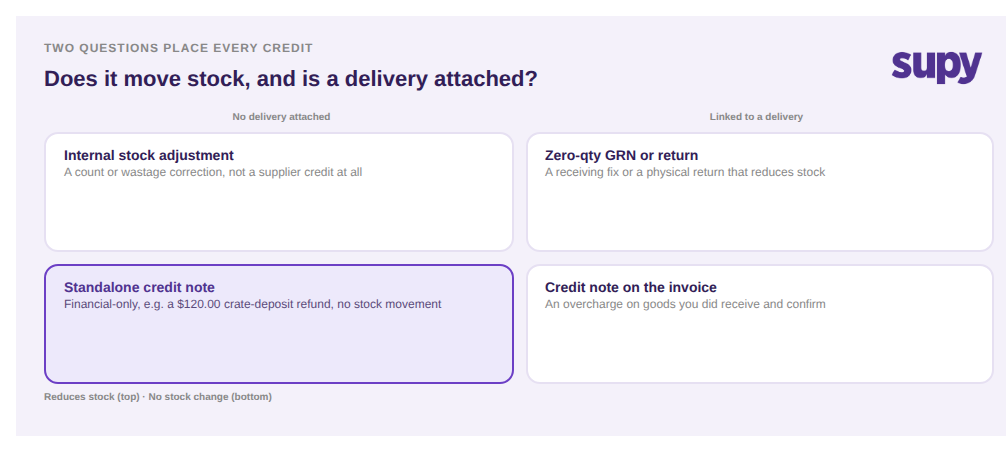
Some credits have nothing to do with stock. A refund on a returnable-crate deposit of $120.00, a billing correction, a negotiated rebate: the money moves but no goods do. Treating these as a return is the mistake here, because a return reduces inventory you never actually sent back, throwing your count out by exactly the value of the item you supposedly returned.
This is what a standalone credit note is for. It records a supplier credit with no delivery to attach it to, posting against your account and flowing through to accounting without touching a single stock figure. The test is simple: ask whether physical goods moved. If nothing left your shelves, it is a standalone credit note, not a return.
Catch It at the Right Moment: Why Timing Decides the Document
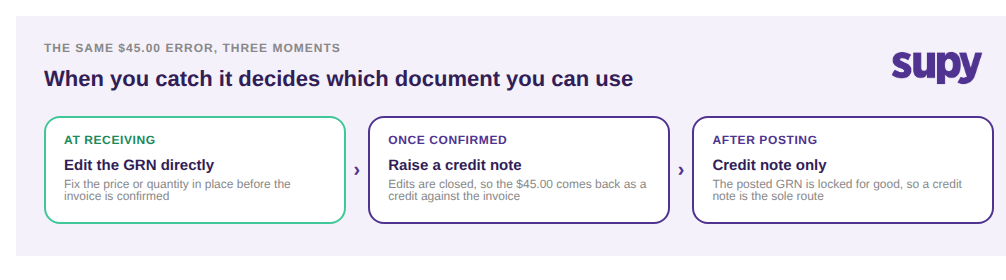
Which document is even available to you often comes down to when you notice the problem. The same $45.00 price error has three different fixes depending on the stage it is caught at.
Caught at receiving, before the delivery note is confirmed to an invoice, you edit the price or quantity directly on the GRN and move on. Once the invoice is confirmed, those edits are closed, so the correction has to come back as a credit note against the invoice. And once a GRN is posted to the ledger it is locked permanently, by design, to protect the integrity of your stock and cost records, which leaves a credit note as the only route. The earlier you catch a discrepancy, the cheaper and simpler the document you need to resolve it.
The rule in one line: match the document to what actually went wrong, not to the amount you want back. Ask two questions in order. First, did the goods physically move or fail to arrive? If a delivery was short or never came and you catch it at receiving, correct the GRN; if goods came back or you were overcharged after the invoice was confirmed, raise a credit note. Second, is there any delivery attached at all? If not, and the credit is purely financial, use a standalone credit note.
Run a quick check on your own operation: pull last month's supplier credits and count how many were entered as negative GRNs or chased over email instead of the system. Each one is a credit your accounts likely never reconciled, and if it was really a no-show, a phantom unit still sitting in your stock. Correcting the document is the fastest way to make your count and your ledger agree again.
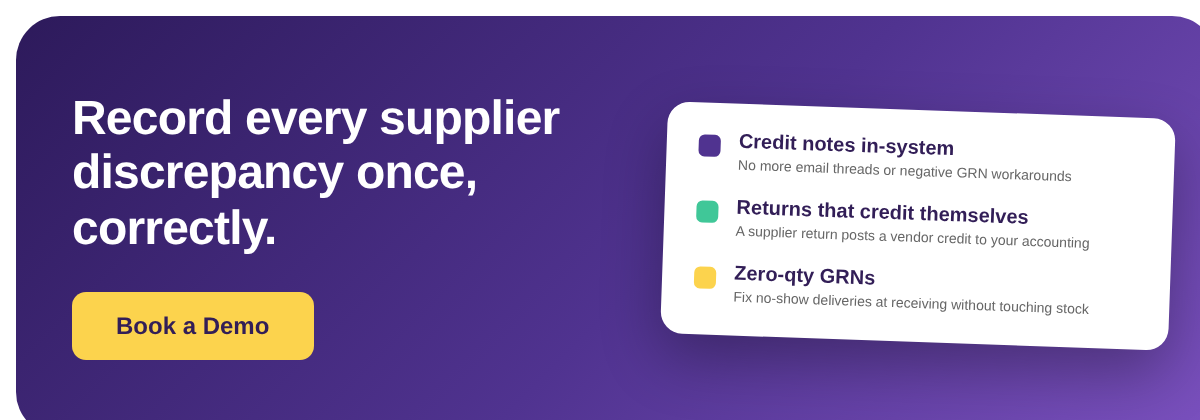
This is the logic Supy is built around: credit notes and returns handled inside the system rather than over email, returns that post their own vendor credits to your accounting, and no-show deliveries corrected at the GRN so your stock never carries goods you did not receive.