.jpg)


Average Cost Accuracy in Restaurant Inventory: How Inactive and Zero-Priced Items Distort It
What a Distorted Average Cost Looks Like on Your Recipe Margins
Weighted-average cost is the running unit cost your system holds for an ingredient: every receipt blends into one number, and your recipes read that number when they calculate a plate cost. When it drifts below what you actually pay, every recipe built on the item understates its cost, and the margin you report is better than the margin you earn.
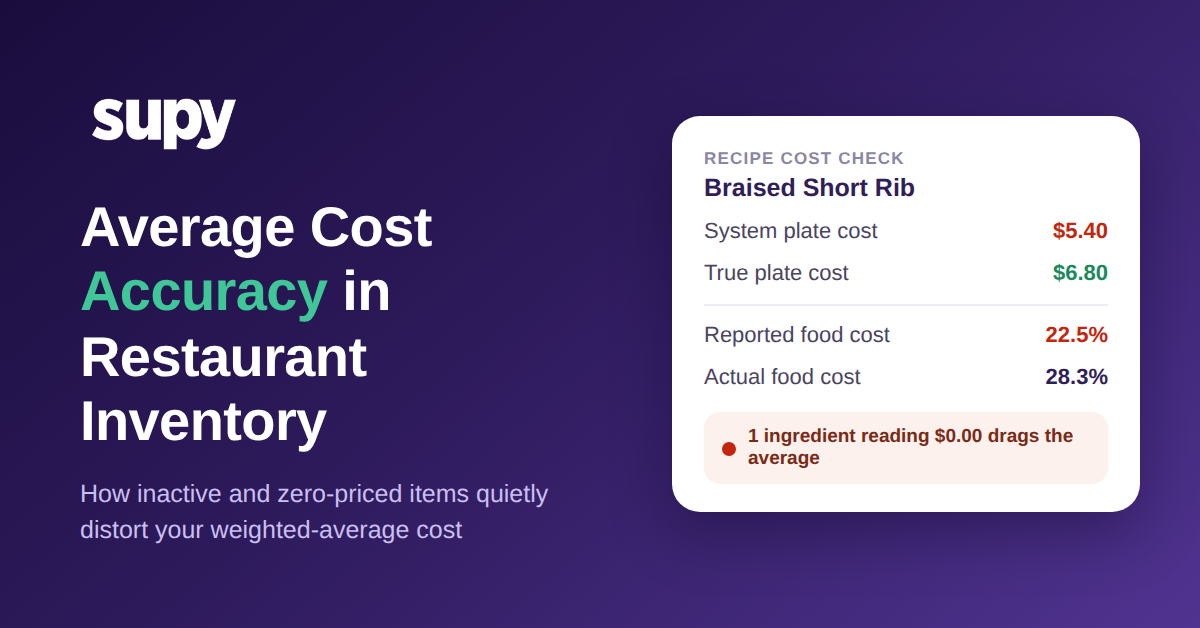
The tell is a recipe cost that looks too good. A Braised Short Rib that should cost $6.80 a plate reads as $5.40, a 21% understatement, and at a $24.00 menu price your reported food cost drops from a true 28.3% to a comfortable-looking 22.5%. Nothing on the plate changed. A cost input went to zero somewhere upstream, and that 5.8 point gap is now baked into every margin report, menu-engineering call, and pricing review that trusts it. Two item conditions cause almost all of this: items that have gone inactive and lost their stored cost, and items priced at zero that still get pulled into the average. The rest of this guide shows how to tell which one you are looking at, and how to fix each.

Why Inactive Items Lose Their Cost and Drag the Average Down
An item with no stock movement for six months or more is commonly auto-marked inactive, and inactivity often strips its stored pricing. The unit cost it carried, the real price you last paid, reads as zero. If that item is still an ingredient in a live recipe, or gets received again later, the zero flows straight into the weighted-average calculation and pulls it down.
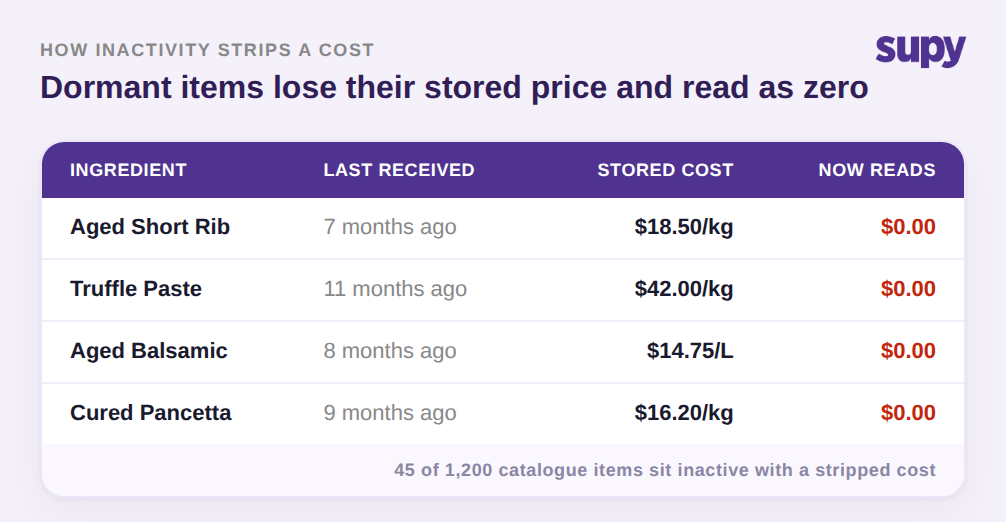
The common workaround makes it worse. To re-establish a cost quickly, operators raise a dummy invoice: a fake receipt at a guessed price, just to get a number back into the field. It restores a value, but it is not the real cost, it has no supplier or document behind it, and it leaves a hygiene problem in your purchase records that someone untangles at month end. A guessed cost is still a wrong cost. The clean move is to recover the actual last price, which the fix section below covers. If duplicate or badly structured items are also in play, the wider discipline is item master-data hygiene.
How Zero-Priced Items Quietly Enter the Average-Cost Calculation
The second cause does not need six months of inactivity. A zero-priced item, a free supplier sample, an uncosted inter-branch transfer, or a promotional case received but never invoiced, enters your records at $0.00 and, in many setups, is pulled into the global average-cost calculation the moment it lands. One zero receipt among a handful of real ones drags the blended cost down immediately.

Because these receipts look legitimate, they are real goods that really arrived, they rarely get flagged. Finance teams running multi-location groups have asked for account-level control to stop zero-priced items from counting toward average cost at all, which tells you how routine the distortion is. Until an item's receipts all carry real prices, its average cost is only as trustworthy as its worst line.
How to Trace a Wrong Average Cost Back to the Item Causing It
When a recipe cost looks wrong, you do not have to audit the whole catalogue. Work back from the recipe to its ingredients and check each item's current unit cost against what you last paid. The item that reads zero, or far below its real price, is your culprit, and one question tells you which fix it needs.
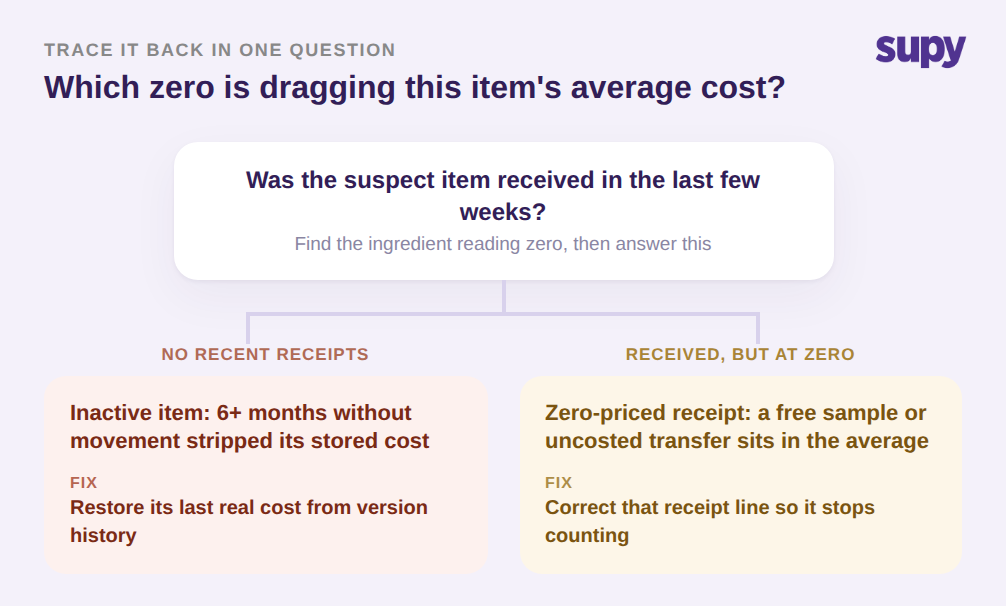
Ask: was the item received in the last few weeks? If it has had no recent receipts and reads zero, it is an inactive item whose stored cost was stripped, so restore its last real cost. If it was received recently but at $0.00, a zero-priced receipt is sitting in its average, so correct that receipt line and stop the free or uncosted arrival from counting. In a catalogue of 1,200 items, the handful that matter, say 45 inactive and 18 zero-priced, are easy to isolate once you know both signatures, and a cost-change or weighted-average audit report that lists items whose cost recently dropped points you straight at them.
The Clean Fix: Rebuild Real Costs and Lean on the Audit Trail
Fixing the number properly takes four steps, and none of them is a dummy invoice.

First, detect: run the cost report or audit log and find every item whose unit cost reads zero, or dropped sharply without a matching real receipt. Second, restore the real cost. When you keep one base item per ingredient with full version history, you restore the last valid cost the item actually carried instead of guessing at one, so the number you put back is the number you really paid. Third, recalculate: because recipe and weighted costs recompute as prices change, correcting the item cost flows through to every recipe that uses it, and your plate costs and food-cost percentages snap back to the truth. Fourth, log it: an audit log that records every cost change with before and after values, tied to a named user and timestamp, and that no one can edit or delete, means the correction is documented rather than buried, so the next person who sees the item does not undo it or reach for another dummy invoice.
So name the branch you are in. If your recipe cost looks too low and the suspect item has not been received in months, you are in the inactive-item branch: restore its last real cost from version history and let the recipe cost recompute. If the item was received recently at zero, you are in the zero-priced branch: fix that receipt line so the free or uncosted arrival stops dragging the average. Either way, the one move that keeps it fixed is documenting the correction in an audit trail instead of papering over it with a guessed invoice, because a cost you can trace is a cost the whole team can trust.