.jpg)


Central Kitchen Production Planning: How to Match Daily Prep to Multi-Site Demand
What a Central Kitchen Production Plan Actually Is
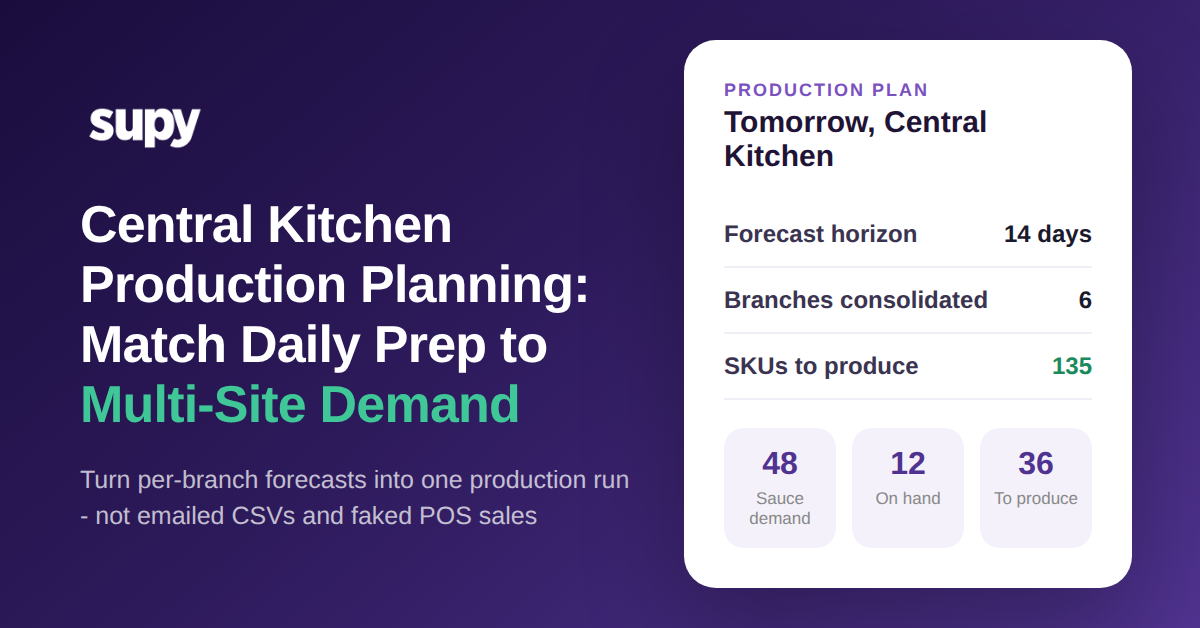
A central kitchen production plan is the daily list of what your central kitchen will make and in what quantity, built from each outlet's forecast demand minus what is already in stock. Done well, it tells the prep team exactly how many batches of every sauce, dough and packaged item to produce before anyone touches a mixing bowl.
The plan is not a standing recipe or a fixed prep sheet that repeats every day. It is a moving target that follows real demand across your sites, so a slow Tuesday and a busy Friday do not produce the same quantities. When the plan is right, the kitchen makes enough to cover every branch order without over-producing perishable stock that ends up as waste. It sits at the centre of wider central kitchen operations, connecting your demand forecast, your branch requisitions and your prep production into one sequence.
Why Prep Planning Breaks When Branch Demand Lives in Email and the POS
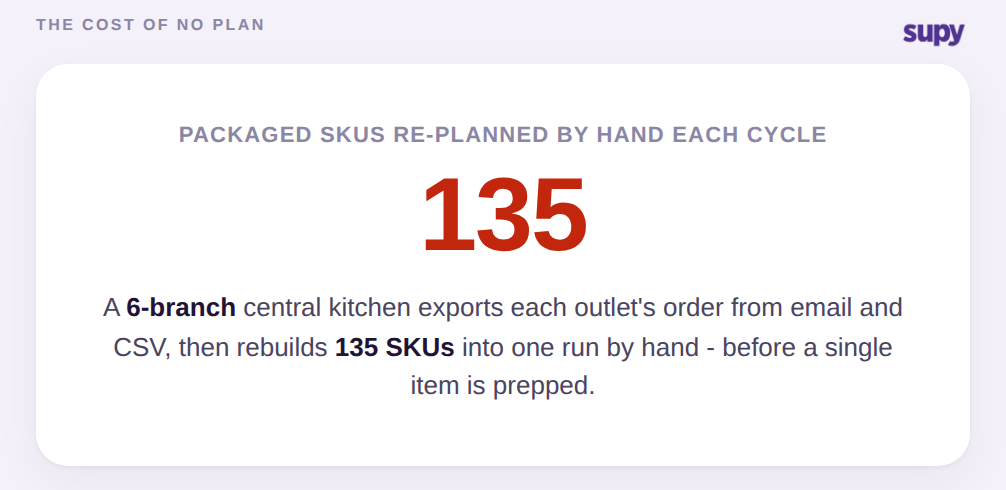
Most multi-site kitchens do not fail to plan because they lack the skill. They fail because the demand they need is scattered. Each branch sends its order by email or a CSV export, and someone in the central kitchen re-keys those into a single list by hand every cycle. A six-branch group manufacturing well over a hundred packaged items ends up rebuilding the same run from scratch every day, and every re-key is a chance to miss a line or fat-finger a quantity.
The workarounds are worse than the gap. Kitchens with no real central-kitchen tooling often run production through the point-of-sale system instead, entering fake branch sales just to move stock off the books. Raw ingredients and finished goods then sit in one undivided stock view, so no one can see what actually needs producing versus what is already made. The plan becomes guesswork dressed up as a spreadsheet.
Forecast Demand Before You Build the Production Plan
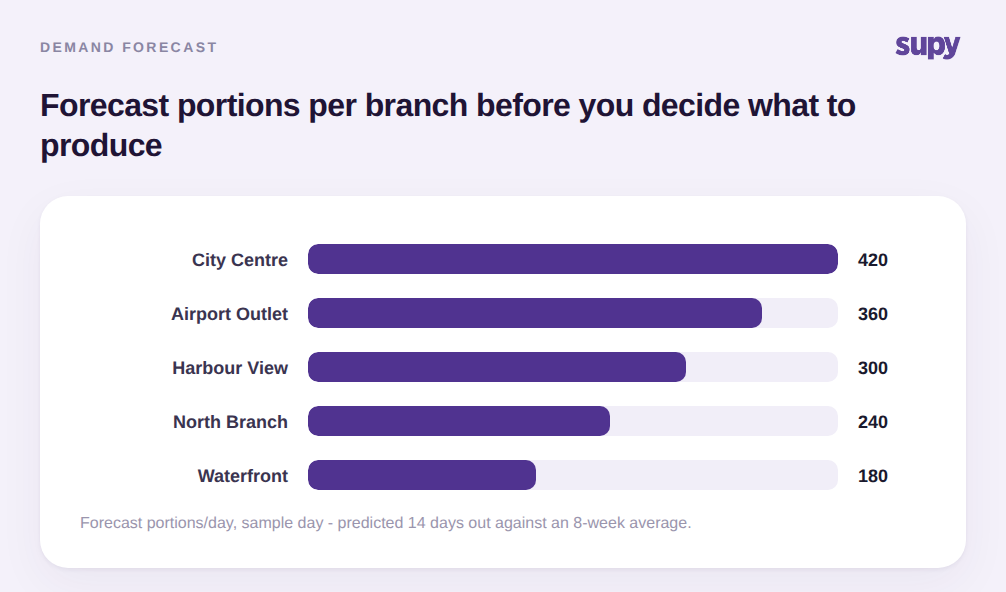
A production plan is only as good as the demand number it starts from. Beginning with last week's figures, or a gut feel, is what drives the twin failures of over-ordering perishables and running out mid-service. The first move is to forecast, per branch, what each site will actually sell.
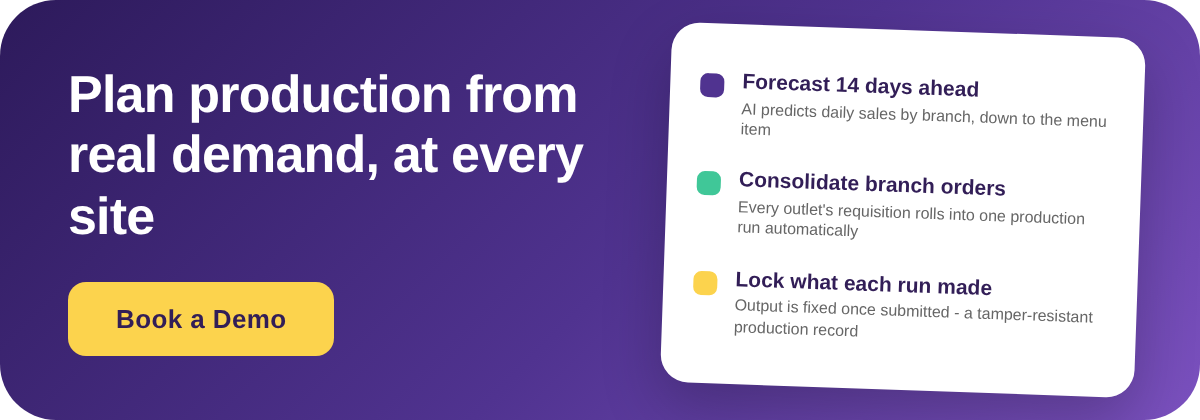
Supy's AI sales forecasting predicts daily sales by branch for 14 days out, down to the individual menu item, and shows each prediction against an 8-week historical average so you can sanity-check it. A manager who knows about a local event the model cannot see can override any day or item without retraining the model. That forecast is the input that turns a production plan from a repeated habit into a demand-led decision.
Consolidate Branch Requisitions Into One Production Run
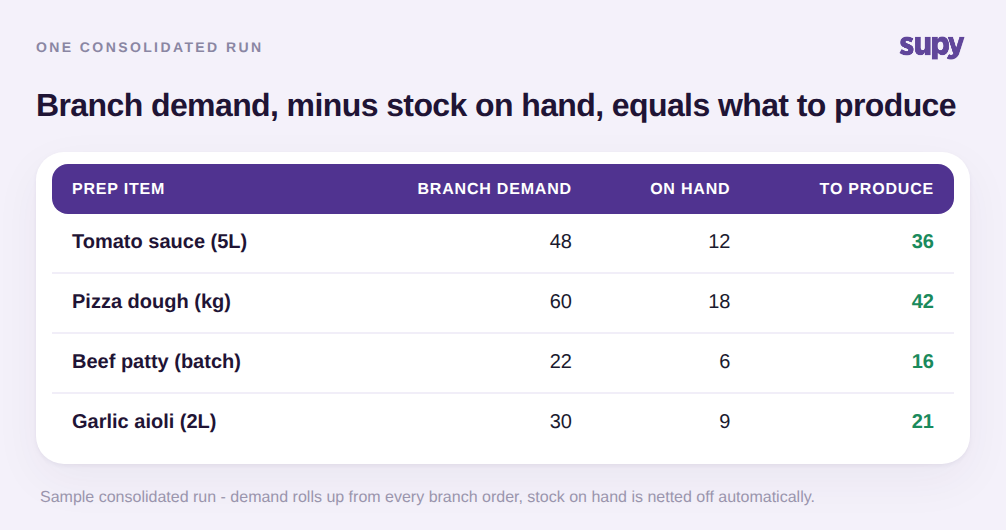
Once every outlet's demand is visible, the plan is a subtraction problem: total branch demand for each item, minus what the central kitchen already holds, equals what to produce. The hard part is getting all that branch demand into one place without the manual re-keying that breaks so many kitchens.
With Supy's central kitchen module, branches raise their orders directly in the app and those requisitions aggregate automatically into a consolidated, cross-branch view per item. There is no CSV export and no rebuild by hand. The kitchen sees one production run for the day, and only published recipes appear when selecting what to make, so a half-finished or discontinued recipe version can never be produced by mistake. Approvals can route through up to 5 sequential approvers when an order needs sign-off before it becomes a run.
Produce to Yield, Lock the Output, and Distribute Cleanly
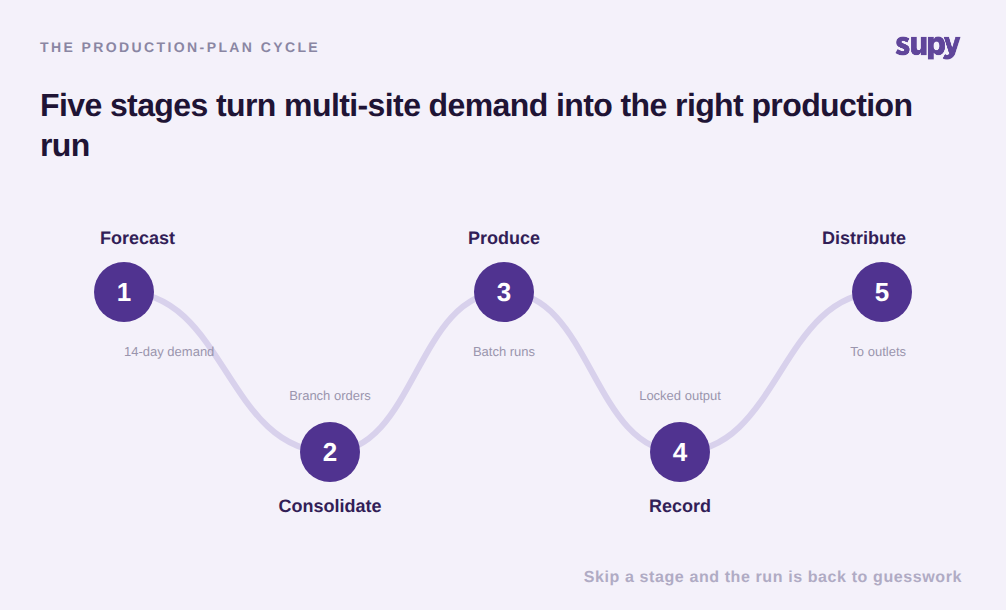
Producing to the plan is where accuracy is won or lost. A prep recipe rarely yields exactly its spec quantity, so the plan has to record what a run truly made, not what it was supposed to. Supy's breakdown production handles reverse-manufacturing, where one input becomes several outputs: it shows a live yield distribution across co-products, by-products and waste, warns when waste passes 30% of input, and blocks a run whose yields add up to more than 100%. Recipe costs apply automatically across production, so your theoretical food cost stays current without a manual recalculation.
Once a run leaves draft, its output quantities lock, giving a tamper-resistant record of exactly what was produced. Finished goods then move to the outlets as inventory transfers rather than blind stock writes: the receiving branch must confirm the delivery before stock updates at either end, which is what stops the phantom stock that plagues email-and-CSV distribution. Keeping raw and finished items separately filterable means the plan always shows what still needs making versus what is already boxed and gone.

You do not need a full rollout to start. This week, pull one day's branch requisitions into a single sheet and compare the total against what your central kitchen actually produced that day. If the gap is more than a batch or two on your top few items, your plan is running on habit, not demand, and that gap is either waste or a stock-out waiting to happen. Fix the sequence in order: get a per-branch forecast you trust, consolidate the orders into one run, then net off stock on hand before you decide quantities.
The operators who get this right stop treating production planning as a daily fire-drill and start treating it as a short, demand-led routine. That shift, more than any single feature, is what keeps a growing central kitchen from producing yesterday's guess every morning.