
Inventory

What AI Agents for Restaurants Can Do for a Multi-Site Group

A purchasing manager approves an AI-drafted order on a Supy screen

What an AI Agent Does for a Restaurant Group

An AI agent for a restaurant group does a back-office job on your own numbers, then waits for a person to approve the result. The ones worth paying for forecast each branch's sales 14 days ahead, draft the supplier order, and answer your data questions. A manager can override any figure the model produces. This article shows which AI agents are worth buying for a multi-site operation, and what to check before you trust one.

Most of the agents you find when you search are built for guests. They take phone orders, run the website chat, and suggest an upsell at the kiosk.
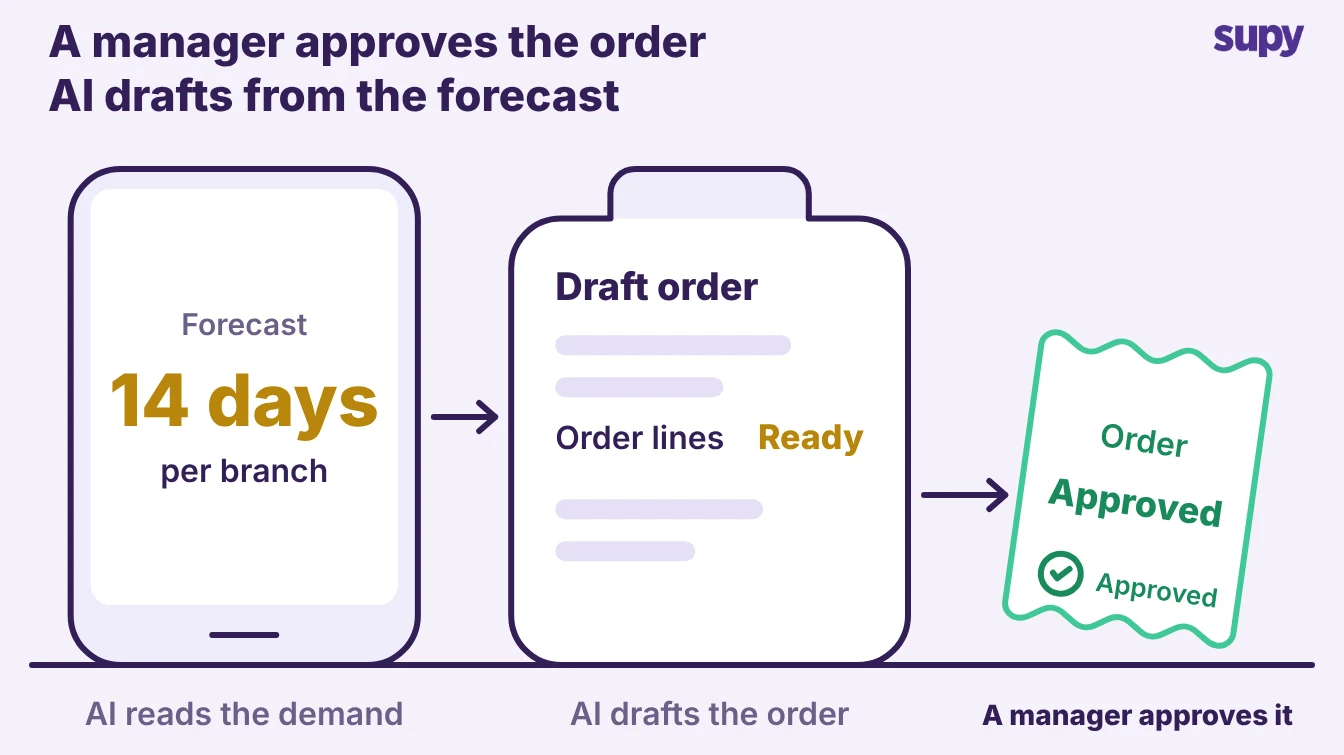
An AI forecast drafts an order that a manager approves

Those tools matter at the counter, but they do nothing for the person who signs off purchasing across ten sites. The agents that move the money for a group sit in the back office. There they read your sales history, your recipes and your stock.

So the real question for a group is not whether AI can talk to a guest. It is whether an agent can take a repetitive back-office job off your team without taking the judgement away from them.

Guest-Facing Agents and the Agents That Run the Back Office

The split between the two kinds of agent decides where the payback is for a multi-site operator. Guest-facing agents raise sales at one counter. Back-office agents cut cost and labour across every site at once, which is where a group's margin actually comes from.

What you are comparingGuest-facing agentsBack-office agents
The job it doesTake orders, answer calls, suggest upsellsForecast sales, draft orders, answer data questions
Whose work it changesFront of house and the guestThe operator, the buyer and the branch manager
What it improvesOne venue's top linePurchasing, stock and labour across every site
Who stays in controlThe guest completes the orderA manager approves the result

Read the table one way and the choice looks obvious for a group. The back-office column is the one that touches purchasing, stock and labour at the same time. A guest-facing agent is a fine second project, rarely the first one a multi-site operator should buy.

The Back-Office Jobs Worth Handing to AI

Three back-office jobs are now safe to hand to an AI agent, because each one still ends with a person. Judge any agent on how well it does these, and on whether it leaves the manager in charge.

  • Forecast demand you can correct. A sales forecast runs 14 days ahead for each branch, down to the menu item, shown against the 8-week average. A manager overrides any day or item when they know something the model does not, such as a local event, without retraining anything. The forecast stays useful because a person can fix it.
  • Draft the order, then approve it. An ordering agent turns that forecast into a ready-to-submit purchase order, shows the 4-week average quantity on each line, and never sends it on its own. Someone reviews every line first, so a buyer skips about 30 minutes of keying a 400 line order by hand. You can read more on how AI predictive ordering keeps that review step.
  • Ask your own data a question. The newest back-office agent is one you chat with. You ask it why food cost rose at two branches last week, and it answers from your own figures with a short summary, a chart or a table. For a group whose numbers sit in separate systems, this is the heart of restaurant analytics software a non-analyst can actually use.

None of these three replaces the operator. Each one removes the typing and the waiting, and leaves the call with a person.
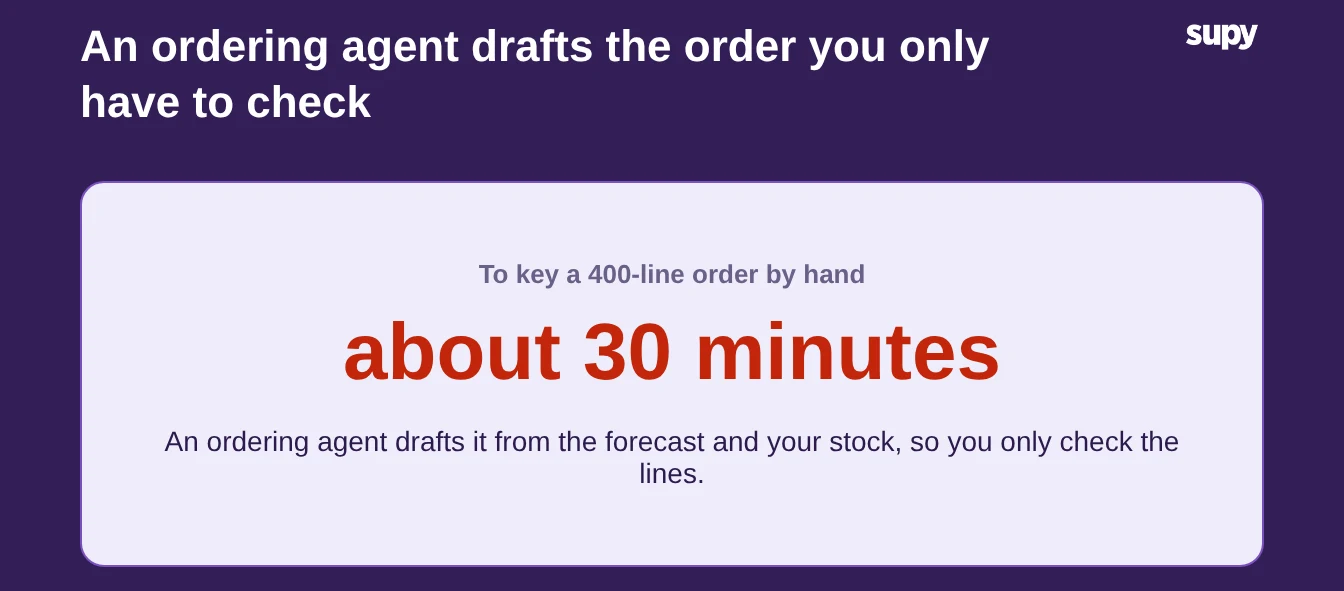
Keying a 400 line order by hand takes about 30 minutes that an ordering agent removes

What to Check Before You Trust an AI Agent

Before you sign for any AI agent, run it against four checks in the demo. Each one separates an agent that helps a group from a bot that only looks clever.

What to checkWhat to ask for in the demo
It works on your own dataWatch it read your sales, recipes and stock, not a sample set
A person stays in controlThe forecast is one a manager can override, and the order is one someone approves before it sends
It cuts work you can measureCount the hours it removes, such as a 400 line order that took about 30 minutes to key
It is live and staff will use itAsk what is live today, and how other groups got their branch managers to adopt it

Score an agent on all four, and the back-office tools beat the guest-facing ones every time. Start with the agent that forecasts your demand, drafts your orders and reads your own data, and keep a manager on the approval.

Leave the guest-facing chat for later. Buying in that order is what makes AI cut the hours your team spends on purchasing and reporting, rather than stay a novelty.
Book a Demo with Supy - AI agents for restaurants

Ready to optimize your restaurant operations?

Blog

Our operational insights

F&B
Menu engineering

How Barcode Scanning Speeds Up Restaurant Stock Counts

F&B
Inventory

Modern Restaurant Management 2025: Balancing Tech, Teams, and Guests

Integration
Inventory

Modern Restaurant Operations: What Execution Looks Like in 2025

Integration
Inventory

The Role of a Restaurant Operations Manager: Skills, Duties, and Impact

Inventory

How Role-Based Access Control Works in Restaurant Inventory Software

Your questions 
answered

Everything you need to know about Supy — from setup to integrations, pricing, and daily use. If it’s not covered here, just ask.

What is an AI agent for a restaurant?
+
An AI agent for a restaurant is software that does a specific job on your data and then hands the result to a person to approve. In a restaurant group, the useful agents work in the back office: they forecast each branch's sales, draft supplier orders from your recipes and stock, or answer questions about your own numbers. Guest-facing agents also exist, such as phone-ordering and website chat bots, but they serve the counter rather than the operator. The common thread is that the agent does the repetitive work and a manager keeps the final call.
Can an AI agent place supplier orders on its own?
+
A well-built ordering agent drafts the order but does not send it on its own. It runs your sales forecast through your recipes, subtracts current stock, and builds a ready-to-submit purchase order with the recent average quantity on each line. A person then reviews every line and approves it before anything reaches the supplier. Keeping that approval step is the point, not a limitation: it is how a group lets software do the typing without handing over the decision to spend money. Treat any agent that sends orders with no human check as a risk, not a convenience.
How accurate is an AI sales forecast for a restaurant?
+
Accuracy depends on your own sales history, which is why a per-branch forecast beats a generic one. Supy's forecast predicts daily sales by branch for 14 days ahead, down to the menu item, and shows each prediction against the 8-week average so you can see where it departs from normal. No forecast is right every day, so the one that helps is the one a manager can override at the day or item level when they know about a local event or a promotion the model has not seen. Judge a forecast on whether you can correct it, not on a headline accuracy figure.
Do AI agents for restaurants work across multiple locations?
+
Back-office agents are built for several locations, and that is where they pay off. A forecast runs per branch, an ordering agent drafts a separate order for each site from that site's stock and recipes, and a data agent reads the whole group's numbers so you can compare branches in one place. Guest-facing agents, by contrast, help one counter at a time. If you run a group, ask a vendor to show the agent working across sites in the demo, not on a single location, because the admin of rolling one tool out to every branch is where many tools quietly fail.
What is the difference between a guest-facing and a back-office AI agent?
+
A guest-facing agent works at the counter, taking phone orders, running website chat or suggesting an upsell, and it raises sales at one venue. A back-office agent works on your operation: it forecasts demand, drafts purchase orders, or answers questions about your sales and stock, and it cuts cost and labour across every site at once. For a multi-site operator, the back-office agents move the money, because purchasing, stock and reporting are where a group's margin is won or lost. A guest-facing agent is a reasonable second project, rarely the first one a group should buy.
Will an AI agent replace my restaurant manager?
+
No. The back-office agents worth buying are built to end with a person, not to replace one. The forecast is one a manager overrides, the supplier order is one someone approves before it sends, and the data agent answers a question the manager chose to ask. What the agent removes is the typing and the waiting: keying a long order by hand, rebuilding a forecast in a spreadsheet, or digging through reports for one number. The manager's judgement about a local event, a supplier problem or a branch that is off is exactly what the agent still needs.
How do I choose an AI agent for a restaurant group?
+
Run every agent against four checks in the demo. First, does it work on your own data rather than a generic sample? Second, does a person stay in control, so a manager can override the forecast and approve the order? Third, does it cut real work you can measure, such as the time to place a large supplier order? Fourth, is the capability live today, and will your branch managers actually use it? Score an agent on all four, and the back-office tools that forecast demand, draft orders and read your own numbers pull ahead of the guest-facing bots.

Ready to transform your operations?

Join 5,000+ restaurant operators cutting costs, streamlining operations and making smarter decisions with Supy.