.jpeg)

Die Verbindung zwischen Rezeptmanagement und Bestandskontrolle in Restaurants
- Einleitung
- Was ist Rezeptmanagement-Software?
- Warenwirtschaftssysteme in Gastronomiebetrieben verstehen
- Die Bedeutung der Integration von Rezeptmanagement und Warenwirtschaft
- So integriert Supy Rezeptmanagement und Warenwirtschaft
- Funktionen der Integrationstools von Supy
- Zukunft von Rezept- und Warenwirtschaftssystemen
- Fazit
- Über Supy
1. Einleitung
Ein erfolgreiches Restaurant zu führen bedeutet nicht nur, hervorragende Rezepte zu kreieren und eine gut bestückte Küche zu haben – es geht darum, dass beides harmonisch zusammenwirkt. Menüplanung, eine Zentralküche und qualifiziertes Personal sind zwar unverzichtbar, doch die Warenwirtschaft ist ebenso entscheidend. Dennoch übersehen viele Restaurants den direkten Zusammenhang zwischen Bestandskontrolle und Rezeptmanagement und behandeln sie als getrennte Prozesse, anstatt als zwei Seiten derselben Medaille.
Bestände existieren, um Rezepte zu unterstützen. Doch wenn eine Diskrepanz zwischen beiden besteht, führt dies zu inkonsistenter Qualität, Warenengpässen, unnötiger Verschwendung und Gewinnverlust. Selbst das am besten optimierte Warenwirtschaftssystem kann an seine Grenzen stoßen, wenn Rezepte nicht strukturiert und konsequent erfasst werden.
Die Realität ist: Rezeptmanagement und Bestandskontrolle müssen zusammenarbeiten, um Effizienz, Kostenkontrolle und Konsistenz in allen Bereichen zu gewährleisten. Restaurants, die diese Verbindung beherrschen, optimieren ihre Einkaufsprozesse, minimieren Verschwendung und verbessern ihren Wareneinsatz. Auch wenn dies komplex erscheinen mag, macht der Einsatz der richtigen Strategien und Tools diesen Prozess nahtlos und äußerst lohnenswert.
2. Was ist Rezeptmanagement-Software?
Rezeptmanagement bezeichnet die Erstellung und Verwaltung von Beziehungen zwischen Produktion, Warenbestand, Rezepten und anderen Faktoren eines Restaurants. Es ist unerlässlich, die Zutatenbestände vollständig zu nutzen und Verschwendung zu minimieren.
Daher ist eine Rezeptmanagement-Software jedes Tool, mit dem Rezeptmanagement in größerem Umfang und mit höherer Präzision durchgeführt wird. Diese Software umfasst häufig verschiedene Funktionen, mit denen Rezeptmanager Beziehungen zwischen Variablen nahezu sofort ermitteln können.
Kernfunktionen der Rezeptmanagement-Software
Obwohl jedes Rezeptmanagementsystem unterschiedlich ist, gibt es einige Kernfunktionen, über die die meisten im Allgemeinen verfügen. Diese Funktionen helfen Ihnen dabei, den Überblick zu behalten, wie Rezepte performen, und ermöglichen notwendige Anpassungen.
- Tools zur Unterstützung bei der Rezepterstellung, Menübearbeitung und Portionsgrößen
- Kostenanalyse und automatisierte Wareneinsatz-Berechnungen
- Möglichkeiten zur Optimierung von Rezepten für maximalen Umsatz und Gewinn
- Einblicke in Nährwerte, Rezeptdaten und Allergen-Tracking
- Tipps zur Menüplanung und Skalierung für mehrere Filialen
Je nach Rezeptmanagement-Software kann es mehr oder weniger Funktionen geben als die genannten. Es ist wichtig, eine Software zu wählen, die den Anforderungen Ihres Restaurants entspricht.
Vorteile der Rezeptmanagement-Software
Rezeptmanagement-Software ist für den Betrieb eines erfolgreichen Restaurants unerlässlich. Einige dieser Vorteile sind:
- Mit den richtigen Management-Tools können Sie Zutatenkosten und Rezeptparameter in Ihrem Restaurant kontrollieren, sodass kein Kapital gebunden wird.
- Automatisierte Rezepte mit Echtzeit-Einblicken reduzieren die Fehlermarge und steigern die Effizienz in der Küche.
- Rezeptmanagement-Software rationalisiert außerdem viele Aufgaben und spart Ihnen mehrere Stunden pro Woche, die Sie für andere Angelegenheiten nutzen können.
3. Warenwirtschaftssysteme in Gastronomiebetrieben verstehen
Menü- und Rezeptoptimierung ist nicht der einzige Bereich, in dem eine technologische Revolution die Restaurantmanagementsoftware beeinflusst hat. Ein weiterer wichtiger Fortschritt, den die meisten Restaurants inzwischen nutzen, sind Warenwirtschaftssysteme. Dabei handelt es sich um Software und Programme, die den Warenbestand eines Restaurants, seine Veränderungen und den Weg seiner Verwendung verfolgen.
Schlüsselfunktionen von Warenwirtschaftssystemen
Die Verwaltung des kulinarischen Betriebs und der Bestände eines Restaurants kann ohne ein geeignetes Warenwirtschaftssystem sehr schwierig sein. Einige der wichtigsten Funktionen eines solchen Tools sind:
- Gewährleistung von Konsistenz bei der Bevorratung und im Warenbestand unter Berücksichtigung von Faktoren wie Abweichung.
- Identifizierung von Beständen mit geringer Umschlagshäufigkeit, die nicht ordnungsgemäß genutzt werden, um die anfallende Verschwendung zu erfassen und Gegenmaßnahmen einzuleiten.
- Analyse von Verbrauchstrends zur Erstellung zuverlässiger Nachfrageprognosen für zukünftige Bestellungen in Restaurants.
Je nachdem, womit Ihr Warenwirtschaftssystem verbunden ist, können sich auch seine Funktionen ändern. Die meisten verknüpfen den Warenbestand mit POS-Systemen, um bessere Verkaufsdaten zu erhalten, während andere es vorziehen, ihn mit Beschaffungsplattformen zu verbinden.
Häufige Herausforderungen ohne Integration
Obwohl die Integration mit verschiedenen Systemen beim Betrieb eines Restaurants üblich ist, übersehen viele Inhaber häufig die Integration von Rezeptsoftware und Warenwirtschaftssystemen. Ohne ordnungsgemäße Integration kann im Back-End vieles schiefgehen.
Zunächst wäre eine manuelle Eingabe von Verkaufs- und Verbrauchsdaten erforderlich, um Analysen und Trends aktuell zu halten. Bei manueller Dateneingabe ist Fehlerpotenzial immer vorhanden, was zu Überbeständen, ungenauen Rezeptkosten und Lebensmittelverschwendung führen kann.
Ebenso bedeutet fehlende Integration, dass die Pflege von Rezept- und Warenwirtschaftsmanagement entweder zwei Personen beschäftigt oder zusätzliche Arbeitsstunden erfordert. Diese Ineffizienz führt zu höheren Arbeitskosten und bindet wertvolle Teamzeit, die für die Verbesserung des Restaurants eingesetzt werden könnte. Stattdessen sind die Teams mit der Verwaltung von Rezepten beschäftigt, obwohl alle Rezepte und Zutaten durch Automatisierung abgewickelt werden könnten.
4. Die Bedeutung der Integration von Rezeptmanagement und Warenwirtschaft
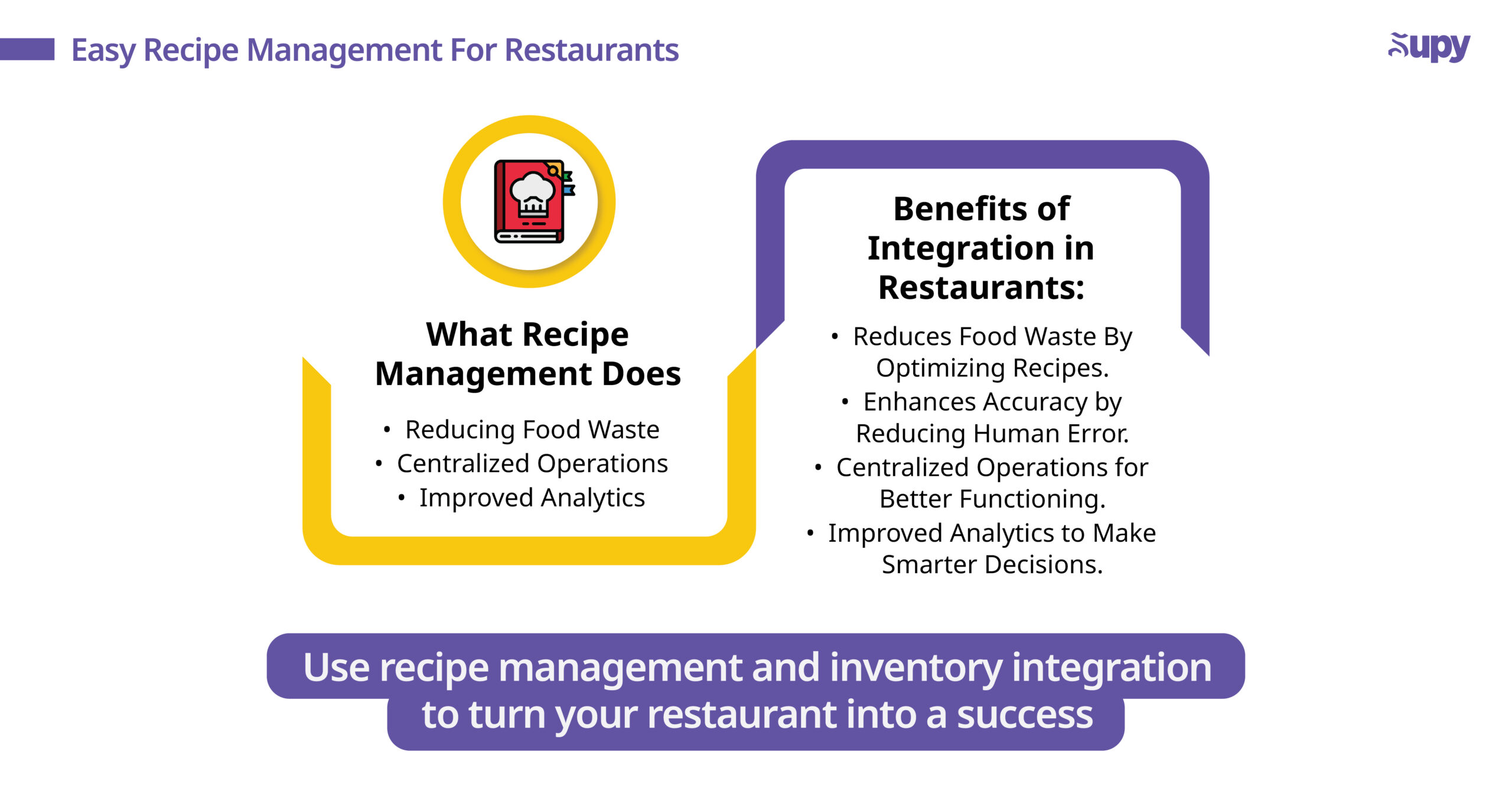
Um die oben genannten Probleme zu vermeiden, ist die Integration von Rezeptmanagement und Warenwirtschaft in einem Restaurant unerlässlich. Inhaber werden möglicherweise feststellen, dass viele Integrationsoptionen zur Verfügung stehen. Am besten ist es jedoch, entweder eine Plattform zu nutzen, die beide Dienste anbietet, oder separate Dienste zu wählen, die miteinander kompatibel sind.
Viele entscheiden sich für Restaurantmanagementsoftware, die mehrere Funktionen wie Warenwirtschaft, Controlling, POS-Einrichtung und Rezeptmanagement bietet. Dies vereinfacht den gesamten Prozess und ermöglicht ein zentrales Dashboard zur Überwachung des Restaurants.
Vor- und Nachteile der Integration
Vorteile
Nachteile
Mit automatisierter Dateneingabe wird das Risiko menschlicher Fehler bei Bestands- und Rezeptaktualisierungen erheblich reduziert.
Die anfängliche Einrichtung und Integration von Rezeptmanagement-Software und Warenwirtschaftssystemen kann kostspielig sein.
Zeigt den tatsächlichen Zutatenverbrauch aus den Beständen und hilft dabei, Rezepte für eine bessere Bestandsnutzung und weniger Lebensmittelverschwendung anzupassen.
Das bestehende Personal muss möglicherweise in der Nutzung dieser modernen Technologie geschult werden.
Klärt die Kommunikation zwischen den Beschaffungs- und Küchenteams, sodass beide über Bestandsnachfrage und -angebot im Bilde sind.
Inhaber müssen sicherstellen, dass bestehende Computersysteme mit den Integrationsanforderungen kompatibel sind.
Aktualisierte Analysen und Berichte bieten eine gute Grundlage für fundierte Managemententscheidungen.
5. So integriert Supy Rezeptmanagement und Warenwirtschaft
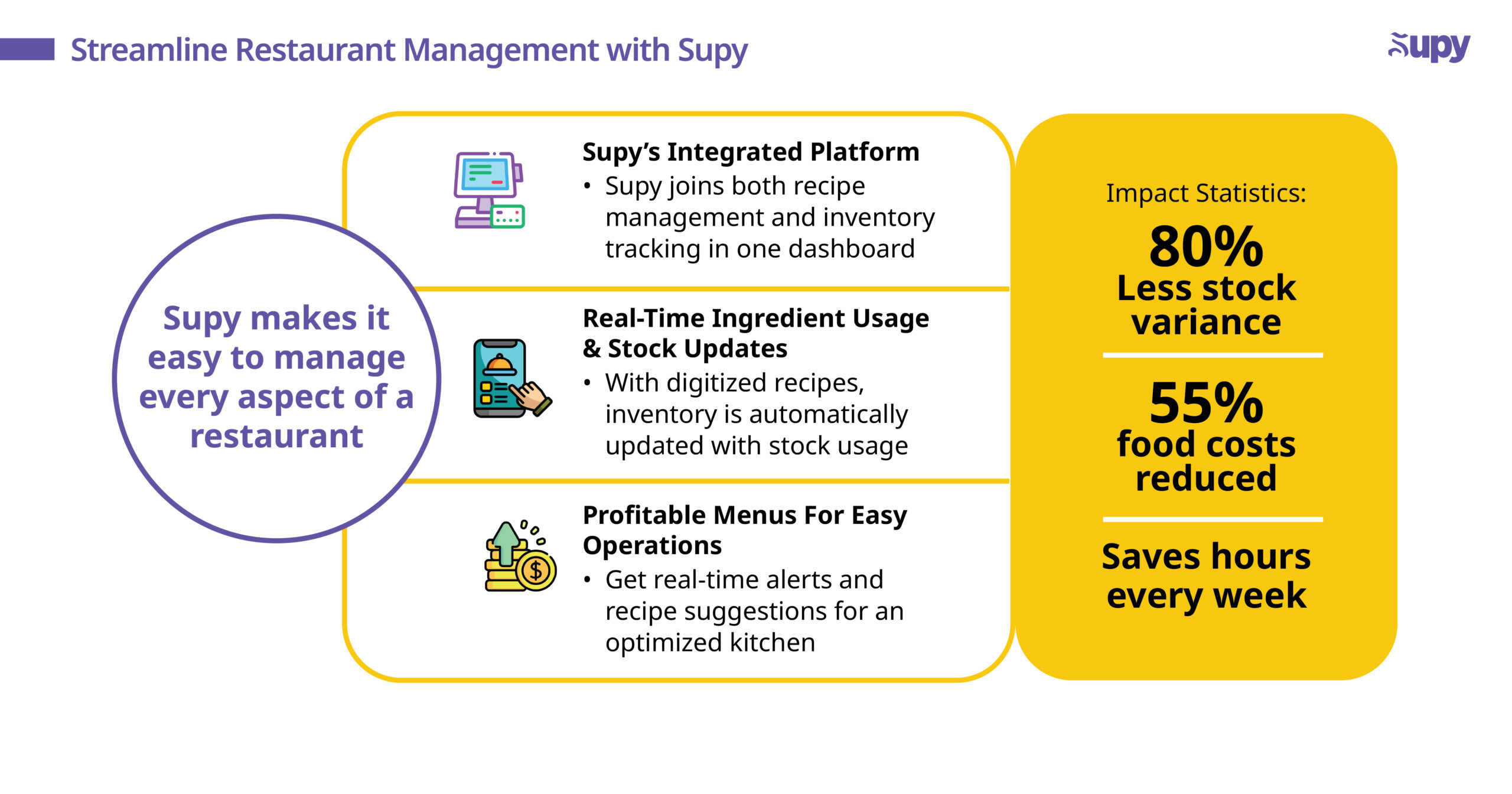
Alle Aspekte eines Restaurants zu managen kann schwierig sein, besonders wenn Sie sich auf Warenbestand und Rezepte in all Ihren Restaurants konzentrieren. Genau hier benötigen Sie eine Plattform wie Supy, die das automatisierte Restaurantmanagement rationalisiert, um Umsätze zu steigern und Betriebsabläufe zu optimieren. Mit Supy ist jede Managementaufgabe in Ihrem Restaurant ein Kinderspiel.
Supys Integrationsprozess
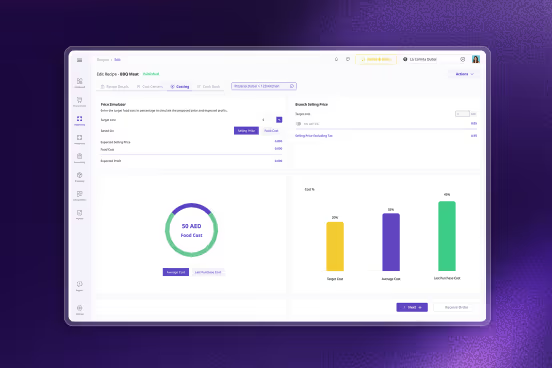
Supy verfügt über eine integrierte Rezeptmanagement- und Warenverfolgungsfunktion in seinem Managementsystem. Vergessen Sie die Suche nach kompatiblen Tools; diese Software enthält alles, was Sie benötigen. Da alles im Paket enthalten ist, können Sie sowohl auf Warenwirtschaft als auch auf Rezeptmanagement über dasselbe Dashboard zugreifen.
Durch die Digitalisierung der Menüliste und der Rezepte verfolgt Supy automatisch den Zutatenverbrauch basierend auf Zubereitung und Verkauf. Dieser Zutatenverbrauch wird direkt aus dem Warenbestand abgeleitet, während die Bestandsniveaus aktualisiert werden. Diese Echtzeit-Darstellung führt nicht nur zu einem besseren Management, sondern lässt auch weniger Raum für Mehrdeutigkeiten und Raterei.
Mit Funktionen wie Wareneinsatz-Warnungen, präziser Zubereitung, Echtzeit-Kostenverfolgung und Umsatzstimulierung können Restaurants ein profitables Menü mit optimierten Rezepten erstellen. Durch die Warenwirtschaft führt die Partnerschaft mit Supy zu folgenden Ergebnissen:
- Bis zu 80 % weniger Bestandsabweichung
- 55 % Reduzierung des Wareneinsatzes
- Bis zu 10 gesparte Stunden pro Woche
6. Funktionen der Integrationstools von Supy
Supy bietet viele Tools, die dabei helfen, den kulinarischen Betrieb und die Warenwirtschaft eines Restaurants zu verbessern. Einige davon sind:
- Menüoptimierung: Mit dieser Funktion können Sie präzise Rezepte erstellen, die keinen Raum für Zutatenabfall lassen. Diese Rezepte sind nicht nur präzise, sondern auch einfach reproduzierbar und können jederzeit angepasst werden. Alle Änderungen werden sofort berücksichtigt und in sämtlichen Analysen aktualisiert.
- Warenwirtschaft: Ein weiteres nützliches Tool auf Supys Plattform ist die Warenwirtschaft. Sie können Bestandsraten verfolgen und Abweichungen erheblich reduzieren. Das Tool integriert sich mit POS-Systemen und anderen Dateneingabequellen, um kontinuierlich zu aktualisieren, wie viel Bestand verbraucht wird, und berücksichtigt dabei auch das Abfallmanagement.
- Echtzeit-Synchronisierung: Sobald Ihre Systeme sowohl in der Küche als auch im Warenbestand integriert sind, stellt Supy die Echtzeit-Synchronisierung für alle Datenänderungen sicher. Wenn Ereignisse in Ihrem Restaurant eintreten, werden sie sofort aktualisiert und erfasst. Wenn Sie beispielsweise eine bestimmte Menge X eines Menüpunkts verkaufen, berücksichtigt Ihre Bestandsanalyse diese Änderung, sobald sie in das System eingegeben wurde.
- Automatisierte Bestandsanpassungen: Im Gegensatz zu herkömmlicher Software, bei der Sie Befehle erteilen müssen, um Bestandsabweichungen und -niveaus zu prüfen, erledigt Supy die Arbeit, bevor Sie überhaupt fragen. Wenn Bestellungen aufgegeben werden, passt Supy automatisch den Bestand an, um die verbrauchten Zutaten zu berücksichtigen. Zudem sendet es automatisch Warnungen zur Wiederauffüllung, sobald der Warenbestand ein niedriges Niveau erreicht.
- Aktualisiertes Controlling und Berichte: Mit all seinen Funktionen bietet Supy außerdem sofort aktualisierte Analysen und Berichte auf Ad-hoc- und periodischer Basis. Diese Berichte helfen Restaurants bei der Inventur ihrer Bestände, dem Management von Lieferkettenbeschränkungen, der Ausgewogenheit der Bestandsniveaus und der Optimierung von Rezepten für minimale Verschwendung. Als Restaurantinhaber oder -manager helfen Ihnen diese Analysen, fundierte Entscheidungen zu treffen.
Mit Supy zur technischen Einfachheit
Supy beseitigt die Probleme im Umgang mit schwer zu bedienender Verwaltungssoftware. Nicht jeder ist ein Technikexperte, und die Plattform trägt dem Rechnung. Mit Supy sind technische Probleme das Letzte, worüber sich ein Restaurantinhaber Gedanken machen muss. Sie bietet eine einfache Benutzeroberfläche, die leicht zu bedienen ist und Ihnen sofort die gewünschten Berichte, Analysen und Tools liefert.
Neben dem Zugriff über einen Computer ist Supy auch für Mobiltelefone geeignet! Sie können Ihr Restaurantmanagement unterwegs verwalten und mit Live-Warnungen auf dem Laufenden bleiben. Ob Sie Bestände nachbestellen oder Rezepte für eine bessere Optimierung anpassen möchten – Sie müssen nicht an Ihrem Schreibtisch warten, um die Arbeit zu erledigen.
7. Zukunft von Rezept- und Warenwirtschaftssystemen
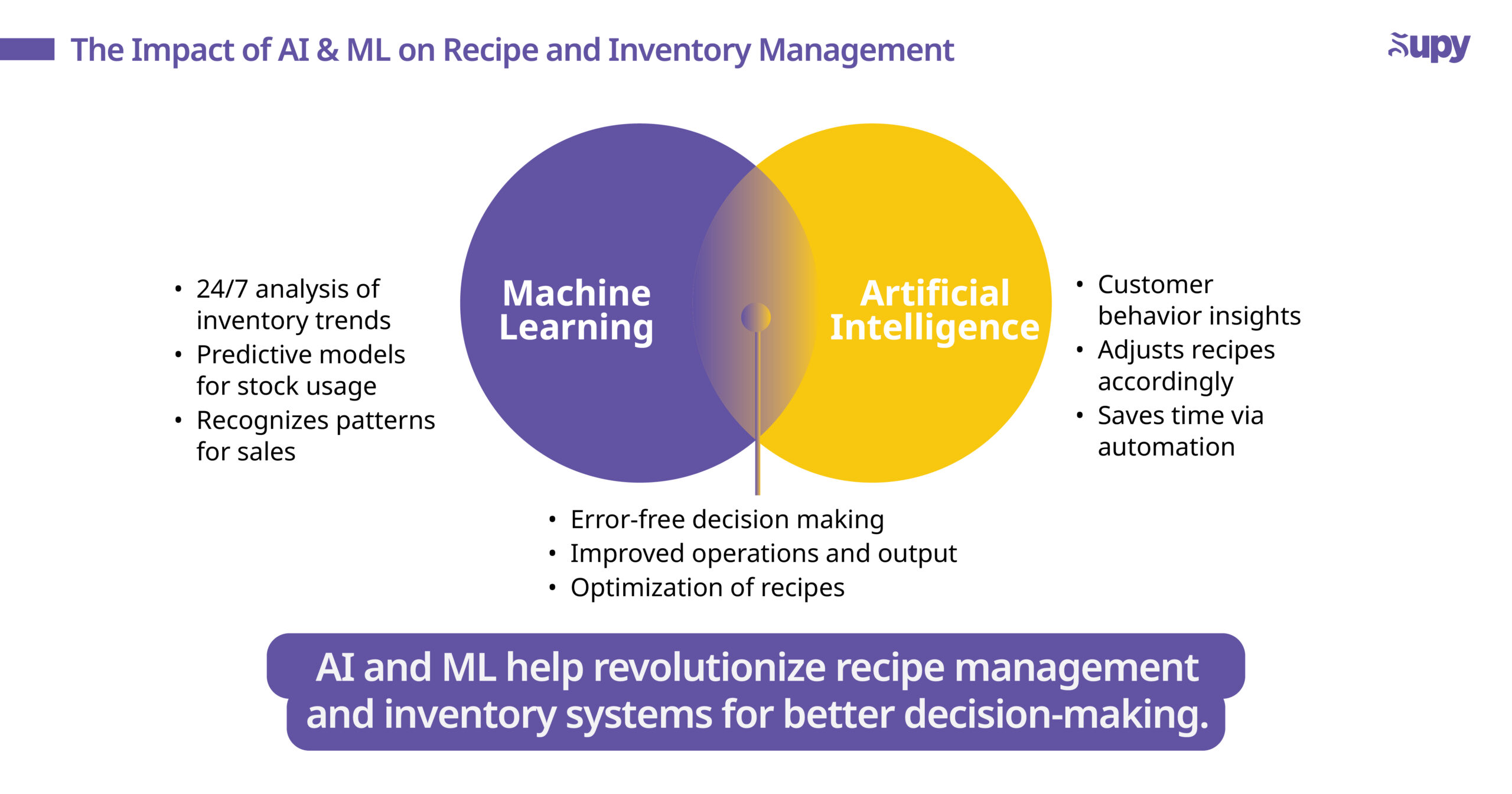
Die Restaurantmanagementbranche verändert sich ständig aufgrund neuer Technologien. Mit neuerer Software und Plattformen, die wesentliche Betriebsaspekte abdecken, scheinen Künstliche Intelligenz und maschinelles Lernen den Weg zu ebnen.
KI und ML helfen dabei, Berechnungen zu beschleunigen und Echtzeit-Analysen zwischen verschiedenen Faktoren und Trends zu erstellen. Sie sparen nicht nur Zeit, sondern stellen alle relevanten Informationen griffbereit zur Verfügung. Darüber hinaus liefert KI Erkenntnisse über Verbrauchertrends und zeigt, wie Anpassungen an bestehenden Rezepten und Betriebsabläufen vorgenommen werden können.
Restaurantinhaber müssen diese sich wandelnden Technologien annehmen, da sie nur das Restauranterlebnis für Gäste verbessern. Durch verlässliche, datengestützte und musterbasierte Entscheidungsfindung kann man menschliche Fehler reduzieren und auf einen effizienteren Betrieb hinarbeiten. Wenn die Last trivialer Berechnungen und Aufgaben vom Team genommen wird, ist es frei, Teamarbeit und andere Aspekte des Restaurantbetriebs zu verbessern.
8. Fazit
Es bedarf vieler Faktoren, um ein erfolgreiches Restaurant zu führen, aber integrierte Rezeptmanagement-Software und Warenwirtschaftssysteme sind ein entscheidender Schritt. Mit einer integrierten Küche und Warenwirtschaft können Restaurantinhaber die dringend benötigte Aufmerksamkeit auf kreative Entwicklung und Expansion richten – und vor allem auf die Kundenzufriedenheit.
Wenn die Verknüpfung Ihres Rezeptmanagements und Ihrer Warenwirtschaftssysteme für Sie und Ihr Team zu aufwändig erscheint, könnte eine Partnerschaft mit Supy die Lösung sein. Supys Geschäftsmodell passt zu allen Arten von Gastronomieunternehmen und Restaurants, unabhängig von ihrer Spezialisierung. Sie müssen lediglich eine kostenlose Demo buchen, und Supy zeigt Ihnen, wie effizient Ihr Unternehmen sein kann.
Bereit, den Supy-Unterschied zu erleben? Demo buchen mit uns!
9. Über Supy
Supy ist eine Restaurantmanagementsoftware-Plattform, die Funktionen zur Integration von Küche, Warenbestand, Buchhaltung und anderen Managementbereichen umfasst. Sie hilft Restaurantinhabern, die besten Entscheidungen für ihr Unternehmen auf der Grundlage von Echtzeit-Analysen und Kundentrends zu treffen.
Mit Supy als Partner können Sie sich auf eine erhebliche Reduzierung des wöchentlichen Managementaufwands freuen. Es ist wie ein zusätzliches Paar Hände, das alle Bereiche im Blick behält und Sie rechtzeitig auf Bereiche aufmerksam macht, die Ihre Aufmerksamkeit erfordern.
Wenn Sie weitere Filialen eröffnen und dabei eine Zentralküche betreiben möchten, lesen Sie dieses E-Book über Der ultimative Leitfaden zur Eröffnung einer Zentralküche für Mehrfilialen-F&B-Unternehmen.