.jpg)


What Is Par Level And How To Calculate It
.jpg)
Running a restaurant profitably is rarely about one big decision. It’s about hundreds of small ones made every week. What to order. How much to prep? When to restock. And how much buffer is enough without turning into waste?
That’s where par levels come in.
Want the numbers for your own kitchen? The free par level calculator works out a par for every item on your sheet from your usage, delivery days and supplier lead times.
Par level is one of the simplest concepts in inventory management, yet it’s also one of the most misunderstood. Get it right, and your kitchen runs calmly with fewer stockouts and less waste. Get it wrong, and you end up tying up cash, over-ordering, or scrambling during service.
In this guide, we’ll break down what par level really means, how to calculate it accurately, and why modern restaurants are moving away from static spreadsheets toward system-driven par planning.
1. What Is A Par Level?
The PAR Level, short for "Periodic Automatic Replacement Level," represents the ideal stock quantity of a given ingredient that a restaurant should maintain at all times to operate its inventory at optimal performance. It's the metric that ensures you never run out of essential items, yet avoids having excess stock, which can lead to waste.
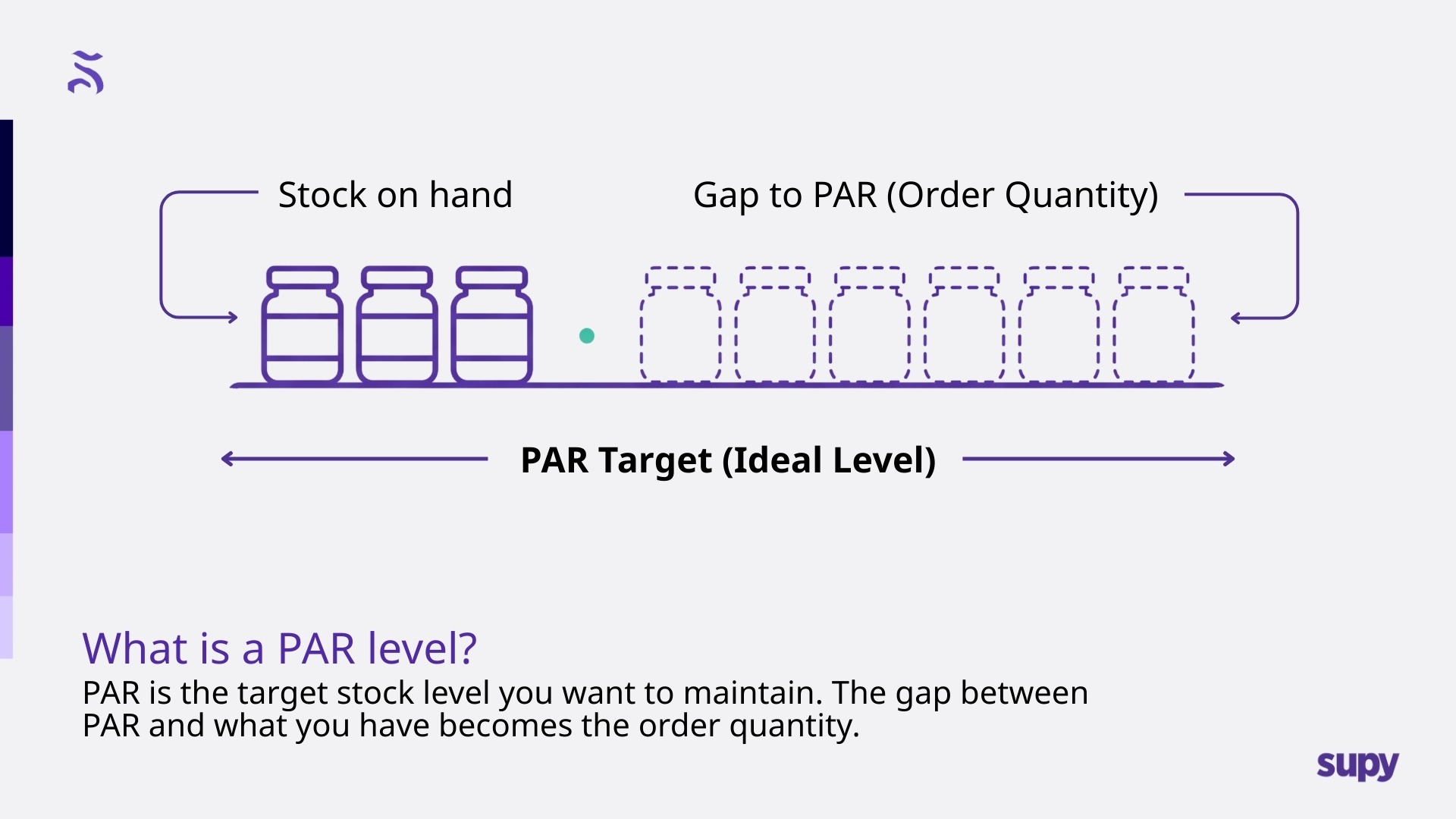
The PAR level of an item combines the quantity in stock plus the quantity ordered. For example, if the PAR level for ketchup is 10 bottles, but you only have 3 in stock, then the order quantity will be 7.
By finding the right Par Level, your restaurant can consistently meet regular demand, with a buffer of safety stock for unexpected surges in customer demand. Setting a Par Level requires a proactive approach, where you need to consider the shelf life of your ingredients, the frequency of your deliveries, and the way in which you manage your stock.
A PAR level system is especially important for multi-branch restaurant businesses, where maintaining consistent Par Levels across all locations is crucial to maintain brand reputation and a consistent customer experience.
Setting up Par Levels across your business can lead to several benefits that affect your bottom line and cost savings:
2. The Benefits Of PAR Level In Restaurant Inventory Management
- Reduce food waste: By avoiding over-ordering, you limit the amount of surplus in your inventory, helping you deal with a lesser number of items that could perish, and therefore be wasted (such as fresh ingredients).
- Have a healthy turnover rate: the turnover rate represents an establishment’s ability to control its inventory, or the ability to empty and replenish an inventory over a given period. By not over- or under-ordering, your turnover rate will reach a healthy number.
- Keep customers happy: having enough of an item ensures you do not miss out on potential sales. If a customer keeps coming back for an item that is regularly out of stock, your brand reputation will go down.
- Increase profits: Yes, setting PAR levels helps you better manage your inventory, which in turn reduces your risks of wastage and shortage, leading to increased profits.
- Take data-driven decisions: each one of your ingredients will have a different PAR level based on its expiration date and popularity. Some items may be seasonal, which is why their PAR level may change over the months. Keeping a digital track record of your PAR levels will help you identify trends and patterns, thus enabling you to better manage your inventory and, therefore, your cost.
3. How To Calculate A Par Level
Calculating a PAR Level requires a deep understanding of your menu, customer demands, and seasonality trends. Several metrics need to be known, such as the lead time, the average daily usage, and the safety stock. Having an accurate PAR level ensures a smooth operation, avoids stockouts, and reduces storage costs. Let's dive into a real-life example to understand how to calculate PAR levels.
1. Determine Average Daily Usage (ADU)
2. Determine Lead Time
3. Estimate the Safety Stock
4. Calculate Par Level
Imagine you run a coffee shop. One of your most popular items is a specialty coffee blend. To ensure you never run out, you need to calculate the PAR level for this coffee blend.
Step 1: Determine Average Daily Usage (ADU)
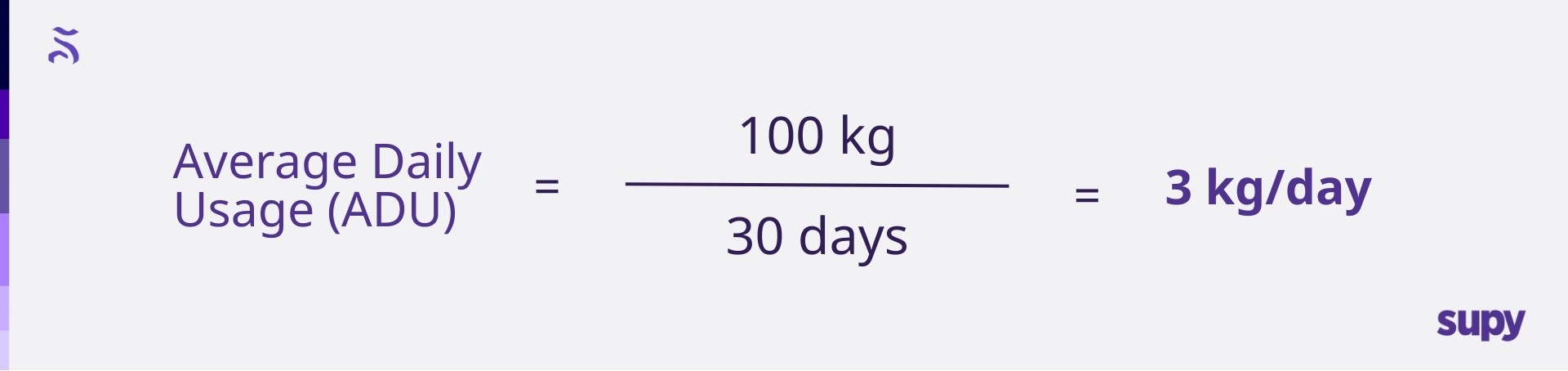
Let's say you reviewed your sales data for the past month (30 days) and found that you used 300 kg of the coffee blend.
This coffee shop uses 3 kg of its special coffee blend a day.
Step 2: Determine Lead Time
The lead time is the time it takes to deliver each of your items. The lead time is key to know in order to accurately forecast how long in advance you will need to order your items in order to have them on PAR on any given day, especially during popular days.
Fresh produce typically has shorter lead times. They may take 2-3 days to arrive, depending on the supplier and seasonality.
Specialty items may have longer lead times, as they might need to be imported from abroad and need to go through customs and long shipping journeys.
Let’s say that the coffee beans will take 5 days to arrive, given they’re imported from an exotic destination.
Step 3: Estimate The Safety Stock
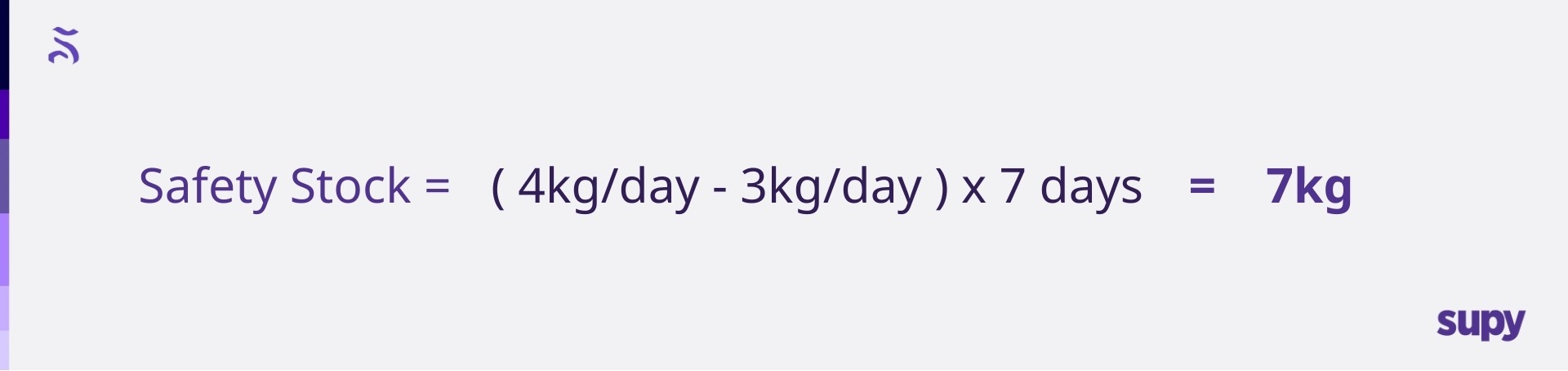
The safety stock accounts for the additional amount of stock you need in case of sudden increased demand.
The safety stock can be calculated using the following formula:
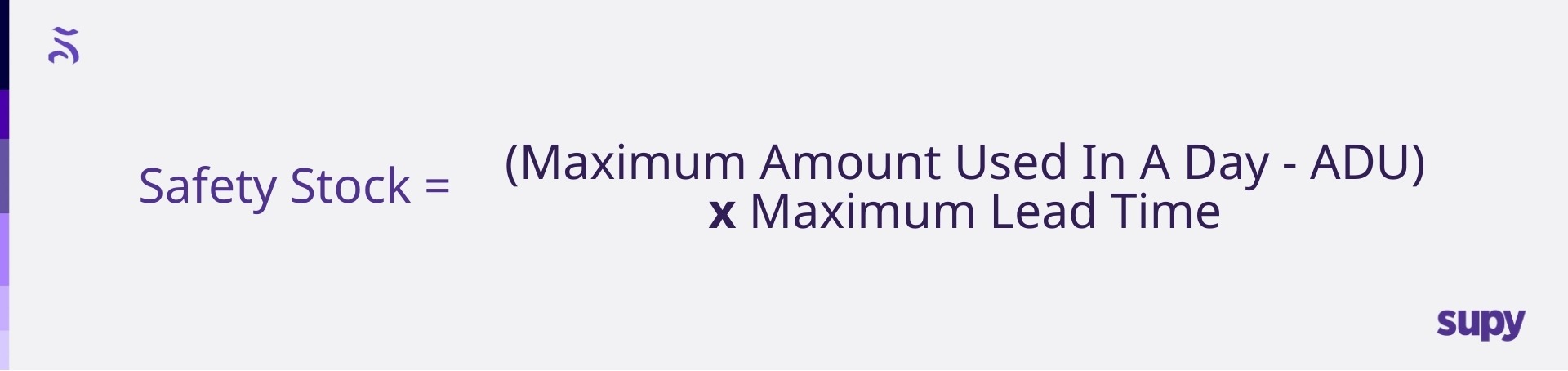
Suppose the maximum amount of coffee beans you've ever used in a day is 4 kg, and the maximum lead time experienced was 7 days. The safety stock would be:
Step 4: Calculate PAR Level
Now, apply these figures to the PAR level formula:

In this example, the PAR Level for the specialty coffee blend at the coffee shop is 22 kg.
This means you should always have at least 22 kg of this coffee blend in stock to meet customer demand and account for any delays in delivery.
Calculating the PAR level is essential for efficient inventory management, ensuring customer satisfaction, and minimizing unnecessary costs. It's a balance between having enough stock to meet demand and not tying up too much capital in inventory.
Keep in mind, PAR level calculations are not a one-time task. Your PAR levels should be revisited regularly to account for changes in demand or supply chain dynamics.
4. Why Manual Par Levels Break Down Over Time
Par levels don’t fail because teams don’t care. They fail because reality changes faster than spreadsheets. Common causes of par drift include:
- Changes in sales mix
- Seasonal demand swings
- Fluctuating supplier lead times
- Menu updates
- Portion creep and waste
When par levels live in Excel, updating them depends on someone remembering to revisit the file, recalculate usage, and push changes to the team. In practice, that rarely happens consistently.
5. PAR Level: Best Practices To Employ
.jpg)
1) Periodic Review and Adjustment
We previously mentioned that a PAR level varies based on the seasons, your suppliers, and your customers. This is why it is key to regularly review your PAR levels and ensure your inventory is running at optimal levels.
Take the example of Pumpkin Cake. This may be a popular item in the fall, but a refreshing ice cream might take its lead in the summer. You may want to have less of that pumpkin cake in the summer.
2) Use Technology for Precision
In the era of digital transformation, employing technology like an inventory management system can greatly enhance the precision and ease of maintaining Par Level Inventory. These systems offer real-time data analysis and can automate the tracking of Lead Time, Usage Rate, and Safety Stock, making the process of maintaining Par Levels more efficient and less prone to human error.
3) Build Relationships With Suppliers
Your PAR level is calculated based on lead times and delivery consistency. These are factors that only your suppliers control. It is therefore key to build trusting relationships with your suppliers to ensure you have a regular incoming stream of products.
6. How Supy Helps Restaurants Manage Par Levels More Effectively
Supy supports par-level planning by connecting inventory movement, purchasing, and real usage data into a single operational view.
Instead of relying on static spreadsheets, teams can:
- Track how quickly items actually move
- Understand supplier reliability and lead times
- Adjust par levels based on real demand
- Reduce over-ordering without risking service gaps
The goal isn’t to automate decisions blindly. It’s to give operators clearer signals so decisions are made earlier and with more confidence.
7. Final Thoughts
Par levels aren’t about perfection. They’re about control.
When par levels are thoughtful and current, kitchens feel calmer, purchasing becomes more predictable, and food cost stays stable even as demand changes. In today’s operating environment, the restaurants that win aren’t the ones ordering the least. They’re the ones ordering just enough, consistently.
If you want par levels that adapt to reality instead of living in spreadsheets, it’s worth exploring how modern inventory systems support smarter planning with Supy, or read more our Ultimate Guide To Restaurant Operations Management.