.jpg)


Restaurant Menu Costing Software: Right Plate Costs at Every Site
What Menu Costing Software Does for a Multi-Site Group
Restaurant menu costing software keeps the plate cost and food-cost percentage of every dish current as ingredient prices move. It recalculates each recipe automatically the moment a purchase price changes. For a multi-site group, it does this per location, so the same dish can carry a different, accurate cost at each site.
A spreadsheet can cost a menu once. It cannot keep costing it. Prices change with every delivery, and a group running dozens of sites sees those changes land at different branches on different days.
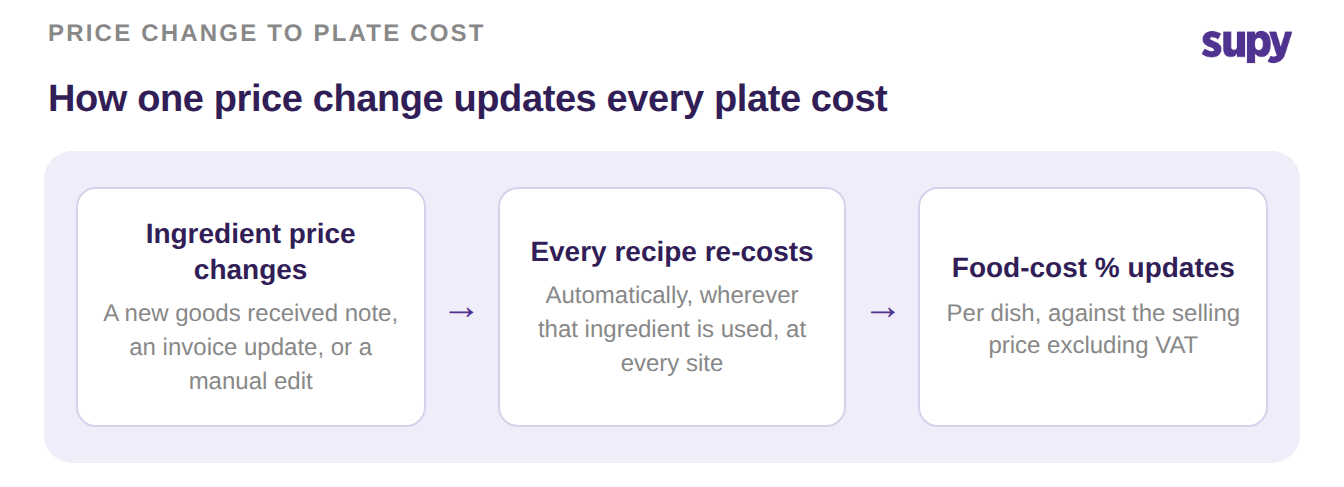
Menu costing software closes that gap. When a new price arrives on a goods received note or an invoice, every recipe that uses the ingredient re-costs on its own. You see the effect on each plate and on your food-cost percentage without touching a spreadsheet. This is also what lets you keep recipe costs current as supplier prices sync, rather than re-costing by hand. Supy calculates the percentage against the selling price excluding VAT, so the cost metric stays tax-clean.
Why the Same Recipe Costs More at One Site Than Another
Suppliers rarely charge every branch the same price. Delivery distance, contract volume, and local availability all move the cost of one ingredient from site to site.
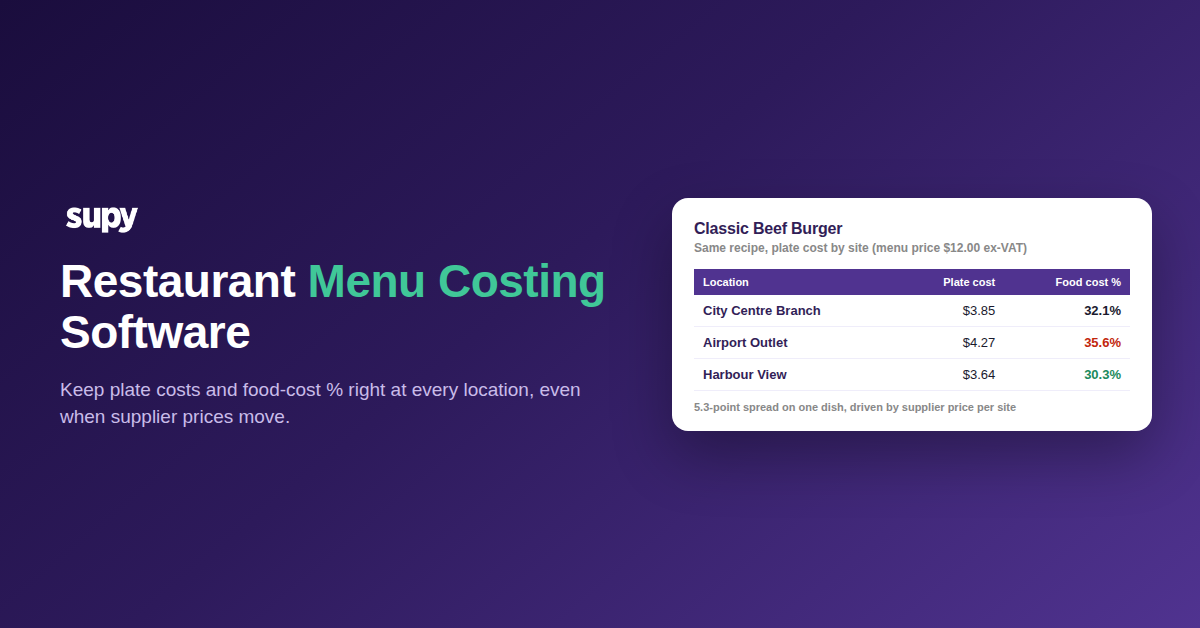
That means a single recipe has more than one true cost. A Classic Beef Burger built to the same spec can cost $3.85 at one branch and $4.27 at another, purely because the beef price differs. On a $12.00 menu price, that is the gap between a 32.1% and a 35.6% food cost.
| Location | Beef price / kg | Plate cost | Food cost % |
|---|---|---|---|
| City Centre Branch | $9.80 | $3.85 | 32.1% |
| Airport Outlet | $12.60 | $4.27 | 35.6% |
| Harbour View | $8.40 | $3.64 | 30.3% |
Menu costing software holds a separate cost for each site and rolls it up for the group. You see food-cost percentage by dish at every location. That shows where a supplier price is eroding margin, so you act on the branch that needs it, not the group average.
Costing Recipes That Are Built From Other Recipes
Real menus are not flat lists of ingredients. A plated dish is built from other recipes, and those recipes are built from still others.
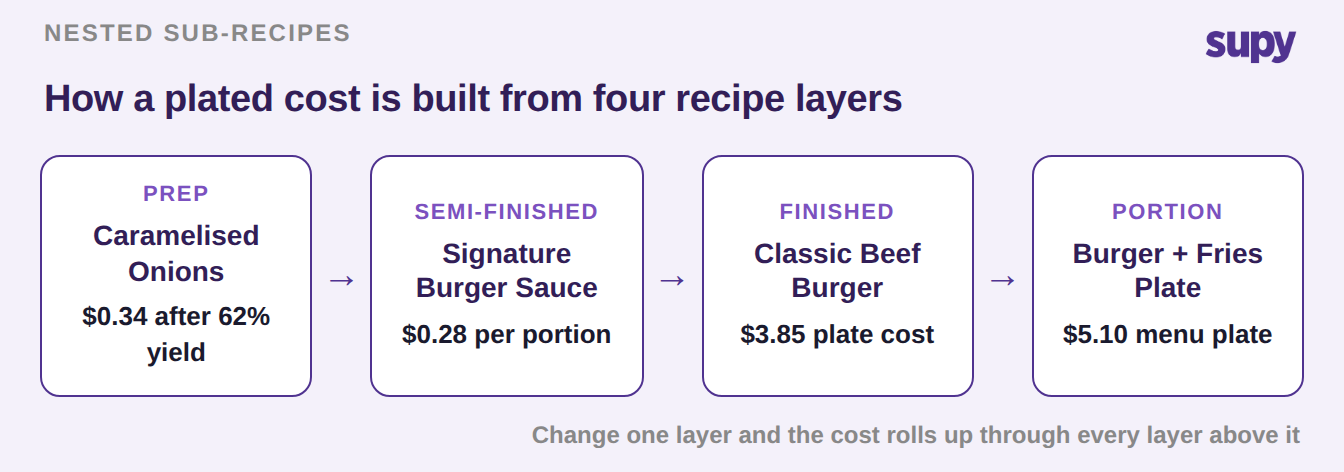
Take the burger. Caramelised onions are a prep recipe. The burger sauce is a semi-finished recipe that uses them. The finished burger uses the sauce, and the plate pairs the burger with fries. That is four layers deep, and one group onboarded around 500 recipes at that depth across 26 locations.
Menu costing software costs each layer once and rolls it up. Change the onion yield or the beef price, and the cost moves through the sauce, the burger, and the plate on its own. Supy's recipe and prep-recipe costing handles plated dishes, semi-finished prep, yields, and shrinkage. The number at the top of the stack stays true to the layers beneath it.
Which Cost to Plan On: Rolling Average or Latest Price
Once every recipe re-costs automatically, a new question appears. Which cost do you plan on: the last price you paid, or a smoothed average of recent ones?
Both are right for different jobs. The latest purchase price shows where your margin sits today, which is what you want when you are checking variance or reacting to a spike. A rolling average smooths the peaks, which is the steadier number to set a menu price against. The trade-off between a live price and a fixed cost is worth understanding before you commit a menu to either.
| Cost view | What it shows | Best for |
|---|---|---|
| Rolling average ($9.60/kg) | A smoothed cost across recent deliveries | Setting menu prices and target costs |
| Latest purchase price ($12.60/kg) | The most recent price you actually paid | Spotting margin erosion and checking variance |
Supy lets you switch between the two views on each recipe's costing screen. You can price the menu on a stable benchmark and still watch the live cost for margin erosion.
Keeping Central-Kitchen Prep Out of Your Food-Cost Numbers
A central kitchen adds one more thing to get right. When it makes prep and sends it to branches, those movements should shift stock, not money.
If a recipe deduction is set up as a sale or posts to the ledger, it creates a phantom cost that inflates your reported food cost. One multi-site group hit exactly this. Their central production facility was generating accounting entries from recipe deductions, which pushed food-cost reporting above the real number and made healthy sites look like they were losing margin.
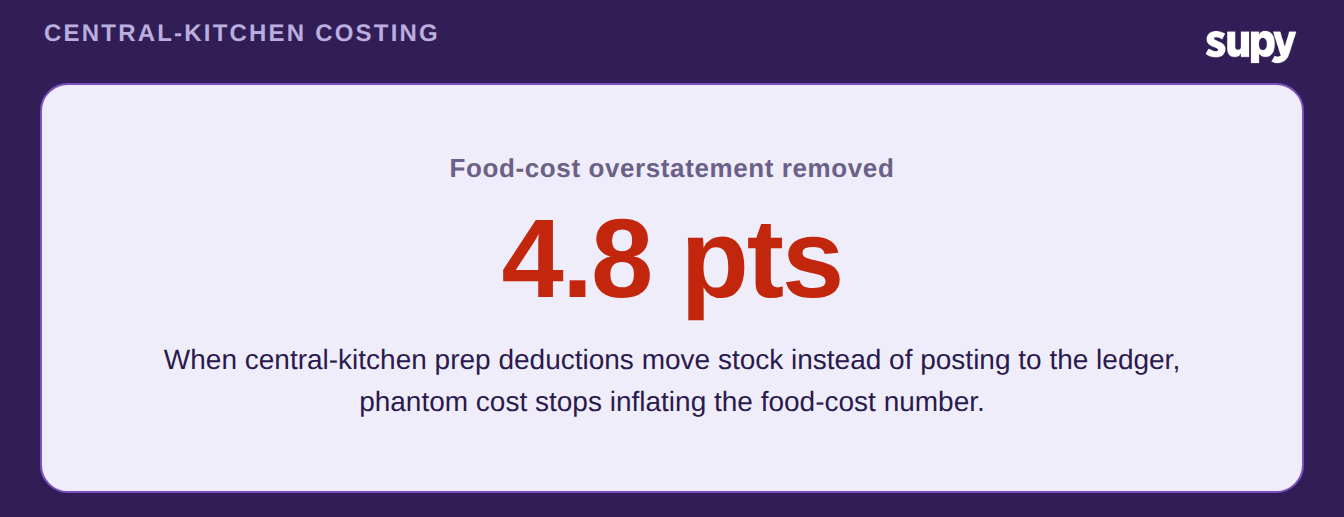
Menu costing software that understands a central kitchen deducts the ingredients a prep recipe consumes and tracks the semi-finished item it produces, without creating an accounting entry. Your food-cost number then reflects what you actually used, not a bookkeeping artefact.
Getting all of this right does not start with the software. It starts with one honest question. Does your current setup show a dish's cost at each site, or only one blended number for the whole group?
If it is one number, pick your highest-volume dish and check its cost at your three busiest sites this week. If the spread surprises you, that gap is money. It is the clearest sign that per-location menu costing is worth a closer look.