Inventory

Parallel Stock Count: One Restaurant Count, Split Across Your Team
How a Parallel Stock Count Works Across a Team

A parallel stock count is one count that several people work at the same time, each on a different section of the same location. You split the count into named sections, give each counter their own, and the results merge into one figure. Nobody waits for one person to finish, and no two people count the same shelf.

Run counts the old way and each site ends up with several separate, uncoupled counts, or one person walking every shelf alone. A parallel count fixes both. It turns a full stock count into a coordinated job the whole team finishes together.
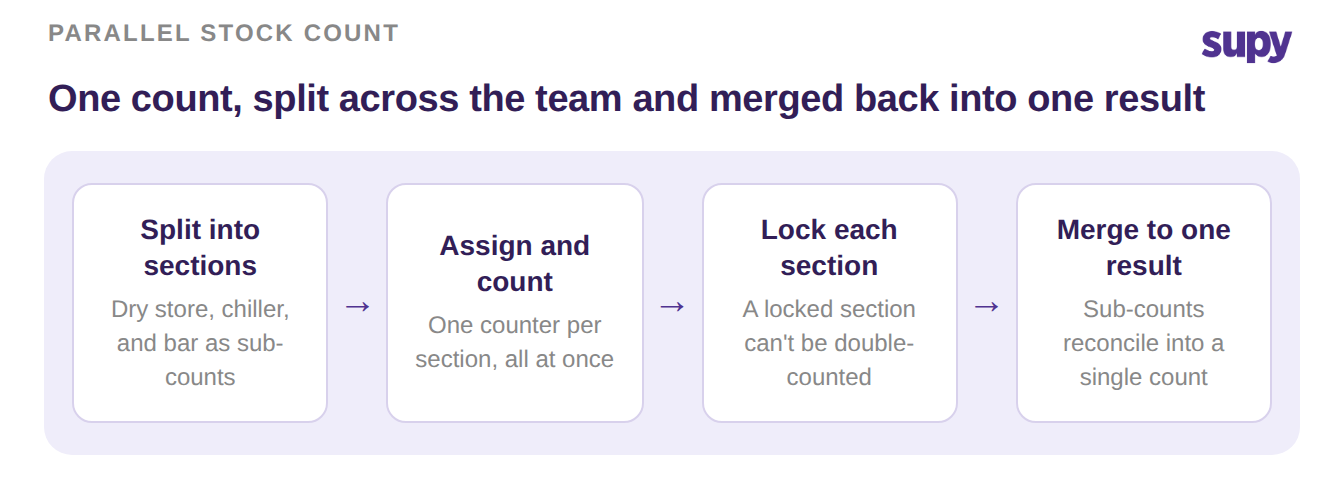
Parallel stock count flow: split into sections, assign and count, lock each section, merge to one result


Split the Count into Named Sections

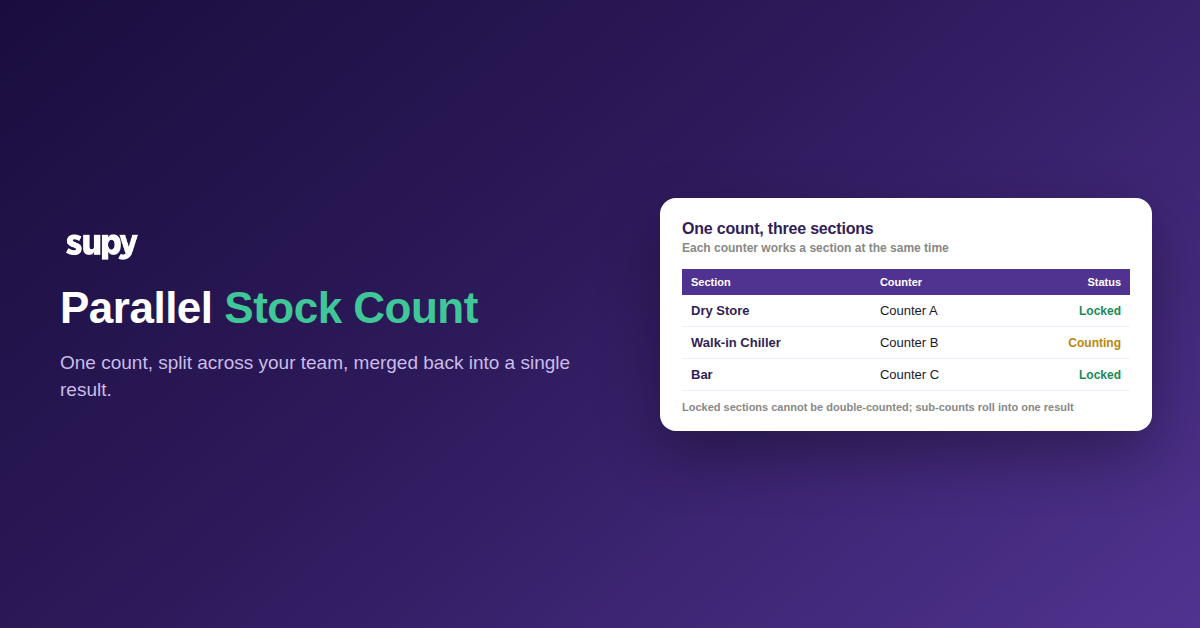
Start by dividing the location into named sections, such as the dry store, the walk-in chiller, and the bar. Each section becomes its own sub-count inside the one count, part of Supy's stock counting. You assign a counter to each, and they all count at the same time.

The table below shows how a three-section count is shared out.

SectionCounterStatus
Dry StoreCounter ALocked
Walk-in ChillerCounter BCounting
BarCounter CLocked


Everyone works from the same count, so their numbers roll up together. No one has to merge separate spreadsheets afterwards.

Lock Each Section to Stop Double-Counting

When a counter finishes a section, they lock it. A locked section cannot be edited by anyone else, so two people never count the same shelf and overwrite each other. That single rule is what removes double-counting.

A manager keeps control of the whole count. One action locks or unlocks every section at once, which is how you close the count when the floor is done, or reopen it if a section needs a recount.
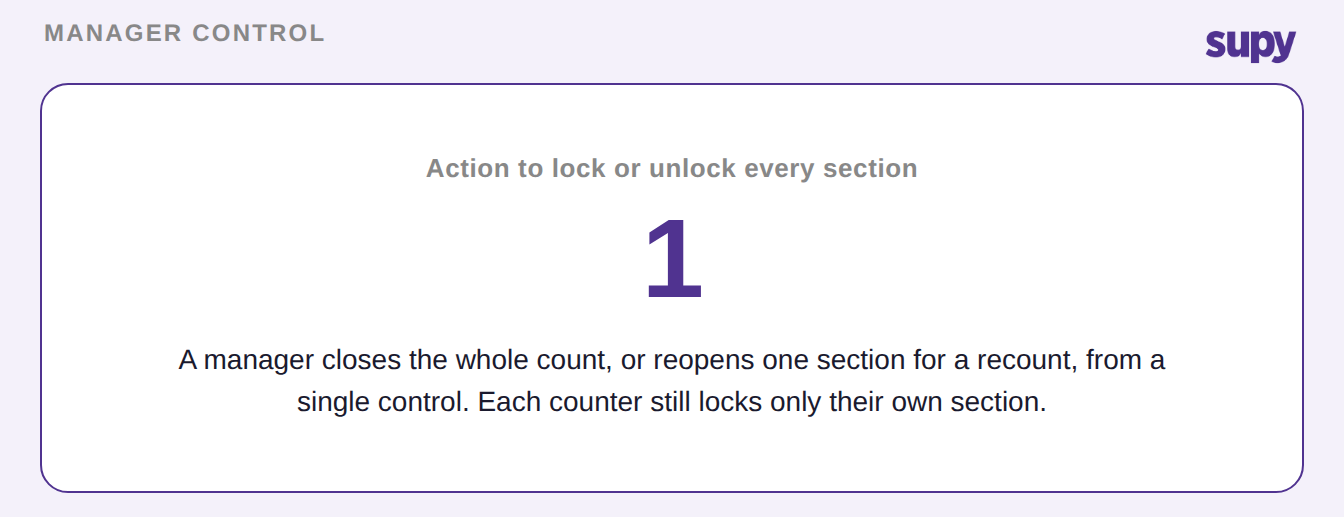
One manager action locks or unlocks every counting section at once


Keep One Audit Trail of Every Count

Every lock and unlock is recorded with the counter's name and the time it happened. If a number looks wrong, you can see who counted that section and when, without asking around.

The count carries its own history, so a recount or a query has an answer ready. That is also what lets a manager reopen one section with confidence, because the log shows exactly what changed.

TimeCounterSectionAction
09:12Counter ADry StoreLocked
09:20Counter CBarLocked
09:24ManagerWalk-in ChillerUnlocked for recount
09:31Counter BWalk-in ChillerLocked


Combine the Sections into One Reconciled Result

Because every section belongs to the same count, the sub-counts add up to one reconciled result on their own. There is no separate step to stitch the parts together, and stronger stock count accuracy follows from that.

Each site counts in its own shelf order, too. Stock count templates are saved per outlet, so a counter follows the same path along the shelves every time. That keeps the count fast and consistent.
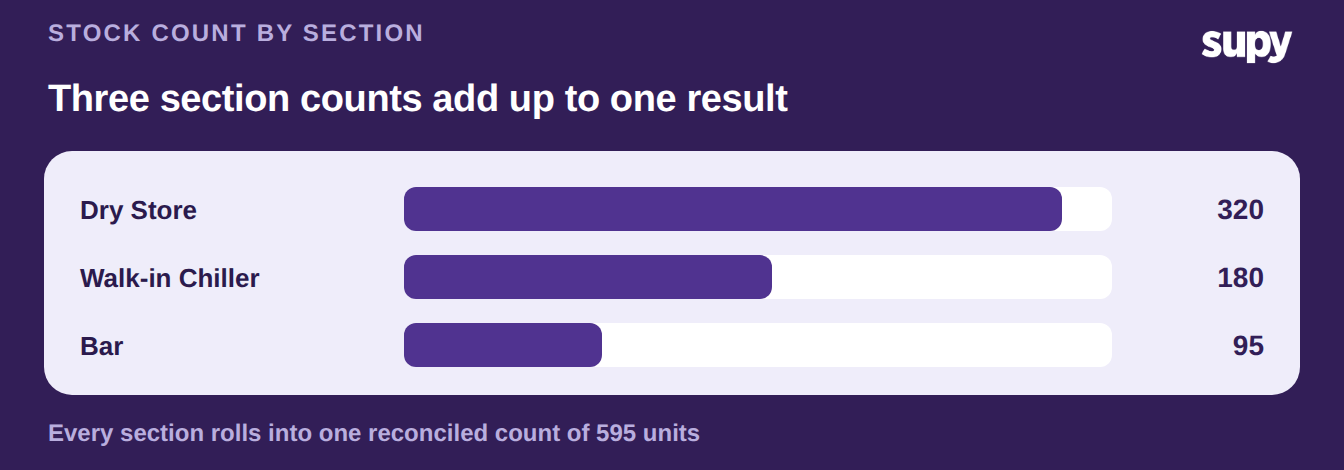
Three section counts of 320, 180 and 95 units add up to one reconciled count of 595 units


To try this on your next count, split one location into three or four named sections and assign a counter to each. Have each person lock their section as they finish.

You will see the whole count close in one pass, with a single result and a full record of who counted what. That replaces the stack of separate counts you would otherwise reconcile later.
Book a Demo with Supy - parallel stock counting across a team

Ready to optimize your restaurant operations?

Blog

Our operational insights

No items found.

Your questions 
answered

Everything you need to know about Supy — from setup to integrations, pricing, and daily use. If it’s not covered here, just ask.

What is a parallel stock count?
+

A parallel stock count is a single stock count that several people work at the same time, each on a different section of the same location. Instead of one person walking every shelf, or each site running several separate counts, the location is split into named sub-counts. Every counter works their own section, and all the sections belong to the one count, so the numbers roll up into a single reconciled result. It is faster than a solo count and avoids the reconciliation work of merging separate counts done by different people.

How do you split one stock count across a team?
+

You divide the location into named sections, such as the dry store, the walk-in chiller, and the bar, and each section becomes its own sub-count inside the one count. You then assign a counter to each section, and they all count at the same time. Because every sub-count is part of the same count, nobody has to stitch separate spreadsheets together afterwards. The result combines on its own. This is what turns a full stock take into a coordinated job the whole team finishes in one pass rather than a stack of uncoordinated counts.

How does section locking prevent double-counting?
+

When a counter finishes their section, they lock it. A locked sub-count cannot be edited by anyone else, so two people can never count the same shelf and overwrite each other's numbers. That single rule is what removes double-counting in a shared count. It also gives you a clear signal of progress: a locked section is done, an open one is still being counted. If a section genuinely needs a recount, a manager can unlock just that one, and the rest of the count stays exactly as it was.

Can a manager lock or unlock the whole count at once?
+

Yes. A manager can lock or unlock all counting sections at once from a single action, on top of the per-section locks each counter controls. That is how you close the whole count when the floor is done, so no further edits slip in. It is also how you reopen the count if something needs checking. The two levels work together: counters lock their own sections as they finish, and the manager keeps control of the count as a whole, closing or reopening it in one step rather than section by section.

How is a parallel count combined into one result?
+

Because every section is a sub-count inside the same count, the parts add up to one reconciled result on their own. There is no separate merge step and no spreadsheet to consolidate by hand. As each counter finishes and locks their section, their numbers join the single count total. When the manager closes the count, you have one figure for the location that already reflects every section. That is the main advantage over running several independent counts, where combining the results is a manual and error-prone job.

What does the stock count audit trail record?
+

Every lock and unlock action on a counting section is recorded with the user who did it and the time it happened. So if a number looks wrong later, you can see who counted that section and when, without asking around the team. The count carries its own history. That record is also what lets a manager reopen a single section with confidence, because the log shows exactly what changed and by whom. For a multi-site group, that traceability is what makes a shared, parallel count auditable rather than a black box.

Do per-outlet templates help a parallel count?
+

Yes. Stock count templates are saved per outlet, so each location keeps its own shelf-order list. A counter follows the same path along the shelves every time, which keeps the count fast and consistent from one period to the next. In a parallel count, the template also makes the sections predictable: the same named areas come up each time, so assigning a counter to each is quick. Consistent shelf order plus split sections is what lets a whole team count one location accurately without tripping over each other.

Ready to transform your operations?

Join 3500+ restaurant operators cutting costs, streamlining operations and making smarter decisions with Supy.