.jpg)


Restaurant Stock Takes: Outsource Them or Run Inventory Software?
Outsourced Counts and In-House Software Answer Different Questions
Two models dominate restaurant stock takes. You either pay an external crew to walk in and count everything on a set date, or your own team counts with in-house inventory software on a schedule you control. The first buys labour for a point-in-time number; the second turns counting into a routine that feeds variance and cost.
The honest question is not which one counts better on the day. A trained external crew and a well-run in-house count can both land an accurate number for a single full stocktake. The question is what you need between those counts, and how often you need it.
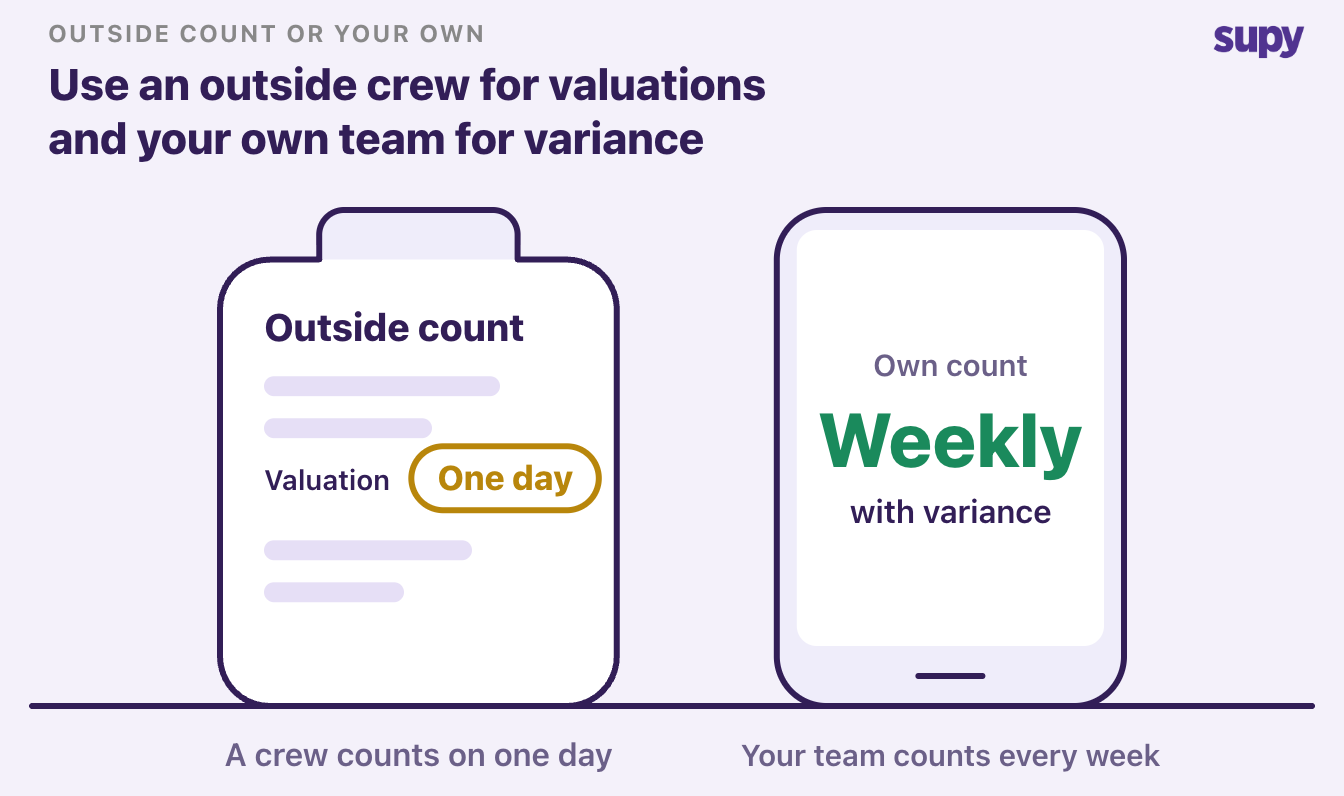
An external crew sells you a service: people arrive, count the shelves, and hand back a valuation. That fits a group that needs one clean full physical now and then across many sites. In-house inventory software sells you a system your own team runs again and again. The count stops being an event and becomes a weekly habit the rest of your numbers depend on.
Read the choice by count frequency and by what each number has to do once you have it.
What a Recurring Stocktaking Fee Actually Buys
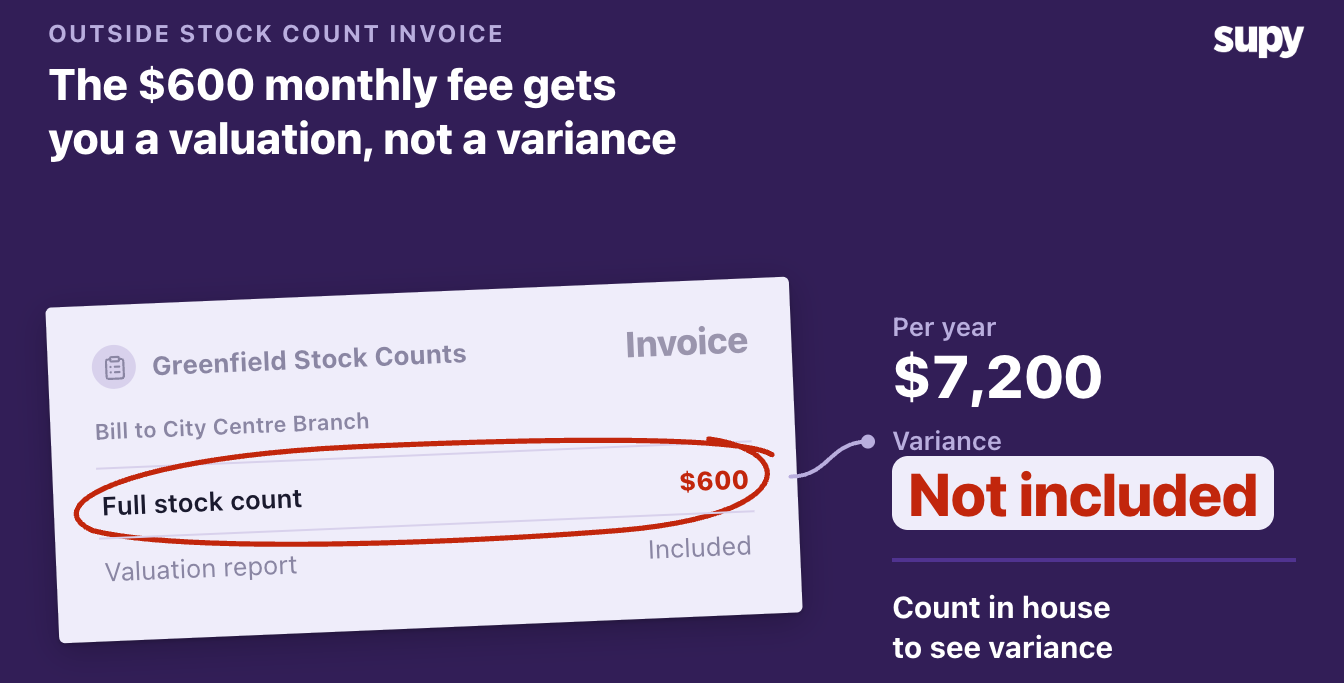
A recurring external fee buys labour and a valuation on the day, nothing more. One hospitality operator paid about $600 a month for an outside company to run its stock takes. That is $7,200 a year before a single extra count. That money pays for trained counters and a number you can book, and for a group with no in-house system it can be the fastest route to a clean figure.
The gap is everything that happens between visits. A monthly or quarterly external physical tells you where stock stood on one morning. It does not tell you whether a line drifted the following week, because nobody counted it until the crew came back.
The fee also buys a count that stands alone. An external crew reports what is on the shelf, not what should be on the shelf. The number arrives with no link to your recipes, sales, or purchases. You get a valuation to put in the accounts, not a variance you can act on in the kitchen.
For an operator who already wants to stop paying the fee, the real cost is this blind window plus the missing variance, not just the monthly line item.
Where In-House Software Pulls Ahead on Count Frequency
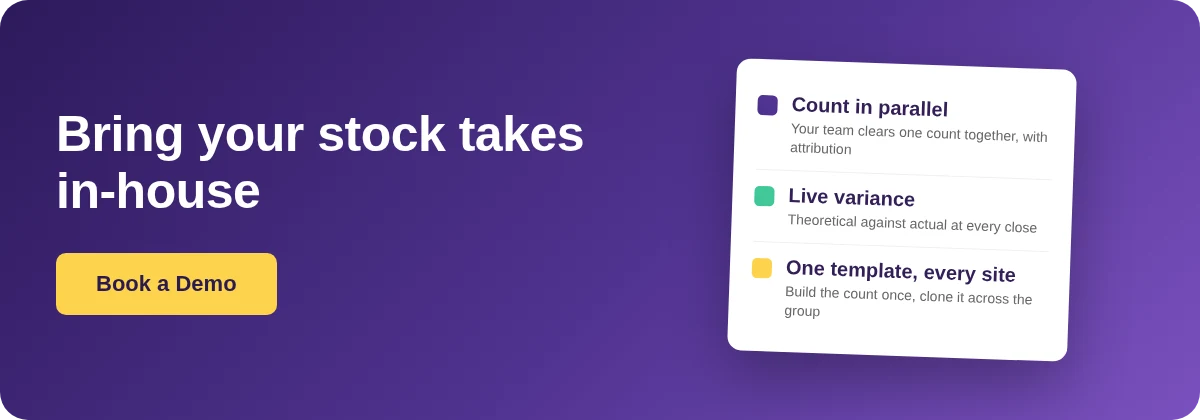
In-house software wins when you need to count often, because it strips the labour out of each count. Parallel counting lets several team members count different sections of one location at once; the app merges their entries into a single count and records who counted what. A job that tied up one person for an evening becomes a task the team clears together before service.
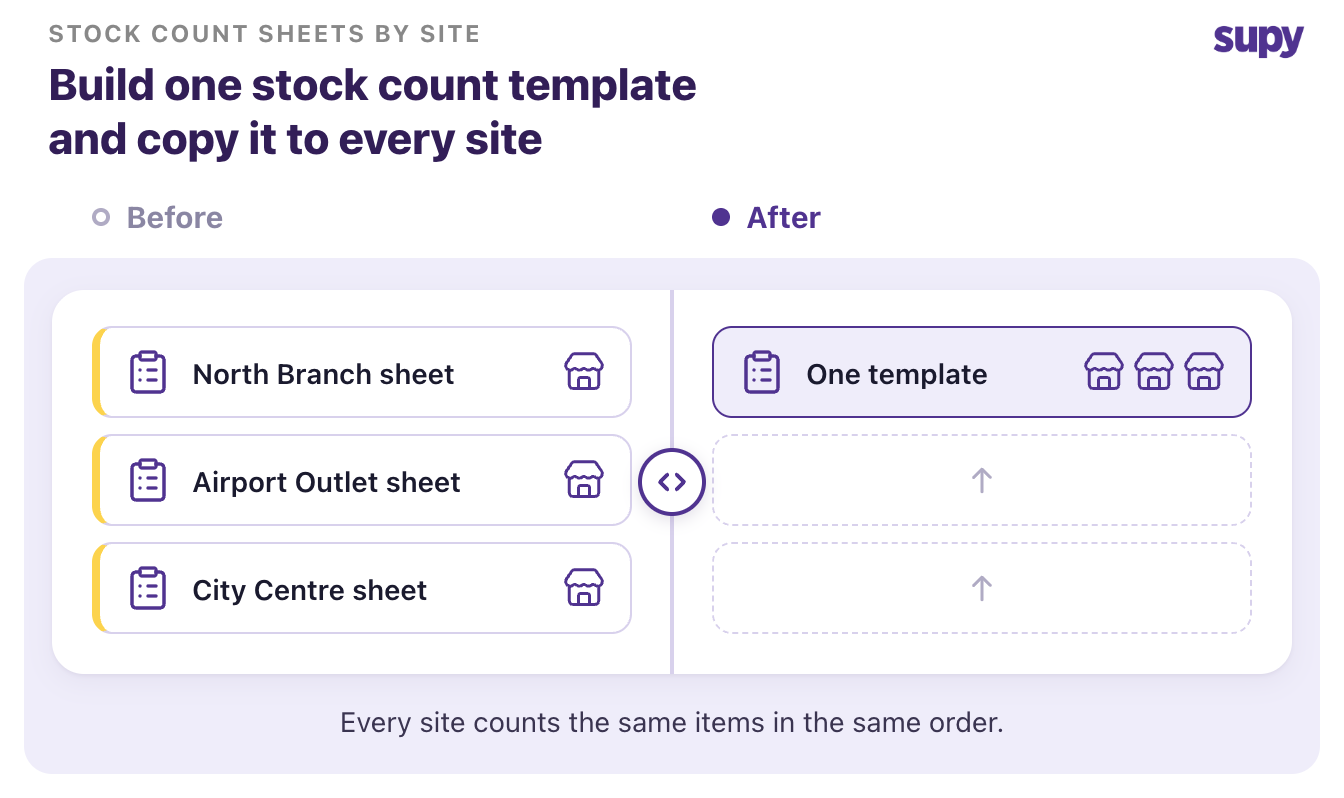
Reusable templates compound that speed. You build a count template once in shelf order and clone it to every site, so each branch counts the same items in the same sequence without rebuilding the sheet. New site, same template, same discipline.
Supy states this cuts counting time by more than 50%, and it runs on phones and tablets even where the signal drops in a walk-in or a basement store. When one count costs a fraction of what it used to, quarterly full counts can become weekly cycle counts without closing the kitchen or booking a crew.
If you want the wider case for counting little and often, our guide to cycle counting versus full stocktakes covers how multi-site groups keep accuracy up without shutting down.
The Variance Number an External Physical Cannot Give You
Recipe-linked variance is the number an external crew cannot hand you, and it is usually the reason to bring counting in-house. When recipes link to your POS menu items, every sale depletes the right ingredients, so the software always holds a theoretical stock figure. At close, it shows theoretical against actual counted, with item-level drill-down into where the two diverge.
That turns a count into a diagnosis. Say one category should hold $4,200 of stock from recipe depletion, and the team counts $3,900. The $300 gap is a variance you can chase to a specific item, a wastage log, or a receiving error, in the same week it happened.
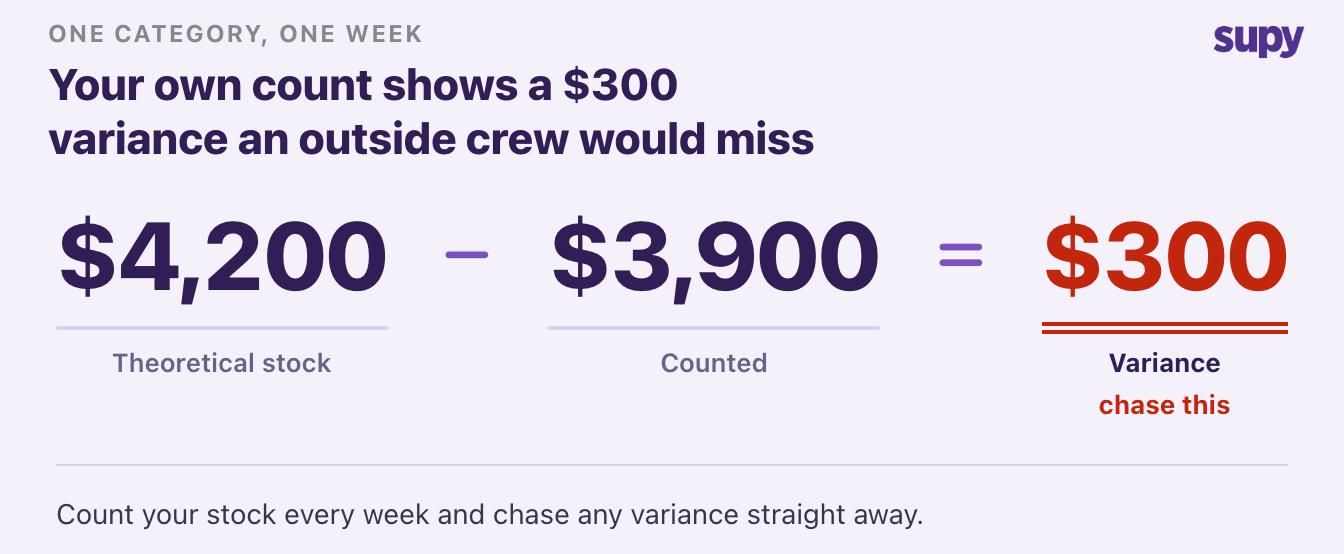
An external physical gives you the $3,900 and stops there. Without a theoretical figure to compare against, the number is a valuation, not a signal. Any drift shows up months later, when the margin has already moved. Restaurant inventory management software keeps that theoretical figure live, which is what makes frequent in-house counts worth running.
This is also the honest limit of comparing against a spreadsheet baseline, which our breakdown of stock counts in spreadsheets versus software walks through in full.
Choosing Between an External Crew and In-House Software
The decision comes down to how often you count and what the number has to do. Match your situation to the column that fits, rather than assuming software always wins.
| What you need | External stocktaking crew | In-house inventory software |
|---|---|---|
| Count frequency | Occasional full physical | Weekly cycle counts and full counts |
| Labour | Supplied by the vendor | Your own team, in parallel |
| Variance vs theoretical | Not available | Live at every count |
| Real-time cost and usage | Not available | Updated from sales and receiving |
| Cost shape | Recurring fee per visit | Platform subscription |
| Best fit | A clean one-off count across many sites | Frequent, recipe-linked control |
Choose an external crew when you need an occasional full physical across many sites, have no in-house system, or want an independent count for an audit. Choose in-house software when you want to count often, need variance against theoretical, or already pay a recurring fee you would rather turn into continuous control. Many groups run both for a while. Keep the crew for the annual full physical, and move the regular counts in-house, so the kitchen gets a usable number every week.
To see whether your own stock takes would move in-house cleanly, list how often each category really needs counting. Then check which of those counts an external visit covers today. The categories it misses are the ones costing you the most to leave blind.