Food cost
Menu engineering

Restaurant Menu Items at Negative or Zero Margin: Find and Fix Them

Restaurant menu items sold at negative or zero margin, shown as a recipe cost check with cost above the target

How Restaurant Menu Items End Up Sold at Negative or Zero Margin

A menu item sold at negative or zero margin costs as much to make as it earns, or more, so every order loses money. The blended average food cost hides it, because strong dishes mask the weak ones. You surface these items by costing each dish against its live ingredient cost and its selling price, then fixing the worst first.

Negative and zero margin are two versions of the same failure.

  • Below cost. A negative-margin dish sells for less than it costs to make, so it loses money on every plate.
  • At cost. A zero-margin dish covers its ingredients and nothing else, so it earns nothing toward rent, labour or profit.

Both drain the group while the menu looks busy and healthy.

  • Quiet causes. Two things push a dish under water, and both stay quiet. Ingredient costs climb while the menu price sits where it was at launch. Or the recipe was costed once and never rechecked, so the figure on screen stopped matching the kitchen months ago.
  • Hidden by averages. One dish rarely moves the headline number, so the average stays calm while individual plates bleed. Our guide to how the average food cost hides unprofitable dishes shows the spread across a menu is wide. The worst plates are rarely the ones anyone watches.
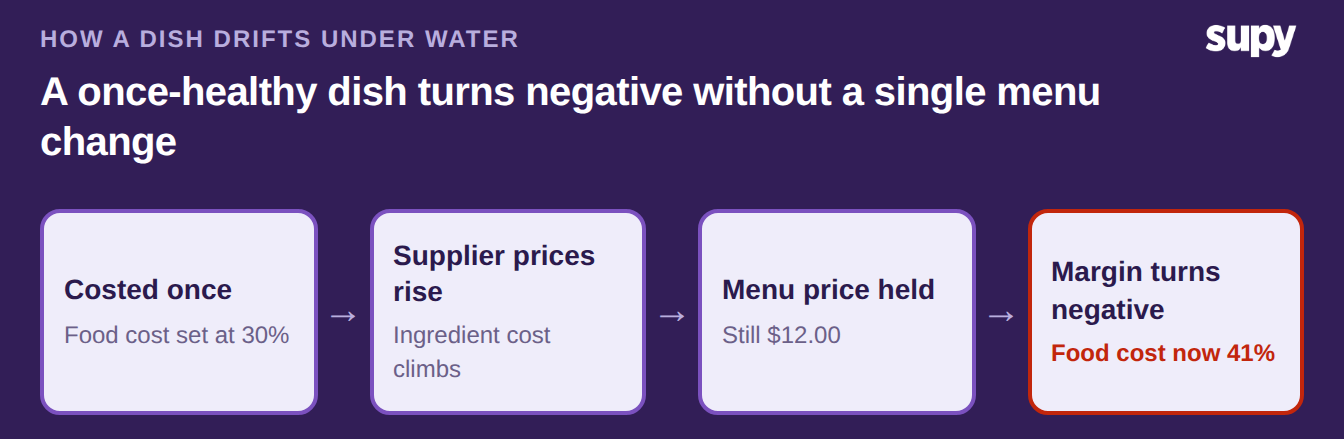
How a once-healthy restaurant dish drifts to a negative margin after supplier prices rise while the menu price stays fixed

The Red Flags That a Dish Is Losing Money

Each flag below is a symptom you can see this week, with the check that confirms it. Run down the list against your own menu.

  1. The food cost percentage runs well above your own target. A dish you costed at a 30% food cost can reach 41% after supplier prices rise, because the recipe was never rechecked. Recost it on today's purchase price and compare that figure to the selling price.
  2. The menu price has not changed since the dish launched. Costs move most weeks, so a price frozen for a year almost always trails them. Review the price whenever a main ingredient jumps.
  3. A wholesale or catalogue item sells at a price you agreed once. A sandwich sold at $6.00 now costs $6.40, so it loses $0.40 a unit. At 120 units a week that is $48 gone. Check each catalogue line against its current cost before you reorder.
  4. Your best sellers are the dishes you have never re-costed. High volume multiplies a small negative margin into a real monthly loss. Re-cost the top sellers first, not the slow movers.
  5. The same dish costs different amounts at different branches. Supplier prices vary by site, so a plate that profits at one branch can lose money at another. Read margin per dish per branch, never one blended figure.
  6. You only spot the problem at month end. By the time the gross profit gap appears, the dishes have already sold for weeks. Watch per-dish cost as it moves, with an alert the moment a dish crosses its target.
  7. A free garnish or packaging line is costed into the plate. A component that should sit outside the recipe cost inflates the food cost and masks which dishes are truly negative. Flag non-costed items so the figure stays clean.
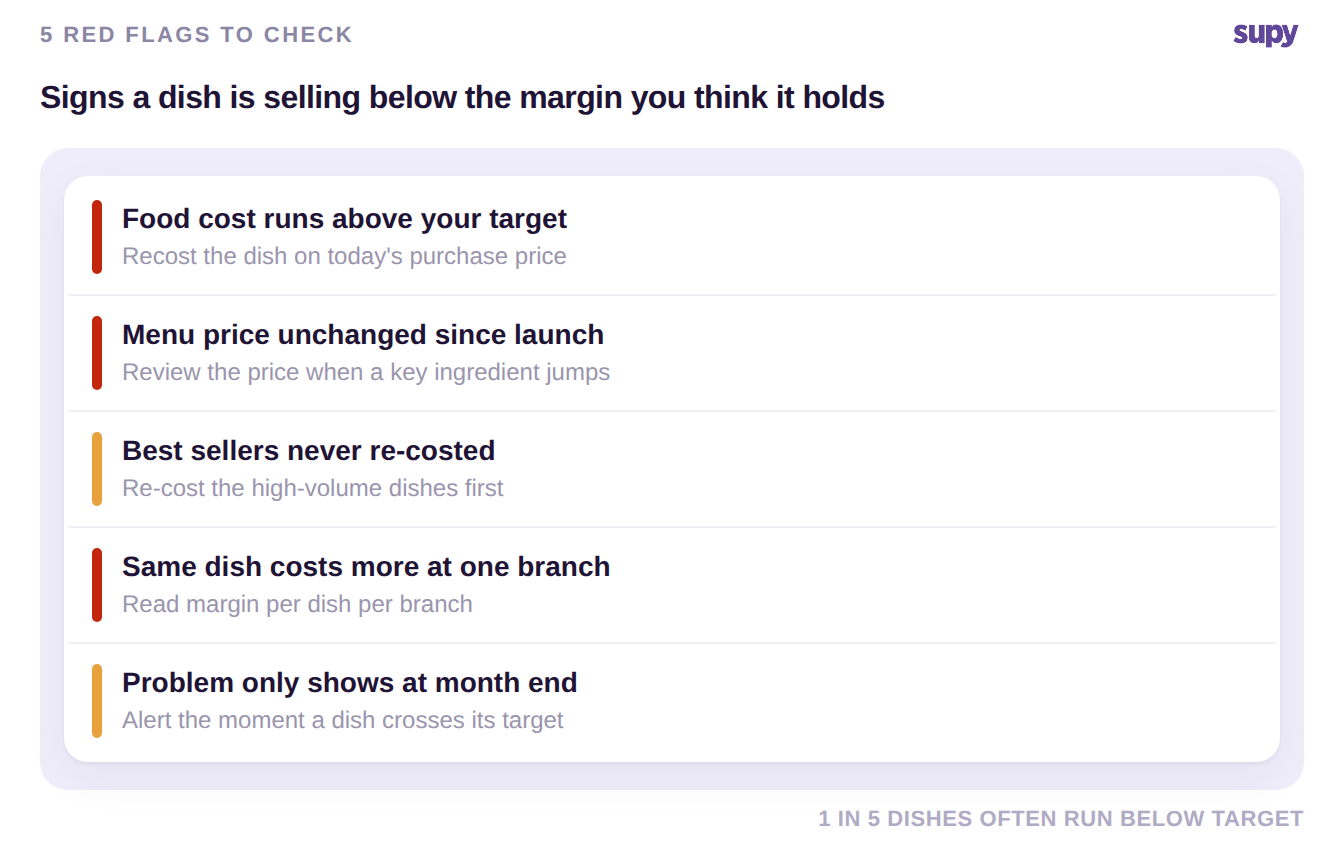
Five red flags that a restaurant menu item is selling below margin, each paired with the check to confirm it

How to Surface and Fix Negative-Margin Items Across Every Site

Surfacing these dishes takes one thing: the current cost and the selling price of every recipe, side by side, kept up to date on their own.

  • Live ingredient cost. Supy tracks two cost figures for each ingredient per branch: the running average and the most recent purchase price. A dish's food cost then reflects what you pay now, not what you paid at launch.
  • Latest purchase price. The latest purchase price matters most here, because a running average lags a price rise by weeks. A dish can read healthy on the average while the next delivery already sells it at a loss.
  • Price and target. Each recipe also carries its selling price and a target food cost percentage per branch, which lets a report rank the plates that breach their target.

Three tools turn that data into action.

  • Target cost alerts. Recipe target costs raise an alert when a dish crosses the threshold you set, so you hear about it in the week it happens.
  • Analytics and reports. The restaurant analytics dashboards plot every dish on a menu engineering matrix, and a one-click spreadsheet report lists recipe costing and margin across the group.
  • Costs on screen. Real-time recipe costs appear inside production, wastage and stock-count screens, so the cost sits in front of the team at the moment they record work.

The menu engineering matrix sorts dishes by how well they sell and how much margin they hold:

QuadrantSells wellHolds marginWhat to do
StarYesYesProtect the recipe and the price
Plow horseYesNoRecost, then lift the price or trim the recipe
PuzzleNoYesPromote it or move it up the menu
DogNoNoFix the cost or cut the dish

For a group, the fix holds only when margin reads per branch. A central recipe can profit at a high-volume site and lose money at a smaller one on the same menu price, because each branch pays its own supplier rates. Comparing per-branch margin on the same dish tells you where to change the price and where to leave it.

Start with one pass this week.

  1. Recost top sellers. Pull your highest-volume dishes, recost each on today's purchase price, and mark any whose food cost now runs above the target you set.
  2. Find the worst. The plate that sells the most while breaching its target bleeds fastest.

Fix its price or its recipe first, then work down the list.
Book a Demo with Supy - find and fix restaurant menu items sold at negative or zero margin

Ready to optimize your restaurant operations?

Blog

Our operational insights

Restaurant recipe costs wrong or zero
Food cost

Restaurant Recipe Costs Wrong or Zero: How to Fix Each One

Food cost
Menu engineering

Spreadsheet Recipe Costing vs Software: Why Static Recipe Costs Go Wrong When Supplier Prices Move

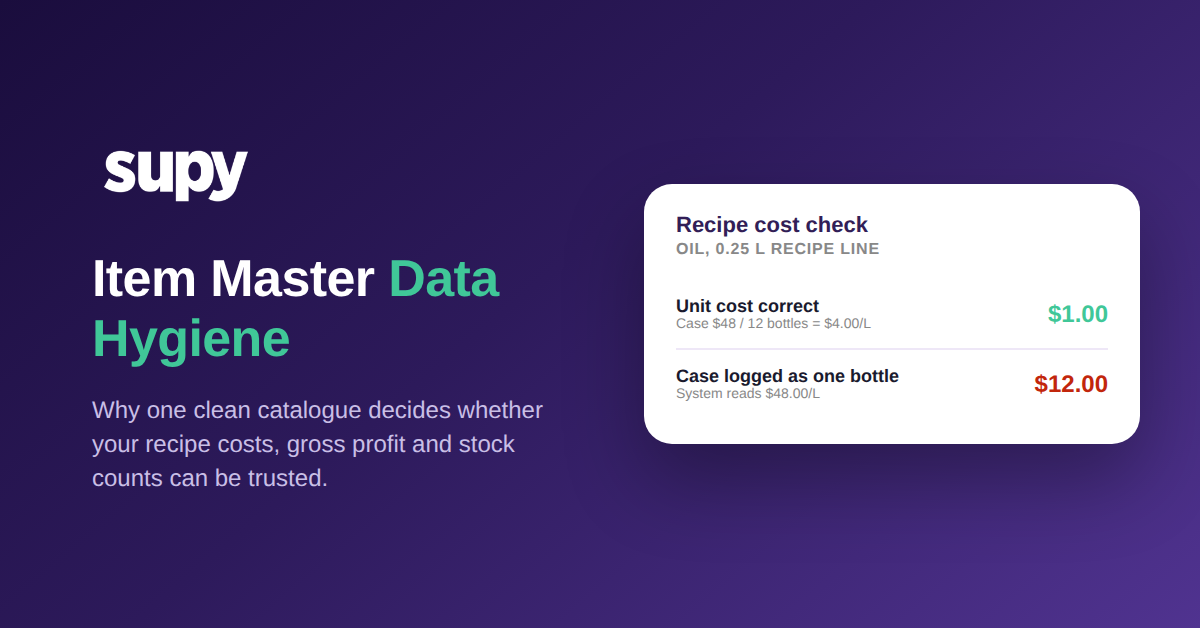
Item master data hygiene: recipe cost check showing a wrong unit cost inflating a plate
Food cost
Inventory

How To Fix Restaurant Item Master Data Hygiene When Inconsistency Breaks Recipe Costing, GP Reporting & Stock Counts.

Your questions 
answered

Everything you need to know about Supy — from setup to integrations, pricing, and daily use. If it’s not covered here, just ask.

What does it mean when a menu item has a negative or zero margin?
+

It means the dish earns no profit on the plate. A negative-margin item sells for less than its ingredients cost, so every order loses money. A zero-margin item covers its ingredients and nothing else, leaving nothing toward rent, labour or profit. The trap is that these dishes rarely look broken. Your menu still sells, the average food cost looks normal, and the loss only surfaces when you cost each dish on its own against today's purchase price. Until then the strong plates carry the weak ones, and the weak ones keep selling night after night.

Why do profitable dishes turn into negative-margin items over time?
+

Because the cost moves and the price does not. You cost a dish once, set a selling price, and then supplier prices climb while the menu stays the same for months. A dish costed at a 30% food cost can quietly reach 41% after a few deliveries, yet nothing on the menu changes to signal it. The second cause is a stale recipe cost: if the figure on screen is never rechecked against the latest purchase price, it stops matching the kitchen. Both drift slowly, which is why the loss is easy to miss until month end.

How do I find which menu items are sold at a loss?
+

Cost every dish against its current ingredient cost and its selling price, then rank the results. Start with your highest-volume dishes, because a small negative margin there multiplies fastest. A dish whose food cost now runs above the target you set is the first to check. Supy keeps each recipe's cost and selling price side by side per branch and can raise an alert when a dish crosses its target, so you do not rebuild a spreadsheet each month. The point is to catch the loss while the dish is still selling, not after the period closes.

What is the menu engineering matrix and how does it help?
+

It sorts every dish by how well it sells and how much margin it holds. The four groups are Stars (sell well, hold margin), Plow horses (sell well, thin margin), Puzzles (strong margin, slow sellers) and Dogs (weak on both). A negative-margin item usually sits among the Plow horses or Dogs, where it does the most damage because volume is high or the dish earns nothing. The matrix tells you what to do with each group: protect Stars, recost or reprice Plow horses, promote Puzzles, and fix or cut Dogs. Supy plots this in its dashboards.

Why does the same dish show a different margin at different branches?
+

Because each branch pays its own supplier prices. A central recipe uses the same ingredients everywhere, but a site that buys at a higher rate carries a higher food cost on the identical plate. So a dish that profits at a high-volume branch can lose money at a smaller one on the same menu price. Reading one blended margin across the group hides this entirely. Comparing margin per dish per branch shows where the price needs to change and where it can stay, which is why multi-site groups track cost per branch rather than one figure for the whole estate.

Should I remove a negative-margin dish or reprice it?
+

Reprice or fix the recipe first, and remove only as a last resort. If the dish sells well, a small price rise or a cheaper substitute ingredient often turns it profitable without losing the customers who order it. If it sells poorly and still loses money, it is a Dog, and cutting it frees menu space for something better. Check the contribution the dish makes before you decide, because a popular item at zero margin may still earn its place if it draws people who order profitable sides. Base the call on per-dish cost and sales, not on instinct.

How often should I re-cost my restaurant menu items?
+

Re-cost whenever a key ingredient's price moves, not on a fixed calendar. High-volume dishes and anything built on volatile ingredients, like proteins or oils, need the closest watch, because their cost shifts most and their volume multiplies the effect. A system that tracks the latest purchase price per ingredient does this continuously, so the food cost on screen always reflects the last delivery. If you recost by hand, a monthly pass on your top sellers catches most of the damage, and a target-cost alert fills the gap between passes so nothing drifts unnoticed for long.

Ready to transform your operations?

Join 3500+ restaurant operators cutting costs, streamlining operations and making smarter decisions with Supy.