





A Food Shelf Life Chart for Restaurants, With Dates for Opened Food

Shelf Life of Common Prepped Items, and the Date to Write On
A food shelf life chart tells your restaurant team how long each prepped item is safe to use, and the FSA caps cooked high-risk food at two days. One rule makes the chart work: the moment you open, decant or cook something, write a new, shorter date on it. This article shows the chart, the dates to write, and how to make every site follow them.
The limits below come from Food Standards Agency guidance (date labels, chilling and defrosting). Confirm them with the FSA or your environmental health officer first, and set your own house limits inside them.
| Prepped item | Sealed or received | Date once opened or cooked | Store at |
|---|---|---|---|
| Cooked high-risk food (cooked meat, rice, pasta, sauces) | Make it fresh | Use by the cooking day plus two days, three days at most | 8 degrees C or below, ideally 0 to 5 |
| An opened or decanted chilled product | The supplier use-by on the sealed pack | The supplier "once opened, use within" date, never later than the sealed use-by | 8 degrees C or below |
| A prepped ready-to-eat item (dressings, prepared salad, sliced garnish) | Make it fresh | The prep day plus your house limit, inside the cooked-food rule above | 8 degrees C or below |
| Defrosted food | Keep frozen until needed | Use within 24 hours of fully defrosting | 0 to 5 degrees C while it defrosts |
| Reheated cooked food | Cooked on site | Reheat once until steaming hot, then use within the cooked-food limit | 8 degrees C or below until reheated |
Three FSA figures anchor the whole chart.
- Cool fast. Cool cooked food and get it into the fridge within one to two hours (FSA).
- Keep it cold. Hold chilled high-risk food at or below 8 degrees C, the legal maximum, and aim for 0 to 5 (FSA).
- Use it in two days. Use cooked, chilled food within two days, and never keep high-risk ready-to-eat food past the production day plus two (FSA).
Why Opened or Decanted Food Needs a Shorter Date
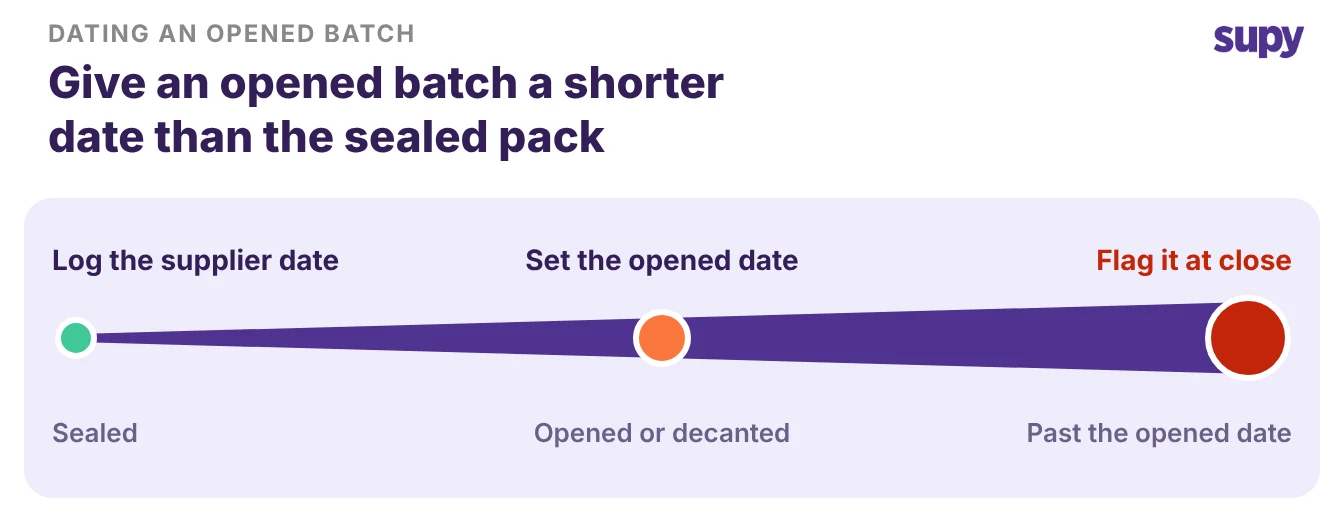
A sealed batch and the portion you open from it do not share a date. Open a 10 kg batch of sauce that keeps five days sealed, and the half you decant into a smaller tub lasts about three days, not five. That opened portion can never carry a date later than the sealed batch it came from.
Chefs call this the parent and child rule, and it is where most shelf life charts quietly fail.
- The parent sets the ceiling. The sealed batch, the full bag, the unopened tub is the parent. Its use-by is the latest date any portion taken from it can carry.
- The child gets a shorter date. Opening or decanting exposes the food to air and handling, so the portion gets its own shorter life. Write the earlier of the two dates on it.
- Cooking resets the clock. A cooked batch starts its own two-day life from the cooking day, whatever the raw ingredients were dated.
A chart that lists only sealed shelf life, with no column for the opened date, sends good food to the bin. The opened date is the one that keeps food safe and stops waste, so it belongs on every chart and every printed label.
Print a Prep Label So the Date Follows the Food
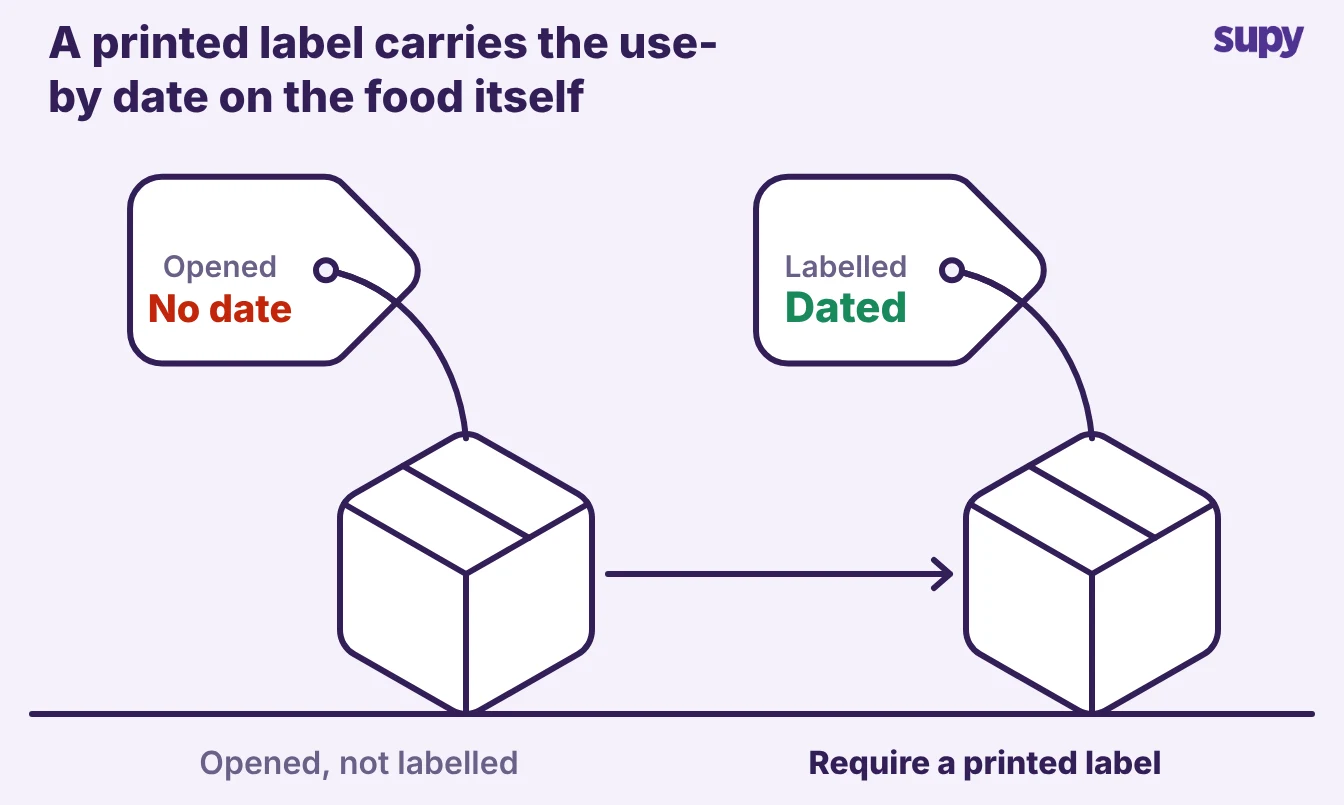
A date only works when it travels with the food, not on a whiteboard by the pass. The reliable fix is a printed prep label on every opened, decanted and cooked item. The label carries what it is, who made it, and the use-by date from the chart.
Supy Ops, Supy's checklist software, prints these labels and builds the routine that produces them. Build a checklist once, add it to the opening and prep routine, and run it at every branch on the same schedule.
- Print, do not handwrite. A printed date and prep label carries the item, the date and the maker in one scan, so a rotation check takes seconds instead of squinting at marker pen.
- Tie the label to a step. When a prep checklist step says "decant and label", staff print the label as part of the task, and the step is not done until the label is on.
- Stamp the proof. Supy Ops stamps each completed check and photo with who did it, when, and at which site. A label is then backed by a record an inspector can trust.
Use First In, First Out So Nothing Expires at the Back
Labels only pay off if the oldest date gets used first. First in, first out means the shortest-dated item sits at the front, and nothing hides at the back until it is weeks past its date. At a three-site group, an after-closing check once found most of a fridge expired, because no label faced out and no one checked.
- Face the dates out. Store items with the use-by date forward, oldest in front, so a cook reaches for the right one without thinking.
- Check it on a routine, not a hunch. A daily open-or-close stock check, run as a checklist step, flags an item that is already past its date before a customer or an inspector finds it.
- Make the gap visible. When every site completes the check as a step, head office sees which branch skipped it. A missed fridge shows up as a gap in the report, not a bin bag on Friday.
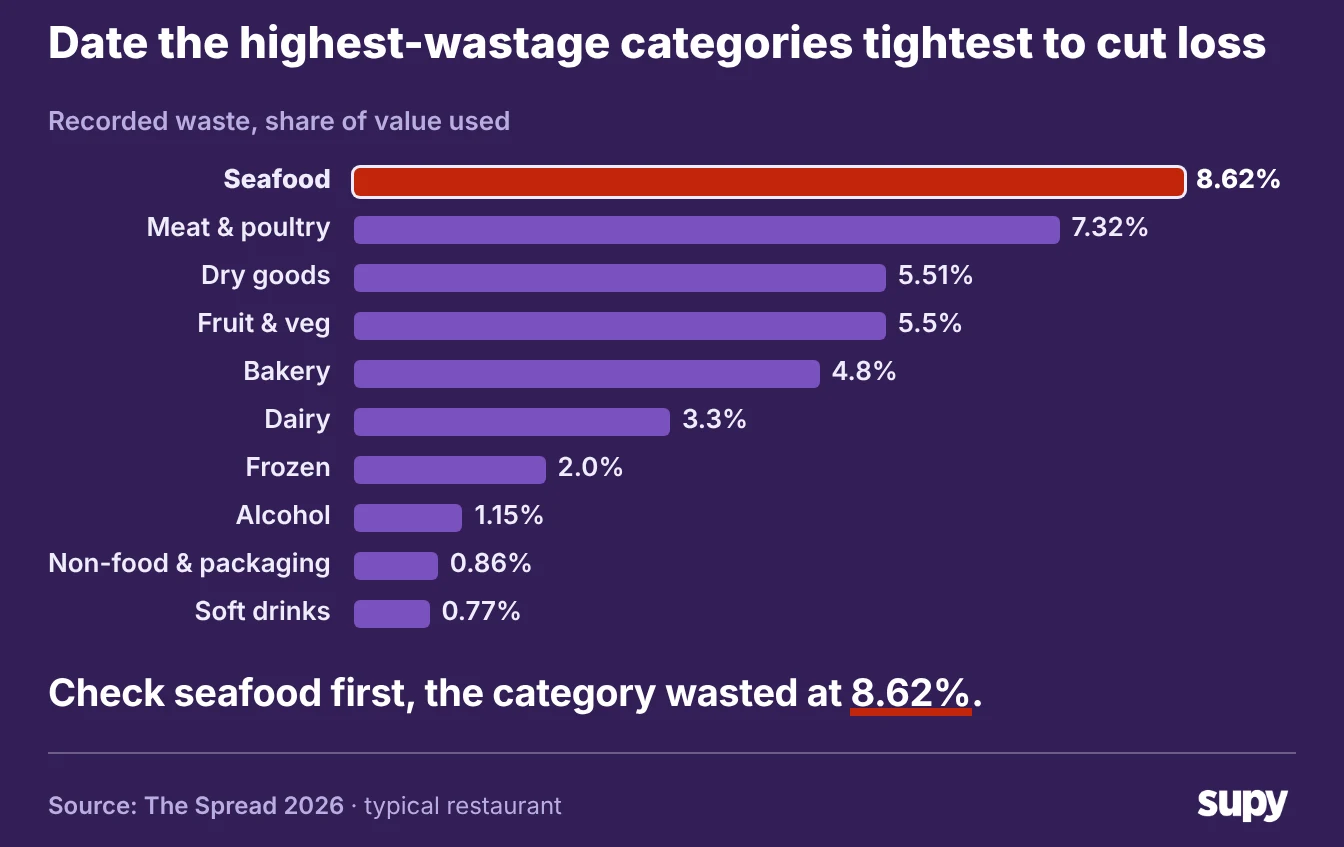
Seafood is the highest-wastage category in Supy's The Spread, recorded at 8.62% of the value bought. It is also one of the shortest-dated, so an item that hides past its date there is the most expensive to lose. Only recorded waste counts in that figure, so treat it as a floor.
Supy's inventory does not track each item's expiry date for you, so the dated label and the daily check are what keep the rule honest. Treat the label as the record and the checklist as the reminder.
Keep One Set of Shelf Life Rules Across a Central Kitchen and Its Sites
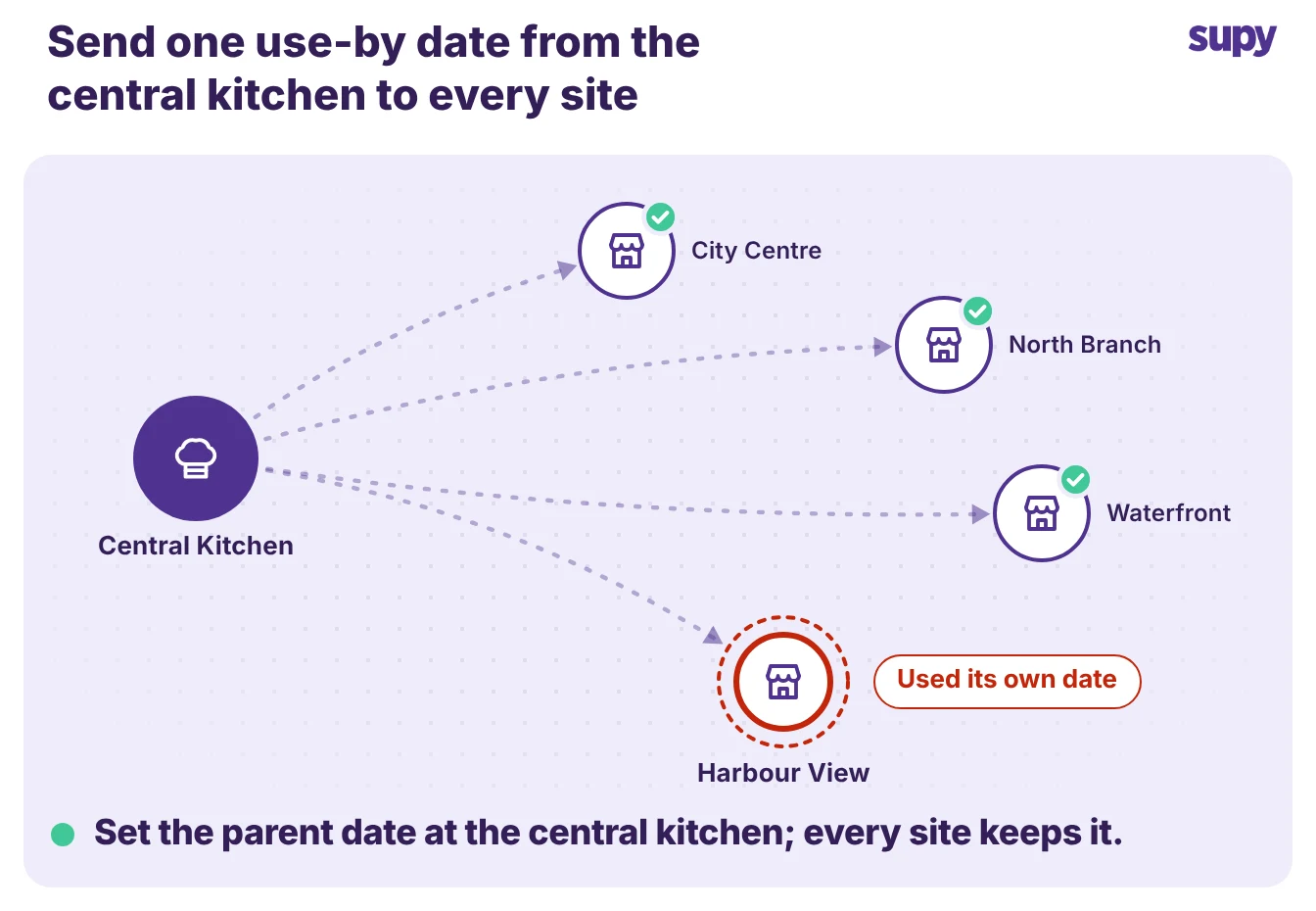
A central kitchen makes the parent and child rule literal. The kitchen cooks a batch, labels it with a production and use-by date, and sends portions to the sites. Each site keeps the parent date the kitchen set, so one set of rules travels with the food.
- Label at production. The central kitchen prints a batch label with the date the chart gives, so every site receives the same use-by, not a guess.
- Run the same checklist everywhere. The opening, prep and closing checks are built once and run at all sites, so a seven-site group follows one standard instead of seven.
- Read it in one place. Completion and compliance reporting across sites show which branches finished their checks and which missed them, so head office sees the whole estate on one report.
A food safety management system holds these rules together, and a shelf life chart is one page of it. For the wider picture, see how a food safety management system keeps your records in order.
Run a quick check across your sites. Open a fridge at random and pick up three prepped items. Does each one carry a printed label, and is the date the opened or cooked date rather than the sealed one?
If any item fails, the fix is the cheapest on this page: a printed prep label tied to a prep step, and a daily check that someone completes. Start with the cooked high-risk items, because they carry the two-day limit and the highest risk.