Procurement
Inventory

Restaurant Franchise Operations Manual: Documenting a New System
Restaurant franchise operations manual with a new system documented for franchisor sign-off

What a Franchisor Needs Documented for a New System

A franchise operations manual is the documented process standard tied to your franchise agreement. A new operations system has to be written into it before or during rollout. The franchisor signs off once the manual shows the procedures, the roles and permissions, the approval controls, the audit trail, and the reports you can export as evidence.

Document those five and the review has something concrete to approve. Leave them vague and the sign-off stalls, because the franchisor cannot confirm the new system is controlled. The table below maps each one to why it is asked for and how it is captured.

What to documentWhy the franchisor asks for itHow the system captures it
Standard operating proceduresConfirms every branch runs one consistent processWritten steps per module, users restrictable to approved templates
Roles and permissionsShows who can approve, edit, or only view200+ configurable permissions by user, branch and category
Approval controlsProves spend and stock changes are gatedSequential approvals up to 5 people by branch and order value
Audit trailGives an action record no one can alterEvery action tied to a named user and timestamp, tamper-proof
Reports as evidenceLets the franchisor verify without a site visitOne-click Excel and CSV exports across procurement and stock


If your team has never had written procedures, build that base first. Our guide to SOP software for multi-location restaurants covers the standard set the manual then references.

Before, During, or After Rollout: When the Manual Must Be Signed Off

Not every franchise agreement treats the manual the same way, so read yours before you plan the rollout. One clause decides your whole sequence. Does the agreement require the new system to be reviewed and documented in the manual before you adopt it? Or can you document it as you roll out?
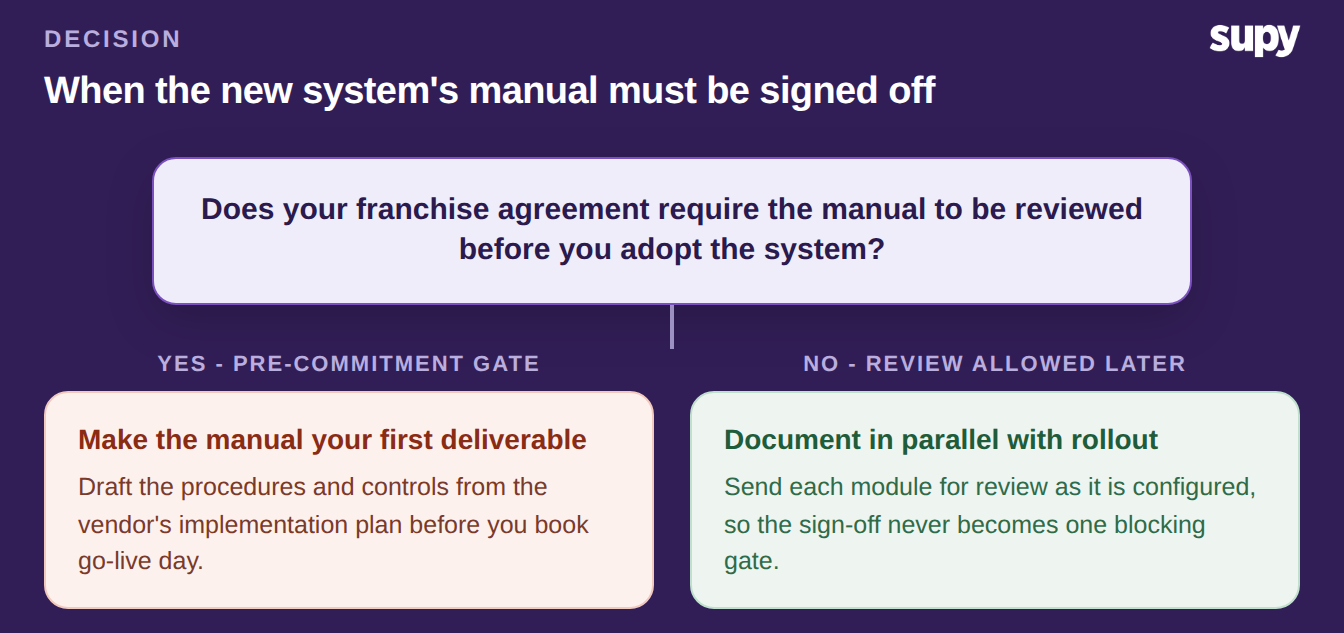
Decision tree for whether the franchise operations manual must be signed off before adopting a new system


If the agreement requires pre-commitment sign-off, treat the manual as your first deliverable, not your last. Draft the procedures and controls from the vendor's implementation plan before go-live day is booked. If it does not, you have room to document in parallel, which is faster and covered further down.

Writing the System's Processes Into the Manual

Documenting a new system is not a copy of the vendor's help centre. Write each process the way your team actually runs it, in one authoritative place, so no branch works from conflicting instructions. The order below keeps the writing tied to what the system does rather than to a generic template.
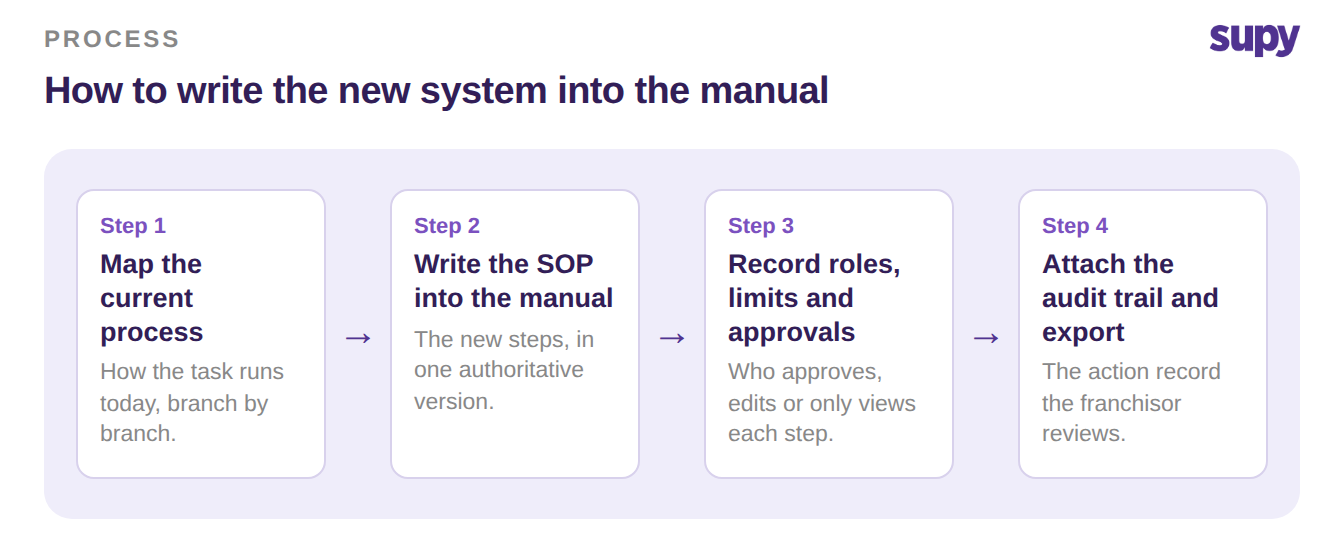
Four-step flow for writing a new system into the franchise operations manual


One manual, one version. When branches receive different setup instructions, the processes drift and the next audit finds gaps. A single documented source is what stops that, and it is the version the franchisor reviews.

Controls and the Audit Trail That Count as Evidence

Controls are what turn a written procedure into something a franchisor can trust. Two carry the most weight: the approval controls that gate spend and stock, and the audit trail that records every action.
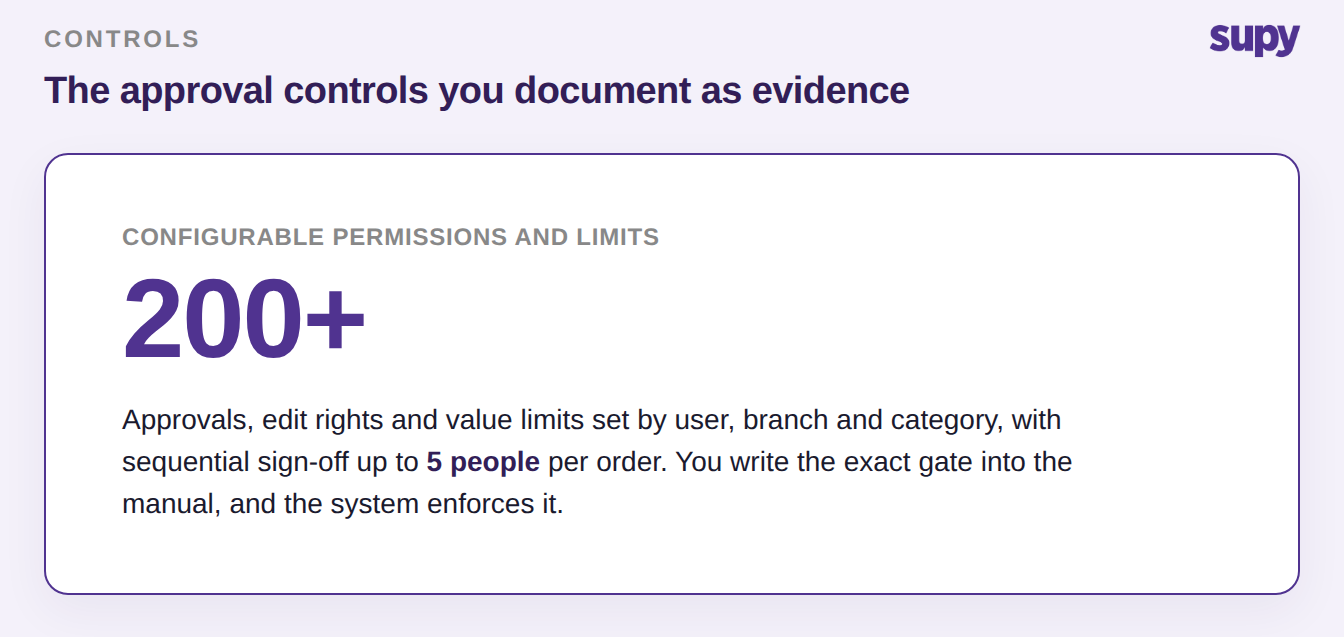
Stat callout showing 200 plus configurable permissions and limits


Audit Logs record every action across modules, tied to a named user and timestamp, and no one can edit or delete an entry. That tamper-proof trail is the evidence a franchisor accepts in place of a site visit. Approval chains run up to five people, set by branch and order value, so the manual can name the exact gate each transaction passes through. You can see how these controls fit together on the restaurant procurement software page.

Sequencing the Review So It Does Not Stall Go-Live

The most common way documentation delays a rollout is treating the franchisor review as one gate at the very end. Run it in stages instead. Send the procedures and controls for review while the system is being configured, not after the last branch is live.
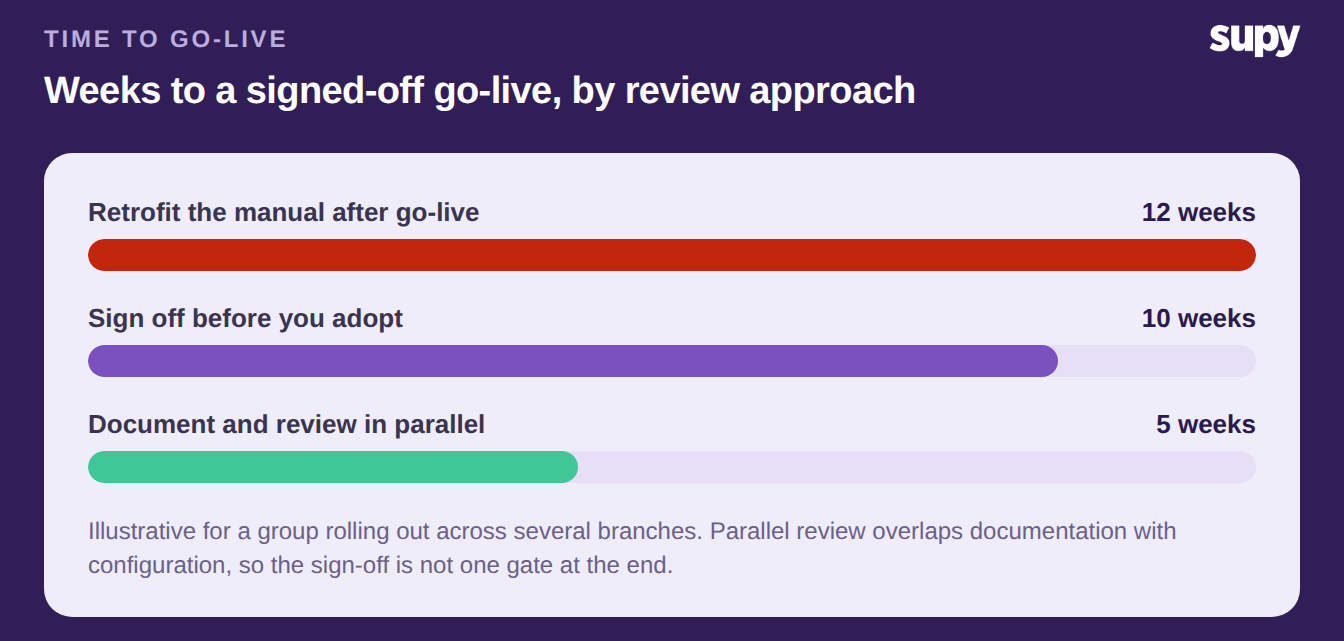
Bar chart of weeks to a signed-off go-live by review approach


Reviewing in parallel gets you to a signed-off go-live fastest, because the documentation and the configuration happen at the same time. A staged rollout also keeps every branch moving. Our guide to rolling out inventory software across a multi-site group shows the sequence in detail.

Start by reading your franchise agreement for the sign-off clause. If it requires review before you adopt, make the manual your first deliverable and draft the procedures from the implementation plan this week. If it does not, book the franchisor review in stages and document each module as it is configured. Either way, turn the audit trail on from day one, so the evidence writes itself while you roll out.
Book a Demo with Supy - documenting a new system in your franchise operations manual

Ready to optimize your restaurant operations?

Blog

Our operational insights

No items found.

Your questions 
answered

Everything you need to know about Supy — from setup to integrations, pricing, and daily use. If it’s not covered here, just ask.

What is a franchise operations manual?
+

A franchise operations manual is the documented standard that every location in the franchise follows, and it is usually tied to the franchise agreement itself. It covers how the business runs day to day: the procedures, the roles, the controls, and the records that prove each one is kept. Because it is contractual, a franchisor often has to review and approve changes to it. That is why adding a new operations system is not just a software decision. The system's processes have to be written into the manual before or during rollout, and signed off.

What should you document when adding a new operations system to the manual?
+

What you document is the new system's standard operating procedures, the roles and permissions that decide who can do what, the approval controls on spending and stock, the audit trail behind those controls, and the reports you can export as evidence. Together these show the franchisor that the system is controlled and repeatable across every branch. Keep the procedures written the way your team actually works, not copied from the vendor's help centre. One authoritative version in the manual stops branches from following conflicting instructions during rollout.

When does the franchisor need to review the new system?
+

When the franchisor reviews depends on your franchise agreement. Some agreements require any new operations system to be reviewed and documented in the manual before you commit to it, which makes the manual a hard pre-commitment gate. Others let you document the system as you roll it out. Read the agreement before you plan the timeline, because the answer changes your whole sequence. If review is required upfront, treat the manual as your first deliverable. If it is not, you can document and submit each part in stages instead.

How do you keep documentation from stalling the rollout?
+

How you avoid a stall is by not treating the franchisor review as a single gate at the very end. Break it into stages and send the procedures and controls for review while the system is still being configured, rather than after the last branch is live. A go-live commonly stalls when documentation and implementation tasks are left incomplete, so track them alongside the technical rollout, not separately. Running the review in parallel with configuration gets you to a signed-off go-live faster, because the two workstreams overlap instead of queueing behind each other.

What audit evidence does a franchisor accept for a new system?
+

What a franchisor accepts as evidence is a record that cannot be quietly changed. An audit trail that logs every action across the system, tied to a named user and a timestamp, and that no one can edit or delete, is the strongest form. It lets the franchisor confirm the controls are actually running without visiting each site. Approval histories showing who signed off each order, and exported reports across procurement and stock, back it up. Point the manual at where each of these lives so a reviewer can find them quickly.

Who should own documenting the new system in the manual?
+

Who owns it is usually the operator or franchisee adopting the system, working from the vendor's implementation plan, with the franchisor reviewing and approving. Give one person clear responsibility for the manual section so it does not fall between the technical rollout team and head office. That owner drafts the procedures, records the roles and controls, and gathers the audit evidence. The vendor supplies the recommended procedures documentation and how each feature works, but the operator has to translate it into their own manual. A single named owner also prevents conflicting versions across branches.

How do you avoid conflicting instructions across branches?
+

How you avoid conflicting instructions is by keeping one authoritative version of each process in the manual, rather than letting branches collect setup notes from different sources. Operators who receive different configuration guidance end up with unclear, drifting processes, and the next audit finds the gaps. Write the procedure once, store it where every branch reads the same copy, and update that single source when the system changes. Tie the manual to the system's live controls and audit trail so the documented process and the enforced process stay the same thing.

Ready to transform your operations?

Join 3500+ restaurant operators cutting costs, streamlining operations and making smarter decisions with Supy.