Inventory
Procurement

Build vs Buy Restaurant Inventory Software: When Each One Wins
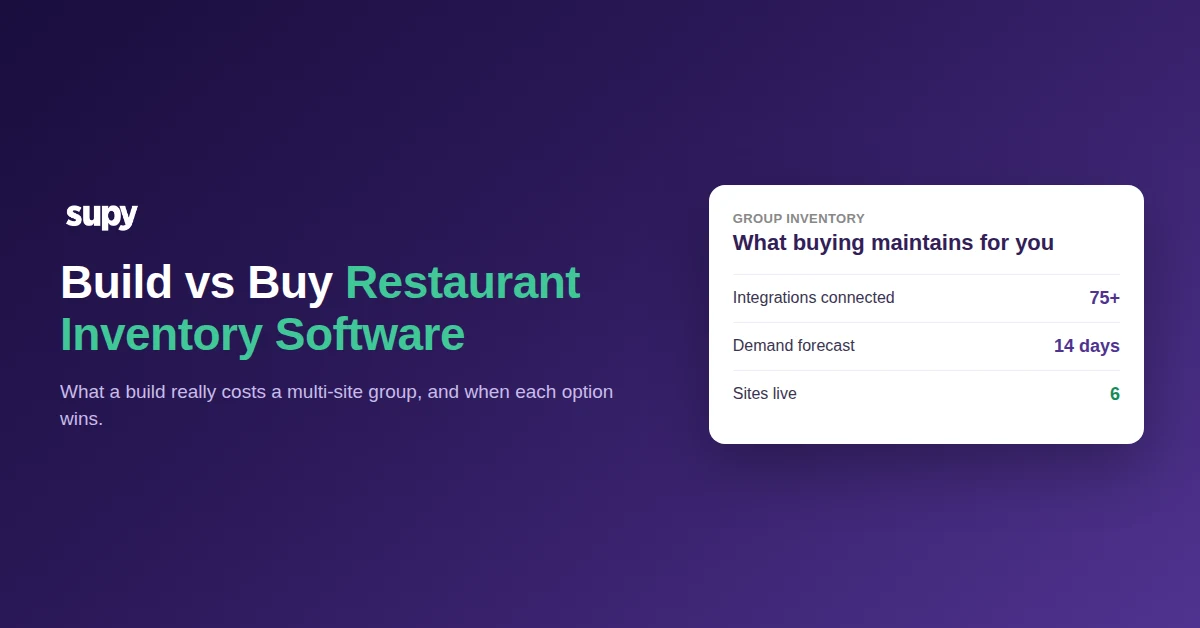
Build vs buy restaurant inventory software: a group inventory summary card showing 75+ integrations, a 14-day forecast and six live sites

What Build vs Buy Really Means for a Restaurant Group

The build vs buy restaurant inventory software decision is the choice between writing and maintaining your own tracker and licensing a platform that already does it. For a multi-site group, the real comparison is not the first version against a monthly fee. It is about who owns the integrations, the forecasting, and the upkeep for the next five years.

The question feels new again for a reason. AI coding tools let a small team stand up a working stock tracker in weeks, not months. A first version is cheap, quick, and genuinely useful, so building looks like the obvious call.

Take the build case seriously, because plenty of operators do build and stay happy. Some run an in-house tool written years ago that still covers their needs. Others reach for a build after a bad run with a third-party platform, where the frustration was the product, not the idea of buying. A good framework has to weigh those wins, not wave them away.
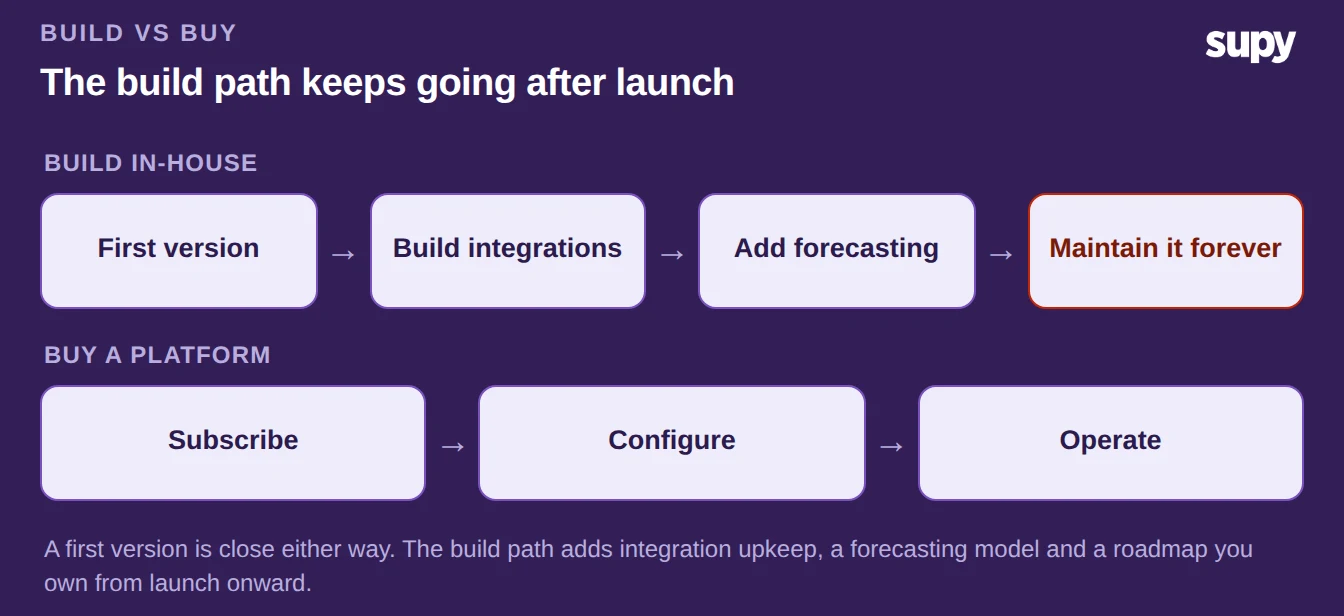
Two paths for a restaurant group: the build path carries a first version plus ongoing integration, forecasting and maintenance work; the buy path is configure and operate

The First Version Is Cheap; Keeping It Running Is Not

The visible cost of a build is the first version. The hidden cost is everything that keeps it accurate after launch, and most of that is integrations. A restaurant inventory tool is only as good as the systems it reads from.

Think about what it has to connect to. Sales come from the point-of-sale system so usage can deplete stock. Invoices and cost data flow to accounting. A larger group also feeds an ERP and an analytics stack. Each connection is a separate piece of software to build, then watch.

The watching is the part that surprises teams. Every one of those systems ships its own updates, and each change can quietly break your link to it. A platform absorbs that work across its whole customer base.

Supy maintains 75+ integrations spanning point-of-sale, accounting, ERP and analytics, including systems like Foodics, Oracle Micros, QuickBooks, Xero and NetSuite. A build has to replicate the ones you need and then maintain them forever.

If your group already feels the strain of stitched-together tools, watch for the signs a restaurant group has outgrown spreadsheet inventory. Those same signals predict that a home-grown tool will struggle to keep up.
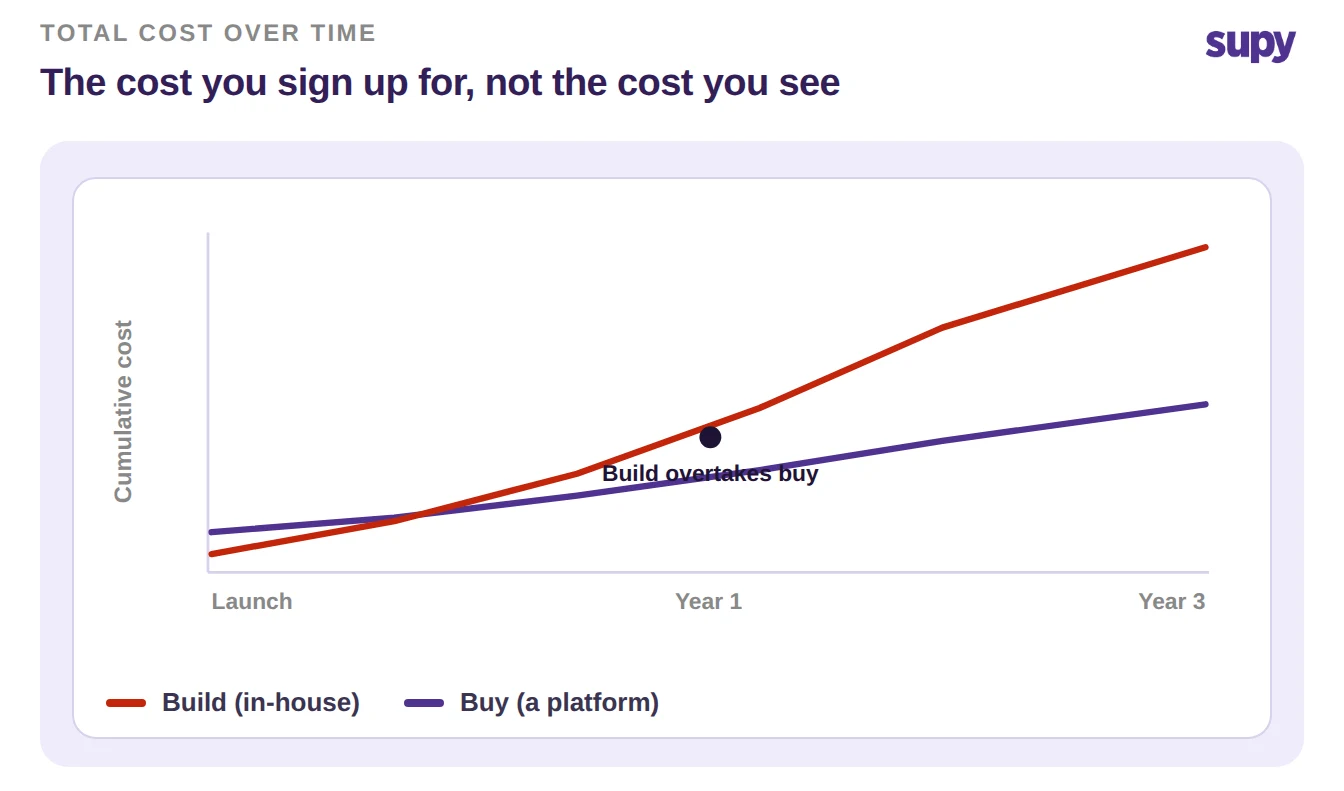
Cost over time: a build shows one upfront cost then a rising maintenance line, while a bought platform shows a flat, predictable subscription line

A Build Rarely Ships With a Forecasting Model

Most in-house tools track what you have. Far fewer predict what you will need. That gap matters, because ordering is where inventory software earns its keep.

A first build almost always orders from a fixed reorder rule: when stock drops below a set point, reorder a set amount. That works until demand moves. A rule cannot see a weekend spike, a slow Tuesday, or a seasonal shift, so it over-orders some items and runs others short.

A maintained forecasting model is a different class of tool. Supy runs an AI sales forecast that predicts demand for the next 14 days, down to the menu item and the individual site, against an 8-week historical baseline. A manager can adjust any item, and the numbers update at once.

Building and retraining that model in-house is a data-science project, not a feature you finish once. For the mechanics of demand prediction, see how AI sales forecasting predicts restaurant demand.
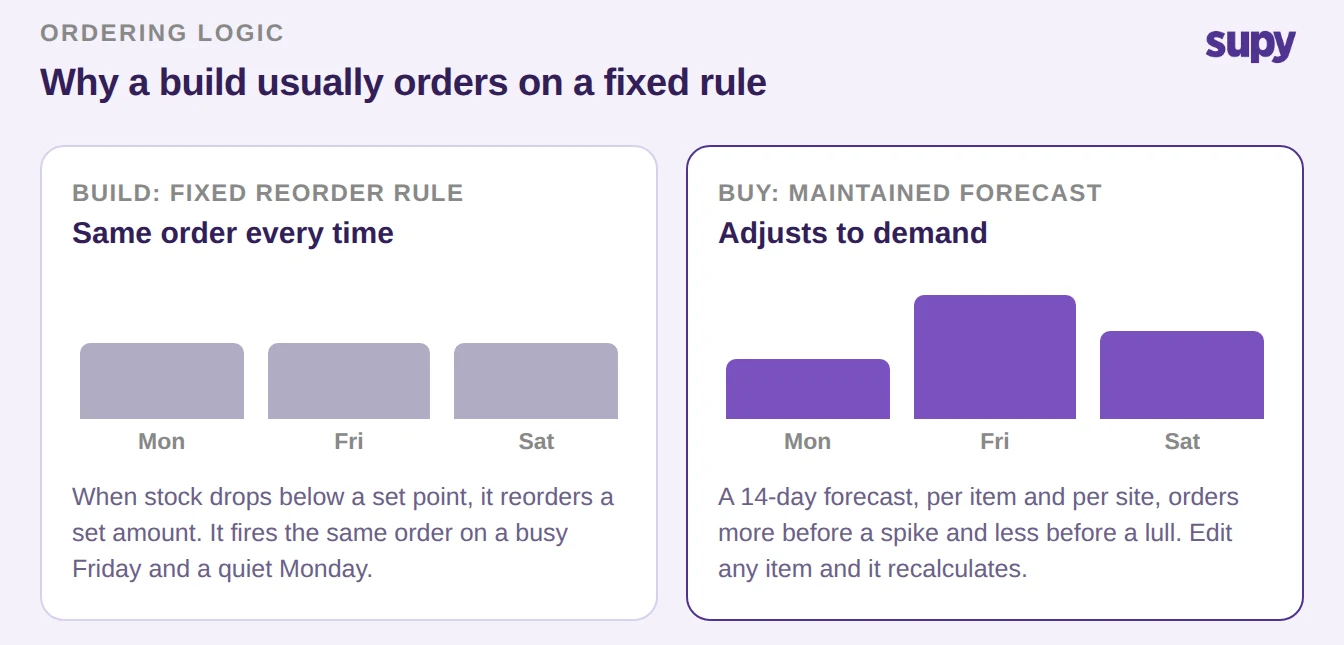
A static reorder rule fires the same order regardless of demand, while a maintained 14-day forecast adjusts orders per item and per site

Build vs Buy, Criterion by Criterion

Set the two options side by side on the criteria that actually decide the outcome for a multi-site group. The first version is close. The gap opens on everything that comes after it.

CriterionBuild (in-house)Buy (a platform)
Time to a first versionWeeks, faster with AI helpDays to configure
POS, accounting and ERP linksYou build and maintain each one75+ integrations, maintained for you
Demand forecastingUsually a fixed reorder rule14-day AI forecast per item and site
Adding a new siteYour team's next projectA setting, not a build
New features and fixesWhoever wrote it, if they stayA shipped product roadmap
Key-person riskHigh: operations rely on the authorLow: the vendor owns continuity
Where the cost landsSmall upfront, rising upkeepPredictable subscription

When to Build, and When to Buy

The honest answer is that build wins in a narrow set of cases. It makes sense in three conditions. Inventory has to be genuinely your edge. You need a permanent engineering team who will still be here in three years, and a model unusual enough that no platform fits.

Buying wins in most others. If frustration with one vendor is pushing you toward a build, test a second platform first. You may be solving a product problem with an engineering project. A build also looks cheapest at the exact moment it is cheapest, which is launch day, before the upkeep starts.

So apply a simple rule. Choose build when inventory is your differentiator, you own the engineering to maintain it for years, and no platform fits.

Choose buy when you want the integrations, the forecasting and the roadmap maintained for you. Then your team spends its time running restaurants, not running software. Whichever way you lean, price the next five years, not just the first version, and ground the comparison against a real product like Supy's restaurant inventory management platform.
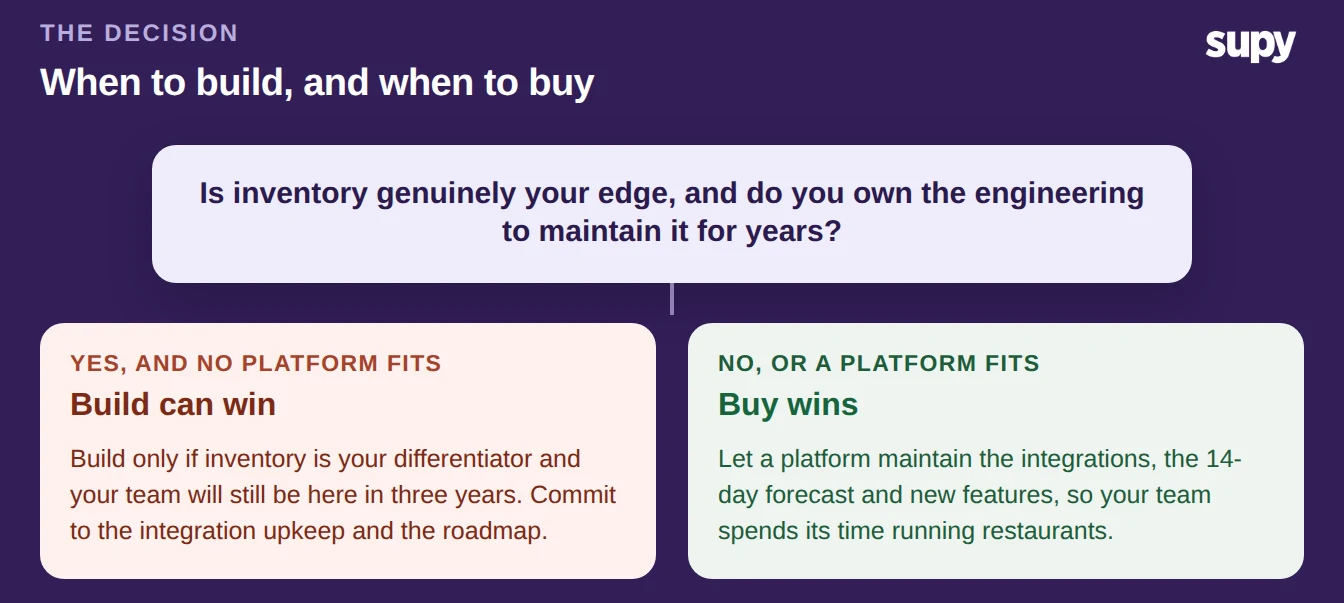
Decision tree: build only if inventory is your edge and you own long-term engineering, otherwise buy a maintained platform
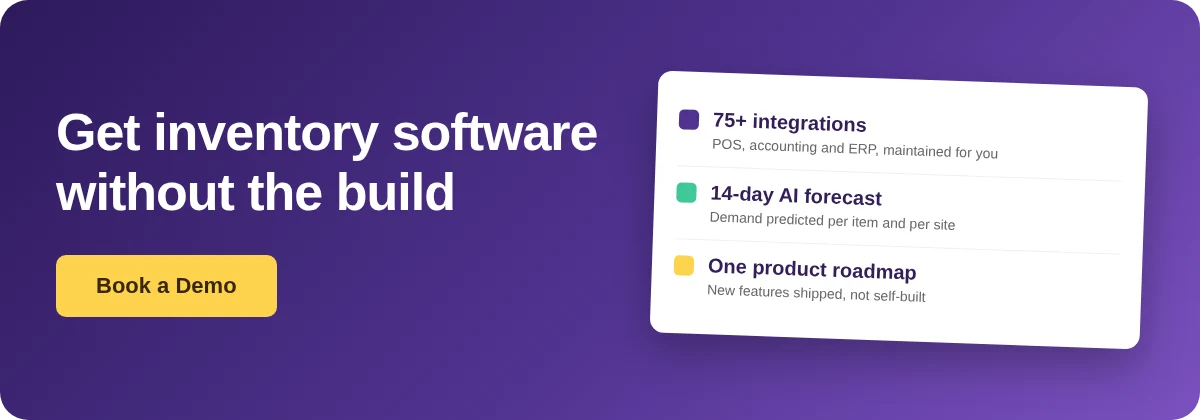
Book a Demo with Supy - build vs buy restaurant inventory software

Ready to optimize your restaurant operations?

Blog

Our operational insights

No items found.

Your questions 
answered

Everything you need to know about Supy — from setup to integrations, pricing, and daily use. If it’s not covered here, just ask.

What does build vs buy mean for restaurant inventory software?
+

Build vs buy is the choice between writing your own inventory software and licensing a platform that already exists. Building means your team owns the code, the integrations with your point-of-sale and accounting systems, and every future update. Buying means a vendor maintains all of that while you configure it to your operation. For a multi-site restaurant group, the decision is less about the first version and more about who carries the integration upkeep, the demand forecasting, and the product roadmap over the next few years.

Is it cheaper to build restaurant inventory software in-house?
+

It is usually cheaper on launch day and more expensive after that. The first version is the visible cost, and AI coding tools have made it quick to reach. The hidden cost is upkeep: every integration with your point-of-sale, accounting or ERP system needs maintaining as those systems change, and someone has to keep improving the tool. A bought platform spreads that cost across its whole customer base. When you price a build across five years rather than one, the ongoing maintenance usually outweighs the subscription you avoided.

Why do integrations make a self-built inventory tool expensive to maintain?
+

An inventory tool is only useful if it reads from the systems around it. Sales flow from the point-of-sale system so usage depletes stock, invoices flow to accounting, and larger groups also feed an ERP and analytics tools. Each of those is a separate connection to build and then watch, because every vendor ships its own updates that can quietly break your link. A platform maintains those connections for you. Supy keeps 75+ integrations across point-of-sale, accounting, ERP and analytics current, so a change on one vendor's side is the platform's problem, not yours.

Can an AI-built inventory tool replace a dedicated platform?
+

AI tools have made it realistic to stand up a working stock tracker in weeks, and for a small, simple operation that first version can be enough. What a quick build rarely includes is the harder, ongoing work: maintained integrations across many vendors, a demand-forecasting model that keeps learning, multi-site controls, and a steady roadmap of new features. Those are not one-time features you finish; they are commitments. If your group is small and your needs are stable, a build can hold. As you scale sites and suppliers, the gaps tend to show.

Does a self-built inventory tool include demand forecasting?
+

Most in-house tools track current stock but order from a fixed reorder rule: when an item drops below a set point, reorder a set amount. That rule cannot see a weekend spike or a slow midweek day, so it over-orders some items and runs others short. A maintained forecasting model is a data-science project, not a feature you finish once. Supy runs an AI sales forecast that predicts demand for 14 days, down to the menu item and the individual site, and recalculates when a manager adjusts any line.

When does building your own restaurant inventory system make sense?
+

Building makes sense in a narrow set of cases. Inventory management has to be a genuine competitive edge for your group, not just an operational need. You need a permanent engineering team that will still be there in three years to maintain integrations and ship improvements. And your operation has to be unusual enough that no existing platform fits. If all three are true, a build can be the right call. If frustration with one vendor is the real driver, test a second platform before you commit to writing your own.

How should a multi-site restaurant group decide between build and buy?
+

Start by pricing the next five years, not just the first version, because the upkeep is where the costs diverge. Ask whether inventory is genuinely your differentiator and whether you own the engineering to maintain a build for years. If both are true and no platform fits your model, building can win. Otherwise buying usually wins: you get the integrations, the demand forecasting and the roadmap maintained for you, and your team spends its time running restaurants rather than running software. Either way, compare against a real platform so the decision is grounded.

Ready to transform your operations?

Join 3500+ restaurant operators cutting costs, streamlining operations and making smarter decisions with Supy.