Inventory
Procurement

New Restaurant Location Par Levels: Setting Them With No Sales History
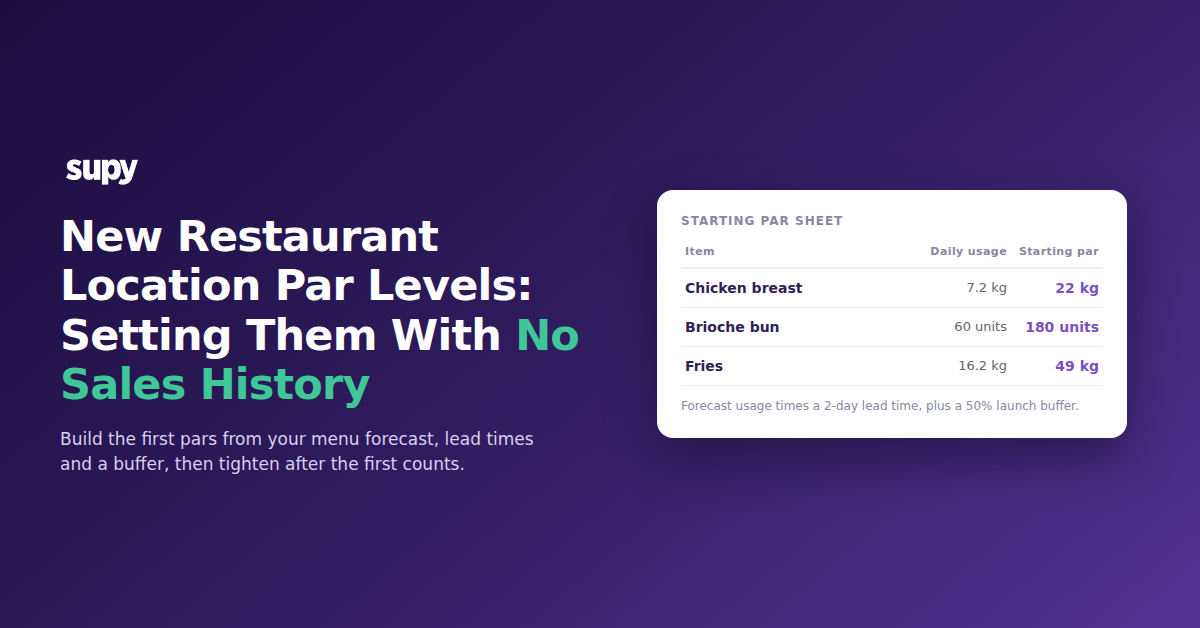
Starting par sheet for a new restaurant location: forecast daily usage and starting par per item with no sales history

Build Your First Par Levels From a Forecast, Not History

A new location can run tight par levels from day one, even with no sales history to average. Build each starting par from three numbers you already have: the menu-driven demand forecast, the supplier's lead time, and a safety buffer. Par equals expected daily usage times lead time in days, plus the buffer. Then replace the estimate with real figures after the first counts.

The usual par formula assumes you already know your daily usage. A brand-new site does not, so the method shifts. You forecast usage from the menu you are about to launch instead of reading it from last month. The general par-level method still applies once sales data arrives, and this is how you bridge the first few weeks.

If the new location belongs to a group that already runs a similar concept, there is a faster start. Clone the items, suppliers and recipes from a comparable existing site, and use that site's established pars as the opening estimate. A location that mirrors an existing one inherits a tested baseline, so you adjust for the new menu rather than building every par from a blank forecast.

Want the numbers for your own kitchen? The free par level calculator does it for every item on your sheet from your usage, delivery days and supplier lead times.
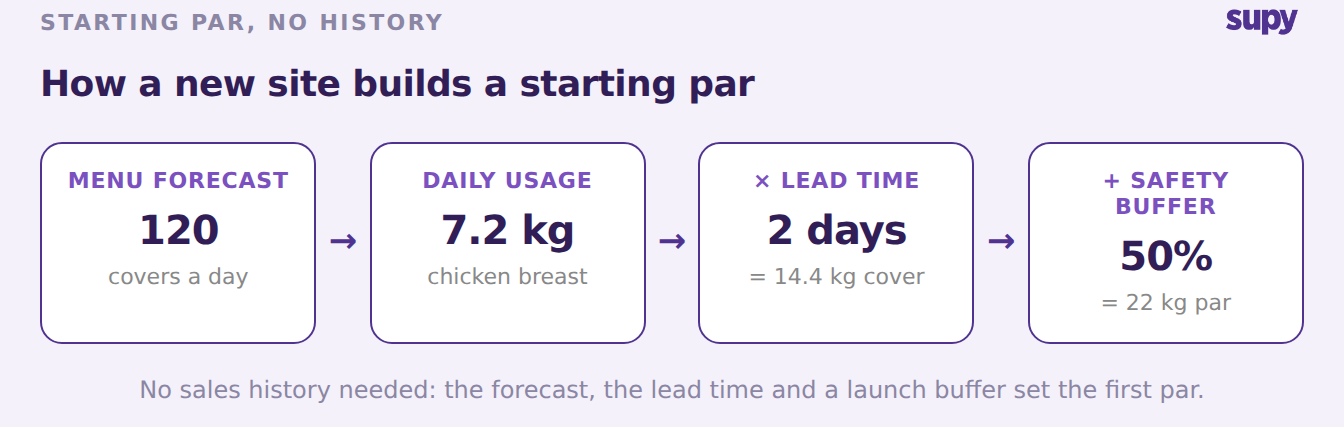
Four steps to a starting par for a new site: menu forecast of 120 covers, 7.2 kg daily usage, times a 2-day lead time, plus a 50% buffer equals a 22 kg par

Turn Your Menu Forecast Into Expected Daily Usage

Start from planned covers, then read each ingredient's usage off the recipe. If the launch plan forecasts 120 covers a day, multiply that by how often each dish sells and by the quantity its recipe uses. A dish that sells in 48 of those covers and uses 0.15 kg of chicken breast needs 7.2 kg a day. Do this for every high-value and fast-moving item. Perishable and long-lead items matter most: a par set too low on a fresh item means a mid-service stockout, and one set too high means waste before the weekend.

The table shows the same calculation across three items. The daily usage column is the number each par is built on.

IngredientPer dishDishes per day (forecast)Daily usage
Chicken breast0.15 kg487.2 kg
Brioche bun1 unit6060 units
Fries0.18 kg9016.2 kg

Pad the Safety Buffer at Launch, Then Narrow It

Set the buffer wide for the first few weeks, because a launch forecast is a guess the market has not tested yet. A safety buffer absorbs two unknowns: how far real demand lands from the forecast, and how reliable a new supplier's deliveries are. Both are at their worst in week one, so start around 50% and bring it down as the picture clears.
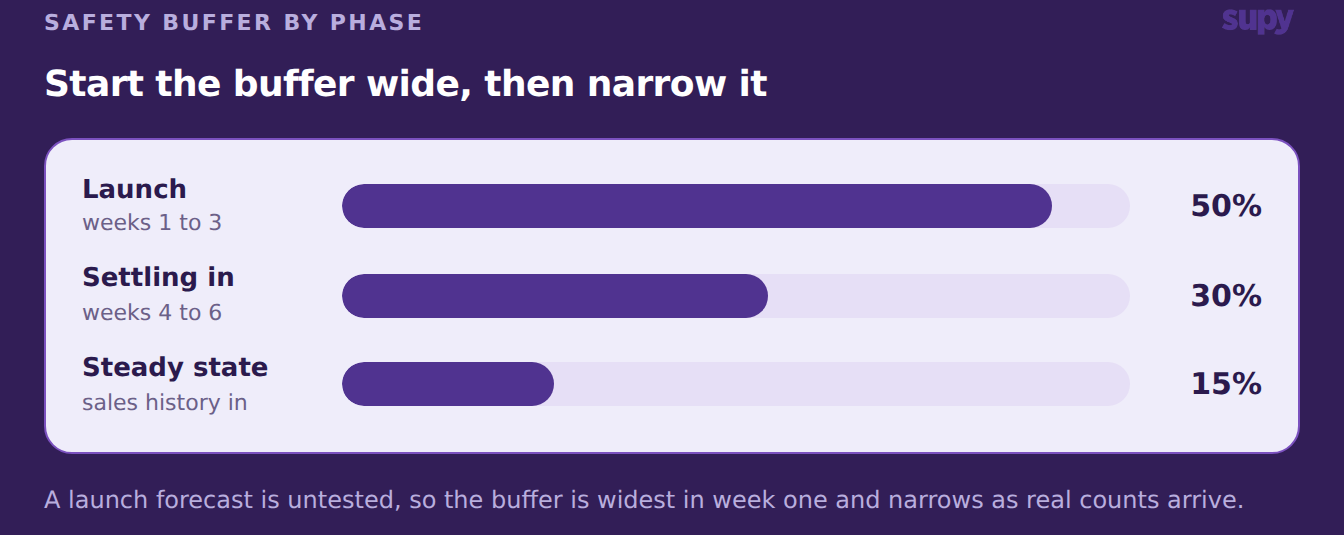
Safety buffer narrowing by phase: 50% at launch in weeks 1 to 3, 30% in weeks 4 to 6, and 15% once the site reaches a steady state

A 50% buffer at launch is deliberately generous. By weeks four to six the first counts have corrected the obvious misses, so 30% is usually enough. Once a few weeks of real sales exist, a steady-state buffer of 15% keeps a reasonable cushion without tying up cash in stock the site does not move. Pad the fast-movers and the fresh items here, not the dry-store staples that keep for months and need no launch cushion.

Order to Par, Then Tighten After the First Counts

Load the starting pars as par and minimum thresholds per item per site, then let the system order against them. With pars set, Supy's inventory software flags any item below its minimum or above its par. It then builds the first order from current stock against par, so the opening weeks do not depend on anyone guessing quantities by hand.
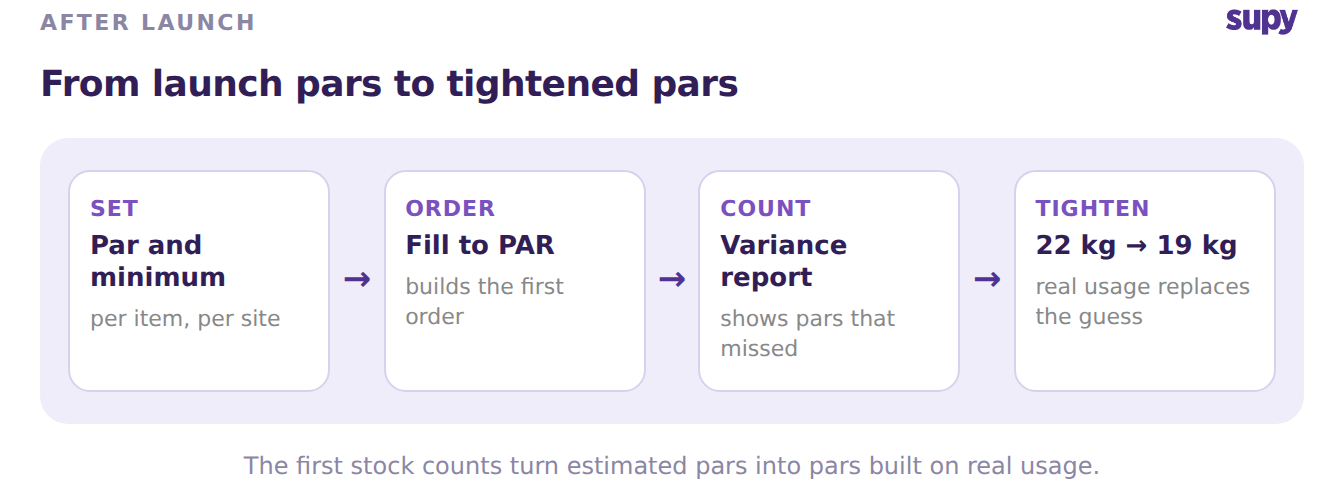
Four steps after launch: set par and minimum per item, order to par with Fill to PAR, read the first stock count variance, then tighten the par

After two or three weeks, the first stock counts give you real usage, and the variance report shows which pars ran too high or too low. Replace the forecast with the actual number. If chicken breast is really using 8 kg a day, a tightened 20% buffer sets the par near 19 kg instead of the opening 22 kg. By now, sales forecasting has enough history to predict demand on its own.

A rule of thumb for a new site: carry a 40 to 50% buffer at launch, then settle near 15 to 20% once about three weeks of counts exist. Check each par against the first month of counts, and review it again whenever the menu or a supplier changes. The aim on day one is narrow: get close enough to avoid both a stockout and a walk-in full of waste, then let real usage do the rest.

Book a Demo with Supy - set par levels for a new restaurant location

Ready to optimize your restaurant operations?

Blog

Our operational insights

No items found.

Your questions 
answered

Everything you need to know about Supy — from setup to integrations, pricing, and daily use. If it’s not covered here, just ask.

How do you set par levels for a new restaurant with no sales history?
+

Build each par from a forecast instead of history. A new location has no past usage to average, so estimate expected daily usage from the menu-driven demand forecast, then multiply by the supplier's lead time in days and add a safety buffer. For a fast-moving item that forecast says will use about 7 kg a day on a two-day lead time, a 50% launch buffer sets the starting par near 22 kg. Load these as par and minimum thresholds per item per site, order against them, then replace the estimate with real figures after the first stock counts.

What is the par level formula when you have no usage data?
+

Par equals expected daily usage times lead time in days, plus a safety buffer. The only part that changes for a new site is where daily usage comes from. With no history to read it off, you forecast it: take the planned covers per day, multiply by how often each dish sells and by the quantity its recipe uses. That gives expected daily usage per ingredient, which feeds the same formula every established site uses. The buffer starts wide, around 50%, because a launch forecast is untested, and narrows as real counts arrive.

How much safety stock should a new location hold at launch?
+

Start around 40 to 50% above the forecast cover, then narrow it as data arrives. A launch forecast is a guess the market has not tested, and a new supplier's delivery reliability is also unproven, so the buffer is widest in the first weeks. By weeks four to six, the first counts have corrected the obvious misses, so 30% is usually enough. Once a few weeks of real sales exist, a steady-state buffer near 15 to 20% keeps a sensible cushion. Pad fast-moving and perishable items, not dry-store staples that keep for months.

Can you use another location's par levels for a new site?
+

Yes, when the new site belongs to a group that already runs a similar concept. Clone the items, suppliers and recipes from a comparable existing location, and use that site's established pars as the opening estimate. A site that mirrors an existing one inherits a tested baseline, so you adjust for differences in menu or volume rather than building every par from a blank forecast. It is the fastest accurate start available to a multi-site group. A standalone new concept with no comparable sibling falls back to the forecast method.

How soon should you adjust par levels after opening?
+

Review them against the first stock counts, usually after two or three weeks. The first counts give you real usage for the first time, and the variance report shows which pars ran too high or too low. Replace the forecast figure with the actual one and tighten the buffer as confidence grows. Check each par against every count for the first month, since early demand is still settling. After that, review pars whenever the menu changes, a supplier's lead time changes, or sales forecasting flags a shift in demand.

How do you forecast ingredient usage before you have any sales?
+

Work down from planned covers and the recipes. Start with the launch plan's forecast covers per day, then for each dish multiply how often it sells by the quantity its recipe uses of each ingredient. A dish selling in 48 of 120 daily covers and using 0.15 kg of chicken breast points to 7.2 kg a day. Summing that across every dish gives expected daily usage per ingredient. Focus the effort on high-value and fast-moving items first, because that is where a wrong par costs the most in a stockout or waste.

What happens to par levels once the new site has sales history?
+

They move off estimates and onto real demand. After a few weeks, sales forecasting has enough history to predict per-branch demand on its own, and predictive ordering can build purchase orders from that forecast minus current stock. The buffer narrows from its wide launch setting to a steady-state cushion. From then on, pars behave exactly as they do at an established site: driven by actual usage, checked against each count, and revised when the menu or a supplier changes. The no-history method was only ever the bridge across the opening weeks.

Ready to transform your operations?

Join 3500+ restaurant operators cutting costs, streamlining operations and making smarter decisions with Supy.