المخزون

Back-of-House Training: Getting Kitchen Staff Fluent in the System That Runs the Kitchen

Back of house training: kitchen staff fluent in the system that runs the kitchen

What Back-of-House Training Should Actually Produce

Back of house training is the work of getting kitchen and store staff genuinely fluent in the operational system that runs the kitchen, not just aware it exists. A team is fluent when every core task, entering a recipe, counting stock, receiving a delivery, has a named owner who can complete it unaided, on their own shift, without stopping to ask a manager or falling back on a paper workaround.

That definition matters because it changes what you measure. "Everyone attended the session" tells you nothing useful. "Every shift can run the count, receive a delivery, and log wastage without help" tells you the training worked. Back of house here means the kitchen, prep, and store side of the operation: the people whose data feeds every downstream cost report. When even one of those tasks lacks a confident owner, the gap shows up later as a broken number, not as a training complaint, which is exactly why it goes unnoticed until month-end.

Table of core back-of-house tasks with a named shift owner and a fluency status for each, one marked at risk


Why One-Off Training Sessions Miss Half the Team

The single scheduled class is the default, and it is where most fluency is lost. A go-live session is built around one room, one time, one trainer, and a kitchen does not work that way. Someone is always on shift, someone is on leave, and in a six-site group the branch teams simply cannot travel to a central session. The result is predictable: whole sites go live under-trained because the people who run them were never in the room.

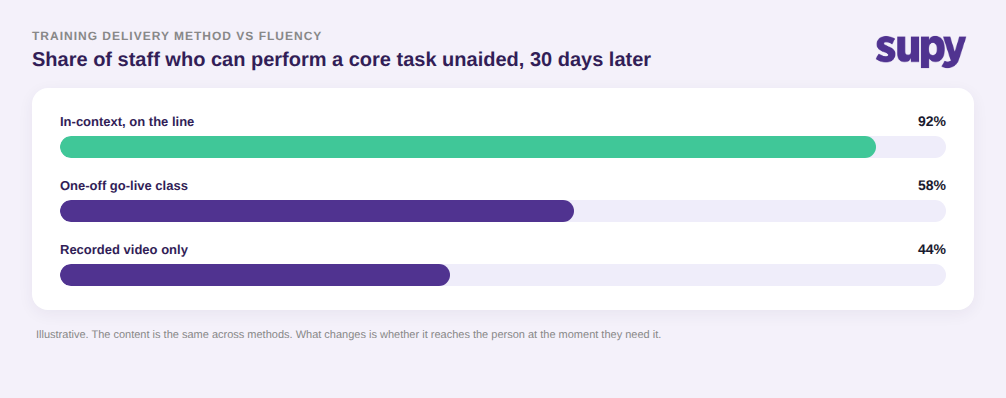
Recorded video helps a little, but watching is not doing. In practice, a one-off class leaves roughly 58% of staff able to perform a core task unaided a month later, while training delivered in context, inside the actual workflow and on the line, gets that closer to 92%. The difference is not the content; it is that in-context training reaches the person at the moment they need it, on their own schedule, at their own site.

Bar chart comparing the share of staff fluent in a core task by training method, in-context highest at 92 percent


This is also why an adjacent tool, a scheduling app or a dedicated learning-management system (LMS), solves only part of the problem. Those tools are good at tracking who completed what. They do not make someone fluent in the recipe screen they will use every day. If you are weighing whether a group your size needs a standalone LMS at all, we cover that trade-off separately.

Where Training Fades: The Three-Month Reversion

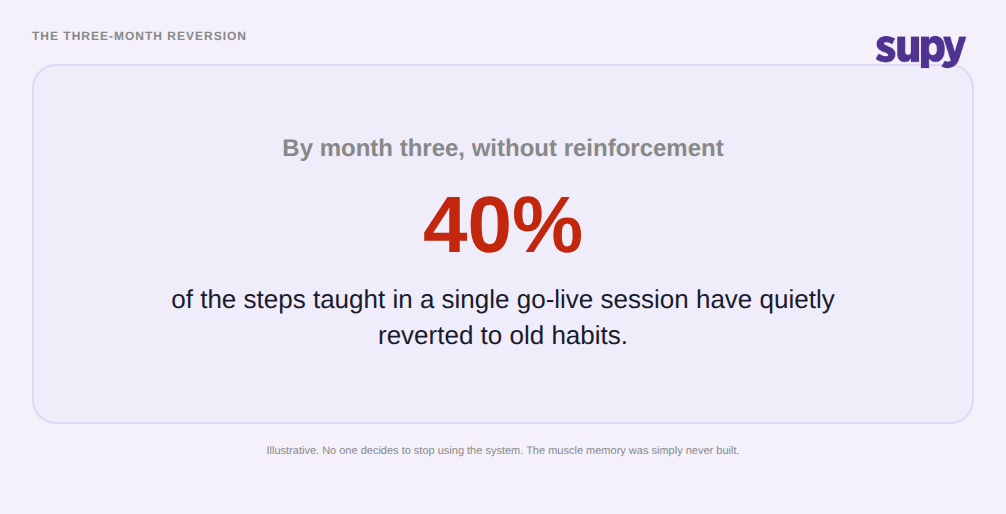
Even a team that was fluent on day one drifts. Knowledge fades fast without reinforcement: by around the three-month mark, roughly 40% of the steps taught in a single go-live session have quietly reverted to old habits. The paper order pad reappears, the count gets "estimated," the recipe never gets updated when the supplier changes. No one decided to stop using the system; the muscle memory simply was never built.

The fix is to stop treating training as an event and start treating it as something that lives inside the work. Reference material and live guidance should sit in the same place staff already work, not in a separate manual nobody reopens. Supy's digital cookbook is built for exactly this: step-by-step instructions and images for every recipe, accessible from any device, right on the line. When the how-to is one tap away at the moment of prep, the reinforcement happens on its own, and every shift becomes a small training session, instead of depending on someone remembering a class from a quarter ago.

Large stat callout showing 40 percent of steps taught in a single session revert to old habits by month three


Start With Recipes, or the Rest Never Sticks

If you teach the modules in the wrong order, fluency collapses no matter how good the delivery is. Recipes are the gating skill. Stock depletion, theoretical-versus-actual usage, and cost tracking all only work once recipes are entered and understood, so a team that is shaky on recipe setup will produce broken numbers everywhere downstream, and no amount of stock-count training fixes that.

The order that holds: recipes and yields first, then daily stock counts, then receiving and goods-received notes (GRNs), then the theoretical-versus-actual reporting that ties it together. Each step feeds the next, so teaching them out of sequence means a team practising on data it cannot trust. Recipe setup is consistently the biggest onboarding blocker precisely because it comes first and it is the hardest, which is the argument for putting your best in-context guidance there, not for rushing past it. We go deeper on why recipe setup stalls rollouts and on sequencing training by role in two companion pieces.

Process flow showing recipes and yields as the first gating step feeding stock counts, receiving, then theoretical versus actual


Winning Over the Staff Who Think They Don't Need It

The hardest people to train are not the new hires; they are the experienced staff who see a new system as extra work rather than part of the job. New hires arrive with no old habit to unlearn and tend to reach fluency fastest. The veterans are the real adoption risk, and pushing harder rarely helps.

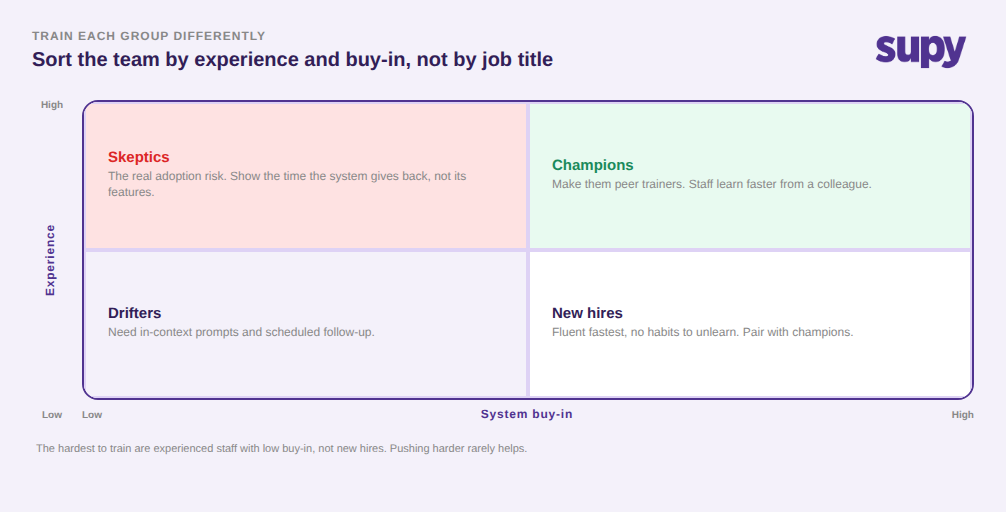
Two moves work. First, sort your team by experience and buy-in, and train each group differently: make your high-experience, high-buy-in people peer trainers, since staff learn faster from a colleague than from a head-office deck; pair new hires with them; and win over the skeptics by showing the time the system gives back rather than the features it has. Second, use role-based access so each person only ever sees the part of the system they actually touch. Supy supports 200+ customisable permissions for this, which keeps training focused and stops an experienced cook from feeling buried under screens that are not their job.

Quadrant chart sorting staff by experience and system buy-in into champions, skeptics, new hires, and drifters


Your First Move This Week

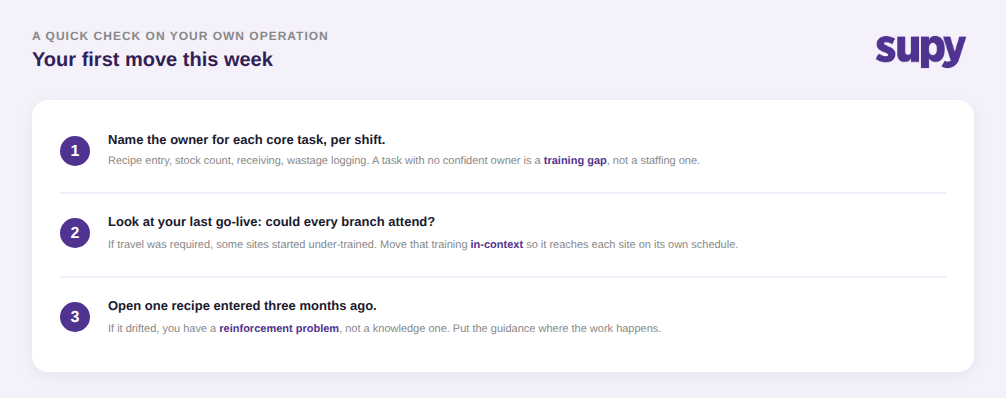
You do not need a bigger launch day; you need a delivery method that reaches everyone and a sequence that holds. Run this quick check on your own operation:

  • Name the owner for each core task, per shift: recipe entry, stock count, receiving, wastage logging. If any task has no confident owner on a given shift, that is your first training gap, not a staffing one.
  • Look at your last go-live. Could every branch actually attend, or did some sites start under-trained? If travel was required, move that training in-context so it reaches each site on its own schedule.
  • Open one recipe entered three months ago. Is it current? If it drifted, you have a reinforcement problem, not a knowledge problem, so put the guidance where the work happens.

Get recipes fluent first, deliver the rest in context, and reinforce it inside the daily workflow. That is what turns a training session into a team that actually runs the kitchen on the system, at every site.

Book a Demo with Supy - back-of-house training that reaches every site

Ready to optimize your restaurant operations?

مدونة

رؤيتنا التشغيلية

Your questions 
answered

Everything you need to know about Supy — from setup to integrations, pricing, and daily use. If it’s not covered here, just ask.

What is back of house training?
+

Back of house training is the process of getting kitchen, prep, and store staff genuinely fluent in the operational system that runs the kitchen, rather than simply aware it exists. Fluency means every core task, such as entering a recipe, running a stock count, or receiving a delivery, has a named owner on each shift who can complete it unaided. The goal is not attendance at a launch session but reliable, everyday use, because it is the back-of-house team whose data feeds every downstream cost and inventory report.

Why do one-off training sessions fail to make kitchen staff fluent?
+

Why they fail comes down to reach and reinforcement. A single scheduled class is built around one room, one time, and one trainer, so staff on shift, on leave, or at a branch that cannot travel are simply missed, and whole sites go live under-trained. Even those who attend drift: without practice inside the daily workflow, a large share of the steps taught in one session revert to old habits within a few months. Fluency needs delivery that reaches every person and reinforcement that happens on the line, not a one-time event.

How long does it take a back-of-house team to become fluent in a new system?
+

How long depends far more on the delivery method than on the calendar. Staff trained in context, inside the workflow they use every day, reach unaided competence much faster and hold it longer than staff given a single classroom session. A useful signal is not a fixed number of weeks but whether every core task has a confident owner on every shift. Reinforcement matters as much as the initial push, because knowledge fades within a few months if the guidance is not available at the moment the work is actually done.

Which skill should back-of-house training start with?
+

Which skill comes first is not arbitrary: start with recipes and yields. Recipe setup is the gating skill because stock depletion, theoretical-versus-actual usage, and cost tracking only work once recipes are entered and understood. A team that is shaky on recipes will produce broken numbers everywhere downstream, no matter how well it counts stock. After recipes, teach daily stock counts, then receiving and goods-received notes, then the theoretical-versus-actual reporting that ties everything together. Each step feeds the next, so teaching them out of order leaves staff practising on data they cannot trust.

How do you train back-of-house staff across multiple sites that cannot attend one session?
+

How you reach dispersed sites is by moving training into the workflow instead of into a single room. A central classroom session cannot scale across a multi-site group, because branch teams cannot travel and shift patterns never line up. In-context guidance solves this: reference material and step-by-step instructions sit inside the system staff already use, accessible from any device, so each site trains on its own schedule. A digital cookbook that shows recipe steps on the line, for example, turns every prep task into a small, self-paced training moment rather than a one-off event.

How do you get experienced kitchen staff to adopt a new system?
+

How you win over veterans differs from onboarding new hires. Experienced staff are the real adoption risk because they see a new system as extra work rather than part of the job, and pushing harder rarely helps. Sort your team by experience and buy-in: make high-buy-in veterans peer trainers, since staff learn faster from a colleague; pair new hires with them; and win over skeptics by showing the time the system gives back, not its feature list. Role-based access that shows each person only their part of the system keeps training focused and less overwhelming.

Do multi-site restaurant groups need a dedicated LMS for back-of-house training?
+

Do you need a separate learning-management system depends on what you are trying to fix. An LMS is good at tracking who completed which course, but completion is not fluency. It does not make someone confident in the recipe screen they will use every shift, which is where most back-of-house training actually fails. Many groups get further by putting guidance inside the operational system itself, so learning happens in context, than by adding a standalone training tool on top. An LMS can complement that, but it rarely replaces in-workflow reinforcement.

هل أنت مستعد لتطوير عملياتك؟

انضم إلى أكثر من 3500 مُشغلي مطاعم يخفضون التكاليف، ويبسطون العمليات، ويتخذون قرارات أكثر ذكاءً مع Supy