.jpg)

Restaurant Inventory Software: 7 Questions Multi-Site Operators Wish They'd Asked Before Switching

Why an inventory software checklist misses what actually breaks
A feature checklist tells you whether a capability exists. It does not tell you how that capability behaves at your scale, in your data, once real invoices and real counts start flowing through it. That gap is where switching regret lives: a promise made in the sales process that only reveals its limits weeks after go-live, when it is far more expensive to unwind.
The pattern is consistent across groups. The demo shows the happy path on clean sample data. The problems surface later, on your messy multi-site reality: a POS feed that flows the wrong way, an integration priced by custom quote, a price permission loose enough to rewrite a cost group-wide. So the useful buyer questions are not "can it do X" but "show me exactly how X behaves when it goes wrong, and who gets to fix it."
The seven inventory software questions to ask before you switch
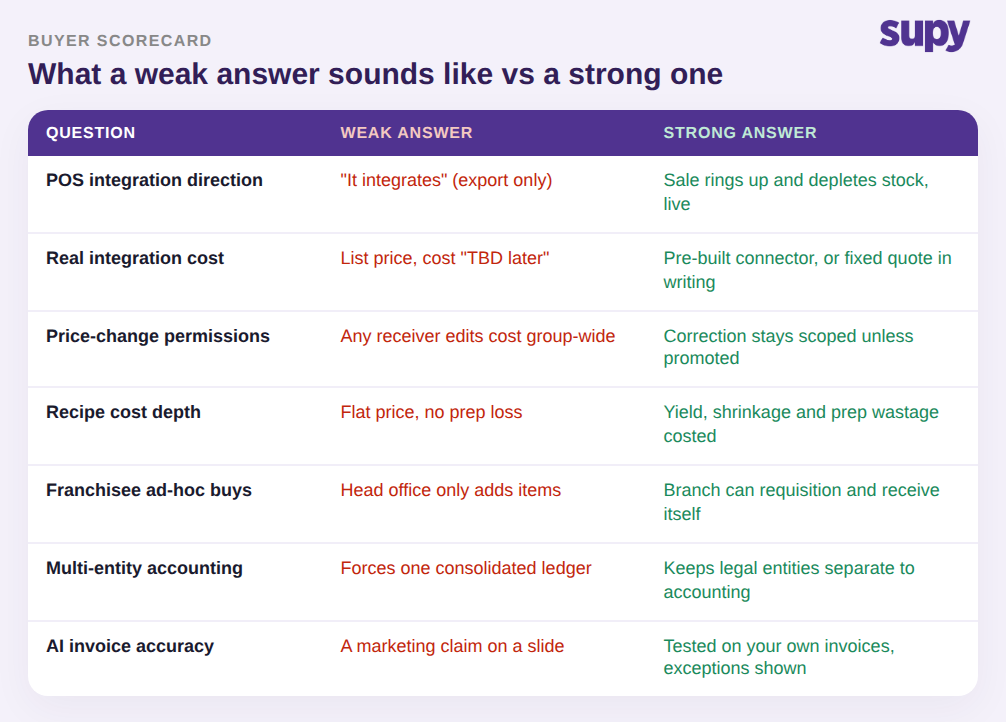
Ask each of these in the demo, and ask for a live example on real-looking data rather than a yes. The weak answer and the strong answer for each are usually easy to tell apart once you know what you are listening for.
1. Does the POS integration feed sales in, or only export data out?
One operator was told during the sales process that the POS integration would feed live sales into the new platform, then found after signing that it only exported data outward, forcing manual CSV uploads to get sales back in. Direction matters more than the word "integration" implies. A true two-way link pulls sales in so they deplete stock through your recipes automatically; a one-way export leaves you re-keying figures by hand. Ask which direction the data flows, and ask to watch a sale ring up and move stock in the same demo. Supy's POS integrations pull sales in and run them through linked recipes so the right ingredients deplete on every check, with a daily sync per branch.
2. What is the real cost and timeline to connect your specific POS?
A two-site group was quoted a large five-figure sum, roughly $11,000-$27,000, to connect their POS via custom API, so they chose a manual daily import instead. The list price on the website is rarely the price you pay if your POS needs custom work. Ask a blunt two-part question: is my exact POS a pre-built connector or a custom build, and if it is custom, what is the fixed cost and go-live date in writing? Supy maintains 75+ pre-built integrations, including major POS systems like Foodics, Oracle Micros, Toast, Square and Lightspeed, so for most groups the connection is configuration rather than a bespoke engineering project. If a custom build is unavoidable, the same discipline applies whether you are wiring up a POS or connecting procurement data to your ERP and BI stack: get the scope, cost and date in writing first.
3. How granular are price-change permissions?
A prior tool let any location receiver correcting an invoice line silently update that ingredient's price group-wide, quietly breaking cost accuracy across every outlet until the group moved to role-based price permissions. Loose permissions are one of the most damaging defaults in multi-site inventory, because a single well-meaning correction at one branch can corrupt group cost of goods sold without anyone noticing. Ask what happens when a receiver at one site edits a price: does that change apply only to that one purchase, or does it propagate everywhere unless someone with authority promotes it? You want a correction to stay scoped to a single receipt by default. Supy runs on more than 200 customisable permissions with variance thresholds on receiving, and every change is captured in a tamper-proof audit log tied to the named user.
4. Does recipe costing use weighted-average cost and per-ingredient prep yield, not a flat price?
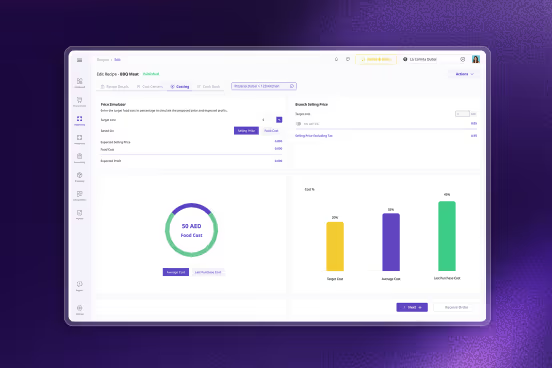
A multi-site group did not know the true build cost of its highest-volume item, a snack sold 2,000+ times a day from the central kitchen, because recipe cost had only ever used a flat ingredient price and never accounted for prep loss. At $48,000-$50,000 a month in supplier spend, even a 5% cut in cost of goods was material money left on the table. A flat-price recipe cost is a guess. Ask whether costing reflects the price you actually paid across deliveries and whether it accounts for yield, shrinkage and prep wastage at the ingredient level. Supy's recipe costing carries yields, shrinkage and prep wastage into every plated and prep recipe, with target costs and over-threshold alerts so a drifting build cost is flagged rather than discovered at month-end.
5. Can franchisees and sub-entities log their own ad-hoc purchases?
A growing franchise group planning dozens of new sites found that its system only let head office add or edit items, so franchisees had no way to log the ad-hoc supermarket runs they made when they ran short between deliveries. Those off-books buys never reached cost or variance reporting, so the numbers head office trusted were quietly wrong. Ask whether a branch or franchisee can raise its own requisition and receive goods without a head-office gatekeeper, and whether an ad-hoc purchase with no prior order still lands in cost and variance. Supy lets any branch raise requisitions on web or mobile and receive goods without a matching purchase order, so ad-hoc buys are captured rather than lost, while permissions still control who can do what.
6. Can the platform post to multiple separate legal entities, or does it force consolidation?
A multi-site group ran separate accounting entities per location, plus a manual invoice-approval step, and had almost no real-time view of which sites were actually profitable. Groups that operate several legal entities get burned when a platform assumes one consolidated books structure and cannot map spend back to each entity cleanly. Ask whether the system can keep entities separate through to your accounting software rather than forcing everything into one ledger. Supy connects to accounting platforms including QuickBooks, Xero, Zoho Books and NetSuite, and reports cost and profitability at both group and individual-site level, so you can see each location on its own before anything is rolled up.
7. What is the tested AI invoice-capture accuracy on your own formats?
Here is the one question an operator got right before signing rather than after. Instead of accepting the vendor's marketing claim, they ran their own test on real supplier invoices and measured it: roughly 55 of 57 captured fully accurately, including multilingual invoices matched against English item names, with no case-sensitivity duplicate items created. That measured number, on their own messy formats, is what a buying decision should rest on. Ask the vendor to run a batch of your actual invoices, in the languages and layouts you really receive, and show you the accuracy and the exceptions. Supy's AI invoice receiving is trained on F&B invoices, auto-matches to purchase orders, and routes anything it is unsure about to a human for approval before it touches stock or accounts.