.jpg)


Restaurant Suppliers: Use Your Spend Data to Negotiate Better Prices
What It Means to Negotiate From Your Own Spend Data
Negotiating from spend data means walking into a supplier review with the exact numbers on your side. You show what every location bought from that supplier, at what price, and how those prices moved over the past year. It replaces "can you do better?" with "we bought 14 tonnes across six sites at three prices, and here is the one we want." Data turns a favour you are asking for into a commercial case the supplier has to answer.
Most advice on supplier pricing stops at rapport: build a relationship, ask politely, pay on time. That works for a single restaurant. A multi-site group has something stronger than goodwill, and it is sitting unused in its own purchasing records. The group already knows its volumes, its price spread across branches, and where the same item costs more at one site than another. Assembled and put in front of a supplier, that is leverage.
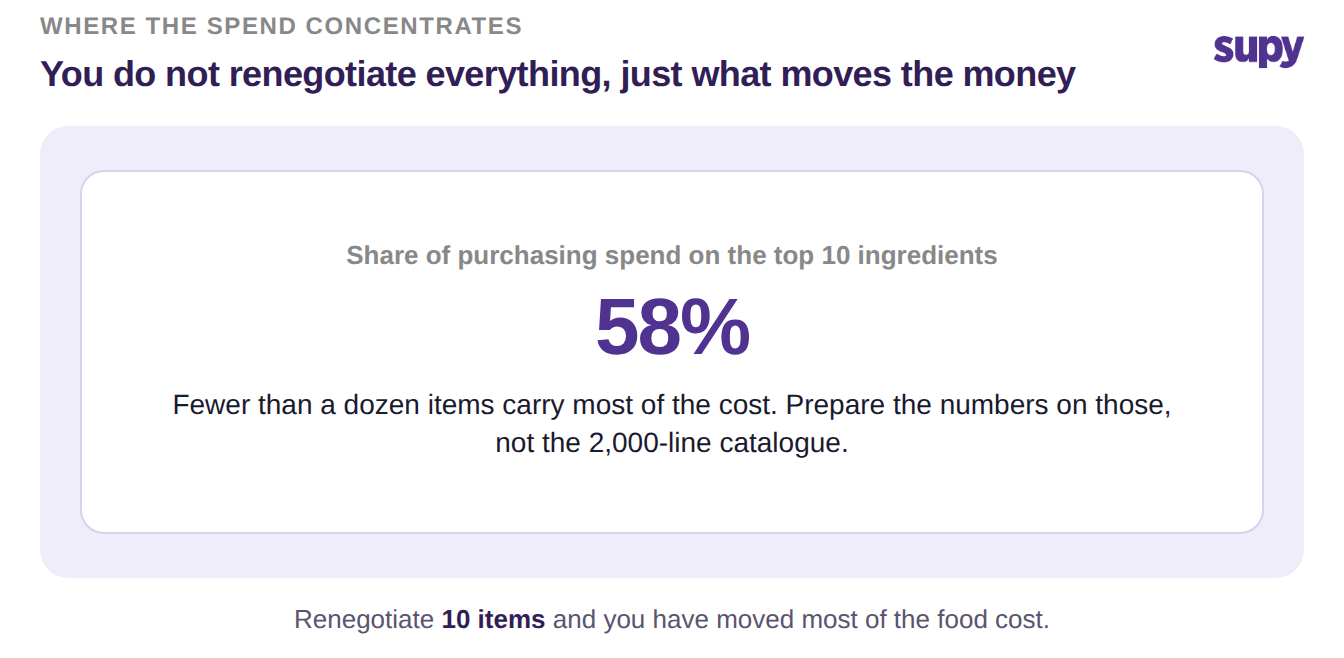
The starting point is concentration. In most groups a short list of items carries the spend: the top 10 ingredients typically drive around 58% of total purchasing value. You do not need to renegotiate a 2,000-line catalogue. You need the numbers on the handful of items that move your food cost, and the discipline to bring them to the table.
The Numbers to Pull Before You Sit Down With a Supplier
Preparation is the whole game. Before any conversation, pull the figures that show the supplier what your business is actually worth to them and where their pricing is inconsistent. Supy's purchasing analytics show spend and order history by ingredient across every location, so each of these comes out of one place instead of six spreadsheets.
| What to pull | What it shows | How you use it |
|---|---|---|
| Annual spend by supplier | Total value you send that supplier across all sites | Anchor the volume you are committing before asking for a price |
| Spend by item, by site | The same item bought at different prices across branches | Point to the lowest price you already pay and ask for it everywhere |
| Price movement over 12 months | Every increase the supplier passed through | Challenge rises that were never justified by market cost |
| Off-catalog and ad hoc buys | Spend going outside agreed pricing | Fold it into the contract for a better rate |
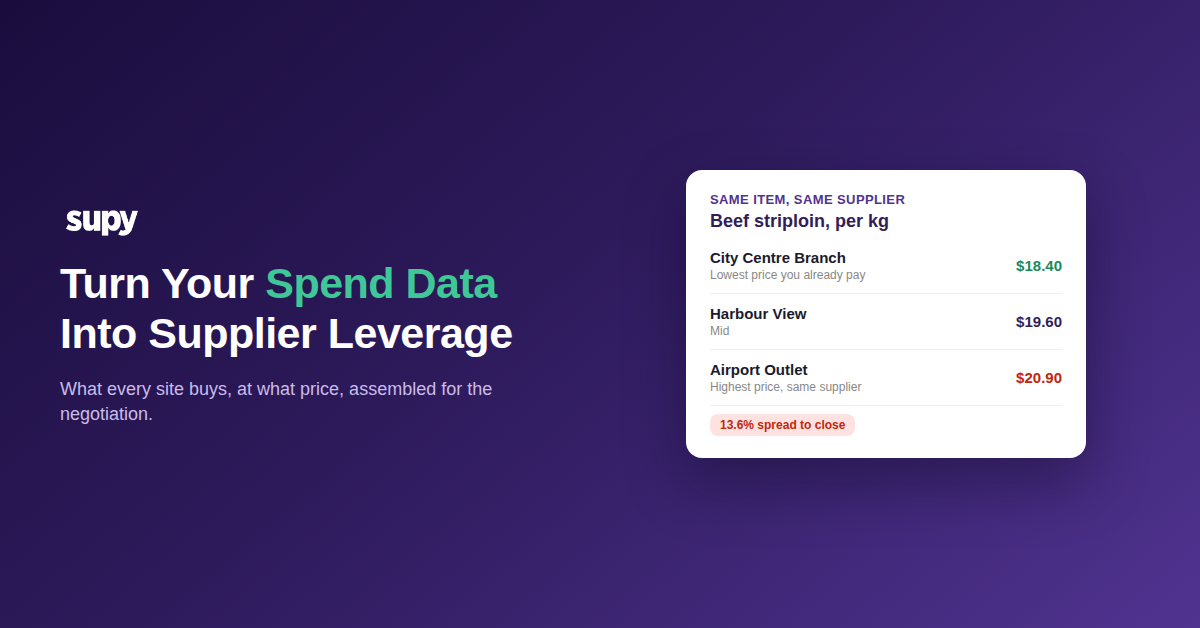
The item-by-site view is usually the sharpest. It is common to find the same cut priced at $18.40 per kg at City Centre Branch and $20.90 per kg at Airport Outlet, a 13.6% spread on one product from one supplier. On 1,200 kg a year that gap alone is worth about $3,000, and the supplier has no good answer for why one of your sites pays more than another.
Where Your Leverage Actually Comes From
Leverage is not one big ask. It is three or four specific, evidenced points that each move the price a little. Seeing them ranked by what they are worth tells you which to lead with and which to hold in reserve.
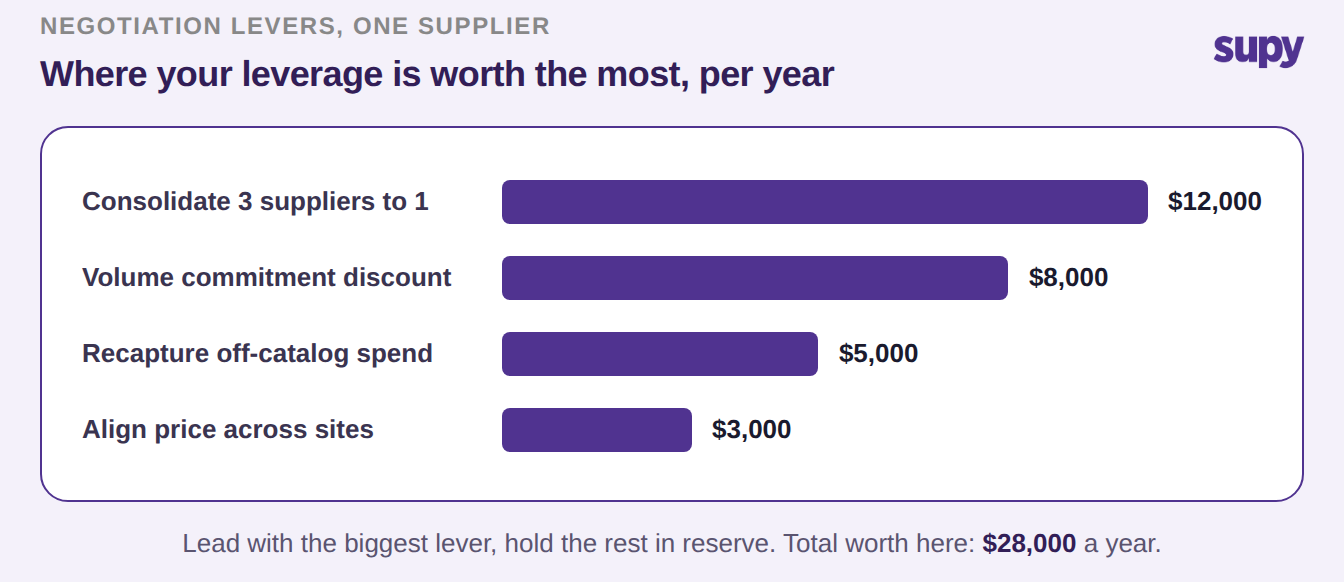
Volume commitment is the clearest. Promise a supplier a set annual quantity across every site, and they can price it as one large account rather than several small ones. Consolidation is next. A group buying produce from three suppliers can move that spend to one, lifting the volume enough to target a 6% to 8% unit-cost reduction. Then comes price alignment, closing the gap between what each branch pays. Last is the off-catalog spend, often around 11% of the total, that quietly leaks margin because nobody negotiated it.
Running the Negotiation: Match the Play to the Situation
There is no single script, because the right move depends on what your data shows. Identify which situation you are in, then run the play for that branch. The three most common are below.
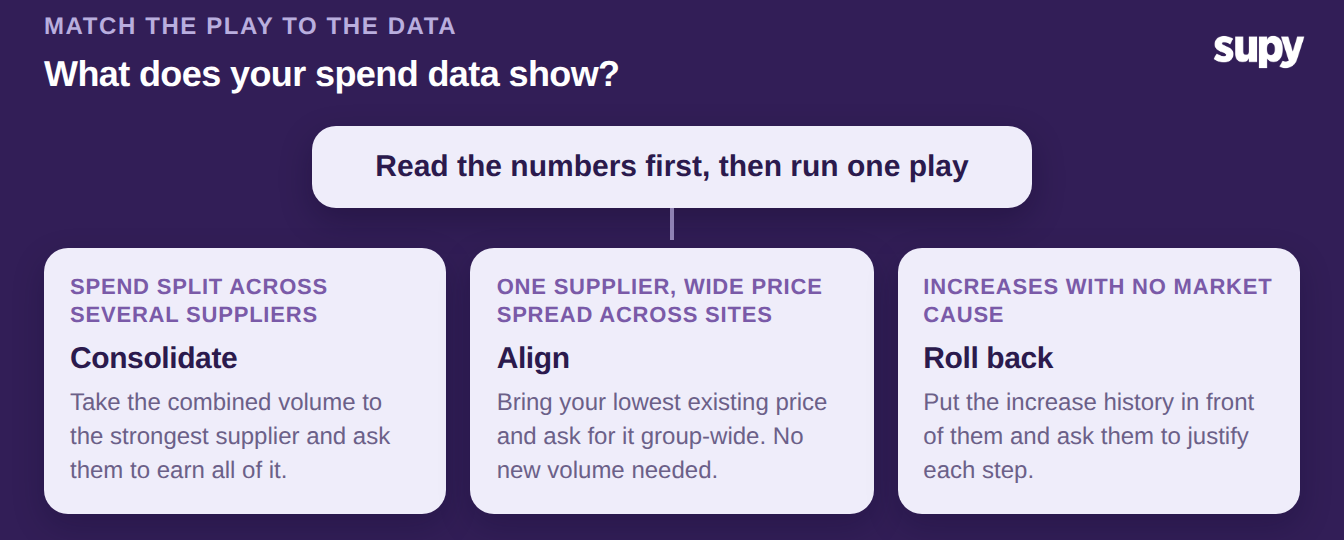
If the data shows heavy spend split across several suppliers for one category, the play is consolidation: take the combined volume to the strongest supplier and ask them to earn all of it. If it shows one supplier with a wide price spread across your sites, the play is alignment. Bring the lowest price you already pay and ask for it group-wide, with no new volume required. If it shows a run of price increases with no market cause, the play is a rollback: put the increase history in front of them and ask them to justify each step. On a $240,000 annual produce spend, even a 5% outcome is worth about $12,000 a year.
Applying the Outcome and Holding the Line Afterwards
A negotiated price is only real once it reaches every purchase order and stays there. The work after the handshake is where most of the saving is won or lost. Lock the price in the same day, then set up a check that flags when it drifts back up.
| After you agree a price | Why it matters | How Supy handles it |
|---|---|---|
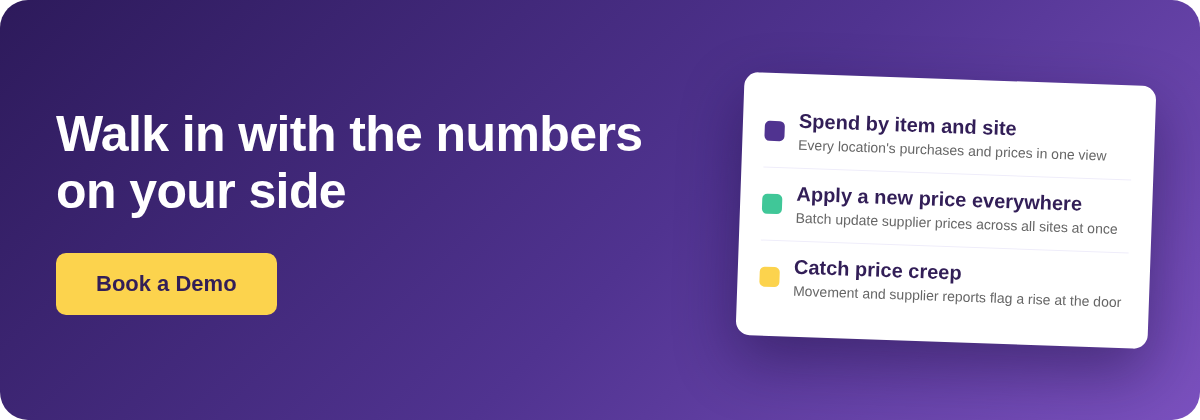
| Apply the new price everywhere at once | A rate agreed but not loaded still bills at the old number | Batch update supplier item prices across all sites in one action |
| Push it into recipe costs | Menu margins are wrong until the new cost flows through | Repriced items feed recipe and COGS reports automatically |
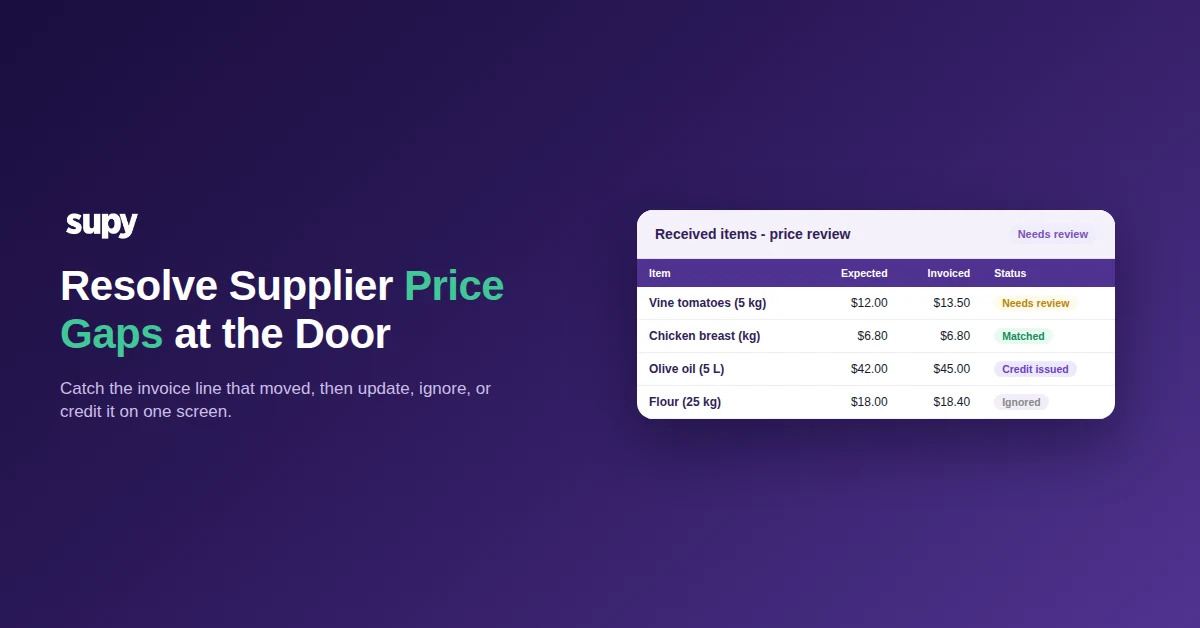
| Watch for the price creeping back | Suppliers often restore an old rate a few weeks later | Price movement and supplier performance reports flag the change at the door |
This is also where consistency compounds. When a negotiated price applies across all locations and every future increase is visible, the next review starts from a stronger position than the last. You can see the platform side of this in Supy's restaurant procurement software, and the related discipline of catching unplanned rises in our guide to restaurant supplier price management.
Where to Start
Pick the one supplier you spend the most with. Pull three numbers: your total annual spend with them, the same key item's price at your cheapest and most expensive sites, and every increase they passed through this year. If the site-to-site spread is the biggest gap, run the alignment play first, because it needs no new volume commitment and the money is already yours to recover. If your spend on that category is split across several suppliers, run consolidation instead. One supplier, three numbers, one play: that is a negotiation you can prepare this week.