





What a UK Food Hygiene Inspection Checklist Must Show the Inspector

What a UK food hygiene inspector checks
A UK food hygiene inspection scores what your records prove, not how the kitchen looks that day. An unannounced officer walks the kitchen and asks for the paperwork: temperature logs, cleaning schedules, allergen information and training records. This checklist shows what each site must have ready, how the 0 to 5 rating works, and how a group stays inspection-ready.
- Show the trail. The officer's real question, as one operator heard it on a call, is whether you can show that you did what you said you would do. They score three areas, and the last one carries the most weight. The officer cannot watch every shift, so they judge your systems by the trail each shift leaves behind.
- Spotless scores worse. A kitchen that looks spotless but cannot produce two weeks of temperature logs scores worse than a busy one that is fully documented.
| Area the officer scores | What they assess |
|---|---|
| Food handling | how hygienically food is prepared, cooked, reheated, cooled and stored |
| Physical condition | cleanliness, layout, lighting, ventilation and pest control |
| Management of food safety | your processes, training, systems, and their confidence that standards will hold |
The visit is unannounced, so inspection-ready has to mean every ordinary day. The Food Standards Agency explains how a visit works on its own food hygiene rating scheme page.
The records to have ready
Keep these records current and to hand, because the officer asks for them by name and scores your management mostly on what they show. Confirm the detail with the Food Standards Agency or your local authority before you rely on it, because requirements change.
| Record | What it proves | How often |
|---|---|---|
| Food safety management system (a HACCP-based system such as Safer Food, Better Business) | your hazards are identified and controlled | reviewed regularly |
| Temperature records for chilled storage, hot holding, cooking and cooling | cold and hot food stayed within safe limits | every service |
| Cleaning schedule with sign-offs | cleaning happens and someone checks it | daily, plus the deep-clean cycle |
| Allergen information for every dish | you can tell a customer what is in the food | updated when a recipe changes |
| Supplier and delivery records | you can trace an ingredient back one step | every delivery |
| Staff training records | your team was trained before they handled food | on hire, then refreshed |
| Opening and closing checks | routine safety checks ran at each site | every day |
| Corrective actions log | a failed check was fixed, by whom and when | as issues arise |
| Pest control records | the premises are monitored and treated | every visit |
Allergens sit inside this list but deserve their own line. UK food businesses must tell customers about the 14 named allergens whenever they are used as ingredients, for both packaged and loose food, and staff must be trained on them.
Food prepacked for direct sale, such as a sandwich made and wrapped on site, needs its own label. That label shows the food name and a full ingredients list with the allergens emphasised, the rule known as Natasha's Law.
How the food hygiene rating is scored
Your rating is a snapshot of the standards the officer found on the day, scored across the three areas above and published as a single number from 0 to 5. You have to do well in all three areas to reach the top rating.
Management is the area most within your control between visits, because it rests on the records you keep every day.
| Rating | What it means |
|---|---|
| 5 | hygiene standards are very good |
| 4 | hygiene standards are good |
| 3 | hygiene standards are generally satisfactory |
| 2 | some improvement is necessary |
| 1 | major improvement is necessary |
| 0 | urgent improvement is required |
A low score is not permanent. Once you have made the improvements the officer set out, you can ask your local authority for a revisit and a new rating. Treat a poor score as a to-do list with a deadline, not a verdict.
Common reasons kitchens lose rating points
Most lost points come from records, not from a dirty kitchen. One chef kept compliance documents spread across folders and drawers, which turned every inspection into a scramble.
A new head chef at another group found that allergen handling was inconsistent across the sites and warned it was a legal risk. These are the gaps that catch groups most often, each with the fix.
| Reason points are lost | The fix |
|---|---|
| Paperwork is paper-based and scattered | keep each site's records in one place, in a fixed order, so anyone on shift can find them |
| Allergen information no longer matches the recipe | update allergen information the moment a recipe changes, and check it in your weekly review |
| No trail that a failed check was fixed | log the corrective action with an owner and a date, and record the recheck that closed it |
| Temperature logs have gaps | make the readings part of opening and closing so they happen on every shift |
| Training you cannot prove | keep dated training records and refresh them |
| One site is ready, the others are not | run the same checks everywhere, every day |
Staying inspection-ready at every site
The hard part for a group is not passing one inspection. It is having every site ready on any morning an officer walks in. The fix is the same whether a central kitchen supplies your branches or each site runs on its own.
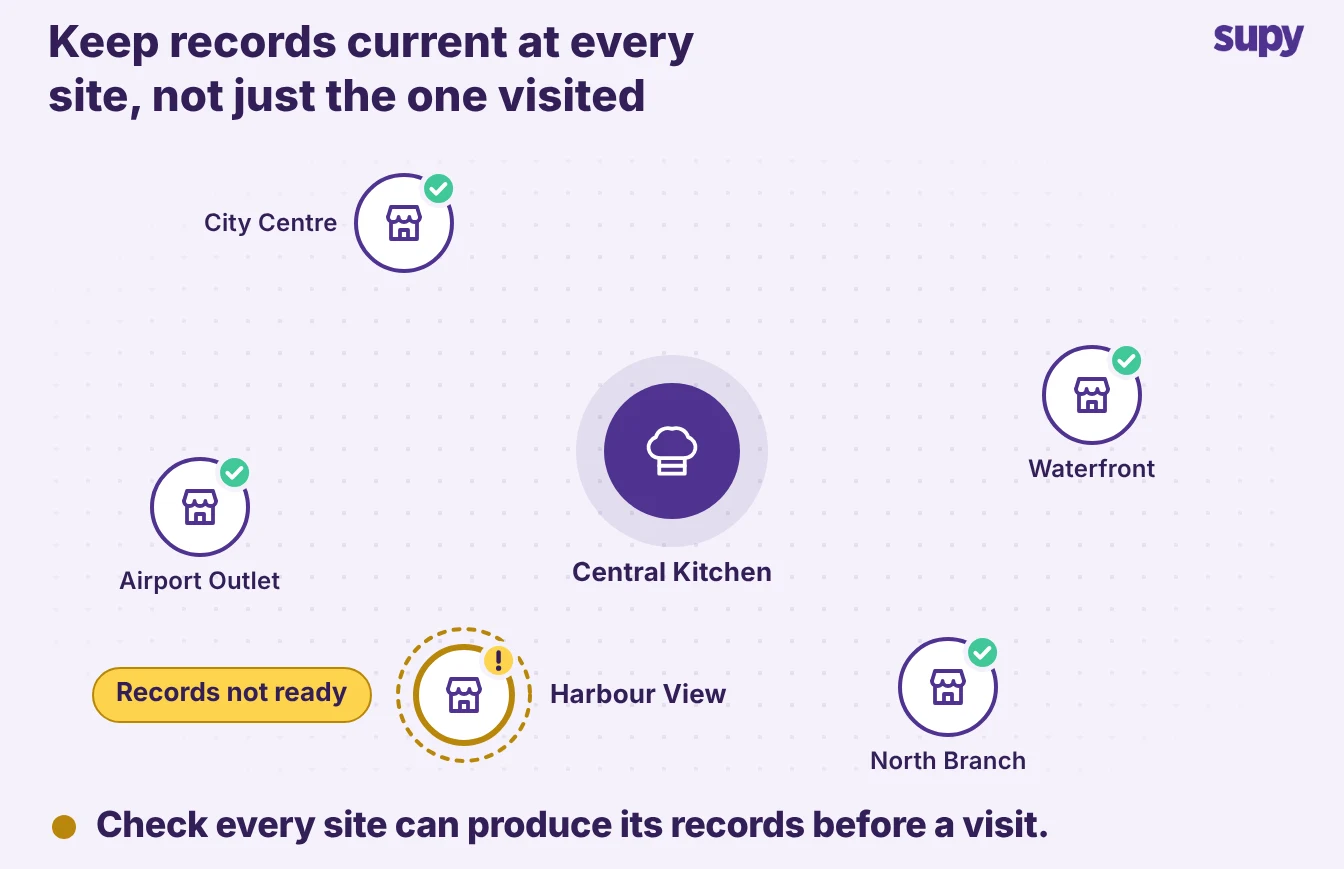
- Centralise the records. Centralise the records so head office can see every site's status, and run the same opening and closing checks everywhere. Turn every failed check into a tracked corrective action with an owner, a due date and a recheck. The person who owns it then finishes the fix before the next visit.
- Records in order. Supy keeps your supplier, delivery and stock records in order across sites. AI invoice scanning captures what each site received and flags a price or quantity mismatch before you pay. The inventory audit trail shows who changed what and when, which is the traceability an officer asks for. For the temperature records themselves, a simple food temperature log kept on every shift is what the officer will ask to see first.
Before your next visit, run a quick self-audit at each site. Can the team on shift produce these four records, in one place, right now?
- Temperature logs. The last two weeks, with no gaps.
- Allergen information. Current for every dish on the menu.
- Training records. Dated, for everyone who handles food.
- Corrective actions log. Each failed check, its owner and its recheck.
If a site cannot produce even one of them, fix that gap first. It is the one most likely to cost points when the officer arrives unannounced.