.jpg)

AI in Restaurants: The Clear 2026 Guide to Forecasting, Ordering, Waste Reduction & Menu Profitability
In this guide, you’ll learn:
- Why forecasting, ordering, waste, and menu profitability are inseparable in modern operations
- How AI connects demand signals with cost discipline
- What “good” looks like for operators, chefs, and finance teams
- Where restaurants typically lose control and why
- A simple rollout model for improving these workflows without disruption
Why 2026 Changes the Equation for Restaurant Operations
Restaurants are operating in a more volatile environment than ever before.
Demand shifts faster, supplier pricing changes more frequently, labor remains expensive and in short supply, and menus continue to evolve constantly.
Yet many restaurants still manage forecasting, ordering, waste, and menu pricing as separate workflows, often owned by different teams using different data.
That disconnect is where margins quietly erode.
AI matters in 2026 not because it replaces people, but because it connects systems. When forecasting, purchasing, execution, and cost control operate from the same data foundation, decisions become faster, more accurate, and easier to trust.
The Core Problem: Disconnected Decisions
Most margin leakage isn’t caused by one big mistake. It comes from small misalignments:
- Forecasts that don’t reflect real demand
- Orders placed with outdated cost assumptions
- Prep based on habit, not data
- Menus priced on historical averages
- Finance reviews performance after the fact
AI doesn’t “optimize everything.”
It reduces the gap between signal and action.
The 4 - Pillar AI Operating Model for Restaurants
At a practical level, AI improves margins by strengthening four connected workflows:
- Forecasting demand
- Ordering inventory
- Reducing waste
- Managing menu profitability
When these pillars reinforce each other, restaurants gain predictability instead of surprises.
Pillar 1: Forecasting That Operators Can Actually Use
Forecasting is no longer just about predicting covers.
AI-supported forecasting incorporates:
- Historical sales by daypart and channel
- Seasonality and local patterns
- Menu mix changes
- Events and promotional impact
For operators, this means:
- More reliable prep guidance
- Fewer staffing misses
- Less reactive decision-making
For chefs:
- Better visibility into what will actually sell
- Less over-prep driven by guesswork
For finance:
- Forecasts that align more closely with actual results
Forecasting becomes the starting signal for the rest of the system.
Pillar 2: Ordering That Reflects Real Demand and Real Costs
Ordering is where good forecasts either translate into margin or break down.
AI helps ordering workflows by:
- Translating demand forecasts into purchasing guidance
- Highlighting abnormal order quantities
- Surfacing pack-size or substitution changes
- Anchoring decisions in verified cost data
When ordering is informed by both forecasted demand and current supplier pricing, restaurants reduce over-ordering, emergency buys, and silent cost drift.
This is where operators regain control rather than reacting to shortages or waste.
Pillar 3: Waste Reduction Becomes Measurable (Not Theoretical)
Waste is one of the hardest problems to manage manually because it’s distributed across:
- Prep decisions
- Storage and shelf life
- Portioning
- Demand volatility
AI doesn’t eliminate waste overnight.
It makes waste visible.
By comparing forecasted demand, actual sales, and inventory movement, AI highlights:
- Chronic over-prep items
- SKUs consistently over-ordered
- Stations or locations with repeat variance
Even small improvements of 1–2% reductions translate into meaningful margin recovery at scale.
Pillar 4: Menu Profitability That Stays Accurate Over Time
Menu profitability only works if costs stay current.
AI supports menu engineering by:
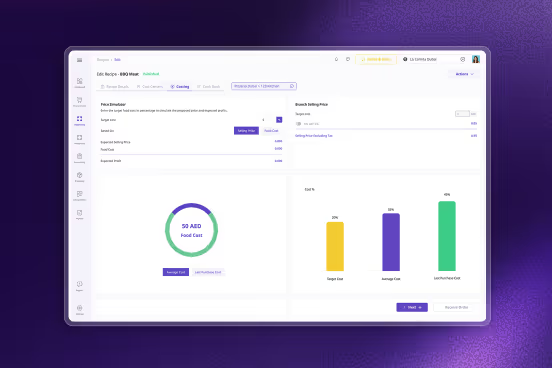
- Continuously updating recipe costs as invoices are validated
- Flagging items where margins drift
- Identifying dishes with negative contribution margins
- Supporting pricing reviews with real data
For chefs, this protects creative intent.
For operators, it protects the margin.
For finance, it ensures menu decisions reflect reality, not outdated assumptions.
What This Looks Like in a Well-Run Operation
In a mature AI-supported operation:
- Forecasts inform ordering decisions
- Ordering reflects verified supplier costs
- Inventory and prep align with real demand
- Waste patterns are reviewed, not guessed
- Menu pricing stays aligned with current economics
- Finance reviews performance proactively, not retroactively
This is not “full automation.”
It’s operational clarity.
How Supy Supports This System of Ai Operations
Supy plays a foundational role in this model by ensuring cost data is accurate, structured, and current.
By digitizing invoices, validating supplier pricing, and feeding verified costs into inventory, recipes, and reporting, Supy helps ensure that forecasting, ordering, and menu decisions are built on reliable inputs.
Supy doesn’t replace forecasting or planning tools.
It strengthens them by removing cost uncertainty from the equation.
Learn more about Supy’s invoice and cost-control capabilities here:
https://supy.io/product-features/invoice-receiving
A Simple Rollout for Operators
Most groups don’t need a full overhaul to start seeing impact.
First 30 days
- Improve demand visibility
- Standardize invoice capture
- Ensure recipe and item structures are clean
Next 30–60 days
- Align ordering with forecasts
- Review waste patterns weekly
- Validate menu costs against real invoices
Beyond 90 days
- Use trends to adjust menus and pricing
- Reduce over-ordering systematically
- Run operations with fewer surprises

.jpg)
