

8 Non-Negotiable Features in Modern Restaurant Management Platforms
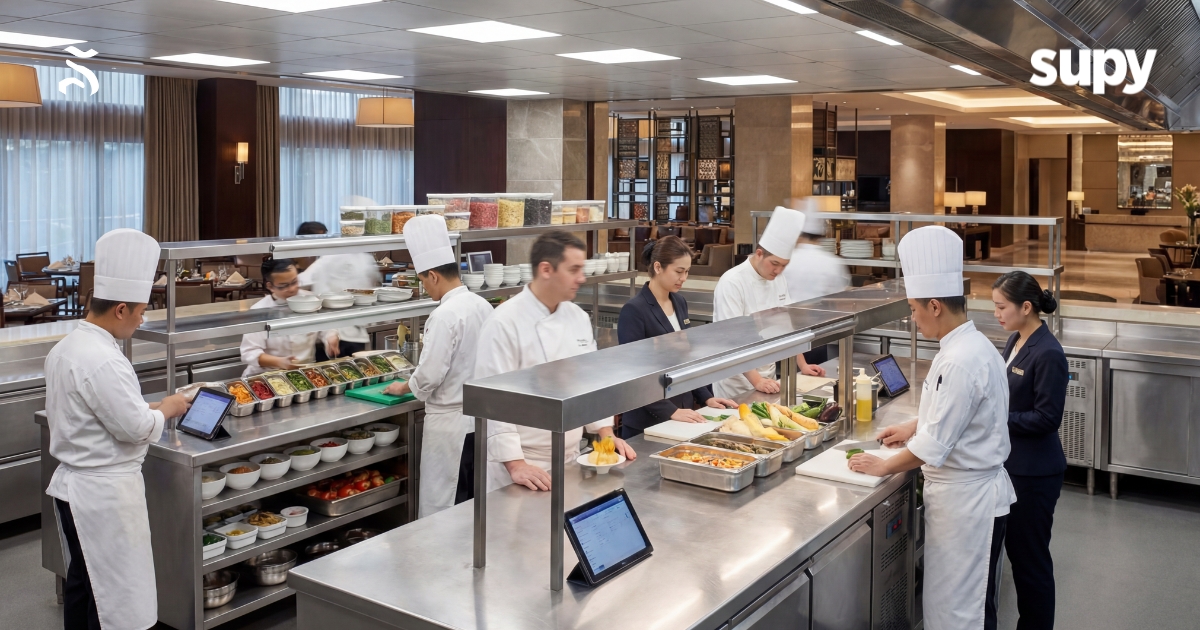
Multi-location restaurants rarely lose margin because a single store “did something wrong.” They lose it because every store does something slightly differently, and those small differences compound across purchasing, inventory, prep, and reporting.
That matters in an industry where the typical restaurant is often operating on thin pre-tax profit margins, and where food and labor are the two biggest cost buckets. The National Restaurant Association has noted that food and labor can each account for roughly a third of sales dollars in a typical cost structure, leaving only a small margin buffer. Operators feel that reality every time a supplier changes pack sizes, an item gets substituted, or a recipe drifts across locations.
Standardization is not “more SOPs.” It is repeatable workflows that make cost truth show up earlier, so teams can act before month-end.
Below are eight workflows that scale cleanly, even when you double the number of locations, suppliers, and menu complexity.
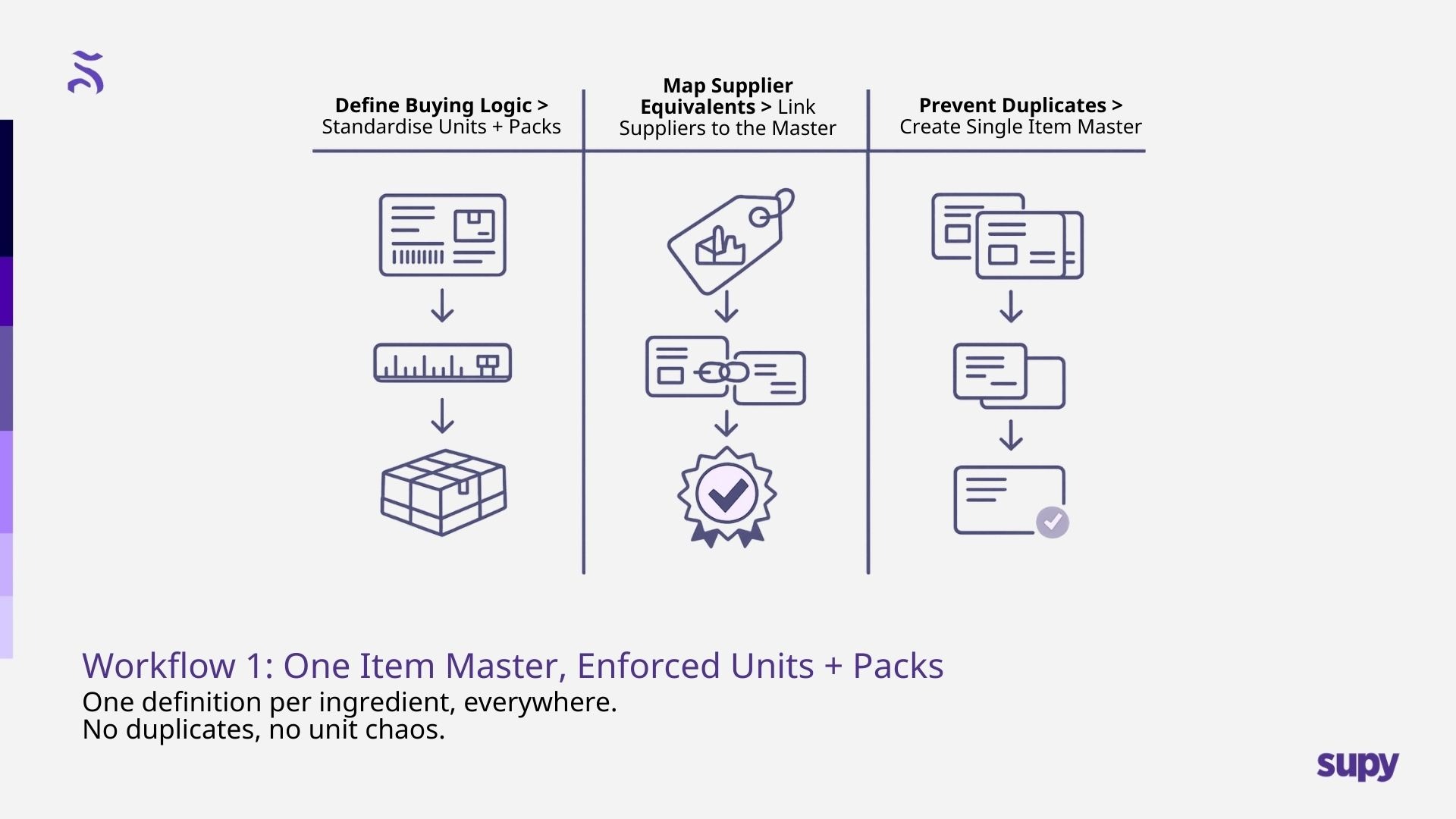
Workflow 1: A single item master, with enforced units and pack logic
What it replaces: Store-by-store naming chaos, spreadsheet item lists, and “we all know what this is” tribal memory.
What “good” looks like:
- One item definition for each ingredient, used by every location.
- A controlled unit hierarchy (buying unit → base unit conversion).
- Pack sizes and supplier equivalents are mapped once, not reinvented weekly.
How it runs (simple cadence):
- The central team owns the item master and approval rules.
- Locations can request new items, but they do not create new “versions” of the same product.
Common failure points:
- Letting locations create items freely.
- Allowing multiple “acceptable” units (kg, case, carton) without clear conversions.
- Not treating pack-size changes as a structured update.
Where AI helps, and where it doesn’t: AI is useful for normalizing messy invoice descriptions and proposing matches. It should not be the final authority on new master data. Humans still own the canonical definition and approvals.
Workflow 2: Line-item invoice digitisation with exception-first review
What it replaces: Manual data entry, inconsistent coding, and late discovery of price drift.
What “good” looks like:
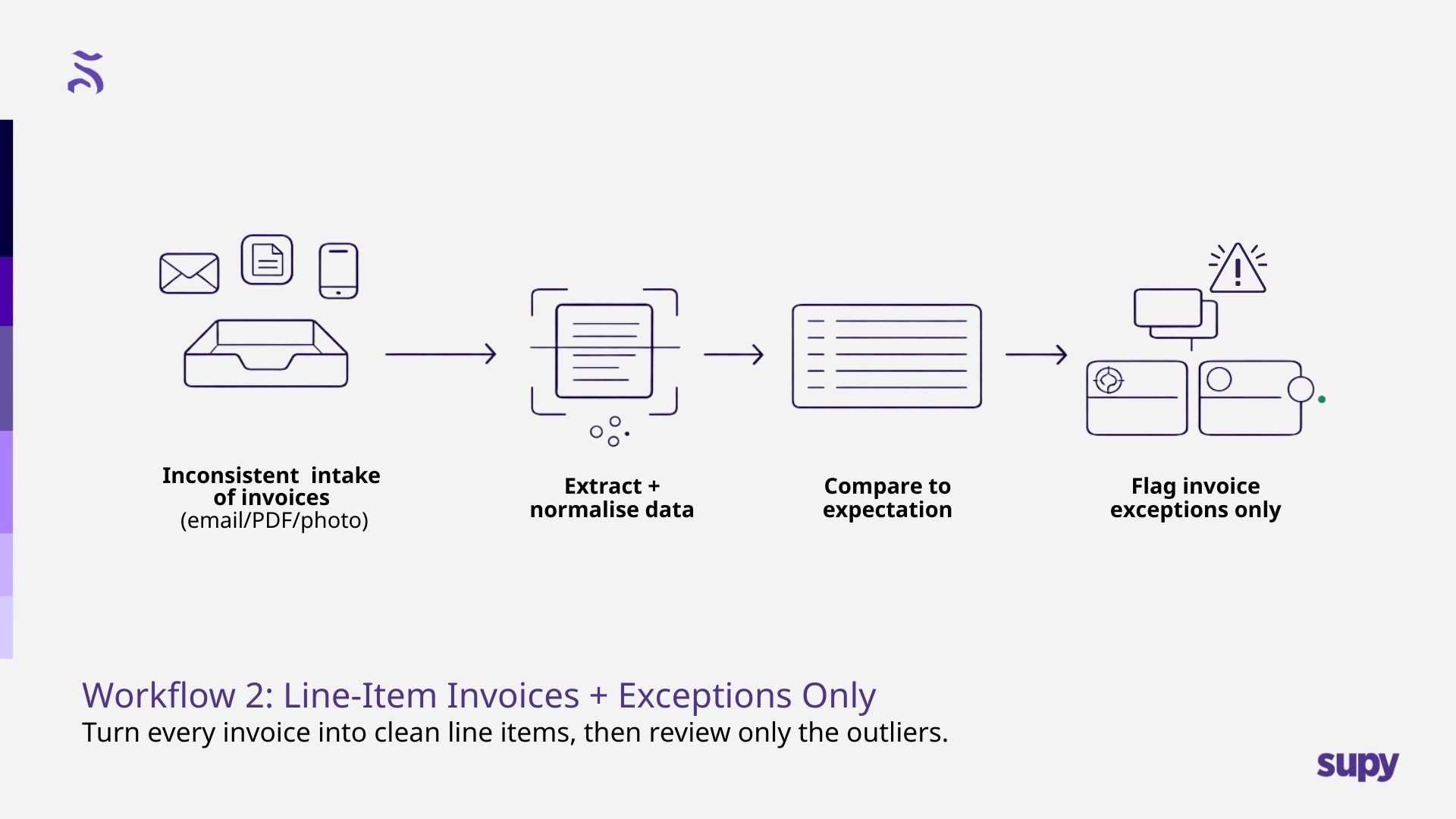
Invoices become structured line-items consistently, across PDFs, scans, and photos. Then the system flags only what changed or looks wrong.
This matters because invoice lines are where cost truth first appears. If you do not standardize invoice ingestion, every downstream process inherits noise.
How it runs:
- Locations send invoices to one intake method (email address, upload, or scan flow).
- The system extracts line items, normalizes units, and compares them against expected ranges.
- Teams review exceptions, not every line.
Common failure points:
- “We review invoices monthly” (too late).
- Treating invoice digitisation as accounting admin rather than cost control infrastructure.
- No clear owner for exceptions.
Where AI helps: AI excels at extracting, normalizing, and detecting anomalies at scale. The win is “no review.” The win is less unnecessary review.
Workflow 3: A procurement approval ladder that mirrors real risk
What it replaces: WhatsApp approvals, informal rules, and inconsistent enforcement between locations.
What “good” looks like:
- Approval thresholds tied to materiality (spend, variance, category risk).
- Different rules for core SKUs vs discretionary purchases.
- Price variance detection that triggers approval when something deviates meaningfully.
How it runs:
- Requisitions raised by locations.
- Approvals routed based on role and location.
- Receiving validation closes the loop (did we get what we approved?).
Common failure points:
- A single approval rule for everything, which becomes either too strict or too loose.
- Approvals that happen after delivery.
- No link between approved pricing and invoice reality.
AI leverage: AI can spot patterns in variance and substitutions that humans miss across many suppliers and stores. Humans still define the acceptable bands and escalation rules.
Workflow 4: Inventory counting that is standardized by method, not by motivation
What it replaces: “Everyone counts differently,” inconsistent cut-off times, and numbers that finance and ops argue about.
What “good” looks like:
- Same count frequency, same count structure (zones, storage areas), same cut-off rules.
- Clear variance ownership. “Variance” is not a report; it is a question: why did reality diverge?
Inventory becomes actionable when teams trust it. The National Restaurant Association has reported median food and non-alcoholic beverage cost ratios in the low 30% range for both limited-service and full-service operators. When food costs sit at that level, even small inventory leakage matters.
How it runs:
- Standard count templates by concept and footprint.
- Counts tied to a workflow: recount triggers, approvals, and adjustment reasons.
Common failure points:
- Inconsistent storage mapping across locations.
- Mixing receiving, transfers, and adjustments without traceability.
- Counting without any follow-through on the cause.
AI leverage: AI can reconcile expected usage vs sales and movement patterns to help explain variance. It cannot replace disciplined receiving, transfers, and counting habits.
Workflow 5: Recipe governance with controlled yields, portions, and prep links
What it replaces: Google Docs recipes, chef-only knowledge, and recipe drift across branches.
What “good” looks like:
- Recipes linked to standardized items and units.
- Yield and prep loss treated as first-class data, not assumed.
- Role-based change control (who can edit what, and why).
How it runs:
- The corporate chef or culinary lead owns the canonical recipe.
- Locations execute and can propose changes via a structured request.
Common failure points:
- Recipes that exist “somewhere” but are not connected to costing and inventory.
- No change history, so you cannot explain the margin movement.
- Portions that vary by shift without visibility.
AI leverage: AI is useful for monitoring drift signals (variance, usage anomalies). It should not be the system that decides what the portion should be.
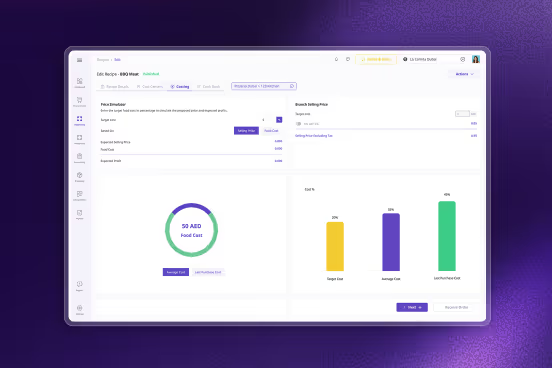
Workflow 6: Live recipe costing connected to real purchase prices
What it replaces: Static costing spreadsheets updated monthly, and surprise margin swings after the fact.
What “good” looks like:
Recipe costs update when supplier inputs change, including unit conversions and pack-size shifts. This keeps margin conversations grounded in reality, not last quarter’s assumptions.
Costs also move faster than menu prices. The BLS CPI data shows restaurant pricing inflation can move year-over-year, and even modest shifts affect operator decisions. The operational response cannot be “wait until month-end.”
How it runs:
- Invoice line-items feed ingredient costs.
- Recipes recompute automatically based on verified inputs.
- Exceptions get routed when a change materially impacts contribution margin.
Common failure points:
- Costing that updates, but is not trusted because item mapping is messy.
- No defined “what counts as material” threshold.
AI leverage: AI is strongest at standardizing messy supplier data and detecting meaningful deviations. The business still decides what changes require action.
Workflow 7: A weekly “Top 20” margin and variance review across locations
What it replaces: Endless dashboards, reactive firefighting, and review cycles that are too broad to be effective.
What “good” looks like:
Every week, you review the same core set of signals:
- Top-selling items and margin contributors
- Top variance ingredients and suppliers
- Locations with outlier waste or usage patterns
- Changes since last week
This is where multi-unit operators win: they don’t review everything. They review the few things that move the margin.
How it runs:
- A fixed 30 - 45 minute weekly cadence.
- A single owner for follow-ups.
- Actions tracked: credits requested, substitutions approved, recipe changes published, and purchasing rules updated.
Common failure points:
- Turning the meeting into a reporting session instead of a decision session.
- No link from insight → invoice/recipe/item evidence.
AI leverage: AI helps prioritize what deserves attention, especially across many stores. It should reduce noise, not create more alerts.
Workflow 8: A finance-ready close that starts upstream, not at month-end
What it replaces: Month-end reconciliation marathons, “ops vs finance” numbers, and delayed corrections.
What “good” looks like:
- Invoices are verified before they become accounting entries.
- Stock values reflect disciplined receiving, transfers, and adjustments.
- Cost allocations and category mappings are consistent.
When upstream workflows are standardized, finance spends less time reconciling and more time analyzing. That is the point of operational standardization: cleaner decisions earlier.
Common failure points:
- Integrations that push totals without item-level mapping.
- No audit trail for changes to recipes, suppliers, or pricing rules.
- “We’ll fix it in accounting,” which is usually the most expensive place to fix it.
AI leverage: AI helps by keeping upstream data consistent. It does not replace governance, approval trails, and role clarity.
A quick self-check: are you standardizing, or just documenting?
If you want a simple test, ask these four questions:
- How quickly do we notice cost drift after it happens?
- How many people touch the same data before it becomes “trusted”?
- Do locations execute one workflow, or ten versions of the same workflow?
- If we add five locations, does admin scale linearly?
If the answers make you nervous, the fix is rarely “more reports.” It is an upstream workflow discipline.
How Supy supports your workflows as you scale
Supy is built to support and enforce these workflows at scale, right in the operational layer where standardisation usually breaks down. It connects the day-to-day building blocks of control, invoice, and supplier cost capture, procurement approvals, inventory movements, recipe costing, and exception-led reporting into one consistent system.
The point isn’t to replace buyers, chefs, or finance. It’s to reduce the manual reconciliation between teams, tighten the feedback loop between cost changes and decisions, and make sure issues surface early with the right context so they can be resolved the same way, every time, across every location.
Final thoughts
The restaurants that scale cleanly are not the ones with the most tools. They are the ones with the fewest gaps between systems and the most repeatable workflows.
Standardization is a margin strategy. When food and labor take up a large share of each sales dollar, and waste remains a meaningful industry problem, small leaks add up quickly.
Build workflows that make cost truth show up earlier, route exceptions to the right owners, and keep every location operating from the same rules.