المخزون

Restaurant Par Levels for Fresh and High-Variability Items: Why Static Pars Break Across Sites

Par status for fresh proteins by site, showing why a single fixed par breaks across locations

Why One Fixed Par Level Breaks on Fresh and High-Variability Items

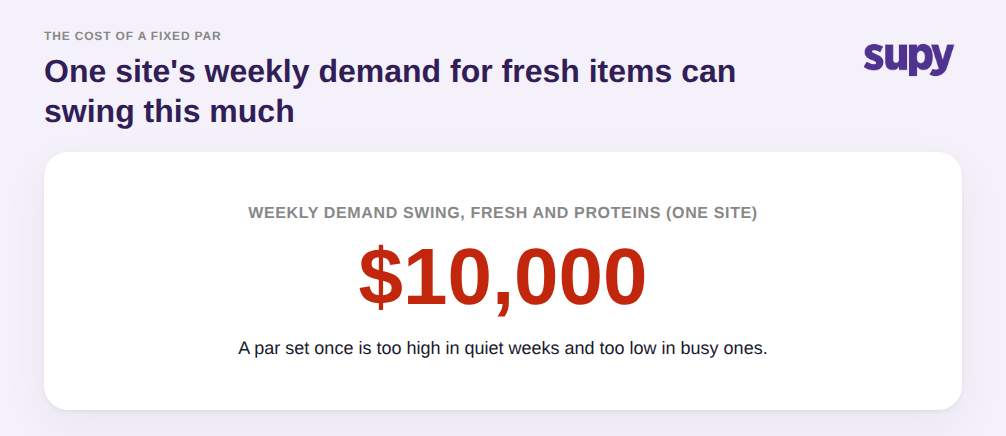
A par level is the stock quantity that triggers a reorder, and a single fixed par works only while demand holds steady. On fresh and high-variability items it breaks: when one site's weekly demand for proteins and produce can swing by $10,000, a number you set once is too high half the year and too low the other half.

The fix is not a looser number. It is to stop treating every item the same. Keep static pars where demand is genuinely stable, where the standard par level formula still holds, and move fresh, high-variability items onto dynamic par levels built from recent sales. The rest of this guide is a decision tree for telling which item belongs on which branch, and how to set the number once you know.

One site's weekly demand for fresh items and proteins can swing by 10,000 dollars


Sort Every Item by Two Questions: How Perishable, How Variable

Every item in your store answers two questions that decide its par strategy: how fast does it spoil, and how much does its weekly demand move. Plot those two axes and four groups fall out, and only one of them is a problem.

Stable and shelf-stable items sit in the easy corner. Canned tomatoes, dry pasta and cleaning supplies barely move week to week and do not expire, so a static par you set once and check occasionally is exactly right. Steady perishables like daily bread and house milk expire fast but sell at a predictable rate, so they still take a static par, just a tight one on a short order cycle. Shelf-stable but variable items, such as bottled drinks tied to an event calendar, can ride a static par you review roughly monthly.

The problem corner is the last one: items that are both perishable and variable. Fresh proteins, seafood and leafy produce spoil in days and swing hard with covers, weather and season. As a rule of thumb, if an item's weekly demand moves more than about 20% between a quiet week and a busy one, a fixed number is wrong most weeks, and this is where dynamic par levels earn their keep.

Quadrant sorting items by perishability and demand variability to choose a par strategy


The Test: Is This Item on a Static Par or a Dynamic One?

The test is a single question you can run item by item: does this item's weekly demand swing more than about 20%, and does it spoil within a few days? If the answer to both is no, keep it on a static par and move on. If the answer is yes, take it off its fixed number and put it on a dynamic, forecast-driven par.

To answer honestly, pull the last eight weeks of usage for the item at one site and compare the busiest week with the quietest. If they are close, the item is stable. If they are far apart, it is variable, and a static par cannot serve both weeks. Picture a par of 40 units you set in the low season: it leaves you 50 units short the moment the same item peaks at 90 units in a busy week, so you either stock out or you carry dead stock the rest of the year to cover a peak that rarely comes.

Decision tree: keep a static par or move to a dynamic par based on demand swing and spoilage


Setting a Dynamic Par Without Guessing the Number

Once an item lands on the dynamic branch, the goal is to stop hand-guessing a new number and let recent demand set it for you. A dynamic par is rebuilt from what the item actually sold, not from a manager's memory of last season.

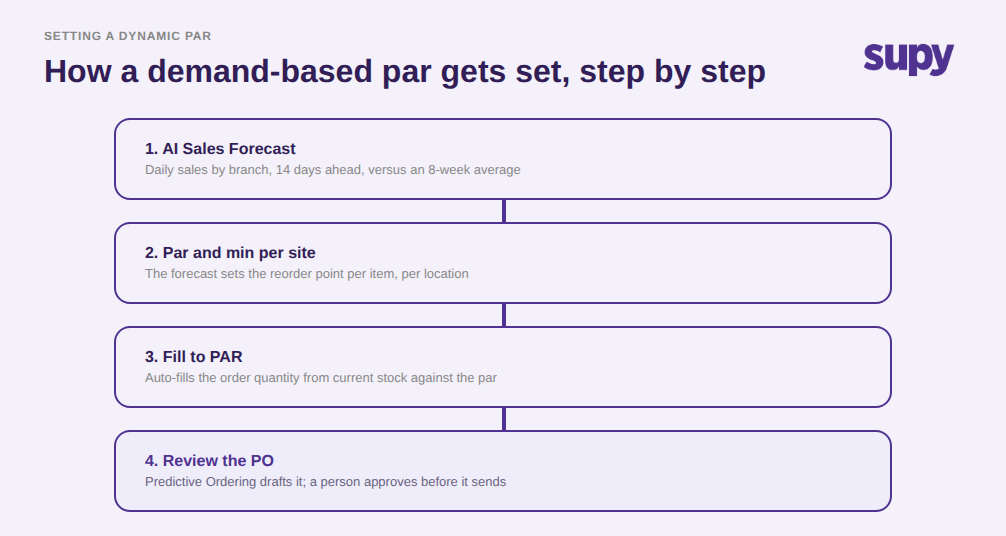
Supy's AI Sales Forecasting predicts daily sales by branch 14 days ahead, down to the menu item, and shows the forecast against an 8-week historical average, reaching under 10% variance between forecast and actual for a multi-site brand. That forecast feeds the par and minimum thresholds you hold per item per site, so the reorder point tracks real demand instead of a stale guess. From there, Fill to PAR auto-fills the order quantity from current stock against that par, and Predictive Ordering assembles a ready-to-submit purchase order that you still review line by line before it goes out. The number moves with the business, and no order ever leaves without a human check. Because thresholds live per item per site, you can manage all of this alongside the rest of your stock in one restaurant inventory management view.

Four steps to set a demand-based par: forecast, par and min per site, Fill to PAR, review the PO


Why the Same Item Needs a Different Par at Each Site

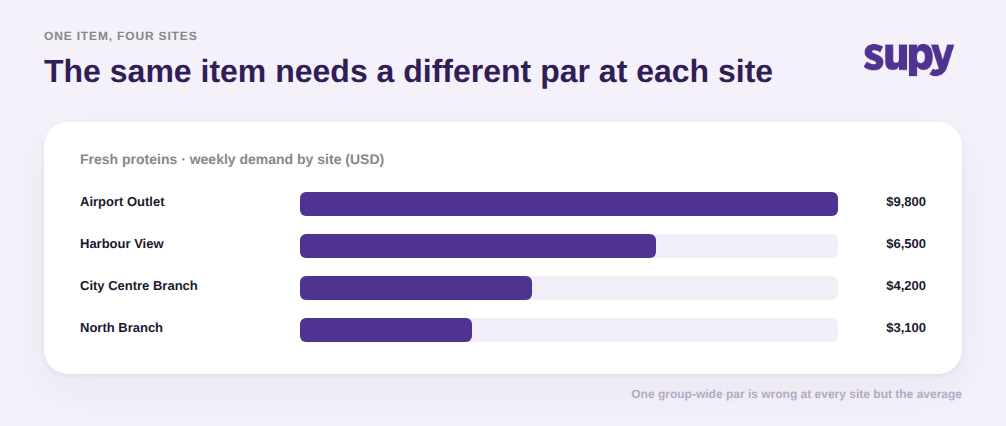
The last trap is copying one par across a group. The same fresh item can pull $9,800 a week at a busy airport outlet and $3,100 at a quiet suburban site, with two more branches somewhere in between. A single group-wide par is wrong at every site except the one nearest the average, so it drives over-ordering and waste at the small sites and stockouts at the big ones at the same time. Per-branch forecasting fixes this because each site gets its own model and its own par, rather than a headquarters number pushed down to all of them.

Bar chart of weekly demand for one fresh item across four sites showing why pars differ by location


That gives you a clear place to start this week. Take your fastest-moving fresh category at your busiest site, pull the last eight weeks of usage, and if the swing is more than about 20%, take that item off its static number and set a demand-based par. If an item is stable and shelf-stable, leave its static par alone and spend the effort where the demand actually moves. You do not need to convert the whole store at once, only the items sitting in the perishable-and-variable corner where a fixed number was always going to be wrong.

Book a Demo with Supy - dynamic par levels for fresh and high-variability items

Ready to optimize your restaurant operations?

مدونة

رؤيتنا التشغيلية

Your questions 
answered

Everything you need to know about Supy — from setup to integrations, pricing, and daily use. If it’s not covered here, just ask.

What is a par level, and why does it break for high-variability items?
+

A par level is the stock quantity that triggers a reorder, so it works as a simple floor for items whose demand barely moves. It breaks on high-variability items because a single fixed number assumes next week looks like an average week. Fresh proteins and produce do not behave that way: when a site's weekly demand for those items can swing by $10,000, a par set once is too high in quiet weeks and too low in busy ones. The fix is a demand-based par that moves with recent sales rather than a looser fixed number.

How do I know if an item is high-variability enough to need a dynamic par?
+

Pull the last eight weeks of usage for the item at one site and compare the busiest week with the quietest. If they are close, the item is stable and a static par is fine. If they are far apart, roughly a swing of more than 20% between a quiet and a busy week, treat it as high-variability. Perishability matters too: an item that both swings hard and spoils within a few days is the clearest case for a dynamic par, because a fixed number there causes either waste or stockouts almost every week.

Should I ever use static par levels at all?
+

Yes. Static par levels are the right tool for most of your store. Anything shelf-stable with steady demand, such as canned goods, dry stores and cleaning supplies, only needs a number you set once and review occasionally. Even fast-spoiling items can stay on a static par if their demand is predictable, like daily bread or house milk on a short order cycle. The point of the decision tree is not to make everything dynamic, it is to reserve the effort of demand-based pars for the perishable, high-variability items where a fixed number genuinely fails.

How are dynamic, demand-based par levels actually calculated?
+

A dynamic par is built from recent demand rather than a manager's estimate. In Supy, AI Sales Forecasting predicts daily sales by branch 14 days ahead and compares that against an 8-week historical average, so the projection reflects what the item is really selling now. That forecast sets the par and minimum thresholds held per item per site, and Fill to PAR then auto-fills the order quantity from current stock against that par. The par is not a hand-typed guess; it is a moving number that tracks the branch's own recent sales and updates as demand shifts through the season.

Why do the same items need different par levels at different sites?
+

Because demand for the same item is rarely the same across a group. One fresh item can pull $9,800 a week at a busy airport outlet and $3,100 at a quiet suburban site. A single group-wide par set to the average over-orders at the small sites, wasting fresh stock, and stocks out at the big ones at the same time. Per-branch forecasting solves this by giving each site its own model and its own par, so the reorder point matches that location's real demand instead of a headquarters figure applied everywhere.

How far ahead can demand be forecast for setting pars?
+

Supy's AI Sales Forecasting projects daily sales by branch 14 days ahead, down to the individual menu item, and shows that forecast next to an 8-week historical average so you can see how the projection compares with the recent baseline. Fourteen days is enough to cover typical order and delivery cycles for fresh items while staying close enough to current sales to stay accurate, reaching under 10% variance between forecast and actual for a multi-site brand. Managers can override the forecast at the day or item level when they know something the data does not, such as a private booking.

Can dynamic par levels create purchase orders automatically?
+

They can assemble the order, but they never send it on their own. Once dynamic pars are set, Fill to PAR auto-fills each order quantity from current stock against the par, and Predictive Ordering builds a ready-to-submit purchase order from the forecast run through your recipes minus current stock. Every line is left for a human to review and adjust before the order goes to the supplier, so you get the speed of an auto-built order without giving up control. That review step is deliberate: it keeps a person in the loop on quantity, timing and supplier choice for items where demand is still moving.

هل أنت مستعد لتطوير عملياتك؟

انضم إلى أكثر من 3500 مُشغلي مطاعم يخفضون التكاليف، ويبسطون العمليات، ويتخذون قرارات أكثر ذكاءً مع Supy