.jpeg)

The Ideal Restaurant Tech Stack for 2026: An Integration Blueprint for Lower Costs and Cleaner Data
.png)
Most restaurants don’t struggle because they lack the software to set them up for success. They struggle because they have too many software programs that don’t talk to each other.
Sales live in the POS. Invoices sit in inboxes. Inventory is tracked somewhere else. Recipes exist in spreadsheets or PDFs. Finance works off numbers that operations don’t fully trust. Each system does its job, but the gaps between them quietly create friction, delays, and cost leakage.
In 2026, efficient restaurant operations are defined less by individual tools and more by how well those tools are integrated. The best operators aren’t chasing dashboards. They’re building connected systems that surface cost truth early and allow teams to act before issues compound.
This blog breaks down:
- The key integration types every modern restaurant needs
- Where disconnected systems quietly increase costs
- How Supy sits at the center of the restaurant tech stack, between POS and accounting, as the operational cost layer
How disconnected systems quietly increase costs
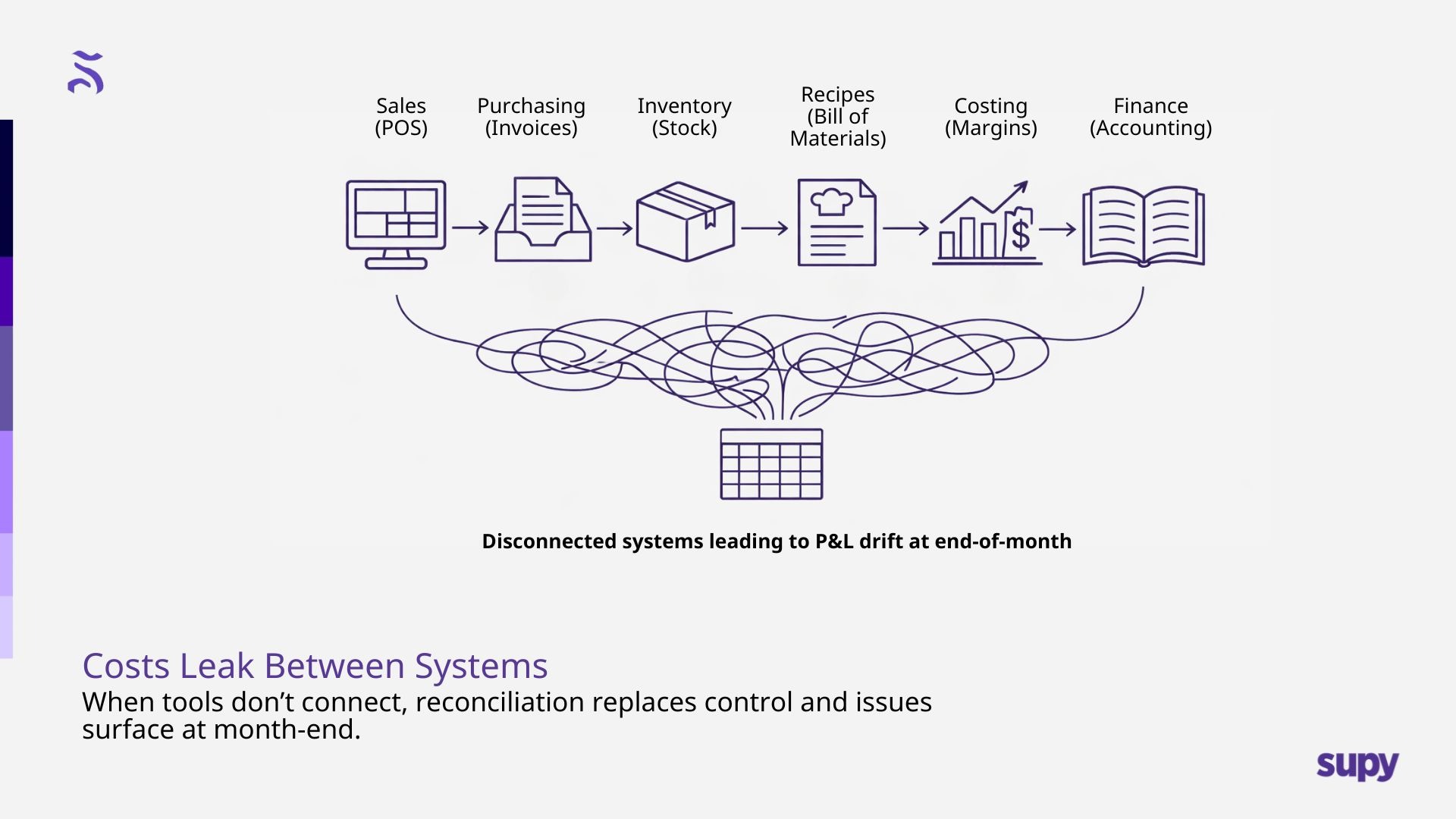
Cost problems rarely start inside a single system. They emerge between systems. Common symptoms look familiar:
- Supplier invoices don’t match inventory values
- Inventory usage doesn’t align with recipes
- Recipe costs don’t reflect real purchasing prices
- Finance and operations report different numbers
- Teams spend hours reconciling instead of acting
When systems aren’t connected, manual reconciliation becomes the default. Spreadsheets bridge gaps. Data is re-entered. Reports are debated instead of trusted. Decisions are delayed until month-end, when the opportunity to intervene has already passed.
Most margin loss doesn’t look dramatic. It looks like “we’ll review this later.”
What “integrated” actually means in restaurant operations
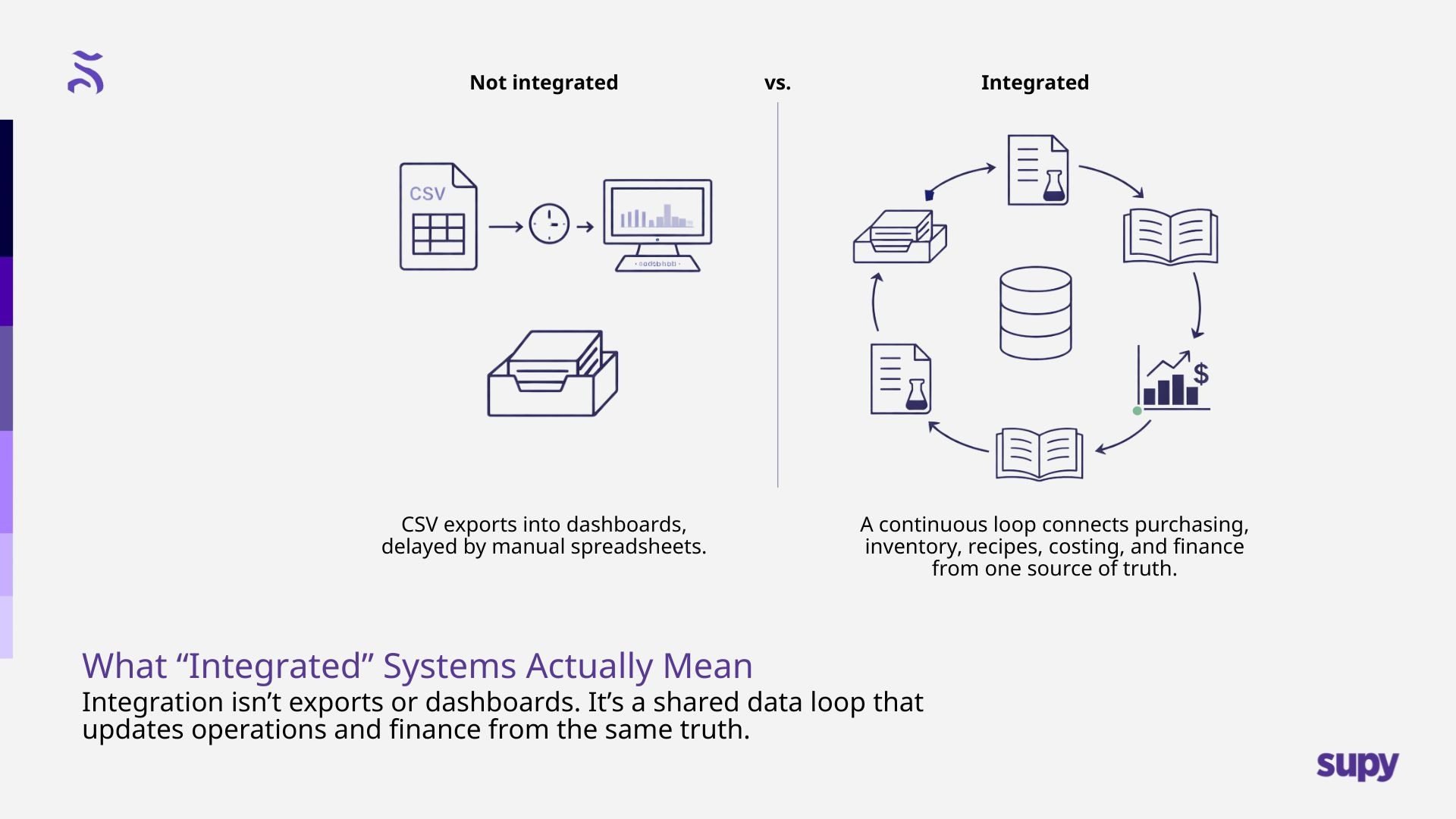
Integration is often misunderstood: it’s not exporting CSV files, syncing data once a day, or adding more dashboards.
True integration means:
- Shared data models across systems
- Real-time or near-real-time syncing
- One source of truth used by operations and finance
- Data that flows forward into decisions, not just reports
In a well-integrated restaurant tech stack, systems behave like one connected workflow:
Sales → Procurement → Inventory → Recipes → Costing → Finance
When this loop works, cost control becomes continuous instead of reactive.
The four integration types every restaurant needs in 2026
1. Sales integrations (POS and channels)
Purpose: Turn sales into demand and usage signals.
POS data is the starting point for everything downstream. It should:
- Drive inventory depletion
- Inform theoretical recipe usage
- Feed forecasting and replenishment logic
Where this breaks down:
- Sales data is aggregated too late
- Online orders and aggregators sit outside the core system
- Menu items aren’t mapped cleanly to recipes
The cost impact is subtle but real. Poor sales integration leads to inaccurate forecasting, excess stock, unexplained variance, and missed margin drift.
In 2026, sales data needs to flow cleanly and immediately into operational systems, not live in isolation.
2. Purchasing integrations (suppliers and invoices)
Purpose: Capture real costs as they happen. Supplier invoices are the earliest source of cost truth. But only if they’re digitised and structured at the line-item level. Strong purchasing integration allows teams to detect:
- Unit price changes
- Pack-size shifts
- Unit-of-measure mismatches
- Substitutions and billing errors
Without this integration, cost updates happen too late. Prices creep into recipes and menus before anyone notices, and procurement decisions become reactive.
Invoice automation is not an accounting upgrade. It’s a cost control layer.
3. Inventory, recipes, and production integrations
Purpose: Translate purchasing into actual usage and margin. Inventory data only becomes meaningful when it connects to:
- Recipes and prep
- Portion sizes and yields
- Waste and transfers
- Central kitchen production
Common failure points:
- Recipes exist in documents, not systems
- Inventory variance has no clear explanation
- Prep and production are disconnected from costing
When inventory and recipes are integrated, operators gain:
- Live recipe costing
- Clear theoretical vs actual usage
- Earlier detection of over-portioning and waste
- Better control in central kitchens and multi-location setups
This is where cost visibility becomes operational, not just financial.
4. Finance and accounting integrations
Purpose: Turn operational truth into clean financial reporting. Accounting and ERP systems are essential, but they are not built to manage the day-to-day operational complexity of restaurants. They rely on clean inputs:
- Verified invoices
- Accurate stock values
- Consistent cost allocations
When operational systems are integrated upstream, finance teams spend less time reconciling and more time analysing. Month-end closes faster. Numbers are trusted. Conversations shift from “why doesn’t this match?” to “what should we do next?”
Where Supy sits in the 2026 restaurant tech stack
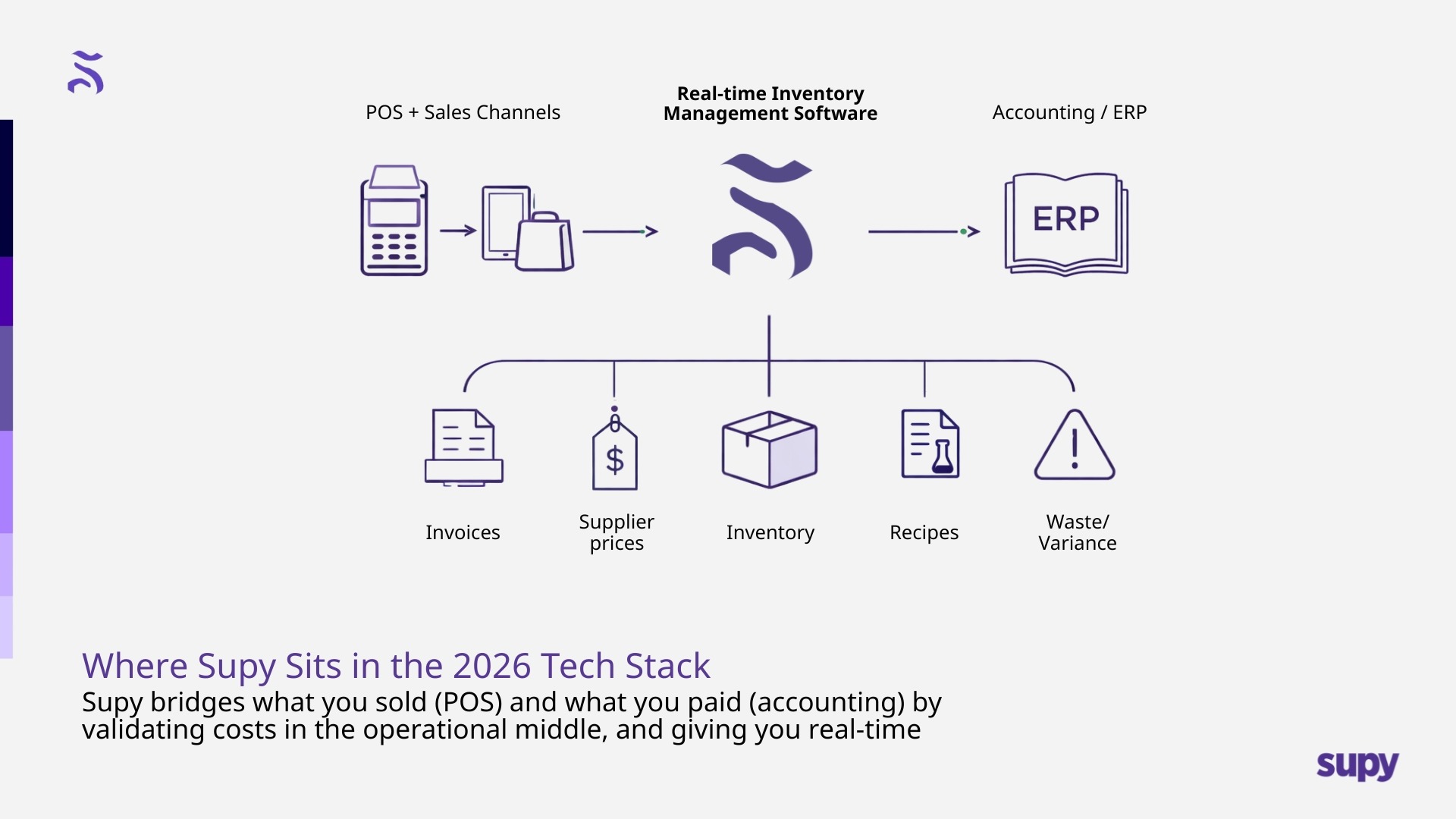
Supy sits at the operational core of the restaurant tech stack, positioned between the systems that show what you sold and the systems that record what you paid.
Your POS and sales channels capture revenue activity, while your accounting or ERP system turns spend into financial reporting.
The problem is everything in the middle: supplier pricing and procurement decisions, invoice accuracy, inventory movement and variance, recipe and prep yields, waste, and the cost logic that determines whether the business is actually performing the way the P&L suggests.
That’s where Supy operates. It doesn’t replace your POS or accounting system; it connects them through a shared operational data layer, so sales can translate into cost control, and verified operational truth can flow cleanly into finance.
Common integration mistakes to avoid
Even well-intentioned tech stacks fail when integration is approached incorrectly.
Common traps include:
- Integrating tools without standardising units, pack sizes, or item mapping
- One-way integrations that surface data but don’t enable action
- Dashboards without workflows to resolve issues
- Adding BI before fixing upstream data quality
- Trying to integrate everything at once instead of sequencing properly
Integration only works when it supports decisions, not just visibility.
A practical integration roadmap for 2026
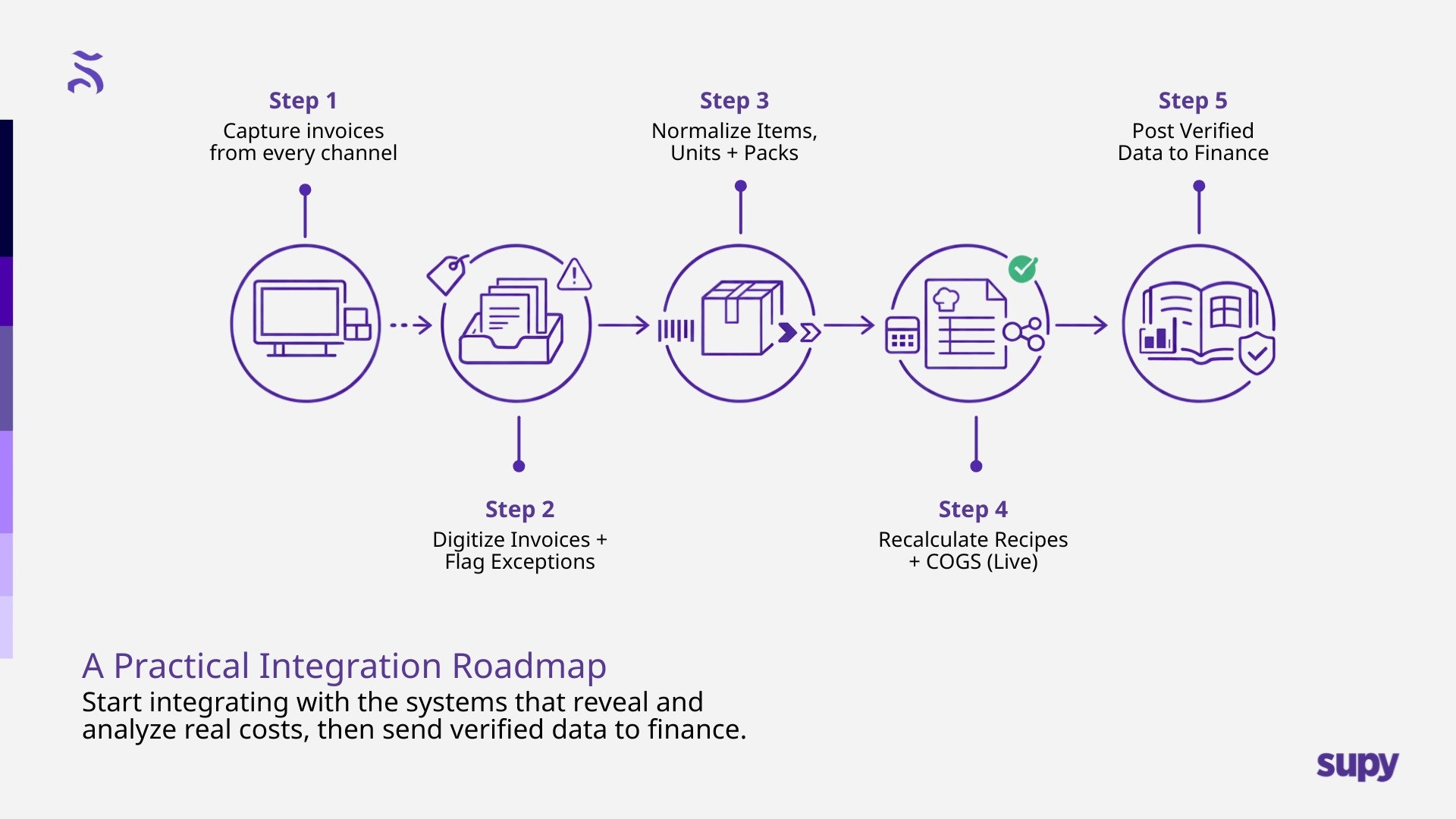
A phased approach works best.
Step 1: POS → Supy
Ensure clean sales data and item mapping.
Step 2: Suppliers and invoices → Supy
Capture real costs early through line-item invoice digitisation.
Step 3: Recipes and inventory → Supy
Connect purchasing to usage, yields, and variance.
Step 4: Supy → accounting or ERP
Push clean, verified data downstream for reporting.
Step 5: Add BI, workforce, and analytics tools
Only once the core cost loop is stable.
This sequence scales from single-site operators to complex multi-location and central kitchen models.
Conclusion: Systems over shortcuts
In 2026, smooth restaurant operations are built on integration, not accumulation.
The ideal restaurant tech stack isn’t about having more tools. It’s about having fewer gaps. When systems are connected, cost truth surfaces earlier, decisions happen faster, and teams spend less time reconciling numbers and more time improving performance.