.jpeg)


A Complete Guide to AI in Restaurants: How Automation Improves Margins
.jpg)
In this guide, you will learn:
- What AI truly means in the context of restaurant operations
- How automation strengthens margins across procurement, inventory, BOH, FOH, and finance
- The core workflows where AI creates a measurable business impact
- The maturity model for becoming an AI-powered restaurant
- What operators should expect from AI adoption over the next 18 - 36 months
- Why real-time data and automation are foundational to predictive decision-making
How AI Is Redefining Restaurant Efficiency and Control
Restaurants today operate in an environment defined by volatility. Supplier pricing changes unexpectedly, labor remains expensive, waste is difficult to control, and many operational decisions rely on manual processes or delayed reporting. AI has become a widely used term in hospitality technology; however, most explanations lack practical value for operators, chefs, finance teams, and multi-site leaders who face margin pressure daily.
The real question operators are asking is simple:
Can AI genuinely improve margins and operational predictability - today, not in some distant future?
Increasingly, the answer is yes. When applied to the right workflows, AI reduces waste, improves accuracy, accelerates financial reporting, and provides operators with the real-time visibility required to manage multi-location operations with confidence. This guide explains how AI works, where it delivers ROI, and why it is becoming a competitive essential for modern restaurants.
Understanding AI in Restaurants: From Automation to Predictive Intelligence
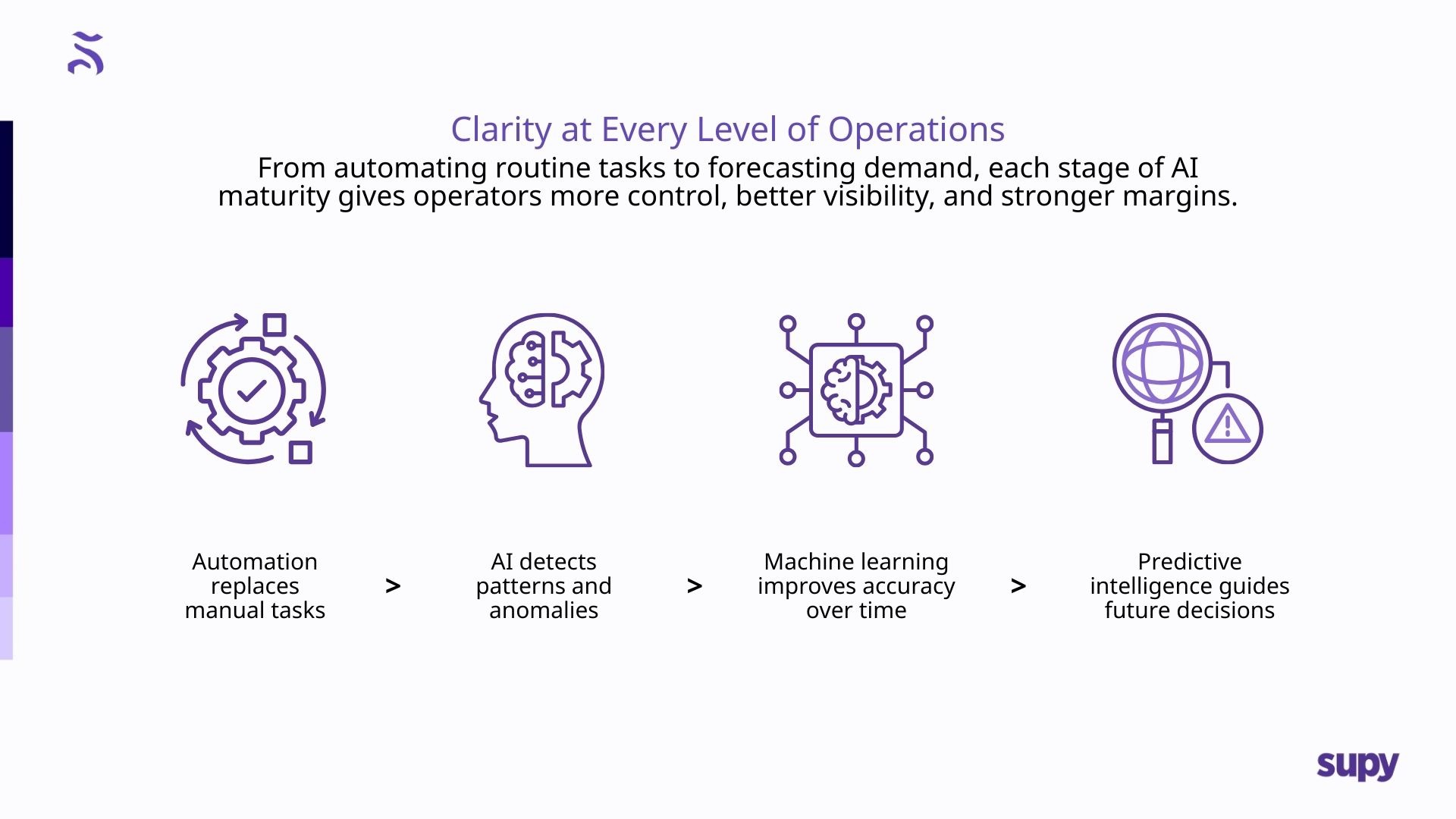
Most operators are already using AI in isolated ways, but often without realizing it or understanding how those tools fit together. Forecasting tools predict covers, delivery platforms optimize demand, and invoice scanners extract data - but these systems frequently operate in silos. As a result, AI feels fragmented, tactical, and disconnected from core margin decisions.
The real opportunity is not adopting more AI tools, but connecting them through clean, reliable operational data. When cost data, sales signals, and inventory information flow into a single system, AI can move beyond automation and start driving better decisions. Clarity comes from understanding how AI supports each workflow - and how those workflows reinforce one another across the operation. To simplify:
Automation: Replaces manual, repetitive tasks like data entry, invoice posting, or discrepancy checks.
AI: Identifies patterns, detects anomalies, learns supplier behavior, and predicts outcomes.
Machine Learning: Improves accuracy over time as it processes more data, such as recognizing supplier naming variations or identifying patterns in pricing.
Predictive Intelligence: Uses live and historical data to forecast demand, model COGS changes, or suggest optimized purchasing and prep decisions.
What AI cannot do:
Replace operator judgment, override financial controls, or compensate for poor data discipline.
AI amplifies good systems; it cannot fix broken ones.
Why Operators Should Care and How AI Improves Restaurant Margins
Margins are tightening faster than most teams can adapt manually. Key pressures include:
- Volatile supplier pricing
- Increasing labor and administrative costs
- Fragmented back-of-house systems
- Inconsistent inventory and waste control
- Unpredictable demand across channels
Together, these pressures create operational environments where small errors compound into significant financial impact. AI helps operators shift from reactive reporting to proactive management.
AI enhances restaurant margins by enhancing accuracy, minimizing waste, and replacing manual decisions with real-time data. It automates invoices, catches price shifts early, and prevents cost creep - saving one 28-location group $8,000 on a single SKU. AI supports smarter ordering, better inventory control, and real-time recipe costing. It also delivers faster finance reconciliation; one brand reduced data-entry hours from 22 to 6 per week.
The result: a more predictable, margin-driven operation.
What an AI-Powered Restaurant Looks Like: A Practical Snapshot
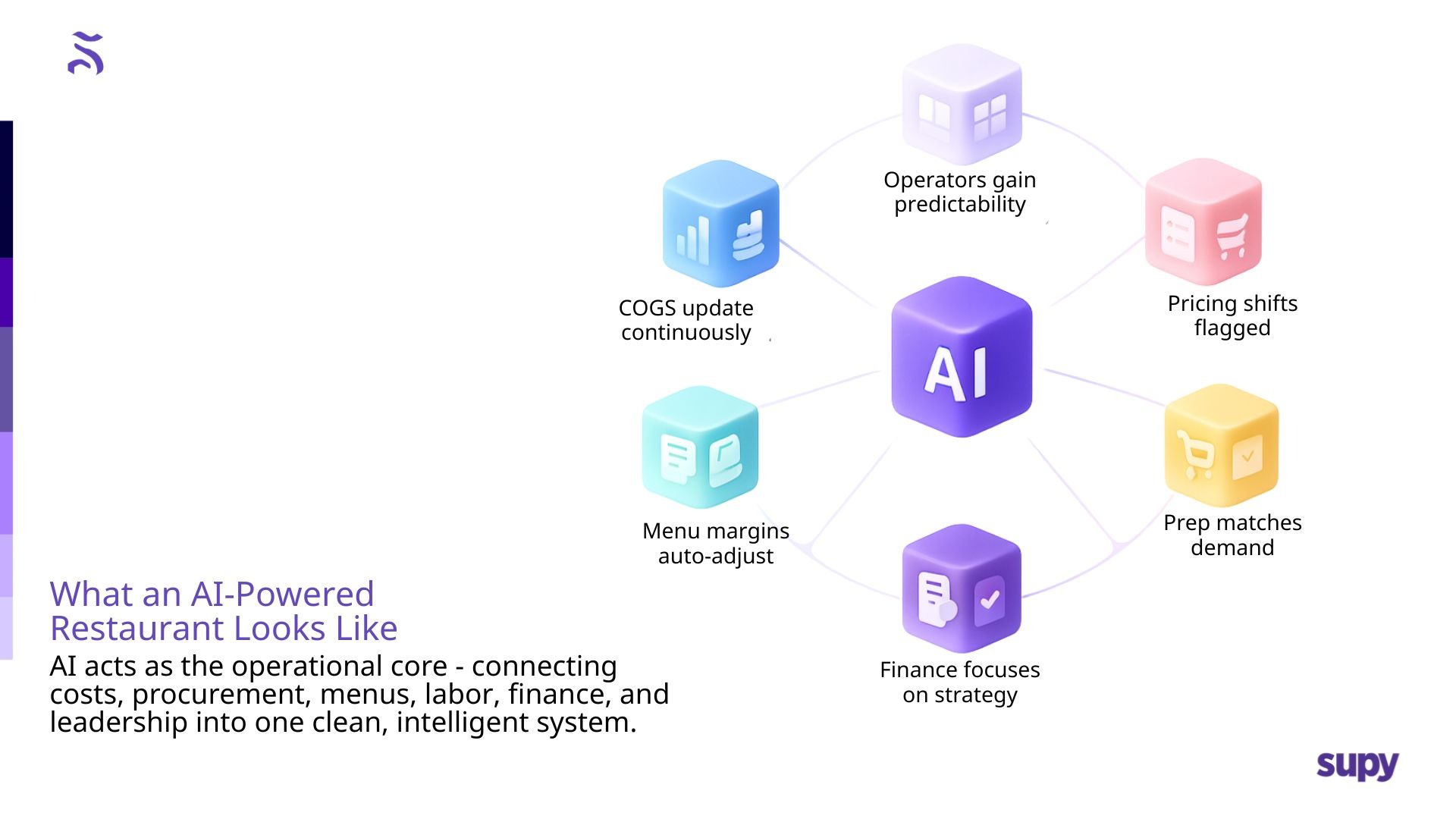
An AI-enabled operation is not defined by futuristic technology - it is defined by clarity and consistency. In a typical week:
- COGS updates continuously as invoices are validated
- Recipe and menu profitability adjust automatically
- Procurement teams receive alerts for pricing shifts
- Prep lists and labor plans reflect accurate demand forecasting
- Finance teams focus on strategy, not typing data
- Operators run multiple locations with fewer surprises and greater predictability
The result is an operation where financial discipline and operational efficiency reinforce one another.
The Four-Stage Maturity Model for AI Adoption in Restaurants
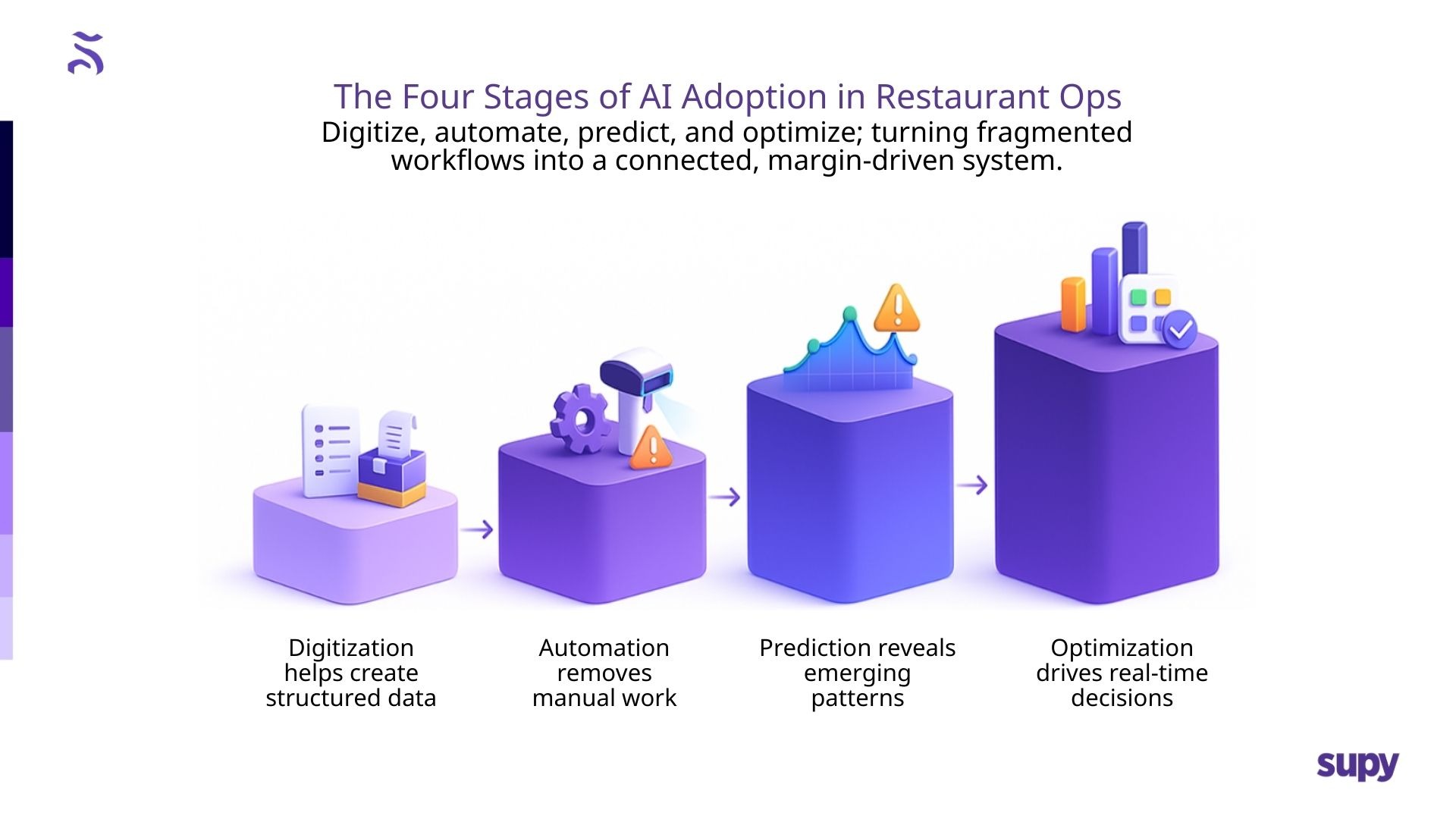
AI adoption tends to follow four stages. Each stage is easier when operators pair BOH cost data with FOH demand signals - and use the right tools to connect them.
1) Digitize BOH by capturing invoices, supplier pricing, inventory, and recipes.
Digitize FOH by capturing sales mix, channels, dayparts, and labor data.
Supy can help operators with AI invoice capture and structured invoice data, while POS platforms such as Oracle Simphony (enterprise POS + integrations) and Toast (POS ecosystem).
2) Automate BOH by streamlining invoice processing, exception detection, cost validation, and posting preparation.
Automate FOH by reducing manual effort in labor scheduling and operational reporting.
Supy supports BOH automation through AI-powered invoice extraction and automated detection of pricing and quantity discrepancies, while labor and scheduling platforms such as Toast Scheduling and 7shifts help FOH teams automate staffing workflows and labor insights.
3) Predict BOH outcomes by identifying cost drift, supplier changes, waste risk, and purchasing inefficiencies early.
Predict FOH demand by forecasting covers by daypart, channel, and location to reduce over- and understaffing.
AI-powered forecasting tools such as 7shifts help operators anticipate sales and align staffing to demand, while POS and labor integrations (for example, Toast connected to workforce tools) translate real-time sales signals into operational planning.
4) Optimize BOH decisions by continuously updating recipe costing, menu profitability, purchasing, and inventory using verified cost data.
Optimize FOH execution by aligning prep plans, labor allocation, and service levels with forecasted demand.
Supy acts as the BOH cost foundation, ensuring invoices and supplier pricing feed accurate, real-time cost data into operations, while enterprise POS ecosystems such as Oracle Simphony help unify FOH activity with back-office workflows at scale.
The ROI of Automation and AI Across the Organization
Restaurants that adopt automation and AI experience measurable gains across departments:
Operational Efficiency
- Reduced waste
- Improved stock availability
- Smoother prep and labor planning
Financial Accuracy
- Lower administrative wage costs
- More accurate and timely P&Ls
- Faster month-end close
Procurement Strength
- Supplier transparency
- Better negotiation leverage
- Fewer disputes
BOH Control
- Updated recipe costing
- Stronger menu profitability
- Early detection of margin leakage
How Supy Supports AI-Driven Operations
Supy acts as the operational data foundation that enables AI to generate real, measurable impact by:
- Digitizing invoices from every source
- Automatically detecting price discrepancies
- Centralizing supplier costs and catalogue data
- Syncing verified pricing into recipes, COGS, inventory, and AI-driven demand forecasts to automate and optimize supplier ordering.
Supy ensures restaurants have the clean, accurate, real-time data required for effective AI automation and predictive insights.
Supy does not replace operational expertise - it strengthens it by transforming fragmented, manual workflows into structured, intelligent systems capable of supporting modern AI-driven decision-making.
Explore Supy’s invoice automation and cost-control features at:https://supy.io/product-features/invoice-receiving